The House of Hades Myth Meaning & Symbolism
The mythic journey into the underworld realm of Hades, a profound narrative of descent, confrontation with the shadow, and the quest for wholeness.
The Tale of The House of Hades
Listen, and hear of the land where the sun’s chariot never runs, where the light of day is a forgotten dream. This is the realm of [Hades](/myths/hades “Myth from Greek culture.”/), brother to Zeus and [Poseidon](/myths/poseidon “Myth from Greek culture.”/), the Unseen One, the Rich One. His domain is not a place of punishment for all, but the final, silent home for every shade that has drawn its last breath. To reach it, one must cross the final boundary.
First, you must find the Acheron or the Styx, waters black and cold as oblivion. On the bank, a withered, shrouded figure waits: Charon. His palm is outstretched, not for friendship, but for the obol, the single coin of passage. Without it, your shade will wander the misty shores for a hundred years, a whisper among the reeds.
If you pay the toll, his hollow boat groans across the [water](/myths/water “Myth from Chinese culture.”/), the only sound in that profound stillness. On the far shore, a gate looms, and before it, a creature of primordial watchfulness: Cerberus. His three pairs of eyes miss nothing; his serpents writhe, his jaws drip. He is the final ward, ensuring that what enters the House of Hades remains, and what belongs within does not flee.
Past the gate unfolds the Asphodel Meadows, a grey, twilit plain where the common dead drift like smoke, their memories thin as mist. Further on, paths diverge. To one side lie the Elysian Fields, where a softer light falls and the air is sweet. To the other, a chasm echoes with distant cries: [Tartarus](/myths/tartarus “Myth from Greek culture.”/), the prison for [the Titans](/myths/the-titans “Myth from Greek culture.”/) and the truly wicked, where the Infernal Judges send those who have transgressed divine law.
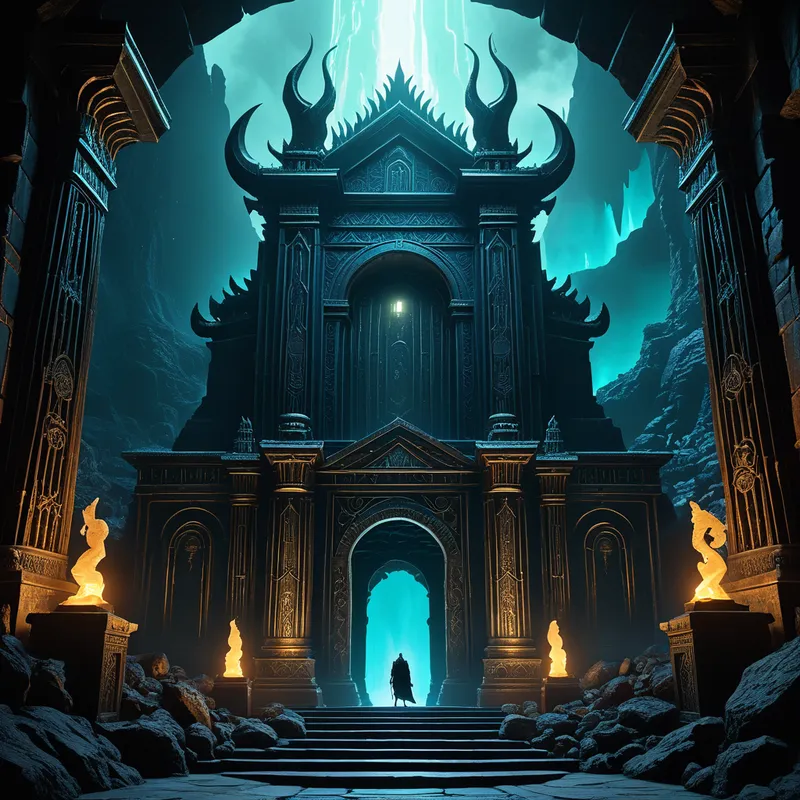
And at the heart of it all stands the House itself, a palace of polished obsidian and dark bronze. Here, upon an ebony throne, sits Hades, crowned and austere, with his queen, [Persephone](/myths/persephone “Myth from Greek culture.”/), by his side for half the year. Here flow the waters of [Lethe](/myths/lethe “Myth from Greek culture.”/), which washes away all memory. Here, the [Moirai](/myths/moirai “Myth from Greek culture.”/) have their say, and the threads of mortal lives find their final cut. It is a kingdom of absolute order, of final accounts, where the noise of the living world is swallowed by an eternal, resonant silence. To walk its halls is to know, in your very soul, that you have crossed the ultimate threshold.

Cultural Origins & Context
The myth of the House of Hades is not the product of a single author, but a collective, evolving vision woven from the deepest fears and spiritual inquiries of the ancient Greek world. It was passed down through epic poetry, most famously in [Homer](/myths/homer “Myth from Greek culture.”/)’s Odyssey (Book XI) and later crystallized in works like Hesiod’s Theogony. These were not mere stories for entertainment; they were sacred narratives performed by bards, integral to religious rites like the Eleusinian Mysteries, which promised initiates a favorable lot in the afterlife.
The societal function was multifaceted. It provided a cosmology that explained the fate of the soul, offering a structured, if somber, alternative to the terror of utter annihilation. It reinforced social and religious order: the necessity of proper burial (to provide the obol for Charon), the importance of honoring the gods (to avoid Tartarus), and the heroic ideal (to aspire to Elysium). The House of Hades was the ultimate cultural mirror, reflecting back a society’s values about life, death, [justice](/myths/justice “Myth from Tarot culture.”/), and memory. It was the map for the final, unavoidable journey every person must take.
Symbolic Architecture
Psychologically, the House of [Hades](/symbols/hades “Symbol: Greek god of the underworld, representing death, the unconscious, and hidden aspects of existence.”/) represents the totality of the personal and [collective unconscious](/symbols/collective-unconscious “Symbol: The Collective Unconscious refers to the part of the unconscious mind shared among beings of the same species, embodying universal experiences and archetypes.”/)—the vast, [interior](/symbols/interior “Symbol: The interior symbolizes one’s inner self, thoughts, and emotions, often reflecting personal growth, vulnerabilities, and secrets.”/) [realm](/symbols/realm “Symbol: The symbol of ‘Realm’ often signifies the boundaries of one’s consciousness, experiences, or emotional states, suggesting aspects of reality that are either explored or ignored.”/) that exists beneath the “sunlit” world of our waking ego and [persona](/symbols/persona “Symbol: The social mask or outward identity one presents to the world, often concealing the true self.”/). It is the land of the forgotten, the repressed, the unlived [life](/symbols/life “Symbol: The symbol of ‘Life’ represents a journey of growth, interconnectedness, and existential meaning, encompassing both the joys and challenges that define human experience.”/), and the ancestral patterns that shape us.
The descent into the underworld is not a flight from reality, but a dive into its most substantial layer—the psychic substrate from which all conscious life emerges.
Each feature is a symbolic facet of the [psyche](/myths/psyche “Myth from Greek culture.”/). Charon and the coin symbolize the necessary [payment](/symbols/payment “Symbol: Symbolizes exchange, obligation, and value. Represents what one gives to receive something in return, often tied to fairness, debt, or spiritual balance.”/)—a [piece](/symbols/piece “Symbol: A ‘piece’ in dreams often symbolizes a fragment of the self or a situation that requires integration, reflection, or understanding.”/) of our conscious [identity](/symbols/identity “Symbol: Identity represents the sense of self, encompassing personal beliefs, cultural background, and social roles.”/), our comfort, our certainty—required to engage with the [depths](/symbols/depths “Symbol: Represents the subconscious, hidden emotions, or foundational aspects of the self, often linked to primal fears or profound truths.”/). [Cerberus](/symbols/cerberus “Symbol: The three-headed hound guarding the underworld’s entrance, symbolizing boundaries, protection, and the unconscious mind’s threshold.”/) is the fierce [guardian](/symbols/guardian “Symbol: A protector figure representing safety, authority, and guidance, often embodying parental, societal, or spiritual oversight.”/) of [the threshold](/myths/the-threshold “Myth from Folklore culture.”/) between conscious and unconscious, the psychological [resistance](/symbols/resistance “Symbol: An object or tool representing opposition, struggle, or the act of pushing back against external forces or internal changes.”/) and fear that arises when we approach our deepest wounds or truths. The Asphodel Meadows represent the undifferentiated [mass](/symbols/mass “Symbol: Mass often symbolizes a gathering or collective experience, representing shared beliefs, burdens, or the weight of emotions within a community.”/) of forgotten memories and half-lived experiences, the psychic “[background](/symbols/background “Symbol: The background in a dream can reflect context, environment, and underlying influences in the dreamer’s life.”/) [noise](/symbols/noise “Symbol: Noise in dreams signifies distraction, confusion, and the need for clarity amidst chaos.”/).” Tartarus embodies the deeply repressed traumas, shames, and complexes that we have condemned and locked away. [Elysium](/symbols/elysium “Symbol: A paradisiacal afterlife realm in Greek mythology, representing ultimate peace, reward, and spiritual fulfillment for the virtuous.”/) symbolizes the integrated, sublime aspects of [the self](/myths/the-self “Myth from Jungian culture.”/)—our innate potential and inner [peace](/symbols/peace “Symbol: Peace represents a state of tranquility and harmony, both internally and externally, often reflecting a desire for resolution and serenity in one’s life.”/) that can only be accessed after navigating the shadows. The [throne](/symbols/throne “Symbol: A seat of authority, power, and sovereignty, representing leadership, divine right, or social hierarchy.”/) [room](/symbols/room “Symbol: A room in a dream often symbolizes the self, representing personal space, mental state, or aspects of one’s identity.”/) of [Hades and Persephone](/myths/hades-and-persephone “Myth from Greek culture.”/) together represent the ruling principle of this unconscious realm: a sovereign, impersonal order (Hades) coupled with the cyclical potential for renewal and life (Persephone).
The Dreamer’s Resonance
When the motifs of this myth surface in modern dreams, it signals a profound somatic and psychological process: a necessary nekyia, or night-sea journey, into the unconscious. Dreaming of being in a vast, abandoned subway system, a labyrinthine basement, or a decaying, silent mansion is the psyche’s way of staging a descent into the House of Hades.
The somatic experience often involves feelings of weight, coldness, or slow, trudging movement—a literal embodiment of the “heavy” work of confronting what has been buried. Psychologically, the dreamer is undergoing a process of shadow-work. The forgotten shades they encounter are disowned parts of their own personality: old angers, unexpressed grief, hidden talents, or instinctual drives. The threatening guardian (a locked door, a menacing figure) represents [the ego](/myths/the-ego “Myth from Jungian culture.”/)’s defense mechanisms. To proceed in the dream is to consent, however fearfully, to this confrontation. The ultimate goal of such a dream is not escape, but acknowledgment—to see, hear, and reclaim the lost parts of the self, bringing them from the grey meadows of forgetfulness back into the light of awareness.

Alchemical Translation
The myth models the alchemical process of psychic transmutation, or individuation. The hero’s journey to [the underworld](/myths/the-underworld “Myth from Greek culture.”/) (be it [Orpheus](/myths/orpheus “Myth from Global/Universal culture.”/) seeking Eurydice, [Heracles](/myths/heracles “Myth from Greek culture.”/) fetching Cerberus, or [Odysseus](/myths/odysseus “Myth from Greek culture.”/) consulting [Tiresias](/myths/tiresias “Myth from Greek culture.”/)) is the ego’s quest for wholeness by engaging with what it has excluded.
The pomegranate seeds that bind Persephone are the symbolic contract of transformation: one cannot taste the depths and return to the surface unchanged. The nourishment of the underworld necessitates a return to it.
The descent ([nigredo](/myths/nigredo “Myth from Alchemical culture.”/)) is the initial confrontation with [the shadow](/myths/the-shadow “Myth from Jungian culture.”/), the “blackening” where old certainties dissolve in the face of the unconscious. Navigating the landscape is the careful differentiation ([separatio](/myths/separatio “Myth from Alchemical culture.”/)) of complexes—learning what belongs to Tartarus (toxic patterns to be contained), what belongs to Asphodel (neutral memories to be acknowledged), and what belongs to Elysium (inner gold to be integrated). Confronting the ruler, Hades, is to bow before the autonomous, non-egoic law of the psyche, accepting that the self is far larger and more mysterious than the conscious “I.” The ascent (or attempted ascent, as with Orpheus) represents the endeavor to bring a piece of this unconscious knowledge back to the conscious world (albedo, the whitening). Success is never guaranteed—the unconscious has its own rules—but the attempt itself is the transformative act. The modern individual undertaking this alchemy does not literally go to Hades; they turn inward, through therapy, creative expression, meditation, or active imagination, to perform the same sacred function: to make the unseen seen, to dialogue with their inner shades, and in doing so, build a more complete, resilient, and authentic House of Self.
Associated Symbols
Explore related symbols from the CaleaDream lexicon: