The Hostel/Inn Myth Meaning & Symbolism
A king enters a spectral hostel, confronting impossible geasa and a sovereignty goddess, in a myth of fate, hospitality, and transformative sacrifice.
The Tale of The Hostel/Inn
Listen, and hear the tale of the house that is not a house, the welcome that is a doom.
The air on the plain of Ériu grows cold as the sun drowns in the west. A king rides alone, Conaire Mór, he who rules by the strange and wondrous prohibitions, the geasa. Peace lies upon the land because he keeps them. But this night, a fog of fate descends, and his path twists against his will, leading him to a place no map records.
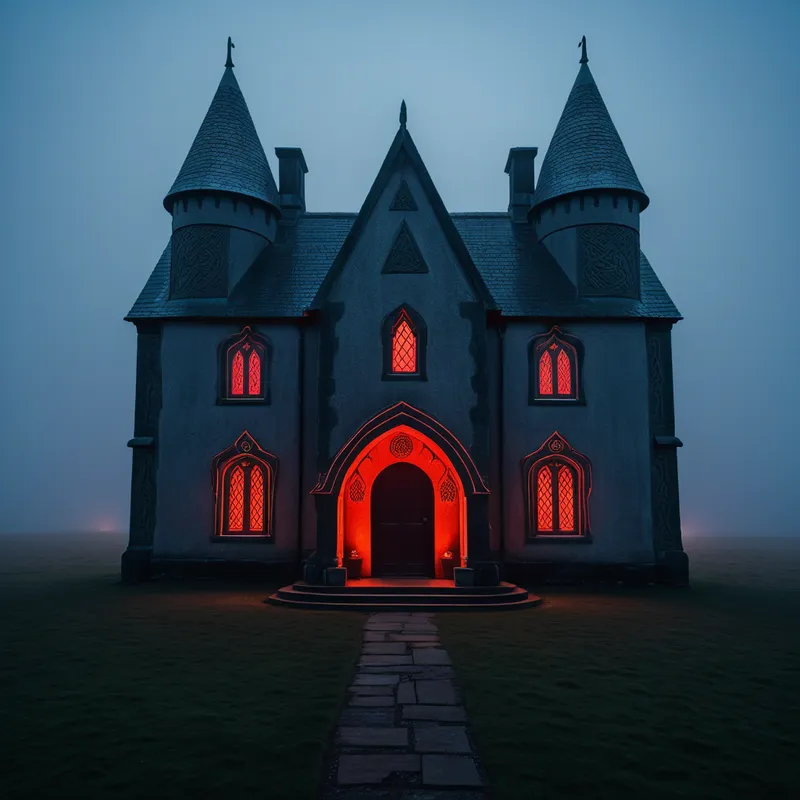
It rises from the mist: the Brúiden Da Derga. A hostel of white bronze, its pillars of red yew glowing as if lit from within. Firelight spills from its countless doors, and the sound of feasting—laughter, song, the clatter of cups—warms the encroaching dark. Yet, around it, the land is silent. No birds call. No beast stirs. It is an island of warmth in a sea of dread.
Hospitality is the highest law, and a king is its greatest pillar. He must enter. As he crosses the threshold, the sounds swell, then hush. The host, Da Derga himself, with hair like flame, welcomes him with a cup. But the king’s eyes are drawn to the woman who tends the central fire. She is taller than any in the hall, her hair like ripened wheat, her eyes holding the depth of a bog pool. She is the Sovereignty, the very land incarnate. She smiles, and it is not comforting.
“Welcome, king,” she says, her voice the whisper of wind through barley. “The feast is prepared. But remember your nature.”
Then the tests begin. They are his own geasa, turned inside out. To refuse hospitality is a king’s shame. To accept it is to break his sacred bonds. He is offered the flesh of a dog—but one of his prohibitions forbids him to eat the meat of his namesake. A trio of red riders demand entrance, their cloaks the color of fresh blood—another geis shattered as he must let them in. The hostel, once a haven, becomes a cage of impossible choices. The warm light now feels like the glare of a tribunal.
The woman by the fire begins to wash. She cleans the feet of the warriors, and the water in her basin darkens, becoming not dirt, but blood. She wrings out the king’s crimson cloak into the basin, and it overflows, a tide of doom seeping across the earthen floor. The laughter of the host is now the shrieking of carrion birds. The red riders draw their swords. The doors and windows of the hostel seal themselves, not with wood or bronze, but with the weight of destiny itself.
Conaire Mór stands, his kingship a heavy mantle. He knows the resolution. There is no escape, only the manner of meeting it. He grasps his weapon, not in hope of victory, but in affirmation of his role. The final, cruel geis is upon him: he must not let his people fight before he fights. He steps forward, into the space before the hearth, where the Sovereignty watches, implacable. The feast is ended. The sacrifice begins.
Cultural Origins & Context
This myth, most famously told as Togail Bruidne Da Derga (The Destruction of Da Derga’s Hostel), survives in medieval Irish manuscripts like the Book of the Dun Cow. Its roots, however, sink deep into the pre-Christian, oral tradition of the filid. It was not mere entertainment; it was a foundational narrative about kingship, told to and by the elite to encode the sacred contract between a ruler and the land.
The king was not a mere political leader but a cosmic hinge. His geasa were the precise conditions for maintaining fír flathemon, the “ruler’s truth.” When he kept them, the land was fertile, the rivers full, the people prosperous. The myth of the Hostel dramatizes the inevitable moment when these personal obligations collide with the impersonal, archetypal forces of fate and sovereignty. It was a cautionary tale about the fragility of order and the sacred price of power, ensuring that the concept of rightful rule was understood as a psychological and spiritual burden as much as a temporal privilege.
Symbolic Architecture
The Hostel is the ultimate liminal space. It is not quite of this world, nor fully of the Sídhe. It is a psychic arena where the constructed self meets the irreducible patterns of the soul.
The Hostel is the psyche itself: a place of warmth and potential that becomes, under the gaze of the Self, a chamber of exacting revelation.
Conaire Mór represents the conscious ego, the “I” that rules the inner kingdom by a complex set of personal ethics, adaptations, and identities (the geasa). The Sovereignty goddess is the Self, the deepest, most profound aspect of the psyche that represents one’s ultimate purpose and totality. She is not cruel, but utterly truthful. Her washing with blood is not a curse, but a stark visualization of the inevitable consequences of one’s life path. The impossible choices are the collisions between our conscious self-image and the demands of our own deeper nature. We cannot satisfy both; one must be sacrificed to the other.
The Dreamer’s Resonance
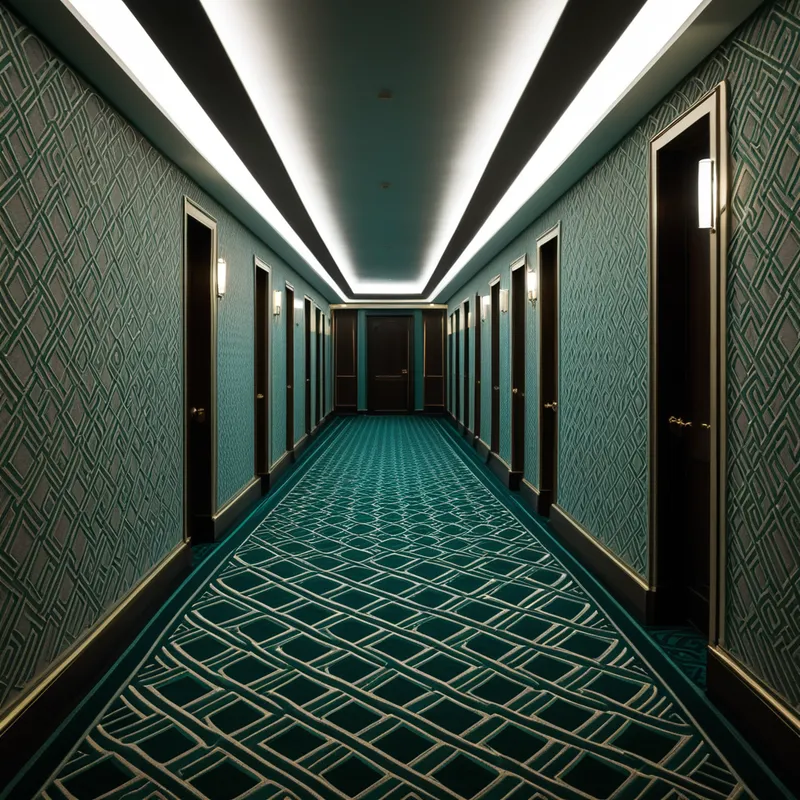
When this myth stirs in modern dreams, it rarely appears as a Celtic hostel. It manifests as the dreamer finding themselves in a familiar-yet-alien place: a childhood home with extra, impossible rooms; a corporate office that transforms into a labyrinth; a welcoming party where the smiles of friends suddenly feel threatening. The somatic feeling is one of visceral entrapment and mounting dread, coupled with a paradoxical sense of inevitability—the dreamer knows they must be there.
This is the psyche signaling a profound confrontation. The dreamer is being “hosted” by an unconscious content—a long-ignored truth, a repressed talent, a core wound—that is now demanding integration. The “impossible choice” in the dream mirrors a real-life tension where all options seem to violate some part of the dreamer’s identity. The process underway is the dissolution of an old, outworn psychological structure (the old kingship) to make way for a more authentic alignment. The anxiety is the ego’s resistance to its necessary reconfiguration.
Alchemical Translation
The alchemy of the Hostel is the nigredo, the blackening, the crucial stage of dissolution that precedes transformation. Conaire Mór’s journey is a map for the modern individual’s individuation.
The sacrifice demanded in the Hostel is not of life, but of the illusion of control. The king must offer his adherence to a conditional identity to meet the unconditional truth of the Self.
First, one is lured by one’s own nature (the path to the hostel). A period of success or peace (Conaire’s reign) leads inevitably to a confrontation with the limits of that success. Then, one enters the arena of paradox (the hostel’s tests). Here, the conscious mind’s rules fail. The ego’s strategies—its personal geasa—become the walls of its prison. The alchemical fire is kindled by this friction.
The key operation is the sacrifice of the ego’s central claim. For Conaire, it is his identity as the perfect, prohibition-keeping king. For the modern individual, it may be the identity as the flawless caregiver, the perpetual victor, the blameless victim. This sacrifice feels like a death. But it is only the death of an image. The figure of the Sovereignty does not destroy the king; she reveals what his kingship was always meant to serve: a truth larger than his personal rule. In psychological alchemy, the ego is not annihilated but relativized. It is dethroned from being the sole ruler and becomes a loyal servant to the greater totality of the Self. The blood that floods the hostel is the vital life force, once bound by rigid form, now released to nourish a new, more resilient order of being. From the ashes of the destroyed hostel, a more integrated consciousness is born, one that has faced its fate and in doing so, found a deeper form of sovereignty.
Associated Symbols
Explore related symbols from the CaleaDream lexicon: