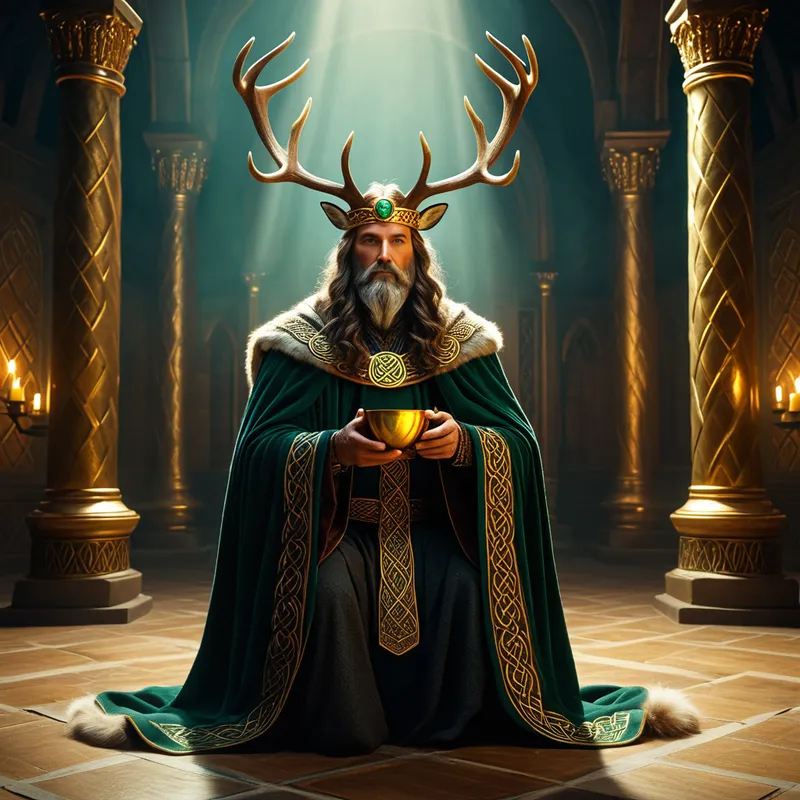
The Hospitality Exchange Myth Meaning & Symbolism
A myth where a king unknowingly hosts a god, learning that true hospitality is a sacred exchange that can alter fate and reveal divinity.
The Tale of The Hospitality Exchange
Listen, and let [the hearth](/myths/the-hearth “Myth from Norse culture.”/)-fire burn low. In the days when [the world](/myths/the-world “Myth from Tarot culture.”/) was younger and [the veil](/myths/the-veil “Myth from Various culture.”/) between the worlds was a mere breath of mist, there ruled a king named Eochaid. His hall was a beacon of warmth and order, its timbers stout, its fires ever-bright. Yet, a shadow lay upon the land: a blight upon the crops, a silence in the woods, a deep and unyielding drought that cracked [the earth](/myths/the-earth “Myth from Hindu culture.”/)’s very skin.
One evening, as the sun bled into the western hills, a solitary figure approached the royal fort. He was a man of no obvious station, cloaked in travel-stained grey, his face obscured by shadow. No retinue followed him; only the dust of the long road. The guards at the gate saw not a threat, but a man in need, and [the law](/myths/the-law “Myth from Biblical culture.”/) of the land was absolute: no one, be they prince or pauper, enemy or friend, was to be turned from the door at day’s end.
He was ushered into the hall. King Eochaid, from his high seat, saw not a beggar, but a guest. [The stranger](/myths/the-stranger “Myth from Biblical culture.”/) was given [water](/myths/water “Myth from Chinese culture.”/) to wash the road from his feet, a seat by the fire, and a portion from the king’s own platter, though the stores were dwindling. No name was asked; in the sacred space of hospitality, identity was secondary to need. They shared mead, and the stranger spoke in riddles of the land’s sickness, his words like keys searching for a hidden lock.
For three nights, the ritual repeated. The guest received the best of what the diminished kingdom could offer: warmth, sustenance, respect. On the third night, as the final embers glowed, the stranger stood. He let his grey cloak fall. A light, not of the fire, emanated from him, filling the hall with a cool, silver radiance. The features of the road-weary traveler melted away, revealing the majestic, terrible countenance of [The Dagda](/myths/the-dagda “Myth from Celtic culture.”/), the Good God, father of the tribe of the gods.
“You have honored the oldest law,” the god’s voice echoed like stone in a deep well. “You saw the man, not the station. You gave from your lack, not your surplus. For this, the contract is sealed.” He raised a hand, and the very stones of the hall hummed. “The drought is broken. The land remembers its fertility. Your sovereignty is bound to this act: as you have cared for the hidden divine, so shall the divine care for your kingdom. Remember: the greatest power often arrives in the guise of the greatest need.” With a sound like a sigh of wind through sacred oaks, he was gone. At dawn, the people awoke to the sweet, forgotten music of rain upon the parched earth.

Cultural Origins & Context
This pattern, less a single myth than a foundational cultural script, is woven into the very fabric of Celtic literature. It appears in tales of the Tuatha Dé Danann testing mortal kings, and in the Ulster Cycle where heroes are bound by félm. It was not merely etiquette but a sacred, legal, and social imperative. In a world of sparse settlements and vast, animistic landscapes, the stranger was a vector of the unknown—potentially a god, a ancestor, or a sorcerer. Hospitality (oíged) created a temporary, sanctified kinship. To violate it was to invite cosmic disorder, a geis upon the land.
Bards and filí would recite these tales not just as entertainment, but as societal programming. They encoded the law, teaching that sovereignty—the right to rule—was contingent upon the ruler’s capacity for compassionate, unconditional giving. The king’s hall was a microcosm of the world; order within it guaranteed order without.
Symbolic Architecture
At its [heart](/symbols/heart “Symbol: The heart symbolizes love, emotion, and the core of one’s existence, representing deep connections with others and self.”/), the myth is a profound exploration of the container and the contained, the [host](/symbols/host “Symbol: The symbol of a ‘host’ often represents nurturing, hospitality, or the willingness to offer support and guidance to others.”/) and the [guest](/symbols/guest “Symbol: A guest in a dream can symbolize new experiences, unexpected situations, or aspects of oneself that are being revealed.”/). The [king](/symbols/king “Symbol: A symbol of ultimate authority, leadership, and societal order, often representing the dreamer’s inner power or external control figures.”/) represents the conscious ego, the ruler of the [interior](/symbols/interior “Symbol: The interior symbolizes one’s inner self, thoughts, and emotions, often reflecting personal growth, vulnerabilities, and secrets.”/) [kingdom](/symbols/kingdom “Symbol: A kingdom symbolizes authority, belonging, and a sense of identity within a larger context or community.”/) (the [psyche](/myths/psyche “Myth from Greek culture.”/)). The hall is the structured self, the [identity](/symbols/identity “Symbol: Identity represents the sense of self, encompassing personal beliefs, cultural background, and social roles.”/) we present to the world. The disguised god is the Self, the ultimate, divine totality of the [psyche](/myths/psyche “Myth from Greek culture.”/), which often approaches [consciousness](/symbols/consciousness “Symbol: Consciousness represents the state of awareness and perception, encompassing thoughts, feelings, and experiences.”/) in disguised, humble, or troubling forms.
The sacred guest is always the unintegrated part of the soul, knocking at the door of awareness, asking to be recognized and welcomed.
The [drought](/symbols/drought “Symbol: Drought signifies a period of emotional scarcity, lack of resources, or feelings of deprivation leading to anxiety or intense longing.”/) symbolizes psychic [aridity](/symbols/aridity “Symbol: Aridity symbolizes emotional or spiritual barrenness, a lack of nourishment, and a state of profound dryness or emptiness.”/), a [life](/symbols/life “Symbol: The symbol of ‘Life’ represents a journey of growth, interconnectedness, and existential meaning, encompassing both the joys and challenges that define human experience.”/) lived from [the ego](/myths/the-ego “Myth from Jungian culture.”/)’s dwindling resources alone, cut off from the nourishing waters of the unconscious. The exchange—sustenance for transformation—is the core [alchemy](/symbols/alchemy “Symbol: A transformative process of purification and creation, often symbolizing personal or spiritual evolution through difficult stages.”/). [The ego](/myths/the-ego “Myth from Jungian culture.”/) does not command the god; it serves the [stranger](/symbols/stranger “Symbol: A stranger in dreams can represent unfamiliar aspects of the self or new experiences.”/). In doing so, it unknowingly serves its own deepest [nature](/symbols/nature “Symbol: Nature symbolizes growth, connectivity, and the primal forces of existence.”/), initiating a reciprocal flow of [energy](/symbols/energy “Symbol: Energy symbolizes vitality, motivation, and the drive that fuels actions and ambitions.”/). The [revelation](/symbols/revelation “Symbol: A sudden, profound disclosure of truth or insight, often through artistic or musical means, that transforms understanding.”/) of the god is the [moment](/symbols/moment “Symbol: The symbol of a ‘moment’ embodies the significance of transient experiences that encapsulate emotional depth or pivotal transformations in life.”/) of [integration](/symbols/integration “Symbol: The process of unifying disparate parts of the self or experience into a cohesive whole, often representing psychological wholeness or resolution of internal conflict.”/), where [the ego](/myths/the-ego “Myth from Jungian culture.”/) realizes its actions have been in service to a greater, guiding totality. The resulting rain is the [symbol](/symbols/symbol “Symbol: A symbol can represent an idea, concept, or belief, serving as a powerful tool for communication and understanding.”/) of psychic renewal, creativity, and the [fertility](/symbols/fertility “Symbol: Symbolizes creation, growth, and abundance, often representing new beginnings, potential, and life force.”/) that comes from this re-established [connection](/symbols/connection “Symbol: Connection symbolizes relationships, communication, and bonds among individuals.”/).
The Dreamer’s Resonance
When this myth stirs in the modern unconscious, it often manifests in dreams of thresholds and unexpected visitors. You may dream of a neglected, shadowy figure at your door, or of needing to prepare a meal for an uninvited but insistent guest. There is a somatic quality of obligation, even anxiety, mixed with a deep, instinctual knowing that you must perform this duty.
Psychologically, this signals that an aspect of your shadow—a repressed talent, a denied emotion, a past trauma—is seeking entry into the conscious “hall” of your life. The discomfort is the ego’s resistance to the unknown. The dream is the psyche’s enforcement of the ancient law: you must host what appears. To turn the figure away in the dream is to perpetuate inner drought. To welcome it, however awkwardly, is to initiate the exchange. The figure may not transform in the dream itself, but the act of hospitality plants the seed for future integration and the potential for a release of pent-up creative or emotional energy upon waking.

Alchemical Translation
The individuation process modeled here is not one of heroic conquest, but of humble, faithful reception. The modern individual is both King Eochaid and his hall. Our first task is to build a stable enough ego-structure—a “hall”—that can host the contents of the unconscious without being destroyed by them. This requires boundaries, self-knowledge, and resources.
The alchemical work begins when life presents us with our “disguised god”: often in the form of a symptom, a recurring failure, a depression, or an inexplicable fascination. It appears needy, draining, and obscure. The ego’s temptation is to refuse it entry, to label it pathology or nuisance.
The transmutation occurs not in solving the riddle, but in the steadfast offering of attention to the riddle itself.
The “hospitality” we offer is conscious attention, non-judgmental curiosity, and the “sustenance” of our psychic energy. We sit with the symptom, journal about the depression, explore the fascination. This is the mead and bread offered to the stranger. The “three nights” signify a process, a commitment beyond a single gesture.
The revelation—the moment the stranger reveals himself as the Dagda—is the moment of insight. The depression is seen as a call to rest and deep reorientation. The failure is understood as a necessary dissolution of an old way of being. The symptom is recognized as a messenger. This revelation is always a gift of meaning, which then releases transformative energy (the rain) into the personality. The ego, having served [the Self](/myths/the-self “Myth from Jungian culture.”/), finds its own sovereignty renewed and deepened, no longer ruling a barren kingdom, but governing a psyche in fertile dialogue with its own depths. The exchange is complete; the guest has gifted the host with the very essence of the host’s true kingdom.
Associated Symbols
Explore related symbols from the CaleaDream lexicon: