The Horologium Myth Meaning & Symbolism
A myth of a celestial clockwork that must be wound by a mortal, binding time, fate, and the soul in a cycle of sacrifice and renewal.
The Tale of The Horologium
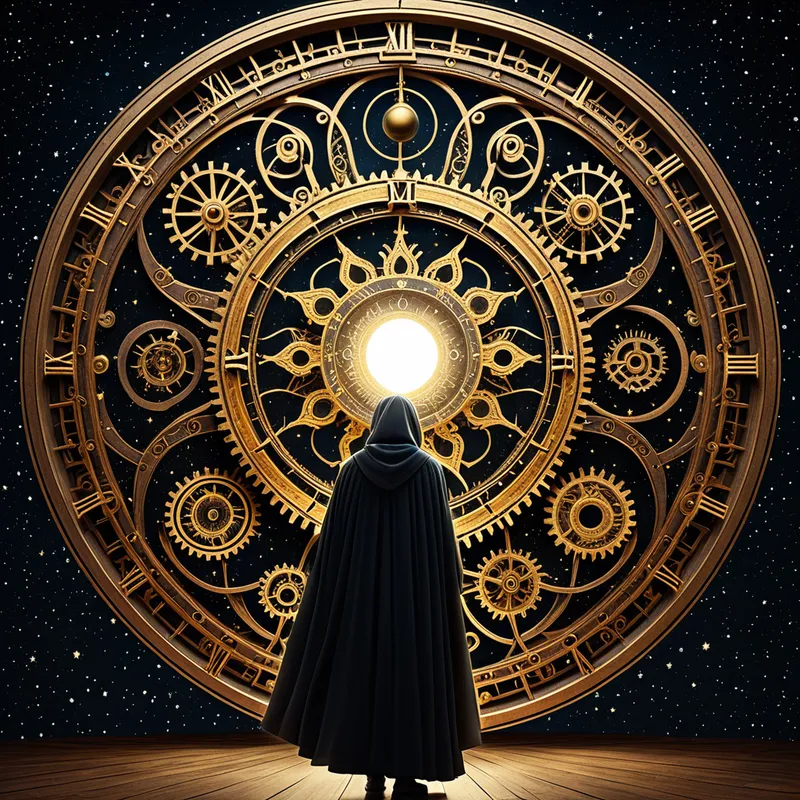
Listen, and hear the turning of the great wheel. In the time before counted time, when the world was still wet with the breath of the Prima Materia, the Cosmocratores forged a mechanism not of earth or fire, but of fate itself. They called it The Horologium. Its face was the dome of the night sky, its gears were the orbits of planets, and its pendulum was the beating heart of every living thing. It measured not hours, but epochs; not minutes, but the lifespan of souls.
The Horologium ran on a sacred tension, a winding born of conscious sacrifice. To keep the world from sliding back into chaos, the great mainspring—a coil of solidified starlight—required turning. This task fell not to a god, but to a mortal. Each age, when the celestial hands trembled at the precipice of the Gulfs of Unbecoming, a call would sound in the soul of one unprepared human. A farmer would hear it in the rustle of wheat. A potter would feel it in the spin of the wheel. A profound, unshakable knowing would descend: You must go to the Spire of the Winds.
So it was for a woman named Elara, a weaver of tapestries. In her quiet workshop, the colors of her threads suddenly bled into grey. The rhythmic clack of her loom became the relentless, slowing tick of a failing clock. Without understanding why, she left her unfinished work, walked past the borders of her known world, and climbed the impossible, glass-smooth mountain to the Spire. There, in a chamber open to the void, The Horologium hung. It was silent. A cold dread filled the air. The great hands were mere moments from the twelfth and final glyph.
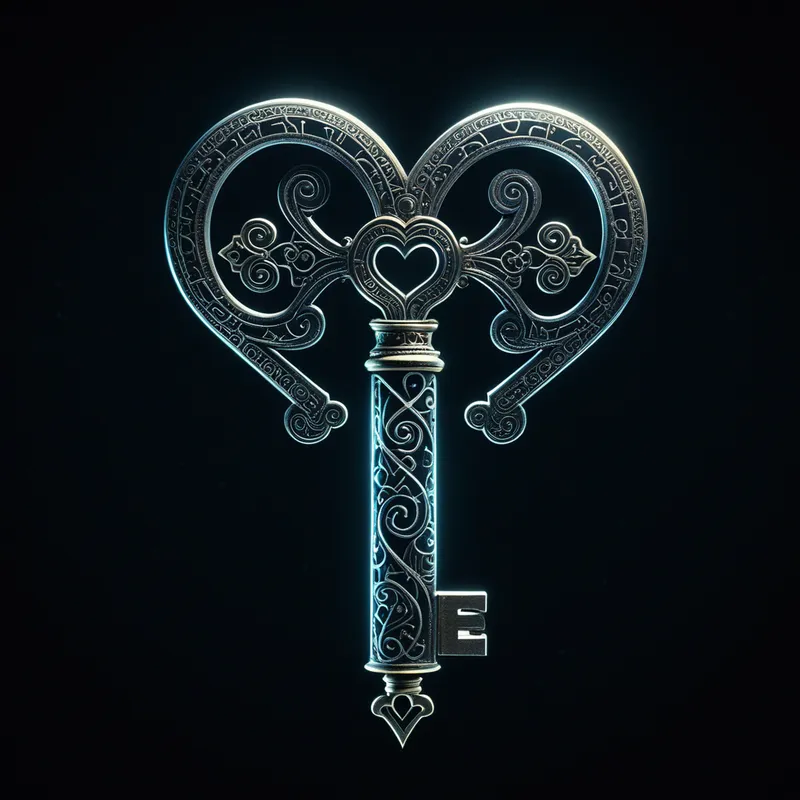
At the clock’s heart was the Vulnus Clavis, a keyhole radiating a painful, beautiful light. But there was no key. The myth whispers the terrible truth: The key is fashioned from the winder’s own certainty, from a piece of their lived purpose. Elara understood. She did not search her pockets. She looked at her hands—the hands that held shuttles, that touched loved ones, that shaped beauty from chaos. With a breath that was both a sob and a song, she pressed her right hand against the light of the Vulnus Clavis. Her flesh did not burn, but transmuted. Bone became intricate filigree, sinew became braided gold, her lifeline etched into the bit of a magnificent, glowing key.
With this key now part of her arm, she turned it. The resistance was the weight of all collective memory, the drag of every unmourned ending. She poured her strength, her memories of joy and sorrow, into the turn. A deep, resonant click-thrum echoed through all realms. The Horologium shuddered. Its hands jerked backward one degree from midnight. Gears the size of cities began to turn again, their motion singing a tone of profound relief. The world breathed anew. Elara’s key-hand dissolved into starlight, leaving her whole, but forever marked by a faint, golden scar. She descended, not to finish her old tapestry, but to begin a new one, its pattern forever altered by the rhythm she now carried in her blood.
Cultural Origins & Context
The myth of The Horologium emerged from the later Introspective Period, a time when Alchemical philosophers shifted their gaze from transforming lead to gold, to transforming the leaden aspects of the soul. It was not a state-sponsored epic, but a Mysterium Fabrica, told in guildhalls, by hearthfires, and during the long watches of the night. It was recounted by Artificer-Sages to their apprentices as they worked metal or wood.
Its societal function was dual. On one level, it was a myth of cosmic maintenance, explaining the fragility of order and the invisible labor required to sustain reality. It answered the profound anxiety of “why does the world not fall apart?” with a narrative of sacred, personal responsibility. On a more immediate level, it served as a profound metaphor for the artisan’s life. The act of “winding the clock” mirrored the dedication of a craftsperson who pours their essence—their time, skill, and vision—into their work to sustain cultural and spiritual continuity. The myth taught that true creation always involves a piece of the self.
Symbolic Architecture
At its core, The Horologium represents the psychic structure of time, fate, and the Self. It is not merely a clock but the Anima Mundi as an ordered system. Its impending halt symbolizes the threat of psychic stagnation, where the ego becomes rigid, patterns become compulsive, and life loses its dynamic, flowing quality.
The mortal winder is the archetype of the conscious ego, unexpectedly called to a responsibility far greater than itself. The call represents the eruption of the Self (the total, archetypal psyche) into conscious awareness, often felt as a midlife crisis, a profound vocation, or a crushing sense of meaninglessness that demands resolution.
The Vulnus Clavis is the sacred wound where the personal meets the transpersonal. It is the point of transformation, where what you are must be sacrificed to become what you are meant to be.
The key fashioned from the winder’s own hand is the ultimate symbol of Opus Proprium. It signifies that the tool for solving the deepest crisis of meaning is not found externally, but forged from one’s own lived experience, talents, and even vulnerabilities. The act of winding, against immense resistance, is the struggle to integrate unconscious contents, to move the psyche forward from a stalled, fatalistic position.
The Dreamer’s Resonance
When The Horologium appears in modern dreams, it signals a critical juncture in the dreamer’s individuation process. One may dream of a gigantic, ornate clock in a familiar place—a childhood home, an office—that has stopped. The silence is oppressive. This somatic experience often correlates with feelings of depression, burnout, or being “stuck in a rut,” where life’s momentum has ceased.
Another common motif is dreaming of desperately searching for a key to fit a strange lock, or of having a key but being unable to turn it. This mirrors the psychological conflict of knowing a change is needed (having the insight, the “key”) but being unable to mobilize the will or sacrifice required to enact it (“turning” it). The dream may present the key as part of the dreamer’s body—a finger that transforms, a tooth that becomes metallic—highlighting that the solution is intimately and physically part of them, often related to their primary mode of engaging with the world (their “handiwork”).
These dreams call for a conscious engagement with what has become static. They ask: What in your life has lost its rhythm? What personal “certainty” or comfort must be offered up to restart the inner movement?
Alchemical Translation
The myth of The Horologium is a precise allegory for the alchemical Magnum Opus, particularly the stage of Nigredo giving way to Albedo. The frozen clock is the Nigredo—the dark night of the soul, the sense of meaninglessness and paralysis. The journey to the Spire is the necessary confrontation with this state, moving toward the core wound (the Vulnus Clavis) rather than away from it.
The forging of the key from the self is the Separatio and Purificatio. It demands an honest inventory: What within me is true, essential, and capable of serving a purpose greater than my immediate comfort? This is often a talent taken for granted, a hard-won wisdom, or a capacity for love.
The winding is the Coniunctio of the personal ego with the transpersonal Self. It is the moment of active commitment to the psychic process, where will is applied to insight.
For the modern individual, this translates to the often-painful decision to change a life pattern, to leave a stagnant situation, to dedicate oneself to a creative work, or to consciously engage with therapy or spiritual practice. The “golden scar” left behind is not a loss, but the enduring mark of transformation—a newfound inner rhythm, a resilience, and an authentic authority that comes from having willingly participated in the maintenance of one’s own soul. One becomes, in a small way, a keeper of time, a conscious participant in the unfolding of their own fate.
Associated Symbols
Explore related symbols from the CaleaDream lexicon: