The Horae- godd Myth Meaning & Symbolism
The myth of the primordial goddess who weaves the fabric of time, embodying the eternal cycle of birth, fruition, decay, and renewal within the cosmic order.
The Tale of The Horae- godd
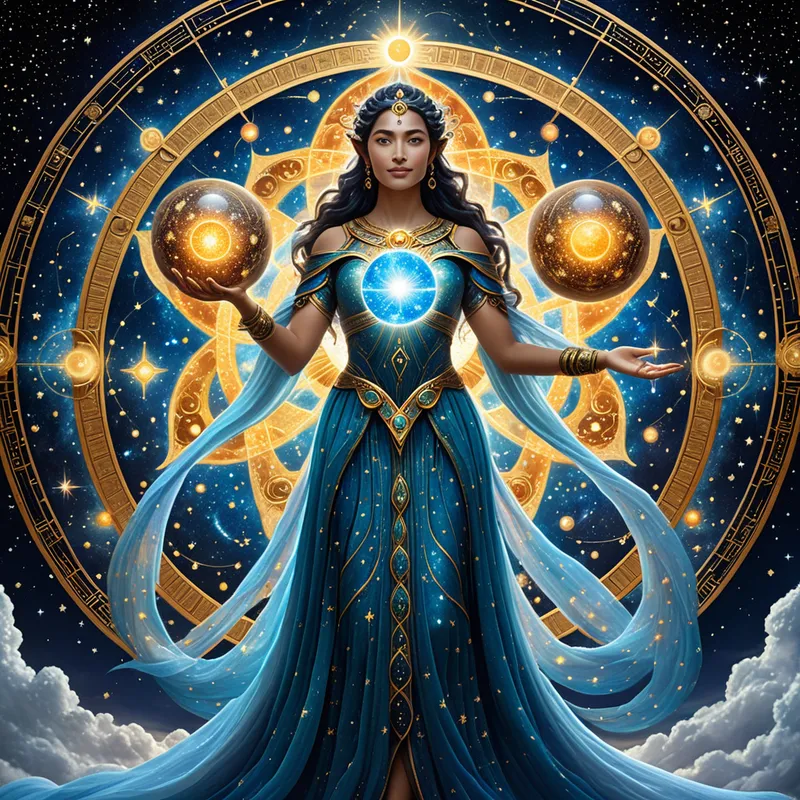
Before the first dawn painted [the sky](/myths/the-sky “Myth from Persian culture.”/), in the silent womb of potentiality, she stirred. She was not born; she unfolded. They called her the Horae-godd, the Weaver of the Great Wheel. Her breath was the first wind, her heartbeat the first rhythm against the formless dark.
In the beginning, there was only the One—a seamless, undifferentiated whole. But within that stillness, a longing arose, a desire for expression, for story. From the core of this longing, [the Horae](/myths/the-horae “Myth from Greek culture.”/)-godd emerged, not as a separate being, but as the principle of differentiation itself. With hands that were not hands but intentions, she reached into the eternal Now and began to spin.
From her essence, she drew forth four radiant aspects, not as daughters, but as expressions of her own being. First came the Seed-Whisperer, cloaked in the deep blues and whites of untouched snow, her touch causing the first, hard shell of a seed to crack in the dreaming earth. Then, the Bloom-Dancer, robed in verdant green and floral gold, who coaxed tender shoots toward a sun that had only just begun to burn. Third emerged the Fruit-Bearer, adorned in the rich ochres and reds of a heavy sunset, her arms laden with the weight of perfect, ripe offerings. Finally, the Veil-Caster, wrapped in the greys and purples of twilight, who gently persuaded the last leaf to fall and return to the root.
But the cosmos, newly breathed into being, knew only chaos. Stars flared and died without pattern; life surged and collapsed in a single, frantic moment. There was no before, no after—only a cacophonous, simultaneous everything. The Horae-godd saw this and knew it was not a story, but a scream.
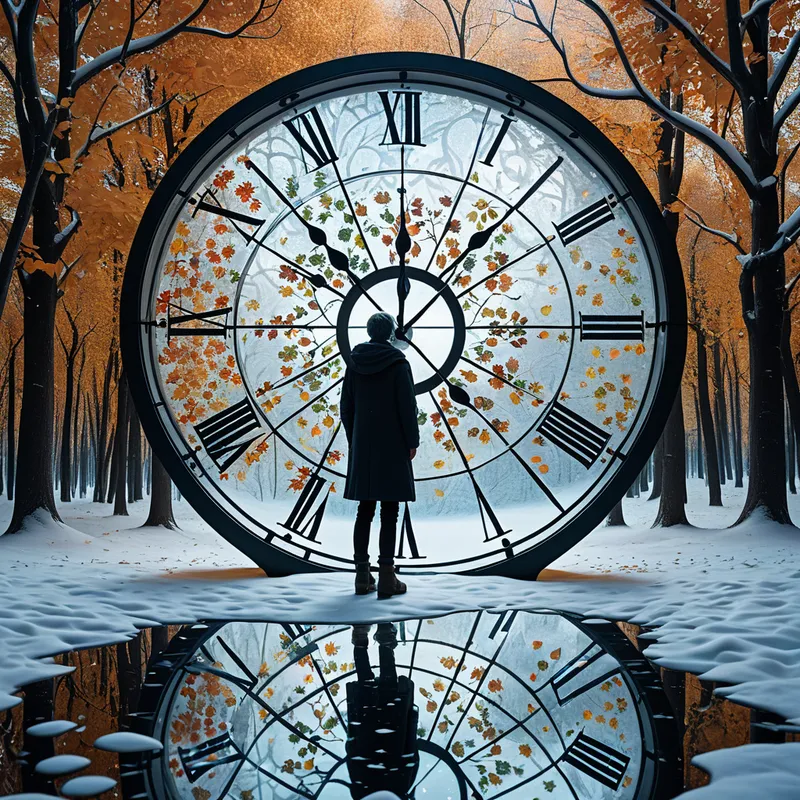
So she began to weave. She took the Seed-Whisperer and placed her at the eastern gate of the wheel. She took the Bloom-Dancer and set her in the south. The Fruit-Bearer she stationed in the west, and the Veil-Caster in the north. Between them, she spun threads of destiny—not as rigid fate, but as sacred sequence. She decreed that one must follow the other: potential must precede growth, growth must labor toward fruition, fruition must surrender to release, and release must make space for potential once more.
The chaos resisted. It was a force that desired everything at once, eternity compressed into a single point of blinding, static glory. The Horae-godd did not fight it with violence, but with rhythm. She began to turn the wheel. With a groan that was the first law of the universe, it moved. The Seed-Whisperer’s time passed to the Bloom-Dancer, and the first true spring washed over a world that had only known a single season of becoming. The wheel turned again, and the fruit swelled. It turned once more, and the leaves fell in a beautiful, melancholy sigh.
With each rotation, the cosmos breathed. In, and out. Tension, and release. The chaos was not destroyed, but tamed—woven into the very fabric of the sequence. The stars learned to trace arcs across the sky; tides learned to obey the pull of [the moon](/myths/the-moon “Myth from Tarot culture.”/); creatures were born, lived, died, and were reborn in the great compost of being. The Horae-godd, her work complete, did not vanish. She became the wheel itself, the silent, sovereign axis around which all stories—of empires, of loves, of a single human heart—must inevitably turn.
Cultural Origins & Context
The myth of the Horae-godd transcends any single [pantheon](/myths/pantheon “Myth from Roman culture.”/) or recorded scripture. She is a psychic archetype that has surfaced, in varying forms, wherever humans have looked at the natural world and perceived not just random change, but an intelligible, repeating pattern imbued with sacred meaning. Scholars of comparative mythology find her echoes in the Greek Horae, the orderly daughters of [Themis](/myths/themis “Myth from Global/Universal culture.”/); in the Norse [Norns](/myths/norns “Myth from Nordic culture.”/) who spin destiny at [the well of Urd](/myths/the-well-of-urd “Myth from Norse culture.”/); and in the cyclical dance of Hindu deities like Kali, who embodies creation and dissolution.
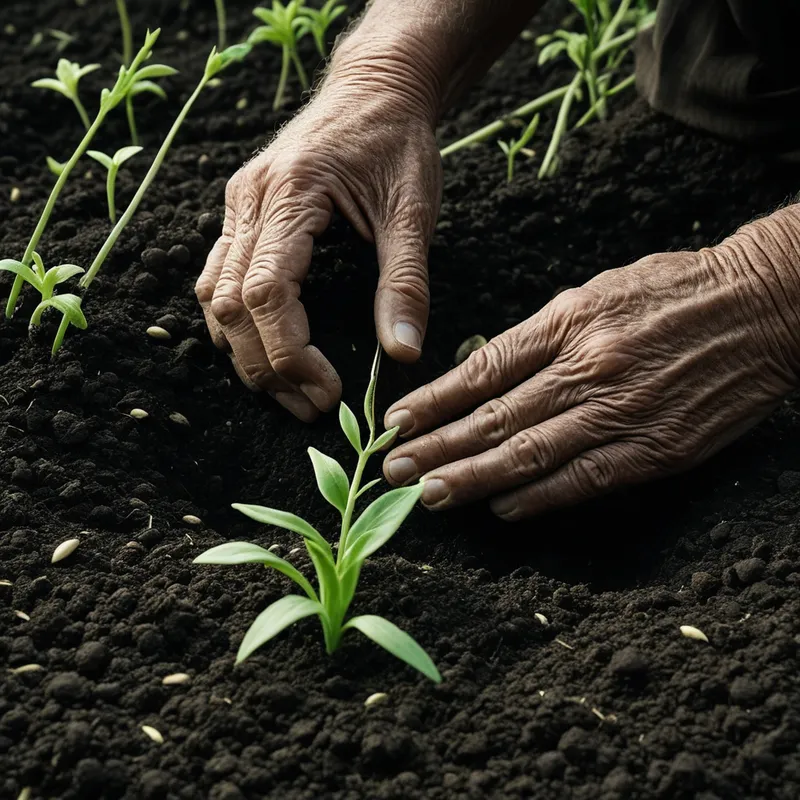
This was not a myth told in royal courts, but one whispered by farmers feeling the turn of the soil, by midwives timing contractions, by elders observing the wrinkles on their own hands. It was a folk understanding, passed down through ritual, festival, and the very structuring of the agricultural year. Its societal function was profound: it provided a cosmological justification for order, for patience, for the acceptance of decay as a necessary part of life. It taught that chaos is not the enemy, but the raw material from which sacred sequence is crafted. To live in accordance with the Horae-godd was to live in harmony with the fundamental law of reality.
Symbolic Architecture
At its core, the myth is a grand [metaphor](/symbols/metaphor “Symbol: A figure of speech where one thing represents another, often revealing hidden connections and deeper truths through symbolic comparison.”/) for the imposition of [consciousness](/symbols/consciousness “Symbol: Consciousness represents the state of awareness and perception, encompassing thoughts, feelings, and experiences.”/)—of meaningful [pattern](/symbols/pattern “Symbol: A ‘Pattern’ in dreams often signifies the underlying structure of experiences and thoughts, representing both order and the repetitiveness of life’s situations.”/)—upon the undifferentiated [flux](/symbols/flux “Symbol: A state of continuous change, instability, or flow, often representing the impermanent nature of existence and experience.”/) of the unconscious. The primordial “One” represents the unconscious state where all potentials exist simultaneously, a state of psychic [chaos](/symbols/chaos “Symbol: In Arts & Music, chaos represents raw creative potential, uncontrolled expression, and the breakdown of order to forge new artistic forms.”/) with no [differentiation](/symbols/differentiation “Symbol: The process of distinguishing or separating parts of the self, emotions, or identity from a whole, often marking a developmental or psychological milestone.”/) between thought, feeling, [image](/symbols/image “Symbol: An image represents perception, memories, and the visual narratives we create in our minds.”/), or [impulse](/symbols/impulse “Symbol: A sudden, powerful urge or drive that arises without conscious deliberation, often linked to primal instincts or emotional surges.”/).
The Horae-godd is the archetype of the ordering principle, the psychic function that dares to say “first this, then that,” transforming timeless potential into a life that can actually be lived.
Her four aspects are not merely seasons, but the essential phases of any complete cycle of being:
- The Seed-Whisperer (Potential): The latent [idea](/symbols/idea “Symbol: An ‘Idea’ represents a spark of creativity, innovation, or realization, often emerging as a solution to a problem or a new outlook on life.”/), the unconscious urge, the unformed dream waiting in the darkness of the [psyche](/myths/psyche “Myth from Greek culture.”/).
- The [Bloom](/symbols/bloom “Symbol: Represents growth, vitality, and the flourishing of potential, often tied to emotional awakening or physical health.”/)-Dancer ([Expansion](/symbols/expansion “Symbol: A symbol of growth, increase, or extension beyond current boundaries, often representing personal development, opportunity, or overwhelming change.”/)): The energetic [investment](/symbols/investment “Symbol: Dreams of investment symbolize commitment of resources for future returns, reflecting personal growth, risk assessment, and life choices.”/), the passionate [pursuit](/symbols/pursuit “Symbol: A chase or being chased in dreams often reflects unresolved anxieties, unfulfilled desires, or internal conflicts demanding attention.”/), the conscious [effort](/symbols/effort “Symbol: Effort signifies the physical, mental, and emotional energy invested toward achieving goals and personal growth.”/) to bring the potential into manifest form.
- The [Fruit](/symbols/fruit “Symbol: Fruit symbolizes abundance, nourishment, and the fruits of one’s labor in dreams.”/)-Bearer (Manifestation): The [achievement](/symbols/achievement “Symbol: Symbolizes success, mastery, or reaching a goal, often reflecting personal validation, social recognition, or overcoming challenges.”/), the completed work, the ripe [moment](/symbols/moment “Symbol: The symbol of a ‘moment’ embodies the significance of transient experiences that encapsulate emotional depth or pivotal transformations in life.”/) of tangible result and fulfillment.
- The [Veil](/symbols/veil “Symbol: A veil typically symbolizes concealment, protection, and transformation, representing both mystery and femininity across cultures.”/)-Caster ([Dissolution](/symbols/dissolution “Symbol: The process of breaking down, dispersing, or losing form, often representing transformation, release, or the end of a state of being.”/)): The necessary ending, the letting go, the decay of the old form so its essence can be recycled into the next seed.
The great conflict with chaos symbolizes the eternal [human](/symbols/human “Symbol: The symbol of a human represents individuality, complexity of emotions, and social relationships.”/) struggle between the desire for ecstatic, immediate totality (a kind of spiritual greed) and the humble, disciplined [acceptance](/symbols/acceptance “Symbol: The experience of being welcomed, approved, or integrated into a group or situation, often involving validation of one’s identity or actions.”/) of process, limits, and time.
The Dreamer’s Resonance
When this myth activates in the modern psyche, it often manifests in dreams of profound temporal disorientation or seasonal urgency. One might dream of being trapped in an endless summer, where projects never conclude and fatigue becomes existential—a sign the Fruit-Bearer is blocked, unable to transition to release. Another might dream of a perpetual, barren winter landscape, feeling utterly devoid of ideas or motivation—the Seed-Whisperer is dormant, perhaps because a previous cycle was never properly released.
Somatically, this can feel like being “out of sync”—a deep, rhythmic anxiety that has nothing to do with external events, but with an internal process stuck in one phase. The psyche is signaling that it is time to consciously complete a cycle: to harvest and honor what has been grown, or to courageously let something die so new soil can be made. The dreamer is experiencing the pressure of the inner Horae-godd insisting on the turning of their personal wheel.
Alchemical Translation
The individuation process—the journey toward psychic wholeness—is not a linear ascent, but a spiral danced along the turning wheel of the Horae-godd. Her myth provides the ultimate alchemical formula for self-realization.
The great work is not to escape the wheel, but to become its conscious turner—to willingly engage each phase without clinging to the bloom or fearing the veil.
The alchemical translation proceeds thus:
- [Nigredo](/myths/nigredo “Myth from Alchemical culture.”/) (The Blackening): Corresponds to the Veil-Caster’s domain. One must consciously enter a period of dissolution, allowing outdated identities, compulsive behaviors, and finished life chapters to decay. This is the painful but necessary “composting” of [the self](/myths/the-self “Myth from Jungian culture.”/).
- Albedo (The Whitening): Mirrors the Seed-Whisperer. From the fertile dark of the compost, a new, purified potential emerges—a lucid insight, a calling from the depths, a fragile new sense of purpose.
- Citrinitas (The Yellowing): Aligns with the Bloom-Dancer. This potential is nurtured with conscious effort, study, practice, and passion. It is brought into the light of day and allowed to expand and take shape.
- [Rubedo](/myths/rubedo “Myth from Alchemical culture.”/) (The Reddening): The achievement of the Fruit-Bearer. The work is fully realized and integrated into one’s life and character. It bears its fruit, offering its gifts to the self and [the world](/myths/the-world “Myth from Tarot culture.”/).
The [triumph](/myths/triumph “Myth from Roman culture.”/) of the myth is the establishment of the wheel itself—the realization that the Self is not the content of any one phase, but the entire, enduring process. To embody the Horae-godd is to achieve a sovereign (ruler archetype) equanimity, presiding over the eternal inner seasons with wisdom, compassion, and the profound peace that comes from trusting the sacred sequence of your own becoming.
Associated Symbols
Explore related symbols from the CaleaDream lexicon: