
The Holy Lance Myth Meaning & Symbolism
A sacred relic of divine suffering and royal destiny, whose possession promises ultimate power but demands profound spiritual and psychological transformation.
The Tale of The Holy Lance
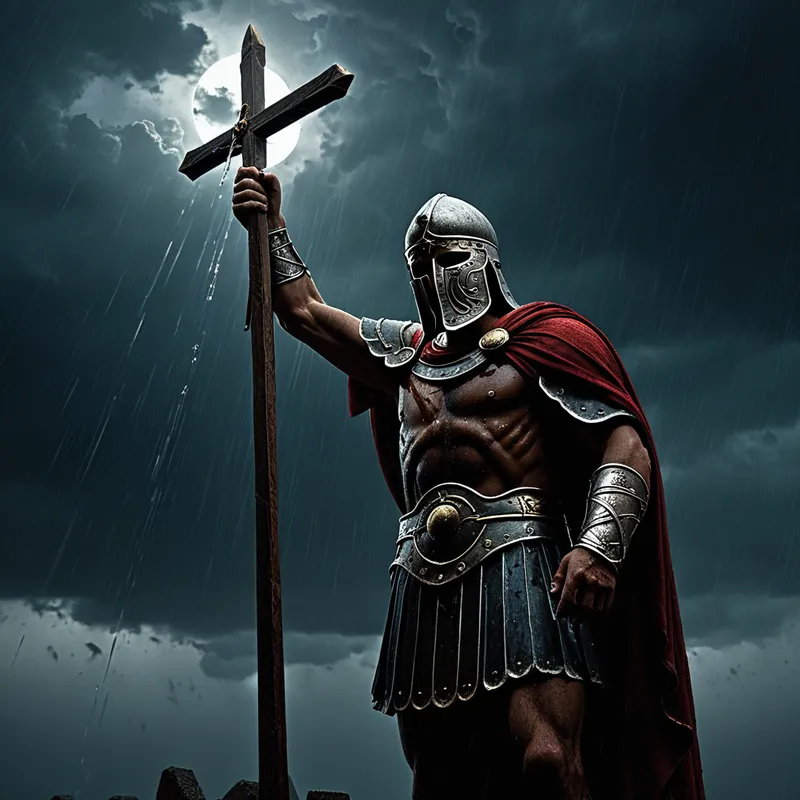
Hear now the tale of the iron that pierced [the world](/myths/the-world “Myth from Tarot culture.”/)’s heart, the spear that drank from the divine wound. [The sky](/myths/the-sky “Myth from Persian culture.”/) was a bruise over [Golgotha](/myths/golgotha “Myth from Christian culture.”/), the air thick with the scent of rain, blood, and bitter myrrh. Upon the cruel timber, the King of a kingdom not of this world hung in his final agony. The crowd’s roar had faded to a haunted murmur; even [the earth](/myths/the-earth “Myth from Hindu culture.”/) seemed to hold its breath.
Among the Roman guards stood a soldier named Longinus, a man whose sight was clouded not by malice, but by a weary, worldly blindness. To confirm the passing of the condemned, he was given a simple task: pierce the side with his lance. He hefted the weapon, a standard-issue pilum, its iron tip dulled by dust and duty. With a soldier’s practiced thrust, he drove it home.
And the world cracked.
Not with sound, but with silence. From the wound flowed not just blood, but [water](/myths/water “Myth from Chinese culture.”/)—a torrent of grace and grief mingled. It splashed upon Longinus’s face, and in that instant, the scales fell from his eyes. The blind man saw. He saw not a failed rebel, but the very face of God in ultimate surrender. The spear in his hand was no longer a tool of death, but the instrument of a terrible, necessary revelation. The lance was sanctified, transformed by what it had touched. It became the Holy Lance, the Spear of Destiny, forever holding the paradox of the wound that heals.
Centuries passed. The Lance traveled in shadow and legend, its power a whispered rumor among emperors and kings. It came to rest in the hands of [The Fisher King](/myths/the-fisher-king “Myth from Arthurian culture.”/), the maimed guardian of the sacred [Grail](/myths/grail “Myth from Christian culture.”/). His kingdom, Carbonek, lay waste, its fields barren, its rivers dry, a mirror of the King’s own unhealing wound. The Lance stood in his castle chapel, its point perpetually bleeding, a symbol of a suffering that poisoned the soul of the land itself.
Then came the pure knight, [Sir Galahad](/myths/sir-galahad “Myth from Arthurian culture.”/). In the silent, luminous chamber of [the Grail](/myths/the-grail “Myth from Arthurian culture.”/), he witnessed the sacred mystery. And he saw the Lance, its iron weeping. In that hallowed space, the weapon of the Roman soldier and the relic of the wasted king became one. Its meaning deepened: it was not only the spear that confirmed death, but the spear that preceded resurrection. To behold it was to behold the sacred cost of redemption. [Galahad](/myths/galahad “Myth from Arthurian culture.”/), in his perfection, asked the healing questions. And in that asking, the Lance’s bleeding ceased, if only for a moment, foreshadowing the healing of the King and the restoration of the land. The tale ends not with the Lance wielded in battle, but held in reverence—a silent witness to the truth that the deepest power springs from the acknowledged wound.
Cultural Origins & Context
The myth of the Holy Lance is a powerful strand woven from two distinct but intertwined traditions: the historical piety of Christian relic veneration and the chivalric romance of the Arthurian cycle. Its earliest roots lie in the Gospel of John (19:34), a single, potent verse describing the piercing of Christ’s side. By the 4th century, this narrative seed had blossomed into the Acta Pilati, which named the centurion Longinus and began the process of sanctifying the spear itself.
As a physical object, lances claiming to be the true Holy Lance emerged in Antioch, Constantinople, and eventually Vienna, where it was incorporated into the imperial regalia of the Holy Roman Emperors. Its societal function here was profoundly political: it was the Spear of Destiny, a [talisman](/myths/talisman “Myth from Global culture.”/) of divine right and world dominion. To possess it was to hold [the mandate of heaven](/myths/the-mandate-of-heaven “Myth from Chinese culture.”/), a belief that would captivate figures from Charlemagne to Hitler.
The Arthurian tradition, crystallized by writers like Chrétien de Troyes and later Sir [Thomas](/myths/thomas “Myth from Christian culture.”/) Malory, absorbed this relic and alchemized it. Removed from the imperial treasury and placed in the mystical, wounded kingdom of the [Fisher King](/myths/fisher-king “Myth from Arthurian culture.”/), its function shifted from political legitimacy to spiritual test. In the [Grail Quest](/myths/grail-quest “Myth from Arthurian culture.”/), the Lance becomes part of a sacred symbology alongside the Grail and the broken sword. It was passed down in romances recited in courtly halls, serving not to legitimize a ruler, but to illustrate the pinnacle of knightly virtue—a virtue defined not by martial prowess, but by compassionate questioning and the capacity to confront sacred suffering.
Symbolic Architecture
At its core, the Holy [Lance](/symbols/lance “Symbol: A long thrusting weapon symbolizing focused energy, penetration, direction, and masculine power. It represents both aggression and protection.”/) is the ultimate [symbol](/symbols/symbol “Symbol: A symbol can represent an idea, concept, or belief, serving as a powerful tool for communication and understanding.”/) of the creative wound. It represents the paradoxical point where destruction and healing, violence and [revelation](/symbols/revelation “Symbol: A sudden, profound disclosure of truth or insight, often through artistic or musical means, that transforms understanding.”/), [death](/symbols/death “Symbol: Symbolizes transformation, endings, and new beginnings; often associated with fear of the unknown.”/) and [life](/symbols/life “Symbol: The symbol of ‘Life’ represents a journey of growth, interconnectedness, and existential meaning, encompassing both the joys and challenges that define human experience.”/) intersect.
The Lance is the axis where the horizontal thrust of human action pierces the vertical mystery of the divine, creating a crossroads of eternal significance.
Psychologically, it embodies the necessary puncture in [the ego](/myths/the-ego “Myth from Jungian culture.”/)’s [shell](/symbols/shell “Symbol: Shells are often seen as symbols of protection, transition, and the journey of personal growth.”/). Longinus, blinded by [convention](/symbols/convention “Symbol: A convention often signifies collective understanding, agreements, or shared knowledge, embodying the pursuit of goals and unity among individuals.”/) and duty, represents the unconscious individual. The thrust of the lance is the [moment](/symbols/moment “Symbol: The symbol of a ‘moment’ embodies the significance of transient experiences that encapsulate emotional depth or pivotal transformations in life.”/) of traumatic [insight](/symbols/insight “Symbol: A sudden, deep understanding of a complex situation or truth, often arriving unexpectedly and illuminating hidden connections.”/)—a [betrayal](/symbols/betrayal “Symbol: A profound violation of trust in artistic or musical contexts, often representing broken creative partnerships or artistic integrity compromised.”/), a [loss](/symbols/loss “Symbol: Loss often symbolizes change, grief, and transformation in dreams, representing the emotional or psychological detachment from something or someone significant.”/), a failure—that, while painful, opens a channel to a deeper [layer](/symbols/layer “Symbol: Layers often symbolize complexity, depth, and protection in dreams, representing the various aspects of the self or situations.”/) of [the Self](/myths/the-self “Myth from Jungian culture.”/). The flowing [blood](/symbols/blood “Symbol: Blood often symbolizes life force, vitality, and deep emotional connections, but it can also evoke themes of sacrifice, trauma, and mortality.”/) and [water](/symbols/water “Symbol: Water symbolizes the subconscious mind, emotions, and the flow of life, representing both cleansing and creation.”/) symbolize the release of both vital life-force ([blood](/symbols/blood “Symbol: Blood often symbolizes life force, vitality, and deep emotional connections, but it can also evoke themes of sacrifice, trauma, and mortality.”/)) and cleansing [spirit](/symbols/spirit “Symbol: Spirit symbolizes the essence of life, vitality, and the spiritual journey of the individual.”/) ([water](/symbols/water “Symbol: Water symbolizes the subconscious mind, emotions, and the flow of life, representing both cleansing and creation.”/)) that follows such a piercing.
In the Fisher [King](/symbols/king “Symbol: A symbol of ultimate authority, leadership, and societal order, often representing the dreamer’s inner power or external control figures.”/)’s castle, the Lance takes on another layer: the unhealed wound. The King’s personal injury and the Lance’s perpetual bleeding reflect a state of arrested development, where a past [trauma](/symbols/trauma “Symbol: A deeply distressing or disturbing experience that overwhelms the psyche, often manifesting in dreams as unresolved emotional wounds or psychological injury.”/) continues to drain vitality, poisoning one’s inner “[kingdom](/symbols/kingdom “Symbol: A kingdom symbolizes authority, belonging, and a sense of identity within a larger context or community.”/).” The Lance here is the persistent, painful [memory](/symbols/memory “Symbol: Memory symbolizes the past, lessons learned, and the narratives we construct about our identities.”/) or complex that blights the [psyche](/myths/psyche “Myth from Greek culture.”/)’s [fertility](/symbols/fertility “Symbol: Symbolizes creation, growth, and abundance, often representing new beginnings, potential, and life force.”/).
Finally, in Galahad’s [vision](/symbols/vision “Symbol: Vision reflects perception, insight, and clarity — often signifying the ability to foresee or understand deeper truths.”/), it becomes the wound integrated. Its [presence](/symbols/presence “Symbol: Presence in dreams often signifies awareness or acknowledgment of something significant in one’s life.”/) in the Grail procession signifies that wholeness (the Grail) does not mean the [absence](/symbols/absence “Symbol: The state of something missing, void, or not present. Often signifies loss, potential, or existential questioning.”/) of wounding, but its sacred [inclusion](/symbols/inclusion “Symbol: The state of being accepted, welcomed, or integrated into a group, community, or society. It represents belonging and participation.”/). The [quest](/symbols/quest “Symbol: A quest symbolizes a journey or search for purpose, fulfillment, or knowledge, often representing life’s challenges and adventures.”/) is not to remove the [spear](/symbols/spear “Symbol: The spear often symbolizes power, aggression, and the drive to protect or conquer.”/), but to understand its place in the divine order.
The Dreamer’s Resonance
When the Holy Lance appears in modern dreams, it rarely manifests as a medieval artifact. Instead, it is the pattern of the piercing. One might dream of a sharp object—a needle, a shard of glass, a beam of light—penetrating the chest or side. There is often a somatic component: a feeling of pressure release, of liquid warmth, or of a shocking, clarifying pain.
This dream motif signals a profound psychological process: the ego’s confrontation with a truth it has resisted. The “lance” is the insight that breaks through denial. It could relate to a necessary ending (a relationship, a job, an identity) that feels like a violent death but is, in fact, a required sacrifice for growth. The dreamer is in the role of both Longinus (delivering/unconsciously receiving the thrust) and Christ (being pierced). They are experiencing the moment when a buried aspect of the Self, perhaps a deep grief or a denied calling, demands recognition and, in doing so, releases trapped energy. The dream is an initiatory wounding, preparing the psyche for a new level of consciousness.
Alchemical Translation
The myth of the Holy Lance models the alchemical stage of mortificatio and [solutio](/myths/solutio “Myth from Alchemical culture.”/)—the killing and dissolving that precedes rebirth. The individuation journey requires not just building a strong ego, but also the sacred wounding of that ego to allow for contact with the transcendent Self.
The quest is not for the Lance itself, but for the courage to be the vessel that is pierced by it, and in that piercing, to become a vessel for the Grail.
For the modern individual, the “Fisher King’s wound” is any core complex—a foundational sense of unworthiness, a betrayal, a childhood injury—that saps our vitality and keeps our inner landscape barren. We guard this wound like a relic, believing it to be our defining truth. The “thrust of the Lance” is the conscious, often painful, act of attending to this wound. It is the therapy session where the memory is finally voiced, the courageous confrontation with the person who hurt us, or the brutal self-honesty about our own complicity.
This is not an act of violence, but of sacred surgery. Like Longinus, we must perform the necessary, difficult action (confrontation, acceptance) that releases the pent-up “blood and water”—the trapped emotions and spiritual blockages. The healing that follows for the Fisher King is not the disappearance of the scar, but the restoration of flow. The land becomes fertile again; creativity, love, and purpose can flow where once there was only stagnant pain. We integrate the lance, not as a weapon, but as a part of our personal myth. We achieve sovereignty not by possessing an external power (the Spear of Destiny), but by undergoing the internal transformation it symbolizes, becoming rulers of a kingdom healed through acknowledged vulnerability.
Associated Symbols
Explore related symbols from the CaleaDream lexicon: