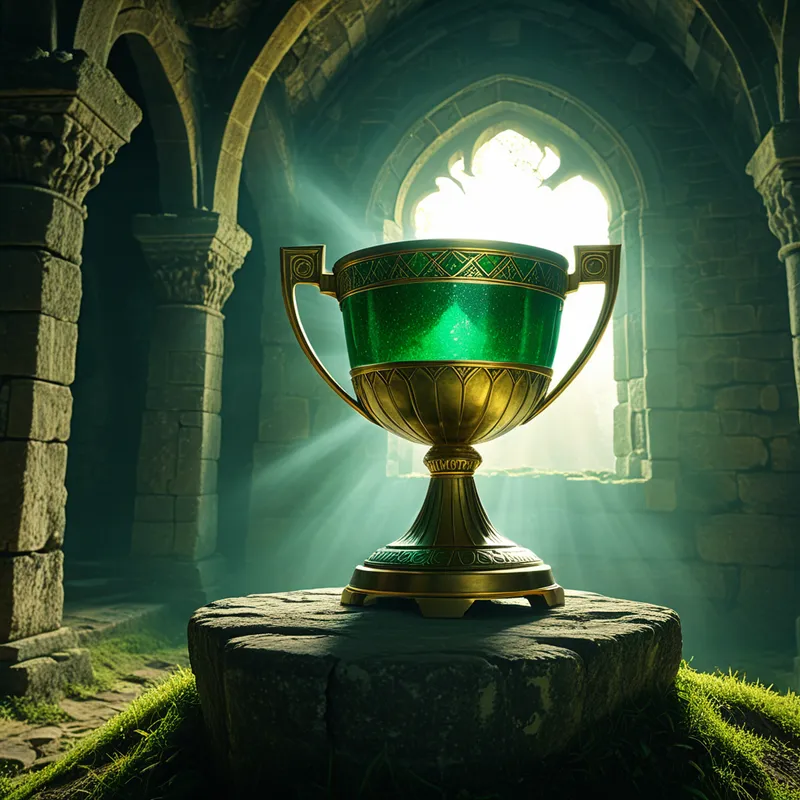
The Holy Grail from Arthurian Myth Meaning & Symbolism
A sacred vessel lost to the world, whose quest defines a knight's worth not by conquest, but by the purity of his soul and his capacity for compassion.
The Tale of The Holy Grail from Arthurian
Listen, and hear the tale of [the world](/myths/the-world “Myth from Tarot culture.”/)’s deepest wound and its only cure. In the days of Arthur, when Camelot’s towers shone with a promise destined to fade, a shadow fell upon the land. It was not [the shadow](/myths/the-shadow “Myth from Jungian culture.”/) of an army, but of a sickness—a spiritual malaise that withered crops, stilled the hearts of men, and left the very king, the noble [Fisher King](/myths/fisher-king “Myth from Arthurian culture.”/), pierced through the thigh, ruling a realm called the Gaste Terre. He could do nothing but fish in [the river](/myths/the-river “Myth from Buddhist culture.”/) beside his castle, waiting, forever waiting, for a question to be asked.
Into this twilight rode [the knights of the Round Table](/myths/the-knights-of-the-round-table “Myth from Arthurian culture.”/), bound by oath to seek not glory, but a mystery: the San Greal, [the Holy Grail](/myths/the-holy-grail “Myth from Global/Universal culture.”/). It was said to be the cup from which the Christ drank at [the last supper](/myths/the-last-supper “Myth from Christian culture.”/), [the vessel](/myths/the-vessel “Myth from Alchemical culture.”/) that caught his sacred blood. It had vanished from the world of men, and with it, the soul of the world had sickened.
The quest was a crucible. The proud [Sir Gawain](/myths/sir-gawain “Myth from Arthurian culture.”/) rode forth and returned empty-handed, having slept through his chance. The passionate [Sir Lancelot](/myths/sir-lancelot “Myth from Arthurian culture.”/), greatest of warriors, was driven to the very threshold of [the Grail Chapel](/myths/the-grail-chapel “Myth from Arthurian culture.”/), but his love for [Guinevere](/myths/guinevere “Myth from Arthurian culture.”/), a sin of the flesh and spirit, barred him. He saw [the Grail](/myths/the-grail “Myth from Arthurian culture.”/) as if through a blinding fog and fell into a swoon for twenty-four days, a broken man. The quest stripped each knight of their worldly armor, revealing the man beneath.
But one was different. He was [Galahad](/myths/galahad “Myth from Arthurian culture.”/), whose shield bore a crimson cross, whose heart had never known a selfish thought. His purity was not innocence, but a fierce and focused light. Guided by visions and holy hermits, he journeyed to Corbenic, [the castle of the Fisher King](/myths/the-castle-of-the-fisher-king “Myth from Arthurian culture.”/). There, in a chamber shimmering with unearthly light, the [Grail](/myths/grail “Myth from Christian culture.”/) appeared, veiled in samite cloth, attended by angels. The air grew thick with the scent of spices and sanctity.
And then, the pivotal moment. The Grail, now uncovered, floated before the wounded king. The knights were fed with food of heaven, yet the land remained barren. It was the knight Percival, in some tellings, or Galahad in others, who finally understood. The silence was the sickness. With a heart swelling with compassion, he spoke the words that broke the spell: “Whom does the Grail serve?”
The question echoed like thunder. [The Fisher King](/myths/the-fisher-king “Myth from Arthurian culture.”/) wept with relief. “It serves the King of the Grail,” he said, and as he spoke, his wound was healed. The streams ran clear, [the earth](/myths/the-earth “Myth from Hindu culture.”/) grew green, and [the Wasteland](/myths/the-wasteland “Myth from Arthurian culture.”/) bloomed. For Galahad, the quest culminated not in possession, but in transcendence. He was taken to the holy city of Sarras, where he gazed into the Grail’s deepest mysteries, his soul leaving his body in a final ecstasy. The Grail then ascended to heaven, for the world was not yet worthy to hold it. The knights returned to Camelot, forever changed, their world touched by a grace it could not keep.

Cultural Origins & Context
The Grail legend is a palimpsest, a parchment written over many times. Its roots are Celtic, drawing from magical cauldrons of plenty and rebirth like the Cauldron of Annwn. These pagan vessels of sovereignty and vitality were baptized into Christian tradition by 12th and 13th century writers like Chrétien de Troyes, Robert de Boron, and in the grand compilation of The Vulgate Cycle. They transformed the cauldron into the ultimate Christian relic, weaving it into the narrative of [Joseph](/myths/joseph “Myth from Biblical culture.”/) of Arimathea, who supposedly brought it to Glastonbury.
The tales were not mere entertainment for courtly audiences; they were a spiritual and social mirror. In an age of crusades and chivalric codes, [the Grail Quest](/myths/the-grail-quest “Myth from Arthurian culture.”/) reframed the knight’s purpose. It was no longer sufficient to be strong and loyal; one had to be spiritually impeccable. The quest served as a narrative container for exploring themes of sin, grace, and the possibility of direct, mystical encounter with the divine, outside the strict hierarchy of the Church. It was a myth for a society in transition, yearning for a lost wholeness.
Symbolic Architecture
At its [heart](/symbols/heart “Symbol: The heart symbolizes love, emotion, and the core of one’s existence, representing deep connections with others and self.”/), the Grail is the [symbol](/symbols/symbol “Symbol: A symbol can represent an idea, concept, or belief, serving as a powerful tool for communication and understanding.”/) of the unattainable yet ever-sought totality of [the Self](/myths/the-self “Myth from Jungian culture.”/). It is not a [trophy](/symbols/trophy “Symbol: The trophy symbolizes achievement, recognition, and the reward for perseverance in competitive endeavors.”/) to be won, but a state of being to be earned through radical inner transformation.
The Grail does not reside in a geographic location, but in the quality of consciousness one brings to the search.
The Wasteland is the psychic state of disconnection—from the divine, from [nature](/symbols/nature “Symbol: Nature symbolizes growth, connectivity, and the primal forces of existence.”/), from one’s own deepest [soul](/symbols/soul “Symbol: The soul represents the essence of a person, encompassing their spirit, identity, and connection to the universe.”/). The Fisher [King](/symbols/king “Symbol: A symbol of ultimate authority, leadership, and societal order, often representing the dreamer’s inner power or external control figures.”/)’s wound is the central neurosis, the unhealed [trauma](/symbols/trauma “Symbol: A deeply distressing or disturbing experience that overwhelms the psyche, often manifesting in dreams as unresolved emotional wounds or psychological injury.”/) that paralyzes the ruling principle of the [psyche](/myths/psyche “Myth from Greek culture.”/). The knights represent different facets of [the ego](/myths/the-ego “Myth from Jungian culture.”/) setting out to heal this inner [king](/symbols/king “Symbol: A symbol of ultimate authority, leadership, and societal order, often representing the dreamer’s inner power or external control figures.”/). [Lancelot](/myths/lancelot “Myth from Arthurian culture.”/) is the powerful but conflicted ego, bound by [passion](/symbols/passion “Symbol: Intense emotional or physical desire, often linked to love, creativity, or purpose. Represents life force and deep engagement.”/) and [guilt](/symbols/guilt “Symbol: A painful emotional state arising from a perceived violation of moral or social standards, often tied to actions or inactions.”/). Gawain is the social [persona](/symbols/persona “Symbol: The social mask or outward identity one presents to the world, often concealing the true self.”/), charming but superficial.
Galahad represents the transcendent function, the [aspect](/symbols/aspect “Symbol: A distinct feature, quality, or perspective of something, often representing a partial view of a larger whole.”/) of [consciousness](/symbols/consciousness “Symbol: Consciousness represents the state of awareness and perception, encompassing thoughts, feelings, and experiences.”/) capable of synthesizing opposites into a new, whole state. His purity symbolizes a consciousness free from the projections and complexes that distort [perception](/symbols/perception “Symbol: The process of becoming aware of something through the senses. In dreams, it often represents how one interprets reality or internal states.”/). The culminating question—“Whom does the Grail serve?”—is the key. It shifts the [paradigm](/symbols/paradigm “Symbol: A fundamental model or framework in arts and music that shapes creative expression, perception, and cultural understanding.”/) from seeking to possess the divine (“How do I get it?”) to seeking to serve it (“How do I align myself with its [purpose](/symbols/purpose “Symbol: Purpose signifies direction, meaning, and intention in life, often reflecting personal ambitions and core values.”/)?”). The answer, “the King of the Grail,” reveals that the divine (the Grail) and the fully realized Self (the King) are in service to one another; they are a unified whole.

The Dreamer’s Resonance
When the Grail appears in modern dreams, it rarely manifests as a jeweled cup. It is the glowing diploma just out of reach, the perfect relationship that remains elusive, the career milestone that promises fulfillment but vanishes upon approach. The dreamer is in a state of questing, often feeling a profound sense of lack or being in a personal “wasteland”—a job, a relationship, or an inner life that feels barren.
Somatically, these dreams may be accompanied by feelings of aching longing or frustrating paralysis (the Fisher King’s wound). The psychological process is one of discernment. The dream ego, like the knights, is being tested. Is the quest driven by vanity (Gawain), unresolved guilt and shadow (Lancelot), or a genuine call to wholeness (Galahad)? The dream asks the dreamer to inspect their motives and their wounds. The elusive goal in the dream is not withholding itself; it is reflecting back the parts of the dreamer that are not yet aligned to receive it.

Alchemical Translation
The [Grail quest](/myths/grail-quest “Myth from Arthurian culture.”/) is the alchemical opus mapped onto the landscape of the soul. The knight leaves the known world (Camelot, the conscious ego) and descends into the perilous forest and strange castles (the unconscious). This is the [nigredo](/myths/nigredo “Myth from Alchemical culture.”/), the blackening, where the ego’s pretensions are stripped away. Lancelot’s failure at the chapel door is a necessary mortificatio—the death of the old, heroic identity.
Galahad’s journey represents the albedo, the whitening, a purification not of avoiding life, but of achieving a singular, focused intent. His shield, often found in a hermitage or abbey, symbolizes the conscious adoption of a spiritual container for the psyche’s journey.
The quest’s goal is not to find the Grail, but to become the vessel that can contain it.
The final confrontation in Corbenic is the [rubedo](/myths/rubedo “Myth from Alchemical culture.”/), the reddening, [the sacred marriage](/myths/the-sacred-marriage “Myth from Various culture.”/). The question heals the split between the seeking ego (the knight) and the wounded, ruling Self (the Fisher King). The land blooming signifies the integration of the unconscious contents into life, resulting in creativity, vitality, and meaning—the philosopher’s stone of individuation. The Grail’s ascent to heaven reminds us that this wholeness is not a permanent possession, but a fleeting state of grace we must continually strive to re-enter, a [north star](/myths/north-star “Myth from Various culture.”/) for the soul’s endless becoming.
Associated Symbols
Explore related symbols from the CaleaDream lexicon: