The Holly King Myth Meaning & Symbolism
A myth of two kings, holly and oak, battling for seasonal supremacy, embodying the eternal cycle of death, sacrifice, and rebirth in nature and psyche.
The Tale of The Holly King
Listen now, by the hearth-fire’s glow, as the wind howls a tale of kings. It is not a tale of men, but of the year itself, a story written in the turning of the sun and the sleeping of the earth.
In the deep heart of the greenwood, where the roots of the world drink from forgotten springs, two brothers are bound in an endless dance. They are kings, but their kingdom is time. One is the Oak King, lord of the bright half. His hair is the colour of sunlit bark, his crown a riot of young, broad oak leaves. His breath is the warm south wind, his laughter the crackle of a midsummer bonfire. He rules from the winter’s deepest chill, growing in strength as the days lengthen, until he stands triumphant at the height of the sun’s journey.
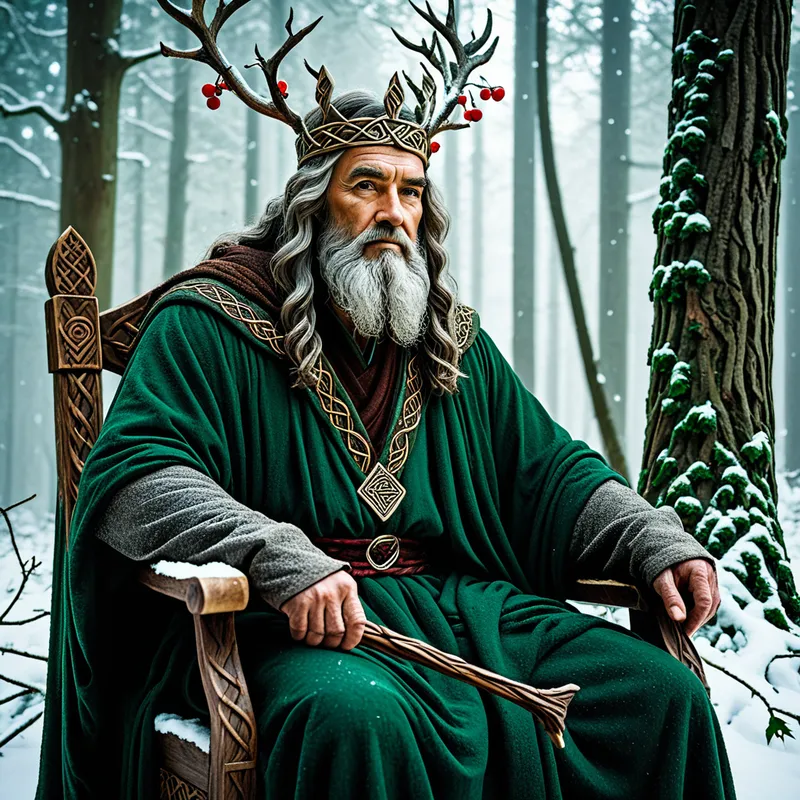
But as the sun pauses at its zenith, a shadow falls across the grove. From the north, where the pines grow thick and the moss is deep, comes his other half. This is the Holly King. His mantle is the dark, evergreen holly, leaves sharp and glossy as forged iron, berries like drops of winter’s own blood. His face is carved from frost and wisdom, his eyes holding the long memory of stars. He does not come with rage, but with a solemn duty. At the moment of the Oak King’s greatest power, they meet.
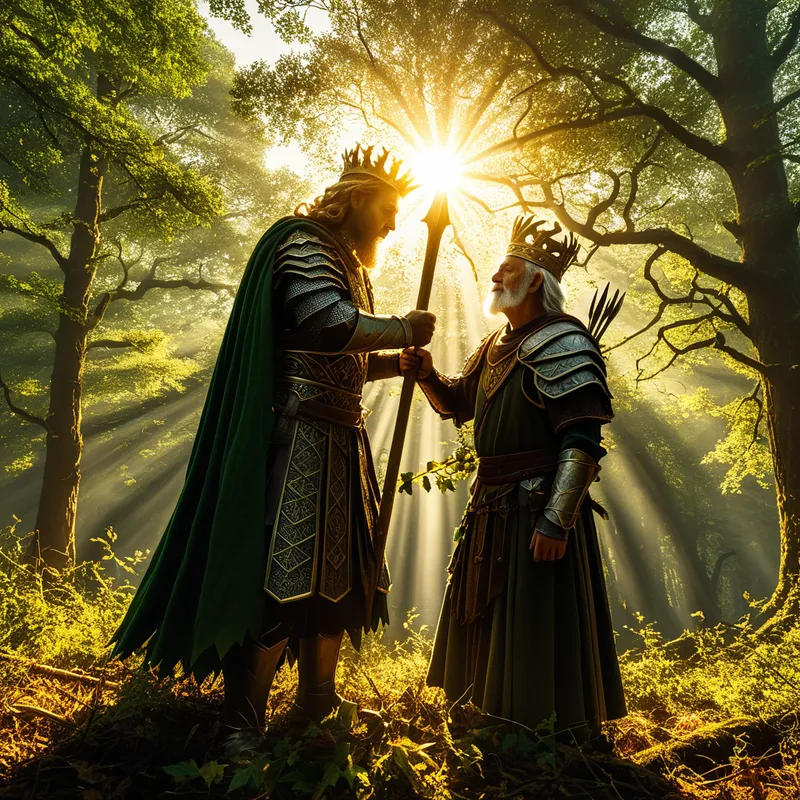
Their battle is a ritual older than stone. Stave against stave, not for hatred, but for balance. The vibrant, outward energy of the Oak meets the deep, inward resilience of the Holly. And as the sun begins its long retreat, the Holly King prevails. The Oak King does not die; he yields, wounded, knowing his part. He sinks into the earth, a seed awaiting its season. The Holly King takes the throne, his rule a time of drawing in. The light fades, the world cools, and he presides over the long night, a guardian of the hidden spark of life beneath the snow. He is the king of introspection, of stories told in the dark, of wisdom earned in stillness.
Then, at the year’s darkest nadir, when the night seems eternal, the wheel turns again. The Oak King, nourished by his rest, rises renewed. He challenges the weary Holly King, who now, at the peak of his own power, understands the necessity of his fall. He yields in turn, retreating to the shadows to watch and remember. And so the dance continues, an eternal embrace of light and dark, growth and rest, forever and ever.
Cultural Origins & Context
The myth of the dueling kings is a mytheme woven into the fabric of pre-Christian Celtic cultures of Britain and Ireland. It was never a single, canonical text, but a living pattern understood through ritual, seasonal celebration, and oral tradition. The figures were likely less personified deities and more poetic embodiments of natural forces, articulated by druids and bards to explain the solar cycle.
The myth’s primary function was calendrical and cosmological. It gave narrative meaning to the two pivotal solar events: the Summer Solstice (Oak King’s peak, Holly King’s ascent) and the Winter Solstice (Holly King’s peak, Oak King’s rebirth). These were not seen as defeats, but as necessary transfers of sovereignty essential for the world’s continuation. The holly and oak trees themselves were sacred. Oak, with its strength and summer canopy, was a symbol of the mundane world and temporal power. Holly, evergreen and protective in the barren winter, was a symbol of the Otherworld and enduring spirit. The myth thus taught a fundamental Celtic principle: that all of reality is a partnership of opposing, yet complementary, forces.
Symbolic Architecture
At its core, this myth is a masterful symbol of the psyche’s inherent duality and its need for rhythmic integration. It moves beyond simple “light vs. dark” to illustrate a sophisticated ecology of the self.
The Oak King is our outward-facing life: ambition, growth, expression, and solar consciousness. The Holly King is our inward-facing soul: introspection, wisdom, shadow, and lunar consciousness.
The battle is not a war of annihilation, but a sacred, cyclical dialogue. The Oak King’s “defeat” at midsummer represents the necessity of ceasing endless expansion, of incorporating limit and shadow. The Holly King’s reign is the time for consolidation, for rooting wisdom gained from experience, and for protecting the vulnerable core of being during a psychic “winter.” His subsequent yielding at midwitter is equally vital; it is the surrender of entrenched, introverted wisdom to the impulse of new life and new growth. The myth denies supremacy to either pole, presenting psychological health as the graceful, willing ceding of the crown at the appointed time.
The Dreamer’s Resonance
When this myth stirs in the modern dreamer, it often signals a critical point of inner transition. Dreaming of a fierce, evergreen figure in a winter landscape may not be a nightmare, but an encounter with the emerging Holly King aspect of the self.
This can manifest somatically as a felt need to withdraw, to “hibernate”—a fatigue with relentless productivity (the Oak King’s exhausted kingdom). Psychologically, it is the process of confronting one’s own shadow: the sharp, prickly, yet resilient parts of the personality that have been guarding something precious during a period of inner darkness. A dream of two figures fighting may indicate an internal civil war where one aspect (e.g., ambition) refuses to yield to the needs of another (e.g., rest or reflection). The dream is the psyche’s attempt to enact the ritual battle, to force a necessary transfer of energy from one ruling complex to its complementary opposite, re-establishing a lost equilibrium.

Alchemical Translation
For the individual on the path of individuation, the myth of the Holly King is a precise alchemical manual. The “royal battle” is the central work of psychic transmutation.
The process begins with identification. We are typically identified with the Oak King—our persona, our striving ego. The first alchemical step is the nigredo, the descent into darkness, initiated by the Holly King’s challenge. This is the painful but necessary “defeat” of the ego’s total dominion, its forced encounter with its opposite. The Holly King’s reign is the albedo, the whitening: a period of lunar reflection, purifying the insights gained in the dark, symbolized by the holly’s evergreen persistence amidst the snow.
The ultimate goal is not to choose one king, but to become the sacred grove itself—the container that holds both in their eternal, generative tension.
The final transmutation is the rubedo, the reddening, symbolized by the holly’s blood-red berry. This is the achieved wholeness where the conscious ego (Oak) and the guiding wisdom of the deep self (Holly) engage in a conscious, respectful dance. The modern individual learns to feel the solstices within: to know when to actively strive and when to wisely withdraw, when to lead and when to sacrificially yield. In doing so, they stop being a subject of the seasonal cycle and become its sovereign, embodying the complete, revolving year within a single, conscious heart.
Associated Symbols
Explore related symbols from the CaleaDream lexicon: