
The Hobo Myth Meaning & Symbolism
The mythic wanderer of the rails, a liminal figure of ultimate freedom and profound exile, who carries the nation's shadow and its untamed spirit.
The Tale of The Hobo
Listen. Can you hear it? A low, lonesome moan, born in the belly of the continent, carried on the wind. It is the song of the iron road, and it calls to those who cannot stay.
In the time when the nation was a raw, stitching wound, when steel veins were laid across its broad back, he appeared. Not born, but became. He was the man who turned his face from the porch light, the one for whom four walls became a cage. He heard the promise in the shriek of the whistle and the rhythmic chant of the wheels: further, further, further.
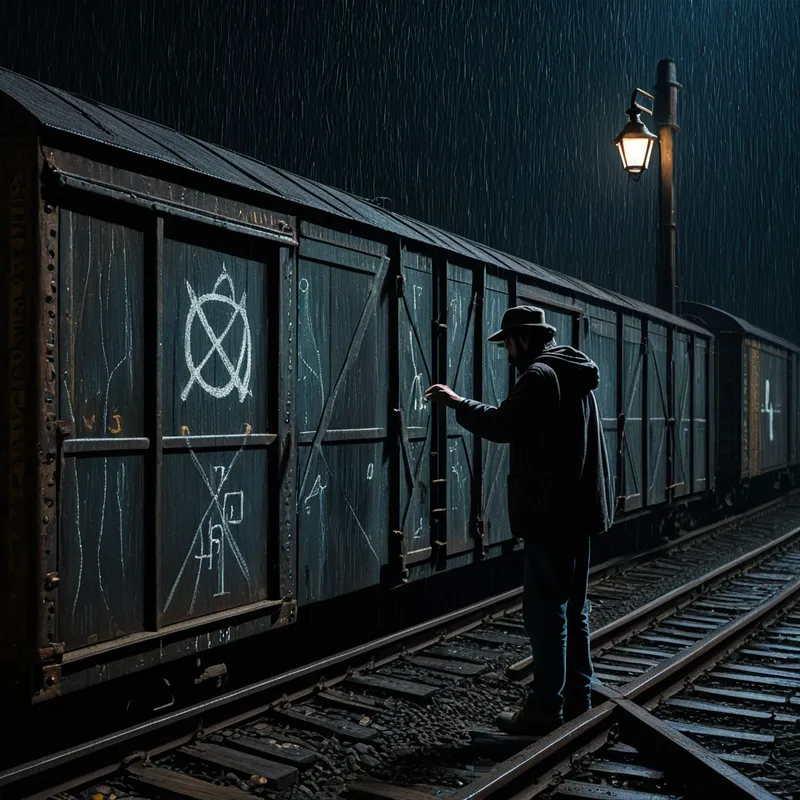
They called him the Hobo. You would see him at dusk, a silhouette against a blood-orange sky, a bindle on his shoulder like a pilgrim’s staff. His kingdom was the jungle—not of vine and beast, but of ash-cold campfires, of shared beans from a dented can, of stories traded for Bull Durham tobacco. His language was not spoken, but drawn: a cryptic lexicon of chalk marks on fence post and boxcar door. A cross meant “preach here, get food.” A circle with two arrows warned of a mean dog. His map was written in symbols on the skin of the world.
His conflict was not with dragons, but with the Bulls</ab title=“Railroad security officers, fierce and often brutal enforcers of private property”>, whose clubs spoke the law of the settled. His odyssey was measured in rattling gondolas and flatcars, in the heart-stopping sprint to catch a “manifest” already rolling, in the bitter cold of a Montana reefer and the blistering heat of a Arizona boxcar. He knew the intimate geography of loss: the family left behind, the job that vanished, the home that was no longer home. Yet, in his freedom was a terrible sacrament. He owned nothing, and thus was owned by nothing. The open road was his chapel, the moon his constant companion, the shared mulligan stew of the jungle his communion.
His resolution was never a return, but a perpetual departure. He did not seek a throne, but the next horizon. His triumph was in the going itself, in the unbroken thread of motion, in the profound brotherhood of the road, and in the silent, stubborn assertion that a man’s soul could not be fenced in. He would vanish into the morning mist, another ghost of the rails, his legacy the fading chalk mark and the echo of a harmonica tune carried on the wind.
Cultural Origins & Context
The myth of the Hobo is not ancient, but it is deeply American, born in the crucible of the late 19th and early 20th centuries. It emerged from the collision of industrialization, economic catastrophe, and the vast, beckoning geography of the continent. This was not a myth passed down by priests, but by the men themselves—a living, breathing oral tradition shared in hobo jungles, documented in the songs of Dust Bowl balladeers, and later romanticized (and sanitized) in popular culture.
Its primary societal function was twofold. For the culture at large, the Hobo served as a shadow figure—a simultaneous warning against social failure and a romantic symbol of ultimate escape from the drudgery of modern life. For the men on the road, the myth provided a crucial structure. It transformed a desperate, often humiliating circumstance into a vocation with its own codes, ethics, and hierarchy. The elaborate system of hobo signs functioned as both practical tool and sacred script, creating an invisible network of care and caution that sustained a nation within a nation. This folklore was a survival mechanism, weaving dignity and identity into the fabric of displacement.
Symbolic Architecture
Psychologically, the Hobo is the archetype of the liminal self. He exists in the betwixt-and-between: not fully of the settled world, nor of the wilderness; not a stationary victim, nor a pilgrim with a fixed destination. He is the soul in transition, the part of the psyche that must leave the familiar to find itself.
The bindle does not carry treasures, but burdens transformed into tools. The road is not an escape, but the only place where the exiled self can breathe.
The railroad track is a profound symbol of fate and direction—a rigid, linear path imposed upon the land, yet it carries the wanderer to infinite possibilities. The freight train itself is the uncontrollable force of collective momentum (the economy, history, destiny); catching it requires courage, skill, and surrender. The Hobo’s perpetual motion represents the psyche’s restless search for a home it can never fully locate in the outer world, because the search itself is the homecoming.

The Dreamer’s Resonance
When the Hobo strides into modern dreams, he announces a profound psychological process: the call to dis-identify. He appears when the dreamer’s life has become overly rigid, defined by roles (employee, partner, consumer) that feel like costumes. The somatic experience is often one of restless legs, a feeling of being “boxed in,” or a literal dream of missing a train.
Dreaming of hopping a freight or walking endless tracks signifies the unconscious initiating a journey away from the consolidated ego-personality. It is not a call to literal abandonment, but to internal migration. The psyche is forcing a confrontation with the shadow aspects of freedom and rootlessness—the terrifying, liberating truth that one could walk away from it all. This dream figure asks the dreamer: What bindle are you carrying? What chalk marks are you leaving for yourself? What song does your lonesome whistle blow?
Alchemical Translation
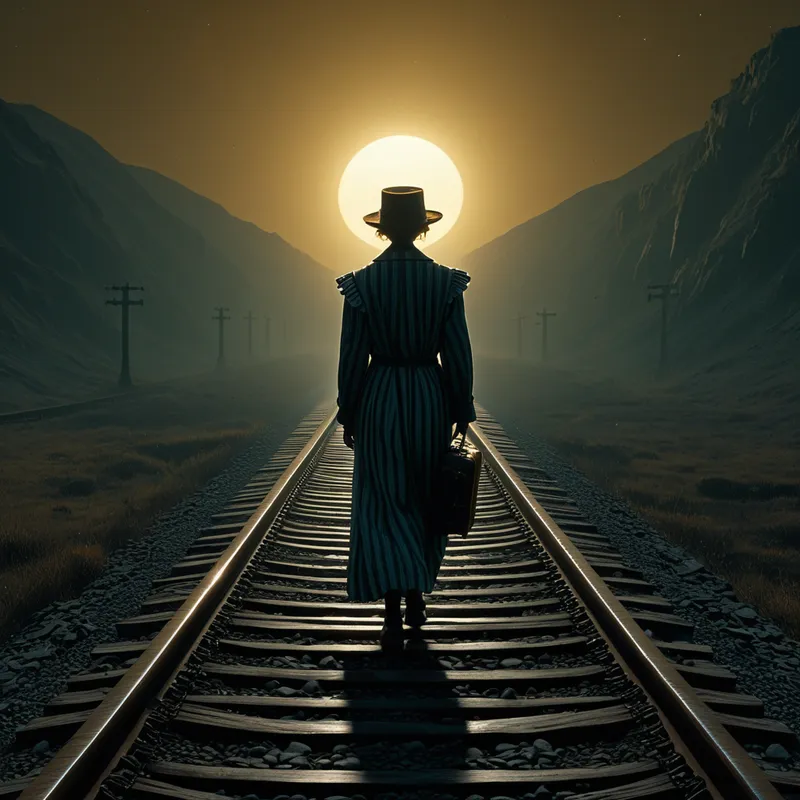
The Hobo’s journey is a stark model of psychic individuation. His starting point is the nigredo: the dark night of loss, economic or spiritual. He willingly enters the separatio, leaving behind the known world (family, stability, identity).
His life on the rails is the long albedo—a bleaching by sun and wind, a purification through hardship and simplicity. In the jungle, he experiences coniunctio with other wanderers, finding a fleeting community in shared exile. The final stage is not a red king crowned in a castle, but the achievement of the peregrinus—the eternal wanderer.
The alchemical gold he seeks is not a destination, but the realization that the transformative power lies in the journey itself. The self is not a place to arrive at, but a path to walk.
For the modern individual, the Hobo myth teaches that individuation often requires a voluntary exile from the comforts of the persona. We must, at least internally, become a little feral, learn the cryptic symbols of our own unconscious, and dare to catch the freight train of a deeper calling, even if its destination is unknown. The triumph is the cultivation of an inner freedom so complete that one can belong anywhere and nowhere, carrying all that is essential tied simply to a stick, moving to the rhythm of one’s own soul along the iron road of fate.
Associated Symbols
Explore related symbols from the CaleaDream lexicon: