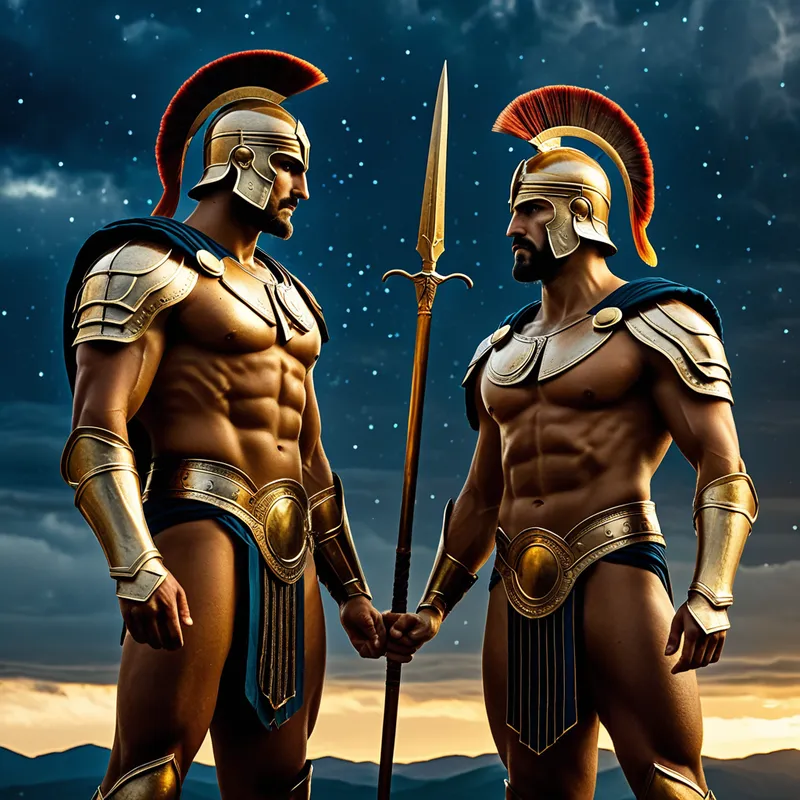
The Dream of Brotherhood: The Council of Selves
The Somatic Echo
Before the image of a brother forms, the body knows. It is a specific, hollow ache in the solar plexus, a gravity well of absence. Or it is a tightness across the shoulders, the weight of a shared burden carried alone. Sometimes, it’s a warmth in the chest, a phantom limb-sensation of a presence that should be standing shoulder-to-shoulder with you. This is the somatic echo of brotherhood—not a memory of a person, but a memory of a structure. It is the body’s intelligence reporting on the state of your internal architecture. It feels like a council chamber that is either empty, in uproar, or finally, blessedly, in session. The dream of brotherhood is the psyche’s urgent communiqué about the state of your inner family, the warring or neglected factions of self that require recognition, diplomacy, and ultimately, a treaty.
The Dreamer's Log
The dream is always the same: walking down an endless, polished corridor towards a door marked Council Chamber. My hand is on the cold handle. I know they are all waiting inside—the furious one, the weeping child, the cynical strategist, the naive optimist. I am terrified to open the door. I am terrified they will tear each other apart. I am terrified they will turn on me.
The dream is the psyche’s final summons to convene the warring councils of the self, where the first act of brotherhood is to simply show up and bear witness.

The False Lead
This theme is not about your literal sibling, your best friend, or your fraternity. To mistake the symbol for the person is to chase a ghost and miss the haunting. A dream of a lost brother is not a premonition of familial strife; it is a diagnostic of internal estrangement. A dream of a betraying brother is not a warning about your social circle; it is an alert from your shadow, a part of you that feels so alienated it has turned hostile. Brotherhood here is an internal dynamic, a structural principle. The grief you feel is for the exiled parts of yourself, not for a person you have lost. The conflict you witness is a civil war within your own sovereignty.
Psychological Architecture
The work of brotherhood is the most profound shadow work: the reclamation of your internal orphans. We are not born whole; we are born a potential. Life fractures us. The sensitive child learns to armor itself and becomes the stoic—they become estranged. The playful spirit is shamed into hiding and the relentless worker takes over—they become rivals. These splintered selves are your brothers. Some are heroes you rely on too heavily. Some are rebels you have locked in the basement. Some are orphans weeping in corners you refuse to visit. Individuation—the process of becoming an integrated individual—is not about killing these brothers or choosing a favorite. It is the agonizing, graceful process of inviting them all to the same table. It is hearing the rebel’s valid rage without letting him burn down the house. It is comforting the orphan’s grief without collapsing into his victimhood. It is acknowledging the ruler’s need for order without letting him become a tyrant. The architecture of the self is rebuilt not with the brick of suppression, but with the mortar of conscious relationship between these once-warring states.
Mythic Resonance
We see this eternal process in the myth of Osiris and Set. Osiris, the wise king, is the ruling consciousness—order, fertility, the known self. Set, his brother, is the shadow—chaos, the desert, the disruptive force. Set does not just kill Osiris; he dismembers him, scattering the pieces. This is the psyche in trauma, the conscious self shattered, its functions (the pieces) lost and buried. The journey of Isis to recover the pieces is the long work of gathering our exiled parts. The final reconstitution of Osiris, who becomes lord of the underworld, signifies the ultimate integration: the conscious self, having integrated its shadow brother, now rules the entire inner realm, both the light and the dark. The brother is not destroyed; he is metabolized, and the whole becomes sovereign over a greater domain.
Symbolic Nodes
- A Council Chamber or Meeting Room: The psyche’s boardroom for internal diplomacy.
- Twins or Doubles: The conscious self and its shadow, or two polarized aspects (logic/emotion).
- A Fractured Mirror: The self seen in broken, distinct fragments.
- An Empty Seat at a Table: An aspect of self that is being ignored or excluded.
- Shared Labor (Building, Rowing, Fighting Side-by-Side): The cooperative function of integrated parts.
- A Blood Oath or Handshake: The internal pact of recognition and mutual support.
Archetypal Resonance
The theme of internal brotherhood resonates most powerfully with The Ruler Archetype, specifically in its journey from Shadow to Sovereign. The Shadow Ruler is the tyrant—the single, dominant part of the self that seizes control, silencing the council of other brothers to enforce a brittle, fearful order. This creates the somatic echo of tightness and isolation. The alchemical potential lies in the Ruler’s true purpose: to bring order and harmony to the entire inner kingdom. The mature Ruler does not dominate; they convene. They listen to the grievances of the Orphan, the visions of the Magician, the warnings of the Rebel, and from this cacophony, they synthesize a true sovereignty—one that is inclusive, resilient, and born of earned loyalty from all facets of the self.
The Alchemical Process
The alchemical fire for this theme is conscious confrontation. The pressure is the unbearable tension of holding contradictory selves within one body—the fierce ambition and the longing for rest, the boundless love and the protective cynicism. The transmutation begins not with fusion, but with differentiation. You must, in the heat of your own awareness, learn to distinguish the voices. This is the grief of the orphan speaking. This is the strategy of the survivor. This is the idealism of the innocent. The prima materia is the raw, undifferentiated pain of inner conflict. The heat is applied by steadfastly refusing to identify with any single voice as the "true you," and instead, holding the space as the witness, the container for the entire council. The gold that emerges is inner diplomacy—the ability to let these brothers negotiate, to let the caregiver comfort the orphan so the hero can stand down, to let the sage advise the lover so passion gains wisdom. The self becomes less a battlefield and more a sovereign state with a functioning government.

The Integration Protocol
Question 1: When you feel that hollow ache or shoulder-tightness of "brotherhood," which part of you feels absent? Is it your courage, your compassion, or your capacity for joy? Name the exile.
Question 2: In your internal conflicts, which two "brothers" are most often at war? (e.g., The Responsible Provider vs. The Free Spirit). What is the core need that each is desperately, clumsily trying to meet?
Question 3: If your inner council were to hold a summit, what would be the first item on the agenda? What fractured part requires the most urgent recognition and airtime?
Action 1 (Somatic Council): When you feel internal conflict, place a hand on the somatic echo—the tight chest, the knotted stomach. Breathe into that space. With each inhale, mentally say "I see you." With each exhale, say "You have a seat here." This grounds the conflict in the body and begins the process of hosting.
Action 2 (Unstructured Portrait): Take a large piece of paper. Without planning, using any medium (crayon, paint, charcoal), let your hand draw the "council." Don't draw people. Draw shapes, colors, textures, lines that represent the different feeling-states or voices within you. Let them interact on the page. This externalizes the internal family system visually.
Action 3 (Ritual of Recognition): Find three small stones or objects. Name them for three of your inner brothers (e.g., the Warrior, the Poet, the Child). Arrange them in a small circle. Light a candle in the center. Speak one sentence of acknowledgment to each, aloud: "Warrior, I acknowledge your need to protect us." "Poet, I acknowledge your need for beauty." This simple ritual formalizes the internal treaty.
Final Validation
To dream of brotherhood is to feel the profound loneliness of a king in an empty palace, or the chaos of a ruler whose subjects are in revolt. This is difficult, sacred work. It asks you to make peace with the enemies within your own borders, to extend compassion to the very parts of yourself you were taught to disown. But remember: the chaos of the council is a sign of life, of multiple potentials seeking expression. Your sovereignty is not found in the silence of suppression, but in the complex, humming harmony of a realm where every citizen—every brother of the self—is heard, valued, and integrated into the greater purpose of your becoming. The dream is your invitation to stop being a battlefield and become, instead, the sovereign.