The Hobbit-hole Myth Meaning & Symbolism
A tale of a cozy sanctuary that becomes a threshold to the unknown, challenging the soul to move from comfort into the depths of the world.
The Tale of The Hobbit-hole
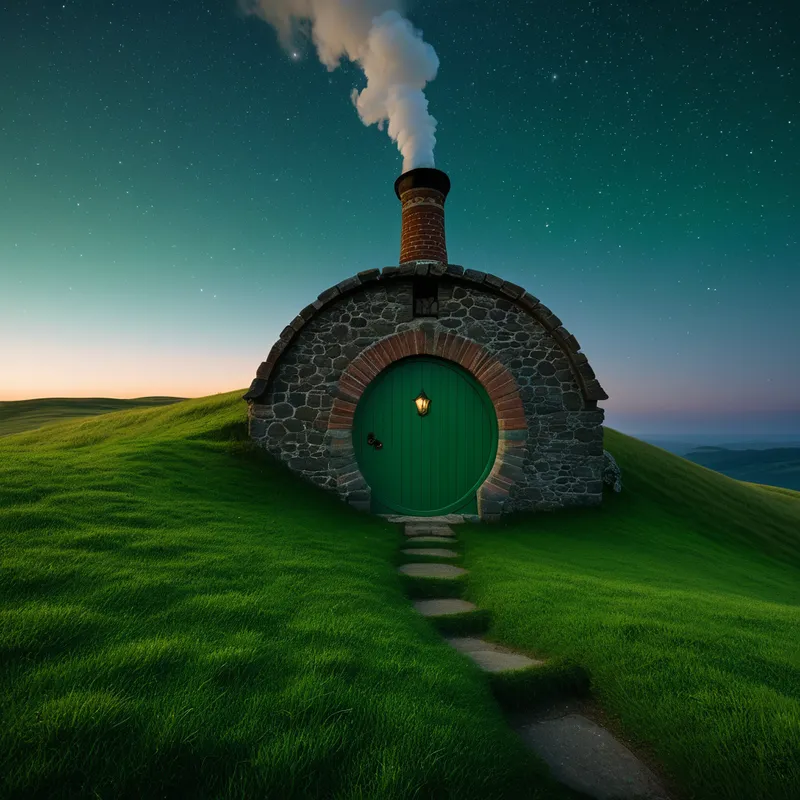
Listen, and I will tell you of a hole in the ground. But not a dank, dark hole, fit for worms and wet stones. This was a Hobbit-hole, and that means comfort.
It had a round, green door, bright as a summer leaf, with a polished brass knob set precisely in the middle. Inside, the air was warm with the scent of baking bread, pipe-weed, and old wood. Floors were tiled and carpeted, walls were paneled, and every room was a perfect circle, for the folk of this tale loved round things. The larders were stocked, the hearths were merry, and the windows looked out on a garden of order and peace. Here dwelt a being of comfort, a soul whose world was measured in meals, in the quiet turning of seasons in his garden, and in the undisturbed dust on a map of distant mountains.
But the heart of [the world](/myths/the-world “Myth from Tarot culture.”/) beats a deeper rhythm, and even the most fortified sanctuary cannot silence it forever. It came not with a storm, but with a knock. A figure stood at the round door—not a neighbor from down the lane, but a being shaped by wind and stone, with a beard like roots and eyes that held the memory of deep places. He was a Wizard, and with him came a song. It was not a song of [the hearth](/myths/the-hearth “Myth from Norse culture.”/), but of misty mountains, of forgotten gold, and of a dragon’s fire that sleeps atop it all.
The song seeped through the wood of the door, through the very walls of the hole. It stirred something that had lain dormant beneath the comfort: a thin, forgotten thread of longing, a whisper of Tookishness. The cozy rooms suddenly felt, for a fleeting moment, like a beautifully furnished cage. [The horizon](/myths/the-horizon “Myth from Various culture.”/) beyond the garden gate, once a tidy border, now seemed a lid.
Conflict raged not on a battlefield, but over tea and seed-cake. The soul of the hole, our comfort-loving being, was torn in two. One voice, loud and sensible, listed the dangers: dragons, deserts, hunger, cold. The other, a mere whisper from a deep pocket, spoke of leaves, of pine-cones, of walking-sticks and road. The rising action was not a charge, but a dreadful, hesitant packing of a handkerchief. It was the signing of a contract. It was the last, lingering look at the round door from the wrong side, as it clicked shut.
The resolution was the first step. Not a heroic leap, but a shuffling, miserable step onto a road that wound away from hill, from garden, from the certainty of supper. The Hobbit-hole dwindled behind, a warm, yellow dot in the gathering dusk. The soul had chosen, not the adventure, but the leaving. The myth begins not with a dragon, but with a closed door at one’s back, and the vast, sighing world ahead.
Cultural Origins & Context
This tale finds its roots not in the grand courts of kings or the temples of gods, but in the oral traditions of hearth and hill. It is a Folk Tradition of a particular kind: the warning and invitation story told by settled, agricultural peoples. It was shared on long winter nights, not by professional bards, but by grandparents and wandering storytellers at harvest fairs.
Its primary societal function was twofold. For the young, it was a warning against the perils of reckless wandering, a validation of the safety and virtue of home. Yet, simultaneously, it was an invitation—a secret passed to the restless spirit. It acknowledged that the call of the unknown was a real, powerful force, and that to answer it was not necessarily a betrayal of home, but a fulfillment of a deeper, often hidden, part of [the self](/myths/the-self “Myth from Jungian culture.”/). The story validated both states: the profound goodness of the sanctuary, and the terrifying necessity of leaving it. It was a cultural container for the anxiety and excitement of change, from the micro-level of a youth leaving the family farm to the macro-level of a community’s encounter with outsiders and new ideas.
Symbolic Architecture
Psychologically, the [Hobbit](/symbols/hobbit “Symbol: Hobbits symbolize a connection to home, simplicity, and a life of contentment, often within a fantastical world.”/)-hole is the [persona](/symbols/persona “Symbol: The social mask or outward identity one presents to the world, often concealing the true self.”/) and the [womb](/symbols/womb “Symbol: A symbol of origin, potential, and profound transformation, representing the beginning of life’s journey and the unconscious source of creation.”/) combined. It is the constructed self we present to the world: orderly, comfortable, in control. It is our routine, our defended [identity](/symbols/identity “Symbol: Identity represents the sense of self, encompassing personal beliefs, cultural background, and social roles.”/), our “[life](/symbols/life “Symbol: The symbol of ‘Life’ represents a journey of growth, interconnectedness, and existential meaning, encompassing both the joys and challenges that define human experience.”/) as it should be.” It represents [the ego](/myths/the-ego “Myth from Jungian culture.”/)’s [fortress](/symbols/fortress “Symbol: A fortress symbolizes security and protection, representing both physical and psychological safety from external threats.”/), a legitimate and necessary stage of development where the conscious [personality](/symbols/personality “Symbol: Personality in dreams often symbolizes the traits and characteristics of the dreamer, reflecting how they perceive themselves and how they believe they are perceived by others.”/) is formed and protected.
The Hobbit-hole is the soul’s perfectly crafted container, and its ultimate limitation.
The figure of the [Wizard](/symbols/wizard “Symbol: A wizard symbolizes wisdom, knowledge, and mastery over the mystical or unknown forces in life.”/) symbolizes the archetypal catalyst, the [psychopomp](/myths/psychopomp “Myth from Greek culture.”/) or guide of souls. He is the agent of the Self, the greater totality of the [psyche](/myths/psyche “Myth from Greek culture.”/), who arrives to disrupt the ego’s comfortable stagnation. His song is the call of the unlived life, the voice of the [shadow](/symbols/shadow “Symbol: The ‘shadow’ embodies the unconscious, repressed aspects of the self and often represents fears or hidden emotions.”/) and the Self combined. The [dragon](/symbols/dragon “Symbol: Dragons are potent symbols of power, wisdom, and transformation, often embodying the duality of creation and destruction.”/) in the song represents the dormant, fearsome power of the unconscious—both creative and destructive—that guards the [treasure](/symbols/treasure “Symbol: A hidden or valuable object representing spiritual wealth, inner potential, or divine reward.”/) of wholeness.
The act of leaving is not a [rejection](/symbols/rejection “Symbol: The experience of being refused, excluded, or dismissed by others, often representing fears of inadequacy or social belonging.”/) of home, but the [birth](/symbols/birth “Symbol: Birth symbolizes new beginnings, transformation, and the potential for growth and development.”/) of the individual from the personal. It is the ego’s reluctant [agreement](/symbols/agreement “Symbol: A harmonious arrangement in artistic collaboration, symbolizing unity, shared vision, and creative consensus.”/) to serve a master larger than comfort: the [journey](/symbols/journey “Symbol: A journey in dreams typically signifies adventure, growth, or a significant life transition.”/) toward completeness.
The Dreamer’s Resonance
When this mythic pattern stirs in modern dreams, it often manifests as dreams of houses. You may dream of discovering a new, cozy room in your own home—a symbol of an undiscovered aspect of your personality seeking integration. More potently, you may dream of your house being invaded, of doors that won’t lock, or of hearing a compelling sound or song from outside that draws you to a window.
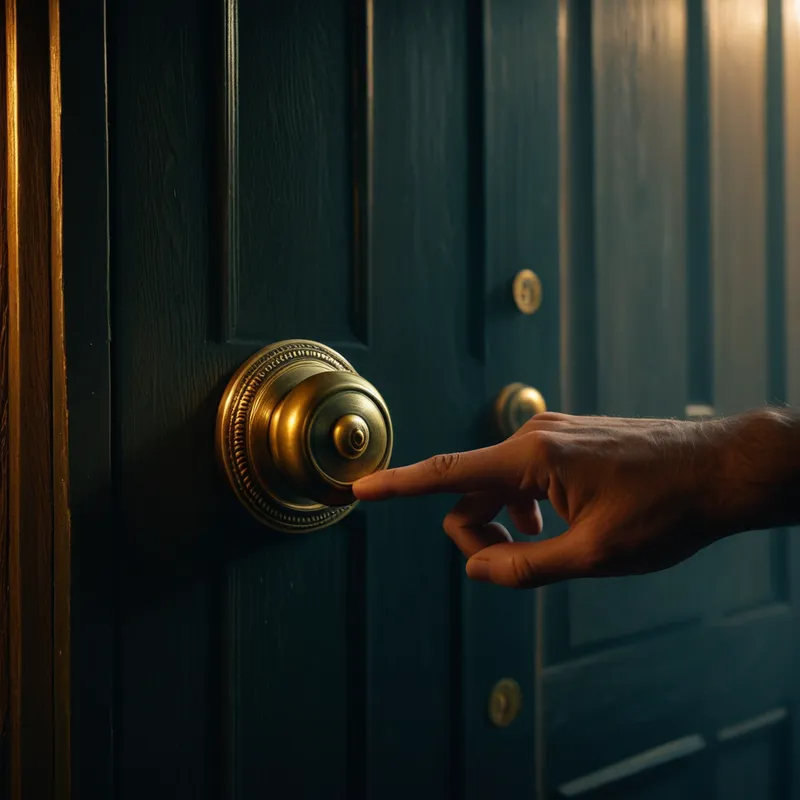
Somatically, this process can feel like a deep, restless itching under the skin of your life. It’s a sense of claustrophobia within your own routines, a feeling that the walls of your career, relationships, or identity are pressing in, no matter how well-furnished they are. Psychologically, it is the onset of what Jung called the “night sea journey,” where the conscious attitude is overwhelmed by contents from the unconscious. The dreamer is in the tense, pregnant pause between the Wizard’s knock and the turning of the doorknob. The psyche is preparing for a descent, a necessary de-structuring of the comfortable ego to make room for something broader and more authentic.
Alchemical Translation
The alchemical process mirrored here is [solutio](/myths/solutio “Myth from Alchemical culture.”/)—the dissolution of the solid into the fluid. The Hobbit-hole is the [prima materia](/myths/prima-materia “Myth from Alchemical culture.”/), the leaden, fixed state of the personality, content in its earthly form. The Wizard’s call is the introducing of the aqua permanens, the divine [water](/myths/water “Myth from Chinese culture.”/) that dissolves and softens.
The journey out the door is the beginning of the [nigredo](/myths/nigredo “Myth from Alchemical culture.”/), the blackening. It is the death of the old, insular identity. The comfort of the hole is not evil; it is the necessary stage that must be outgrown. The treasure guarded by [the dragon](/myths/the-dragon “Myth from Chinese culture.”/) is not material wealth, but the [lapis philosophorum](/myths/lapis-philosophorum “Myth from Alchemical culture.”/), the philosopher’s stone of integrated selfhood. To gain it, one must first lose the certainty of home.
Individuation does not begin with a quest for glory, but with the humble, terrifying acceptance of homelessness.
For the modern individual, the alchemical translation is this: Your “Hobbit-hole” is any state of psychic equilibrium that has become a prison of repetition. The “Wizard’s knock” is the symptom—the depression, anxiety, sudden obsession, or life crisis that shatters your peace. The myth models that the cure is not to repair the hole more stoutly, but to see the disruption as a sacred call. The [triumph](/myths/triumph “Myth from Roman culture.”/) is not in slaying the dragon, but in having the courage to step onto the road at all, to allow the solid, known earth of your former self to become the uncertain, winding path of your becoming. The true transmutation is from a soul defined by its sanctuary to a soul defined by its seeking.
Associated Symbols
Explore related symbols from the CaleaDream lexicon: