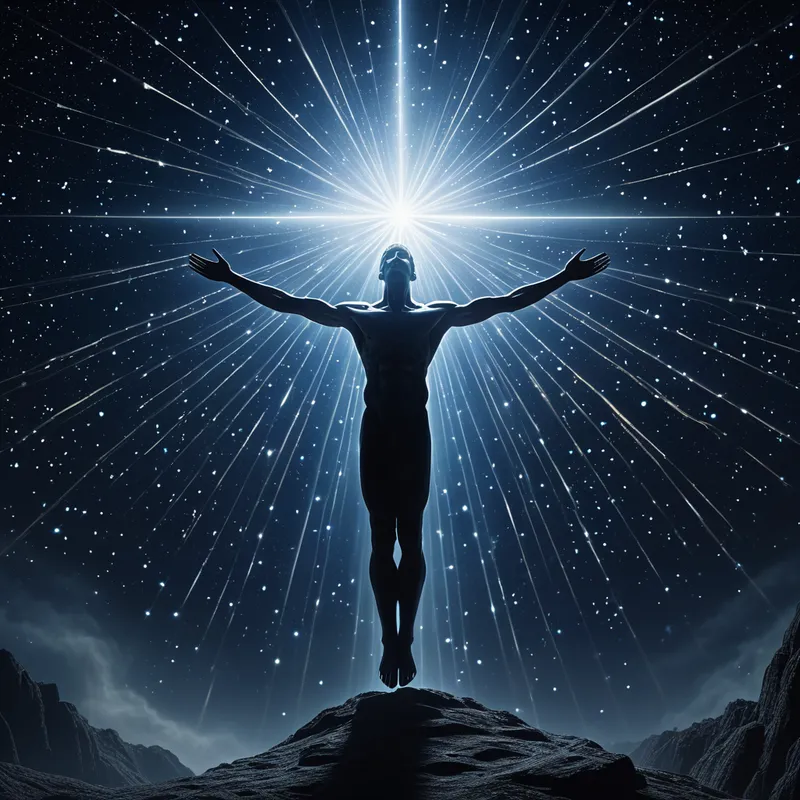
The Hill of Golgotha in Christ Myth Meaning & Symbolism
A cosmic story of the divine essence descending into the heart of mortality, suffering a world's weight, and rising as the foundation of a new creation.
The Tale of The Hill of Golgotha in Christ
Listen. Before time was counted, in the silent heart of eternity, a Word was spoken. It was a Word of such pure love that it took form, weaving itself from star-stuff and the breath of the void. This was the Logos, the beloved child of the Source, who walked into the dreaming clay of creation.
The world was a beautiful, broken mirror. In its fragments, beings forgot their origin, weaving cages of fear, towers of pride, and chains of hatred. The echo of the original Word grew faint, drowned by the cacophony of separation. Seeing the world lost in its own shadow, the Logos made a choice deeper than the abyss. It would descend not as a conqueror on a chariot of fire, but as the most fragile note in the symphony—a human life, threaded with hunger, joy, sorrow, and the chill of mortality.
He walked among the fragments, speaking in parables that were keys to forgotten doors. He touched the untouchable, loved the unlovable, and named the divine spark in the eyes of the outcast. This light was too bright for the rulers of the cages. The mechanisms of the world—the cold law without mercy, the political expediency, the betrayal of friends—clanked into motion against him. He was accused, stripped, and beaten. The crowd, that fickle embodiment of the world’s unconscious fear, chose the release of a thief over the liberation he offered.
And so they led him to a place. A skull-shaped hill outside the city walls, a mound of execution and finality. Its name was Golgotha. The air was thick with the taste of iron, dust, and despair. They nailed his hands and feet to the rough-hewn timber of a cross and raised it against the bruised sky. There, at the nexus of cruelty and abandonment, the Word made flesh hung suspended between heaven and earth.
For three hours, a darkness fell that was not of night. It was the darkness of the world’s accumulated sin, the weight of every broken promise, every act of violence, every lonely tear. He drank the cup of this darkness to its dregs. A final cry tore from his lips—a cry of utter dereliction that echoed the soul’s deepest terror of being forsaken by the Source itself. Then, he bowed his head, and released his spirit.
At that moment, the earth itself shuddered. The temple veil, which separated the holy from the human, was torn from top to bottom. The hill of the skull cracked open. And in the silent tomb where his body was laid, wrapped in linens and spices, a mystery deeper than death began to stir. On the third day, at the first hint of dawn, the stone was rolled away. The tomb was empty. The one who had been executed was encountered alive, bearing the wounds of his passion, yet radiant with a life that death could not contain. He had passed through the ultimate negation and returned, making the hill of death the birthplace of everlasting life.
Cultural Origins & Context
This narrative, while most meticulously chronicled in the Christian Gospels of the 1st century Mediterranean, transcends its specific historical vessel to achieve a “Global/Universal” resonance. It is the culmination of a deep archetypal pattern found in fragments across cultures: the dying and rising god, the scapegoat, the king sacrificed for the fertility of the land. From the Osiris of Egypt to the Attis of Anatolia, the psyche has long wrestled with the necessity of sacrifice for renewal.
In its Christian context, it was passed down orally by communities of believers for whom this event was not merely history but present, transformative power. It was told at clandestine gatherings, etched in catacombs, and later proclaimed from pulpits. Its societal function was dual: it provided a foundational cosmogony for a new community (explaining the problem of evil and its solution), and it offered a profound template for personal identity—one could now define oneself in relation to this act of sacrificial love. It became the central axis around which a civilization’s calendar, art, ethics, and very conception of hope would revolve for millennia.
Symbolic Architecture
The myth is a dense symbolic architecture mapping the journey of consciousness itself. The Logos represents the transcendent principle of order, meaning, and unifying love. Its incarnation is the descent of this principle into the chaotic, fragmented, and suffering realm of matter and human experience—the ultimate act of empathy.
The Hill of Golgotha is not a geographical location, but the psychic pinnacle where the conscious self fully encounters the weight of the world’s shadow, and its own complicity within it.
The cross is the ultimate symbol of the conjunctio oppositorum—the intersection of the vertical (divine aspiration) and the horizontal (earthly, temporal existence). The crucifixion is the moment these opposites are held in unbearable tension. The cry of dereliction—“My God, my God, why have you forsaken me?”—is the experiential death of the ego’s perception of God, a necessary dark night of the soul where all previous spiritual understanding proves inadequate.
The resurrection is not a mere resuscitation, but the birth of a new ontological reality. It symbolizes the emergence of the Self from the crucible of ego-death. The wounds remain, not as marks of failure, but as sacred apertures—proof that transformation incorporates suffering rather than erasing it.
The Dreamer’s Resonance
When this myth activates in the modern dreamer’s psyche, it signals a profound initiation into a process of shadow-work and ego dissolution. To dream of climbing a steep, barren hill under a heavy burden is to feel the weight of one’s life responsibilities, repressed guilt, or inherited trauma converging into a single, inescapable point of crisis.
Dreams of being crucified or pinned represent the ego’s feeling of being trapped by circumstances, judged by others, or sacrificed for a cause. It is a somatic experience of ultimate exposure and powerlessness. The dreamer may feel the nails as specific fears, obligations, or relationships that immobilize them. The accompanying darkness signifies a depression or a loss of meaning so total it feels cosmological.
Conversely, dreaming of a radiant figure on a hill, or of a tomb cracking open to reveal light, indicates the nascent emergence of the Self from this crisis. It is the psyche’s assurance that the process of “dying” to an old, outworn identity is not an end, but the painful prelude to a more authentic form of being. The dream body may feel a release, a lightness, or a profound, quiet joy upon waking.
Alchemical Translation
Psychologically, the myth is a perfect map of the individuation process. The alchemical stages are vividly present: the descent (incarnatio) into the leaden reality of the human condition, the mortificatio (crucifixion) where the old, rigid structures of the personality and its naïve god-image are broken down, and the sublimatio (resurrection) where a new, more conscious and resilient spirit is born from the ashes.
The ultimate alchemical secret is that the Philosopher’s Stone—the perfected Self—is forged not in avoidance of suffering, but in its conscious, willing crucifixion within the vessel of the soul.
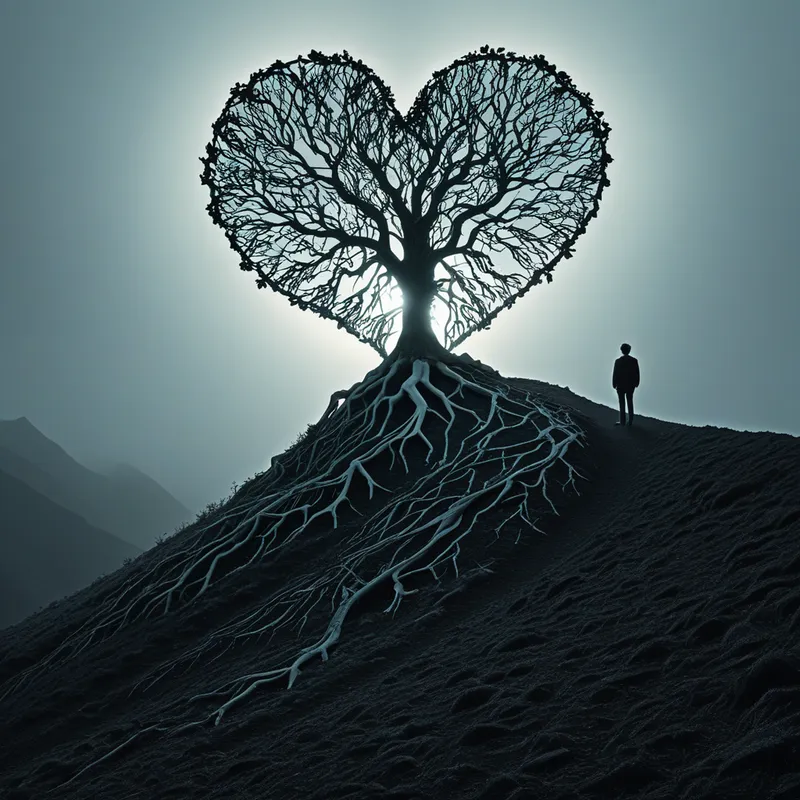
For the modern individual, this translates to the courage to fully inhabit one’s life, with all its contradictions and pain, without spiritual bypass. It is the process of “carrying one’s cross”—not with masochistic resignation, but with the understanding that one’s specific suffering contains the seed of one’s unique transformation. The “hill” is the accumulated mass of our personal and ancestral history. The “crucifixion” is the moment we stop running from it and allow it to dismantle us. The “resurrection” is the unexpected, often quiet, reorganization of the personality around a center (the Self) that has witnessed its own death and is therefore no longer afraid.
The myth teaches that redemption is not deliverance from matter and suffering, but redemption of matter and suffering. By descending fully into the “skull-place” of our mortality and brokenness, we crack it open from within, and find it was, all along, the fertile ground from which a liberated and compassionate consciousness can finally grow.
Associated Symbols
Explore related symbols from the CaleaDream lexicon: