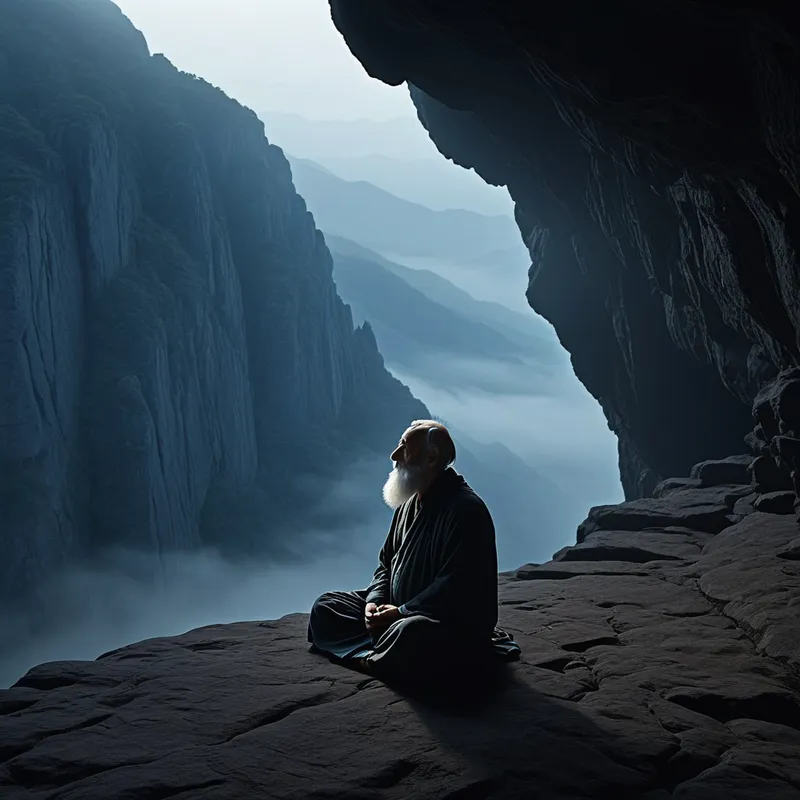
The Hermit's Cave Myth Meaning & Symbolism
A universal tale of retreat into solitude, where a seeker enters a sacred cave to confront the self and emerge with transformative wisdom.
The Tale of The Hermit’s Cave
Listen. [The world](/myths/the-world “Myth from Tarot culture.”/) is a cacophony of doing. The marketplace shouts, the fields demand, [the hearth](/myths/the-hearth “Myth from Norse culture.”/)-fire crackles with expectation. But beneath it all, in the deep, silent heart of the mountain, there is another call. It is not a sound, but a pull, a hollowing in the soul.
So it was for the one who became [the hermit](/myths/the-hermit “Myth from Tarot culture.”/). He was not always so. Once, he was of the village, bound by name and duty. Yet, a restlessness grew in him, a sense of carrying a vessel that was never filled by the wine of ordinary life. His eyes began to see the world as a veil, shimmering and thin, and behind it, he sensed a vast, patient darkness calling. It was the call of the mountain, of the Cave.
He left at the turning of the season, when the last harvest was gathered and [the earth](/myths/the-earth “Myth from Hindu culture.”/) prepared for sleep. He took no staff, only a bowl for [water](/myths/water “Myth from Chinese culture.”/). The villagers watched him go, some with pity, some with scorn, a few with a flicker of forbidden envy. The path was not a path. It was a scramble over sharp stone, a fight through grasping thorns, a climb into thinning air where eagles circled and [the wind](/myths/the-wind “Myth from Various culture.”/) spoke in tongues.
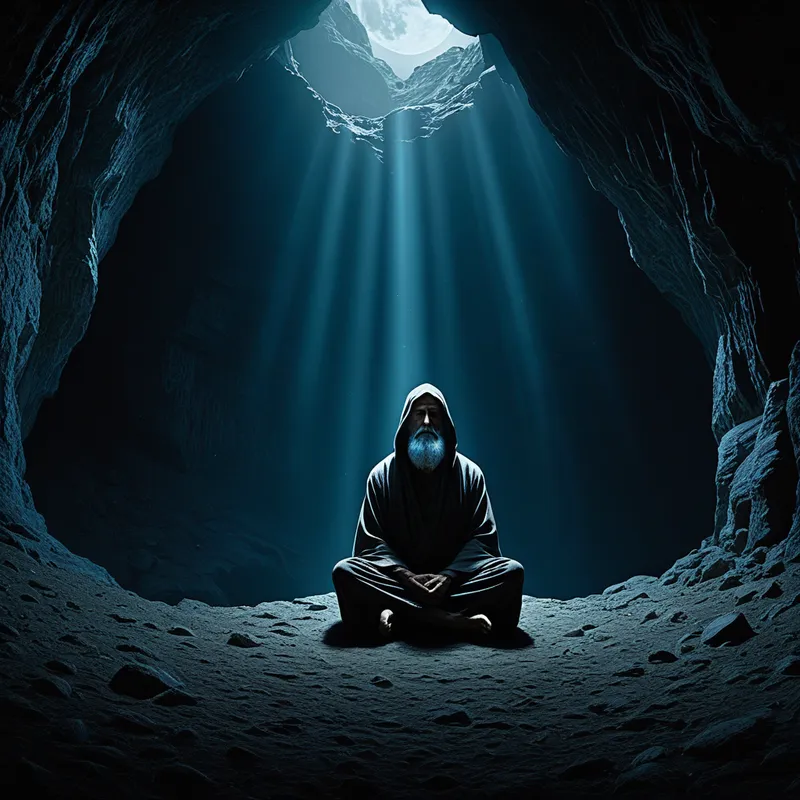
For days he climbed, until his hands were raw and his breath came in clouds. Then, he found it: not a grand arch, but a dark mouth in the cliffside, exhaling a breath of ancient, damp stone. The entrance was a threshold between worlds. Outside, the sun; inside, a darkness so complete it felt like a substance. He crossed it. The light of the world vanished, swallowed whole.
Inside, the silence was not an absence, but a presence. It pressed on his ears. He felt his way forward, the rock cold and wet beneath his palms. He found a chamber where a trickle of water fell from the ceiling into a small, black pool. Here, he sat. Time unraveled. The first enemy was not a monster, but his own mind—a chattering, fearful [thing](/myths/thing “Myth from Norse culture.”/) that replayed his life in the village, his regrets, his fears of madness and death. Phantoms of memory danced in the dark. He faced them, one by one, until their power faded into the stillness.
Then came the true darkness, the Dark Night of the Soul. In this void, he was nothing—no name, no past, no future. He was a question mark etched in stone. He hungered. He thirsted. He doubted the very call that brought him. In the absolute black, he was forced to meet the raw, unadorned essence of his own being, stripped of all its stories.
And in that meeting, in the core of the despair, a shift occurred. It was not a vision of light, but a deepening into the dark until it ceased to be an enemy and became a womb. The silence began to hum with a subtle frequency. The dripping water became a mantra. His own heartbeat was [the drum](/myths/the-drum “Myth from West African / Diasporic culture.”/) of the earth. He did not find an answer; he became a space where understanding could grow, like a crystal in the deep rock. When he finally rose, his body stiff as old wood, and turned back toward [the cave](/myths/the-cave “Myth from Platonic culture.”/)’s mouth, he did not carry a scroll of secret laws. He carried a new quality of silence within him, a calm, deep-seeing awareness. He emerged, not as a prophet with thunderous pronouncements, but as one who had been utterly remade in the quiet dark. The world looked the same, but he saw it with entirely new eyes.
Cultural Origins & Context
The myth of the hermit’s retreat is a global story, appearing not from a single “Various” culture, but as a psychic pattern emerging independently across continents and epochs. It is the bedrock narrative of ascetic traditions: the Sannyasis of India seeking liberation in forest caves, the Christian Desert Fathers of Egypt wrestling with demons in their cells, the Daoist immortals cultivating Qi in mountain grottoes, and the solitary shamans of Siberia and the Americas undertaking vision quests in remote pits or caverns.
This story was never just a biography of a saint; it was a societal organ. It was told around fires and in temples to explain the existence of the wise elder on the edge of town, the one who had gone beyond. The hermit’s journey served a critical function: it carved out a sacred space for the interior life in a world dominated by exterior survival. It validated the radical, often unsettling, pursuit of wisdom over wealth, of essence over appearance. The hermit was the culture’s embodied question mark, its living proof that there was more to human existence than the cyclical dramas of the community. His return, or the tales of his uncanny peace, acted as a psychic anchor, reminding the collective of a deeper, more enduring reality.
Symbolic Architecture
The cave is the central, multivalent [symbol](/symbols/symbol “Symbol: A symbol can represent an idea, concept, or belief, serving as a powerful tool for communication and understanding.”/). It is the unconscious itself—the dark, fertile, and often frightening [interior](/symbols/interior “Symbol: The interior symbolizes one’s inner self, thoughts, and emotions, often reflecting personal growth, vulnerabilities, and secrets.”/) world. To enter it is to turn away from the [persona](/symbols/persona “Symbol: The social mask or outward identity one presents to the world, often concealing the true self.”/), [the mask](/myths/the-mask “Myth from Various culture.”/) worn in the “marketplace” of society, and descend into the bedrock of [the self](/myths/the-self “Myth from Jungian culture.”/).
The cave is not a place of escape, but of encounter. One does not hide from the world there; one is devoured by the Self to be reborn.
The hermit is the archetypal Sage, but in his [journey](/symbols/journey “Symbol: A journey in dreams typically signifies adventure, growth, or a significant life transition.”/), he first embodies the Explorer. His climb is the arduous [path](/symbols/path “Symbol: The ‘path’ symbolizes a journey, choices, and the direction one’s life is taking, often representing individual growth and exploration.”/) of [differentiation](/symbols/differentiation “Symbol: The process of distinguishing or separating parts of the self, emotions, or identity from a whole, often marking a developmental or psychological milestone.”/), leaving the collective values behind. The darkness and silence are not punishments, but the necessary conditions for introversion. The phantoms he faces are his own complexes, his personal [history](/symbols/history “Symbol: History in dreams often represents the dreamer’s past experiences, lessons learned, or unresolved issues that continue to influence their present.”/), and the collective fears projected onto solitude. The pivotal [moment](/symbols/moment “Symbol: The symbol of a ‘moment’ embodies the significance of transient experiences that encapsulate emotional depth or pivotal transformations in life.”/)—the “dark [night](/symbols/night “Symbol: Night often symbolizes the unconscious, mystery, and the unknown, representing the realm of dreams and intuition.”/)“—symbolizes [the ego](/myths/the-ego “Myth from Jungian culture.”/)’s [dissolution](/symbols/dissolution “Symbol: The process of breaking down, dispersing, or losing form, often representing transformation, release, or the end of a state of being.”/), its surrender to a larger psychic process. The wisdom he gains is not intellectual [knowledge](/symbols/knowledge “Symbol: Knowledge symbolizes learning, understanding, and wisdom, embodying the acquisition of information and enlightenment.”/), but a transformed state of [consciousness](/symbols/consciousness “Symbol: Consciousness represents the state of awareness and perception, encompassing thoughts, feelings, and experiences.”/), often symbolized by the [inner light](/symbols/inner-light “Symbol: A spiritual symbol representing divine presence, consciousness, enlightenment, or the soul’s essence, often associated with awakening and inner wisdom.”/) or [peace](/symbols/peace “Symbol: Peace represents a state of tranquility and harmony, both internally and externally, often reflecting a desire for resolution and serenity in one’s life.”/) that arises from having fully inhabited the dark.
The Dreamer’s Resonance
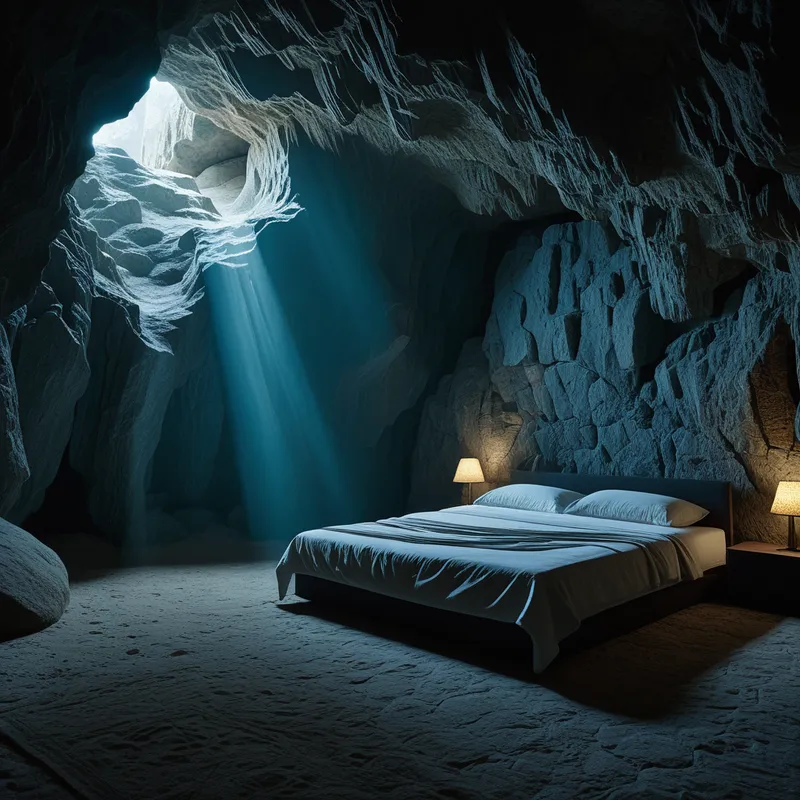
When this myth stirs in the modern [psyche](/myths/psyche “Myth from Greek culture.”/), it often manifests in dreams of secluded, interior spaces: a forgotten room in one’s own house, a basement that descends endlessly, a cozy but isolated cabin in the woods, or, directly, a cave. These are not dreams of adventure, but of profound, sometimes anxious, introspection.
The somatic feeling is one of compression and quiet. The dreamer may feel a pressing need to be alone, a sense of being “full to bursting” with the noise of daily life. This dream pattern signals a critical psychological process: the psyche’s demand for a withdrawal of projections. The energy that has been poured into outer relationships, work, and distractions is being recalled. It is a time of necessary loneliness, where the ego must cease its constant dialogue with the world and begin a dialogue with the soul. The anxiety present is the fear of what one might find—or not find—in that silence. It is the call to a hermitage of the spirit, often preceding a major life transition or a period of deep creative incubation.
Alchemical Translation
In the alchemy of the soul, the hermit’s cave represents the [Nigredo](/myths/nigredo “Myth from Alchemical culture.”/) stage. It is the deliberate descent into the massa confusa, the chaotic, dark matter of the unexamined self. The hero’s journey is often one of conquest, but the hermit’s is one of coniunctio with [the shadow](/myths/the-shadow “Myth from Jungian culture.”/).
The triumph here is not over a dragon, but over the need for constant stimulation and external validation. The gold forged is not a trophy, but a steadfast inner witness.
For the modern individual, this myth models the non-negotiable requirement of solitude for individuation. We cannot become who we are meant to be solely in the reflection of others’ eyes. The “cave” may be literal solitude, a silent meditation retreat, a long solo walk, or simply the disciplined, daily practice of turning off all devices and sitting with oneself. The process is one of psychic distillation. In the dark quiet, the contaminants of others’ expectations, societal pressures, and compulsive behaviors slowly settle. What remains, clarified, is the individual’s unique essence—their own inner voice and authority. One emerges not necessarily with a new plan, but with a renewed capacity to see and to choose from a place of inner alignment, having made peace with the fertile darkness within.
Associated Symbols
Explore related symbols from the CaleaDream lexicon: