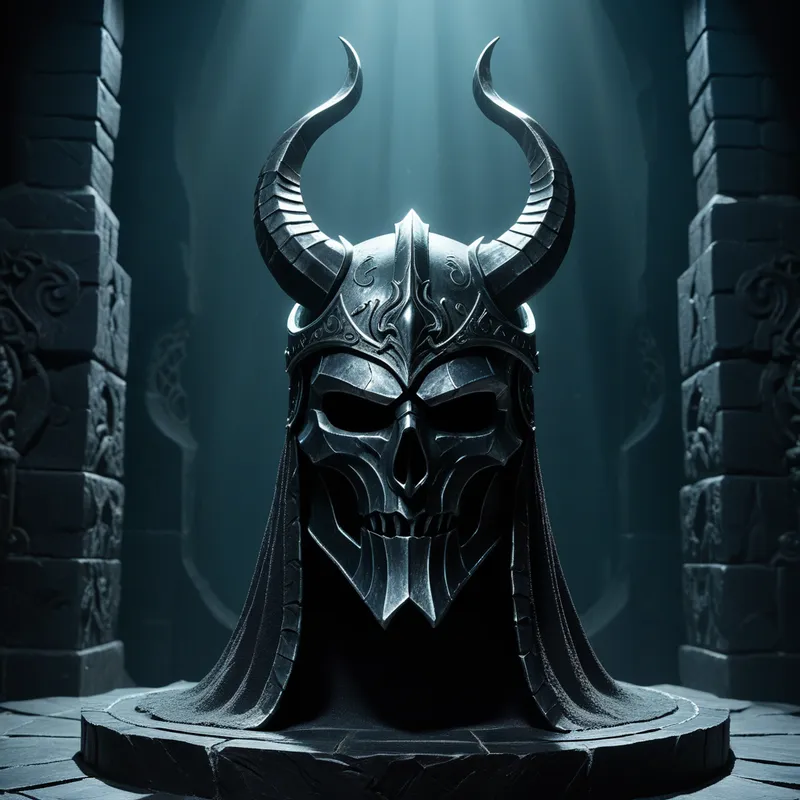
The Helm of Hades (Cap of Invi Myth Meaning & Symbolism
A divine artifact of shadow and unseen power, granting invisibility to gods and heroes, symbolizing the profound act of withdrawing to see the unseen.
The Tale of The Helm of Hades (Cap of Invi
Listen, and hear the tale of the shadow-helm, the gift of the unseen king. In the age when gods walked with heroes and monsters haunted the world’s edge, there existed a power not of light, but of its absence. Not in the sun-drenched halls of Zeus was it forged, nor in the fiery heart of Hephaestus. It was born of the deep, silent places, a child of the primordial dark that existed before the first dawn.
Its keeper was Hades, lord of the Necromanteion, he who rules from a throne of ebony in a palace where no sun ever shines. His helm was not a weapon of war, but of essence—a cap, a helmet, wrought from the very substance of oblivion and the mist of the river Lethe. To don it was to step sideways from the world of forms, to become a whisper in a silent room, a chill where no wind blows. It rendered the wearer utterly, perfectly invisible, not just to mortal eyes, but to the gaze of gods and the senses of beasts.
The helm’s story intertwines with that of a hero born under a cursed star: Perseus, son of Zeus, cast to sea in a wooden chest. His quest, a death sentence from a tyrant king, was to bring back the head of the Gorgon Medusa. To face her was to face petrified death. No mortal could look upon her and live. Knowing this, the gods of guidance, Athena and the swift Hermes, came to him. They did not give him strength or courage outright, but tools of cunning and indirect power.
They sent him to the Stygian nymphs, who dwelt in a twilight grove at the world’s root. From them, he received the artifacts of his impossible task: winged sandals to fly, a sack to hold his terrible prize, and a sickle of adamantine sharpness. But the final, crucial gift came not from nymphs, but from the lord of the land they bordered. To enter the Gorgon’s lair, to move unseen past her serpent-haired sisters who never slept, he needed the ultimate concealment. Thus, Perseus descended to the threshold of the Underworld itself, or sought out its divine keepers. And there, by fate or divine decree, he was given the Cap of Invisibility.
Imagine the cavern of the Gorgons, a place of stone and echoing dread. The air is thick with the hiss of serpents and the slow drip of mineral tears. Perseus enters not as a warrior, but as a void. The helm settles upon his brow, and the world loses him. He becomes a breath of cold air, a pressure on the stone floor, a presence felt only by the primal unease of the monsters. Guided by the reflection in his polished shield—seeing without being seen—he navigates the petrified forest of Medusa’s victims. He moves silently, a shadow among statues, until he stands over the sleeping horror. In that moment of absolute withdrawal, of perfect unseen-ness, he strikes. The sickle flashes from emptiness, and the deed is done. The helm shields his escape as the awakened Gorgon sisters wail at the empty air, clutching at a ghost. He flees, a secret borne in a sack, invisible even to the wrath of gods.
Cultural Origins & Context
The myth of the Helm of Hades is a thread woven deeply into the fabric of ancient Greek epic poetry and drama. Its most famous appearance is in the Iliad, where the god of war, Ares, borrows the helm to escape a wound in battle, a testament to its power even among the Olympians. Its primary narrative home, however, is in the Perseus cycle, preserved through poets like Homer and later systematized by mythographers.
This was not a story told lightly. It belonged to the repertoire of bards and rhapsodes, performed in aristocratic halls and public festivals. Its function was multifaceted: it was an adventure tale of a foundational hero, a religious narrative acknowledging the power of the chthonic (underworld) gods often feared and placated, and a cultural lesson. It taught that not all challenges are met with direct force. The myth validated cunning (metis), divine favor earned through piety, and the strategic use of tools over brute strength. The helm, specifically, represented a profound truth acknowledged in that worldview: that power can reside in withdrawal, in secrecy, and in the ability to operate outside the perceived field of conflict, a concept as strategic in politics and warfare as it was in myth.
Symbolic Architecture
The Helm of Hades is no mere plot device. It is a profound symbol of the unseen potential within the psyche. It does not grant flight like the sandals, or cutting power like the sickle; it grants absence. This is its primary alchemy: to make the subject an object no longer, to remove the self from the field of projection and observation.
To become invisible is to step out of the collective gaze, to withdraw the persona and encounter the raw, unobserved self.
Psychologically, it represents the capacity for introspection—the vital, often terrifying journey into the personal shadow. When Perseus dons the helm to face Medusa, he is enacting the necessity of turning away from the direct, conscious confrontation with a paralyzing trauma (the petrifying gaze). He must instead approach it indirectly, through reflection (the shield) and from a place of hidden observation (the invisibility). The helm symbolizes the protected, sacred space of inner work where the most monstrous aspects of the self can be approached, not in public battle, but in private, focused integration.
It is also a symbol of sovereignty over one’s own visibility. In a social sense, the “cap of invisibility” is the ability to disengage from roles, expectations, and the performative self. It is the power to say “I am not available for your perception,” to conserve energy, and to act from a place of inner authority rather than reactive defense.

The Dreamer’s Resonance
When the symbol of the Helm of Hades appears in modern dreams, it signals a critical phase of psychic withdrawal and reorientation. The dreamer may not see a literal helmet, but experience the state it confers: being unseen in a crowd, speaking and not being heard, or observing a charged situation from a detached, hidden vantage point.
Somatically, this can feel like a profound numbness, a social dissociation, or a sense of being “ghosted” by the world. Psychologically, it is the psyche’s imperative to retreat. The ego is being asked, or forced, to step back from an overwhelming external demand, a toxic pattern, or a “Medusa” complex that threatens to paralyze growth. The dream is not necessarily pathological; it is often a restorative act of the unconscious. It creates a liminal space where the dreamer can process without being processed, see without being seen. It may arise during burnout, after trauma, or at the beginning of a deep introspective journey, marking the moment the conscious self enters the “cave” of the unconscious, cloaked in the necessary anonymity to do its work.

Alchemical Translation
The myth models the alchemical process of individuation, specifically the nigredo or blackening phase—the descent into darkness and dissolution of the old, rigid ego structure. Perseus’s journey is the individual’s journey toward wholeness.
The quest is assigned by the tyrannical king (the oppressive, one-sided conscious attitude or super-ego demands). The hero must retrieve the head of Medusa—integrate the terrifying, petrifying aspect of the unconscious (often rage, shame, or primal fear). To do this, he cannot face it head-on with his heroic persona; that leads to paralysis (stone). He must first acquire the Helm of Hades.
The first step in transmuting the inner monster is not to fight it, but to become invisible to its gaze—to suspend judgment, to withdraw identification, and to observe from a place of hidden neutrality.
This is the act of creating inner containment. The winged sandals represent the elevated perspective (insight) needed for the journey, the sickle is the discriminating function of the mind that can make the necessary “cut,” but the helm is the vessel itself. It is the therapeutic container, the meditative state, the journal page, the silent walk—the space where the observing self can separate from the reacting self.
By donning the helm (entering a state of reflective withdrawal) and using the shield (the mirror of self-reflection), the individual can approach the monstrous complex. The subsequent “decapitation” is not destruction, but a symbolic separation and integration; the Gorgon’s head, even severed, retains its power and is placed on Athena’s aegis, becoming a protective, apotropaic symbol. The once-paralyzing force is transformed into a shield. The modern individual completes this alchemy when they can withdraw from compulsive external reactions, observe their inner patterns without being consumed by them, and integrate that raw power into a conscious, protective wisdom. The Helm of Hades teaches that true power often begins with the courage to disappear.
Associated Symbols
Explore related symbols from the CaleaDream lexicon: