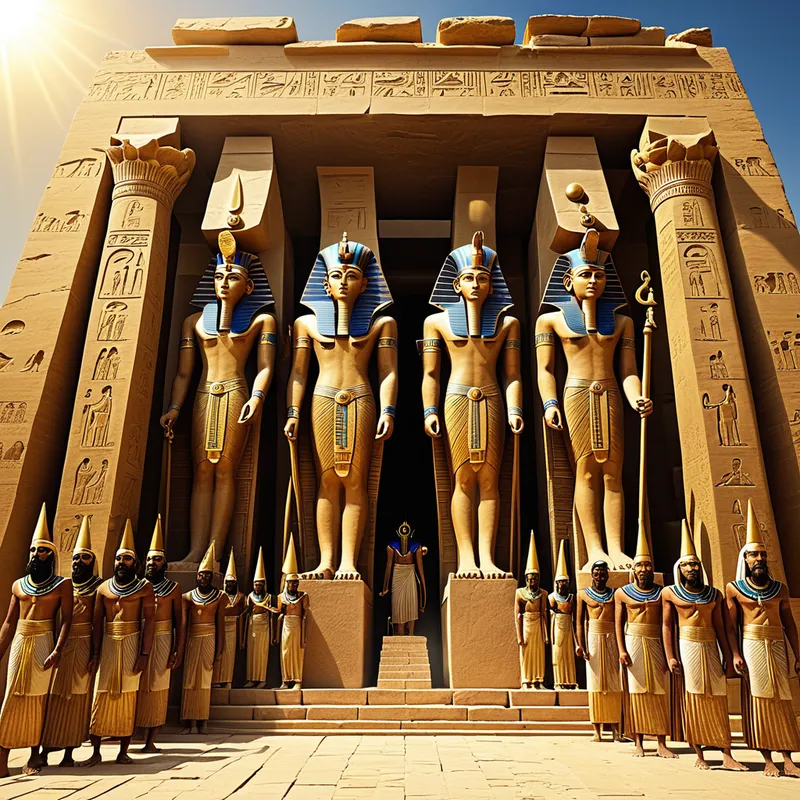
The Heliopolitan Ennead Myth Meaning & Symbolism
The primordial drama of the first nine gods, from the self-created Atum to the triumphant Horus, mapping the emergence of consciousness from the dark waters.
The Tale of The Heliopolitan Ennead
In the beginning, before the names of things, there was only Nun. A silent, boundless ocean of potential, without light, without form, without time. From within this liquid darkness, a consciousness stirred. It was not placed there; it became. This was Atum, the Complete One. With a thought that was also an act, he willed himself into being upon the first mound of earth, the benben, as the sun first breaks the horizon.
Alone on that island of existence, Atum knew a profound solitude. From this longing for the Other, he brought forth the first pair from his own substance. He spat forth Shu, the atmosphere, the empty space that allows breath and separation. He vomited forth Tefnut, the dew, the fluid principle of life. The world now had breath and moisture, emptiness and liquidity. Shu and Tefnut, lost in the dark wastes, were sought and found by the eye of their father, bringing light back to him. From their union, the next horizon was drawn: Geb, the solid land, and Nut, the star-studded vault.
Their passion was immense. Geb and Nut lay in a perpetual, fertile embrace, leaving no space for creation to unfold between earth and sky. So their father, Shu, the air, was commanded to part them. He pushed Nut high above, her body becoming the arch of the heavens, her fingers and toes resting on the horizons. Geb lay beneath, the mountains his bones, the soil his flesh. Their separation was an agony that created the world—the space for life, the stage for drama.
Into this ordered space, Nut gave birth to the great cycle. First, Osiris, the wise and green king. Then, Isis, the devoted and cunning. Next, Set, the fierce and storm-red. Finally, Nephthys, the shadowy and supportive. These four completed the Nine, the Ennead.
Osiris brought order, ma’at, to the land, teaching humanity the arts of civilization. Isis was his queen and his shield. But Set, whose domain was the untamed desert, saw his brother’s ordered kingdom as a prison, a rejection of the raw power he embodied. In a great feast, Set unveiled a masterpiece of deception: a splendid chest, fashioned to fit Osiris alone. As the king lay within it, reveling in the craftsmanship, the lid was slammed shut, sealed with lead, and cast into the Nile. The wise king was gone, drowned in the coffin that became his first sarcophagus.
Isis’s lament echoed across the world. With endless devotion, she searched, finding the coffin entangled in a cedar tree in a faraway land. She brought Osiris’s body back, and through her potent magic, conceived a son, Horus. But Set discovered the body and, in a rage, tore it into fourteen pieces, scattering them across Egypt. Undeterred, Isis and Nephthys became the first mourners, seeking every fragment. Where they found a piece, a shrine was built. They reassembled Osiris, binding him with linen and spells, creating the first mummy. But Osiris did not return to the land of the living. He became king of the beautiful West, the lord of the dead, whole and resurrected in the Duat.
Now the conflict passed to the next generation. Horus, the avenging son, the rightful heir, challenged his uncle Set for the throne. Their battle was epic, spanning decades. Horus lost an eye; Set was grievously wounded. The tribunal of the gods, the Ennead itself, was called to judge. The debate was fierce, mirroring the chaos of their struggle. Finally, the wisdom of Osiris, speaking from the underworld, tipped the scales. Horus was given the throne of the living world, the kingship of Egypt. Set, though defeated, was not destroyed. He was given the stormy sky as his domain, a necessary force of chaos bound within the ordered cosmos. The Eye of Horus, restored and whole, became the symbol of all that was sacrificed and regained, of order eternally renewed against the ever-present threat of dissolution.
Cultural Origins & Context
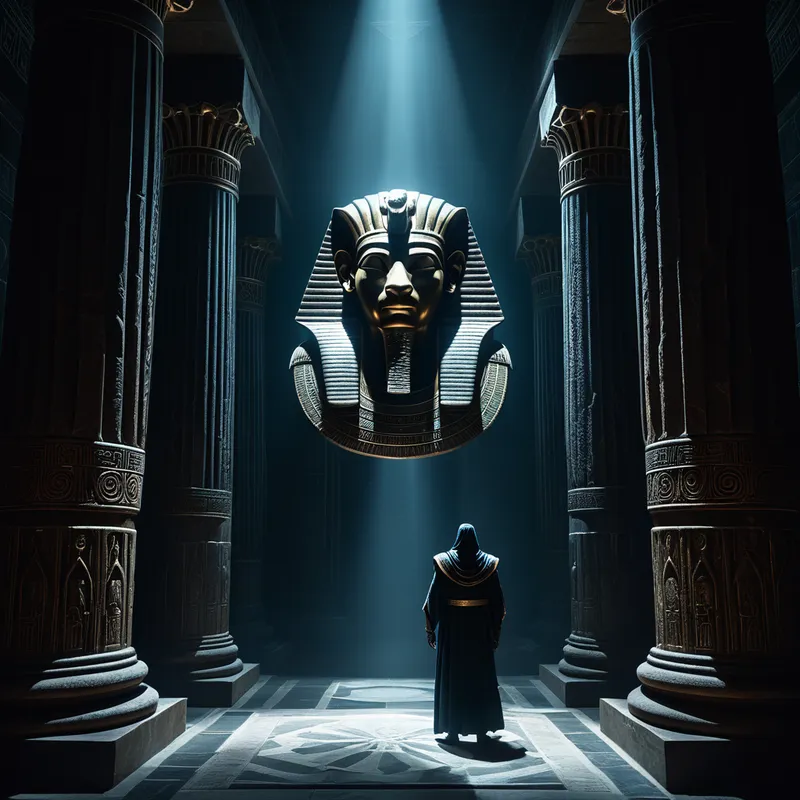
This myth cycle was the central cosmological narrative of Heliopolis (Iunu), one of the most influential religious and intellectual centers of ancient Egypt. It was not a single, fixed text but a living theological framework, elaborated upon in Pyramid Texts, Coffin Texts, and later in temple inscriptions. The priests of Heliopolis were not merely storytellers; they were cosmologists, using this genealogy of the divine to explain the nature of reality, the origin of kingship, and the Pharaoh’s divine role. The Pharaoh was the living embodiment of Horus, the rightful heir who maintains ma’at against the ever-lurking chaos of Set. The myth provided the sacred blueprint for the state, for rituals of coronation and mortuary practice, ensuring the cyclical victory of life, order, and resurrection over death and disorder.
Symbolic Architecture
The Ennead is not a random pantheon but a precise symbolic map of emergent consciousness. Nun represents the undifferentiated unconscious. Atum’s act of self-creation is the first spark of ego, the “I am” emerging from the formless deep.
The journey from Nun to Horus is the psyche’s journey from potential to conscious, responsible existence.
The successive generations are stages of differentiation: Shu (air/space) and Tefnut (moisture) are the first principles of separation and relation. Geb (earth) and Nut (sky) are the archetypal parents, the foundational opposites—the concrete and the transcendent—whose painful separation by Shu creates the “psychological space” where the drama of the soul can unfold. The final quartet—Osiris, Isis, Set, Nephthys—represent the core dynamics of the mature psyche: the ordering, civilizing principle (Osiris); the nurturing, magical, connective power (Isis); the disruptive, aggressive, shadow energy (Set); and the supportive, often overlooked aspect that facilitates transformation (Nephthys). The conflict is internal, a civil war within the self.
The Dreamer’s Resonance
When this myth pattern stirs in modern dreams, it signals a profound restructuring of the inner world. Dreaming of being trapped or confined in a beautiful box may echo Osiris’s coffin, a feeling of being constrained by one’s own role or a system. Dreams of searching for scattered body parts reflect a sense of psychic fragmentation, a need for self-recollection and integration. The fierce battle between a falcon and a strange, powerful beast embodies the internal conflict between one’s aspirational, rightful self (Horus) and one’s destructive, chaotic impulses or inherited trauma (Set). The somatic experience can be one of suffocation (the coffin), frantic searching, or the exhaustion of a long, unresolved fight. The dream is asking for a divine tribunal—a conscious adjudication between these warring inner factions.
Alchemical Translation
The alchemy of the Ennead is the individuation process in its grand, cosmic form. It begins with the nigredo, the primal darkness of Nun, the chaos of unexamined life. Atum’s self-creation is the initial act of self-awareness, the call to consciousness. The separation of Geb and Nut by Shu is the necessary, often painful, act of discrimination—learning to distinguish the earthly from the spiritual, the personal from the transpersonal.
The dismemberment of Osiris is not an end, but the crucial dissolution (solutio) required for a higher synthesis. The old, rigid order of the conscious personality must be broken apart.
Isis’s gathering of the fragments is the meticulous work of analysis, introspection, and shadow-work—reclaiming lost and rejected parts of the self. The reassembly and mummification of Osiris represent the coagulatio, the formation of a new, enduring psychic structure that can survive in the realm of the dead (the unconscious). This resurrected Osiris is no longer king of the day-world but lord of the inner depths, a source of underworld wisdom. Finally, the Horus-Set conflict and its resolution model the final stage: the conscious ego (Horus), now informed by the wisdom of the transformed self (Osiris), must engage with and integrate the remaining chaotic, vital energy (Set). The goal is not to eliminate Set, but to bind him, to give his fierce energy a place in the ordered sky of the personality. The restored Eye of Horus is the symbol of the whole, conscious individual—one who has seen the conflict, suffered the loss, and achieved a hard-won, functional wholeness that includes both light and darkness, order and chaos, within the sacred Ennead of the Self.
Associated Symbols
Explore related symbols from the CaleaDream lexicon: