
The Heavenly Court
A celestial realm where divine justice is administered through angelic hierarchies, cosmic laws, and the unfolding of God's will across creation.
The Tale of The Heavenly Court
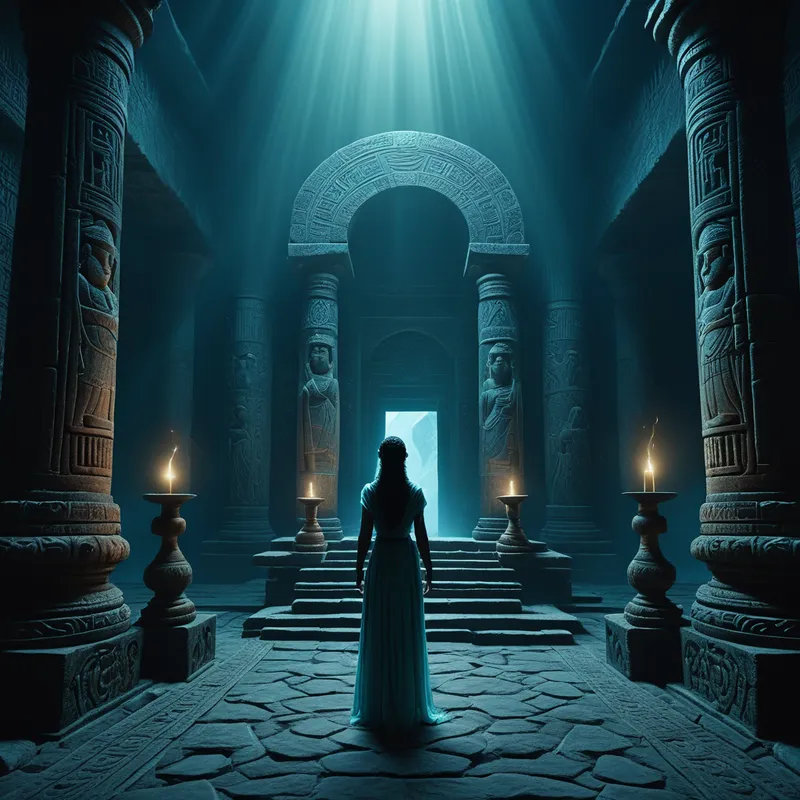
Beyond [the veil](/myths/the-veil “Myth from Various culture.”/) of the visible world, in the unapproachable light, stands the ultimate seat of governance. This is not a place of stone and mortar, but a realm of pure will and law, the Heavenly Court. Here, the Holy One, blessed be He, is enthroned in majesty, surrounded by a living architecture of fire and spirit. The air thrums with the sound of wings, not of birds, but of the myriad hosts who serve: the Ophanim, wheels within wheels, eyes gazing in every direction; the [Seraphim](/myths/seraphim “Myth from Christian culture.”/), whose six wings veil their faces from the unbearable glory; and the [Cherubim](/myths/cherubim “Myth from Judeo-Christian culture.”/), guardians of the sacred threshold.
Each dawn, the court is in session. The books of life and [death](/myths/death “Myth from Tarot culture.”/), of deeds and destinies, lie open. Angels of record, like celestial scribes, present the accounts of creation. Prosecuting angels bring charges, born from the [chaos](/myths/chaos “Myth from Greek culture.”/) of human transgression and the brokenness of [the world](/myths/the-world “Myth from Tarot culture.”/). Defending angels plead for mercy, their arguments woven from threads of repentance and the inherent worth of the divine image within humanity. The debates are not shouts but resonances, harmonies and dissonances that shake the foundations of being. The King presides, listening, weighing. His judgment is not a sudden verdict but the unfolding of a cosmic process, a meticulous balancing of Din with Chesed, of truth with peace.
On the Days of Awe, the Heavenly Court becomes the focal point of all existence. The gates of prayer are opened, and the shofar’s blast is both a alarm and a key, piercing the heavens. It is said that on Rosh Hashanah the books are opened, and on Yom Kippur they are sealed. Yet this is not a distant, mechanical fate. The entire drama invites participation; human prayer, repentance, and charity become forces that tilt the scales, that ascend like incense to influence the deliberations of the high court. The fate of the world—rainfall, harvest, peace, life itself—hangs in this divine balance, decided in the silent, luminous dialogues between [justice](/myths/justice “Myth from Tarot culture.”/) and mercy.
Cultural Origins & Context
The Heavenly Court emerges from the deep Jewish conception of a cosmos governed by moral law. It is the theological and mythological elaboration of the fundamental belief in a God who is both transcendent King and intimately involved Judge. Its roots are in the throne visions of [the prophets](/myths/the-prophets “Myth from Biblical culture.”/), most vividly in [Isaiah](/myths/isaiah “Myth from Abrahamic culture.”/)’s call (“I saw the Lord sitting upon a throne, high and lifted up”) and Ezekiel’s bewildering chariot (Merkavah) vision. These are not mere metaphors but accounts of a perceived reality—the infrastructure of creation itself.
This concept served multiple vital functions. It addressed the problem of theodicy: how can a good and all-powerful God permit evil and injustice? The court provides an answer—judgment is ongoing, meticulous, and ultimately assured, even if its workings are inscrutable. It also democratized access to the divine. While God is the ultimate monarch, the court imagery, with its advocates and procedures, suggests a system one can appeal to, argue with, and influence through righteous action. This is powerfully expressed in the Talmudic tradition of arguing with God, of holding Him to His own laws of justice.
Furthermore, the court model reflected and sanctified earthly social structures. Just as a human king has ministers, generals, and scribes, so too does the King of Kings. This mirrored the developing rabbinic bureaucracy after the destruction of [the Temple](/myths/the-temple “Myth from Jewish culture.”/), projecting an eternal, perfect version of their own communal order onto the cosmos. It transformed the universe from a chaotic battleground of capricious gods into a Ordered [Labyrinth](/myths/labyrinth “Myth from Various culture.”/) of purposeful law, where every action has a consequence and every soul is accounted for.
Symbolic Architecture
The [architecture](/symbols/architecture “Symbol: Architecture in dreams often signifies structure, stability, and the framing of personal identity or life’s journey.”/) of the Heavenly Court is a map of the [psyche](/myths/psyche “Myth from Greek culture.”/) in its [relationship](/symbols/relationship “Symbol: A representation of connections we have with others in our lives, often reflecting our emotional state.”/) to the absolute. The [throne](/symbols/throne “Symbol: A seat of authority, power, and sovereignty, representing leadership, divine right, or social hierarchy.”/) represents the central, organizing principle of [the Self](/myths/the-self “Myth from Jungian culture.”/)—the divine core around which the [personality](/symbols/personality “Symbol: Personality in dreams often symbolizes the traits and characteristics of the dreamer, reflecting how they perceive themselves and how they believe they are perceived by others.”/) constellates. The surrounding angels are not independent beings but personified aspects of divine function: [memory](/symbols/memory “Symbol: Memory symbolizes the past, lessons learned, and the narratives we construct about our identities.”/) (the Recorders), judgment (the Advocates), execution (the Messengers), and protection (the Guardians).
The hierarchy is not about domination but differentiation of function. It is the necessary structure for consciousness to process the infinite data of existence—separating light from darkness, mercy from judgment, the sacred from the profane.
The open books symbolize the unforgiving mirror of [consciousness](/symbols/consciousness “Symbol: Consciousness represents the state of awareness and perception, encompassing thoughts, feelings, and experiences.”/) itself, where nothing is forgotten. Every deed, [word](/symbols/word “Symbol: Words in dreams often represent communication, expression, and the power of language in shaping our realities.”/), and thought is inscribed. This can be a terrifying prospect, the root of existential [Shame](/symbols/shame “Symbol: A painful emotion arising from perceived failure or violation of social norms, often involving exposure of vulnerability or wrongdoing.”/) and [Guilt](/symbols/guilt “Symbol: A painful emotional state arising from a perceived violation of moral or social standards, often tied to actions or inactions.”/). Yet, it is also the [foundation](/symbols/foundation “Symbol: A foundation symbolizes the underlying support systems, values, and beliefs that shape one’s life, serving as the bedrock for growth and development.”/) of ultimate meaning; in a [universe](/symbols/universe “Symbol: The universe symbolizes vastness, interconnectedness, and the mysteries of existence beyond the individual self.”/) without a record, actions would be weightless and morality meaningless. The [scale of justice](/symbols/scale-of-justice “Symbol: A balanced scale representing fairness, moral integrity, and the weighing of actions against consequences.”/) is the [heart](/symbols/heart “Symbol: The heart symbolizes love, emotion, and the core of one’s existence, representing deep connections with others and self.”/) of the moral faculty, the internal compass that weighs desire against duty, self against other.
The court’s most profound [symbol](/symbols/symbol “Symbol: A symbol can represent an idea, concept, or belief, serving as a powerful tool for communication and understanding.”/) is its fluidity. It is a [Cosmic Gateway](/symbols/cosmic-gateway “Symbol: A Cosmic Gateway symbolizes a passage or portal to higher realms of consciousness or spiritual truth, often associated with transformation and exploration of the unknown.”/), a permeable border between the [human](/symbols/human “Symbol: The symbol of a human represents individuality, complexity of emotions, and social relationships.”/) and divine. [Prayer](/symbols/prayer “Symbol: Prayer represents communication with the divine or a higher power, often reflecting inner desires and spiritual needs.”/), repentance, and good deeds are presented as legitimate forms of “[evidence](/symbols/evidence “Symbol: Proof or material that establishes truth, often related to justice, guilt, or validation of beliefs.”/)” that can sway the [outcome](/symbols/outcome “Symbol: Outcome symbolizes the results of actions or decisions, often reflecting hopes, fears, and the consequences of choices.”/). This establishes a reciprocal relationship. We are not passive subjects of a celestial tyrant but participants in a cosmic [drama](/symbols/drama “Symbol: Drama signifies narratives, emotional expression, and the exploration of human experiences.”/) of Justice, our lives the very substance being weighed and measured.

The Dreamer’s Resonance
When the Heavenly Court appears in the inner landscape of dream or active imagination, it signals a profound moment of self-assessment. The dreamer stands before the tribunal of their own conscience and higher Self. The prosecuting angel may voice the relentless inner critic, the catalog of failures and shortcomings. The defending angel may speak for the soul’s inherent worth, for mitigating circumstances, for the Seed of potential still waiting to grow.
This archetypal encounter forces a confrontation with one’s personal Shadow—all that has been denied, hidden, or left unaccounted for. The “books” are the psyche’s total memory, and the judgment is the unavoidable integration of this material. To face the Heavenly Court is to undergo a psychic ordeal where the [persona](/myths/persona “Myth from Greek culture.”/) is stripped away, and one must answer for their authentic life, not the one presented to the world.
The experience can feel like a crisis, a Tower moment where old structures of self-justification crumble. Yet, its purpose is ultimately Healing. It calls for rigorous honesty (Mirror) and the courage to accept responsibility. The mercy that balances the judgment is the compassion one must learn to extend to oneself and others after such a ruthless inventory. Passing through this inner court leads not to condemnation, but to clarification, release from unconscious Guilt, and a realignment with one’s true Destiny.

Alchemical Translation
In the alchemy of the soul, the Heavenly Court represents the stage of [separatio](/myths/separatio “Myth from Alchemical culture.”/) and judicium—the separation of components and the assessment of their value. The raw material of the personality (the [prima materia](/myths/prima-materia “Myth from Alchemical culture.”/)) is brought into the refined vessel of consciousness and subjected to the fire of scrutiny. Base elements (ignorance, greed, hatred) are separated from the noble ones (wisdom, generosity, love).
The alchemical goal is not to destroy the base but to transmute it. In the court, even the prosecuting angel’s charge is necessary; it is the nigredo, the blackening, that precedes the dawn of insight. The divine verdict is the moment of albedo, the whitening, where the purified essence is recognized.
The process mirrors the Jewish concept of Tikkun Olam. Each individual’s inner judgment and rectification is a microcosmic act of repairing a fracture in the cosmos. By ordering one’s inner chaos, one contributes a fragment of Order to the universal Cosmic Balance. The Heavenly Court, therefore, is the internalized template for this sacred work. The King on the throne is the latent, integrated Self, and the soul’s journey is to approach that throne, not in fear, but in recognition of its own royal origin, participating in the eternal Cosmic Dance of justice and redemption.
Associated Symbols
Explore related symbols from the CaleaDream lexicon:
- Scale of Justice — The celestial balance where divine measure is meted out, weighing deeds and intentions with perfect equity.
- Throne — The immovable center of divine authority and the seat from which cosmic order emanates.
- Mirror — The unforgiving reflection of the soul’s true state, presented before the court of conscience and heaven.
- Book — The eternal record where all actions, thoughts, and potentialities are inscribed, forming the basis for judgment.
- Hierarchy — The structured, purposeful order of angelic beings, reflecting the necessary differentiation of divine functions within unity.
- Border — The permeable veil between the human and divine realms, crossed by prayer, vision, and the soul after death.
- Light — The uncreated radiance that fills the court, representing truth, law, and the illuminating presence of the divine.
- Circle — The wholeness and perfection of divine governance, encompassing all creation within its law and compassion.
- Key — The means of accessing mercy or understanding within the rigid structures of judgment, often linked to repentance and prayer.
- Tower — The moment of crisis and revelation when the soul’s defenses fall and it stands exposed before the ultimate judgment.
- Recorder — The angelic function of witnessing and inscribing, the cosmic memory that grants weight and meaning to temporal existence.
- Ordered Labyrinth — The cosmos as a structured, purposeful, and intricate pathway toward the center of divine judgment and truth.