The Hearth Cake Myth Meaning & Symbolism
A myth where a humble hearth cake, offered to a stranger, becomes a vessel for divine blessing and the soul's eternal flame.
The Tale of The Hearth Cake
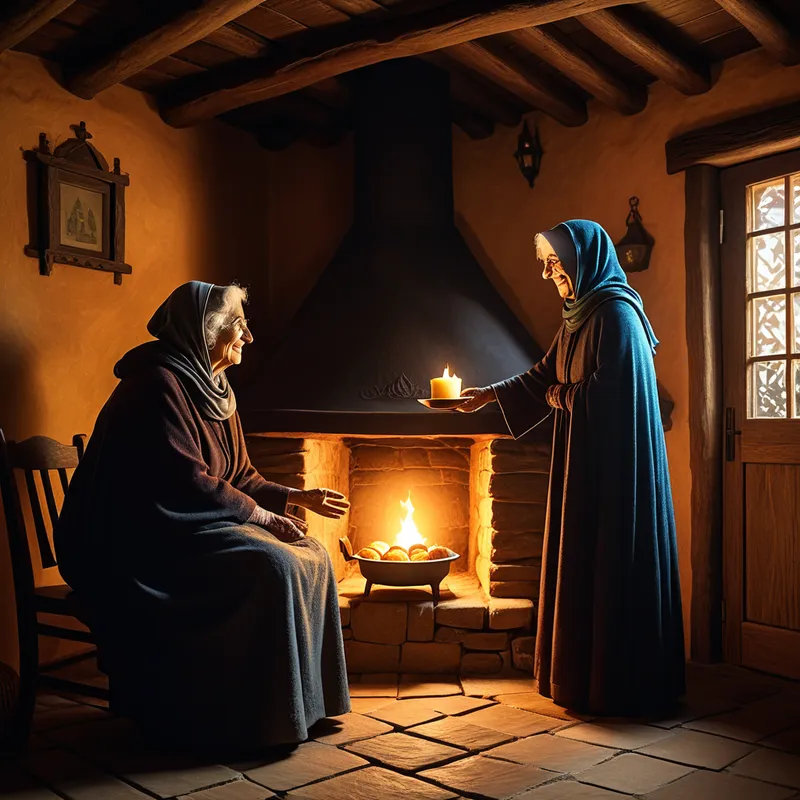
Listen. The wind howls across the frozen world, a beast of ice and teeth. In the deepest dark of the year, when the sun is a memory and the earth sleeps a death-like sleep, there is a cottage. Not a palace, not a fortress. A cottage of stone and sod, with a roof of thatch bowed under the weight of winter. Inside, the only defiance against the endless cold is the hearth. Its fire is a living heart, beating red and gold in the breast of the home.
Here lives an old woman. She has no great name in the songs of kings. Her wealth is the warmth of her fire, her store a last handful of coarse meal, a pinch of salt, a cup of meltwater from the ice outside her door. This night, the hunger of the world presses against her walls. She has nothing but enough for one small cake, mixed with her own hands and baked in the ashes of her hearth—a hearth cake, humble and grey.
As she kneels to draw it from the embers, a knock sounds. Not a human knock, but a sound like a branch tapping glass, or a bone against stone. She opens her door to the screaming gale. There stands a figure, cloaked and hooded in shadows that swirl like storm clouds. No face is visible, only a sense of immense, weary cold that makes her own fire gutter.
“Shelter,” the figure whispers, a voice of cracking ice. “And a share of your warmth.”
The old woman looks at the single, ash-dusted cake in her hand. She looks at the stranger who brings the winter in with him. Her own stomach is a hollow ache. The rational voice, the voice of scarcity, says to shut the door. But an older voice, from a place deeper than hunger, speaks. It is the voice of the hearth itself—not just a fire for cooking, but a fire for welcoming.
She does not speak of her lack. She steps back. “Enter,” she says. “The fire is for all who come in peace.”
The stranger enters, and the cold around him is so profound it steals breath. He sits on the stool by the fire, and the flames grow pale, shrinking. Without a word, the old woman breaks the hearth cake in two. She gives the larger piece to the stranger. He takes it, his long, thin fingers brushing hers—a touch like frostbite.
He lifts the cake to where his face might be. He does not eat it. He holds it over the weakest part of the fire. And he breathes.
His breath is not air. It is the first wind of spring, the sigh of thawing earth, the whisper of sap rising. He breathes upon the humble cake, and then upon the dying fire.
The cake in his hand transforms. The ash falls away like a shell. It becomes golden, radiant, giving off a light that is not firelight but something clearer, like captured sunlight. The hearth fire erupts. It does not roar; it sings. Flames of emerald, sapphire, and gold spiral up, warm but not burning, filling the cottage with the scent of blooming fields and sun-warmed stone.
The stranger stands. His cloak falls open, and for a moment, he is not a man of shadows but a being of shifting light, with eyes like distant stars. “You gave the last of your substance,” he says, his voice now rich and deep as fertile soil. “You kept the law of the hearth: that its warmth is a covenant, not a possession. Your fire shall never go out. Your cake shall always feed the hungry spirit.”
He places the transformed, glowing cake back into her hands. Then he is gone, not out the door, but into the very flames of the hearth, which settle back into a steady, unwavering, perpetually warm glow. In her hands, the Hearth Cake remains, eternally warm, a small sun. And she knows, as long as she shares its essence, the true fire—the fire of welcome, of sacrifice, of the heart’s own core—will never die.
Cultural Origins & Context
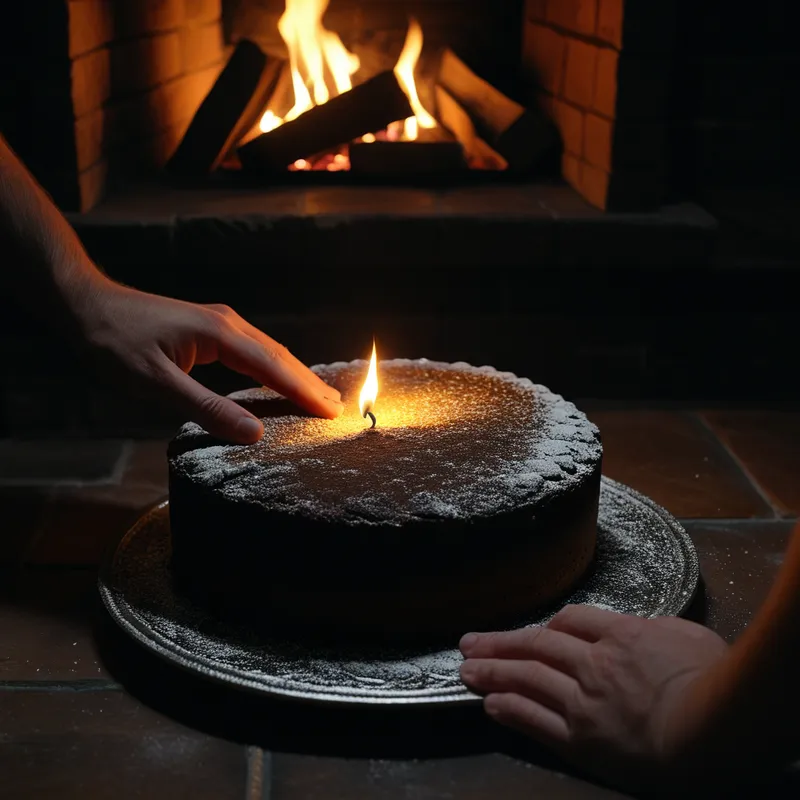
This myth finds its roots not in the courts of priests or the scrolls of scholars, but in the oral traditions of peasant and pastoral communities across the cold northern reaches of Europe. It is a folk tale of the highest order, told during the long nights of winter, often near the very hearth it sanctifies. The teller was typically the eldest matriarch or a traveling storyteller, and its recitation was more than entertainment; it was a ritual reinforcement of a sacred domestic law.
Its societal function was multifaceted. Primarily, it codified the ethics of hospitality—Xenia in its most primal, northern form. In subsistence cultures, sharing your last morsel was an immense risk. The myth taught that this risk was the cornerstone of community and divine favor. Secondly, it sacralized the domestic sphere, particularly the woman’s role as keeper of the hearth-fire, the literal and symbolic center of life, warmth, and family continuity. The hearth was not just a appliance; it was an altar, and this story was its scripture. The myth assured that faithfulness in this small, daily domain held cosmic significance.
Symbolic Architecture
At its core, the myth is an alchemical parable of the soul. The Hearth Cake represents the prima materia of the ego—our basic, mundane substance, shaped by effort (kneading) and tempered by the trials of life (the fire’s ashes). It is all we believe we have to sustain ourselves.
The ultimate sacrifice is not of something extra, but of the very thing you believe is necessary for your survival. In that offering, the self is cracked open to become a vessel for the Self.
The stranger is the numen, the god in disguise—the Zeus Xenios archetype filtered through a northern lens. He is the spirit of winter, of need, of the outer world’s harsh demand. Psychologically, he is the Shadow or the Self appearing at the door of consciousness, presenting itself as a drain on our resources. The old woman’s choice to welcome him is the ego’s consent to engage with what it fears will deplete it.
The transformation occurs not through the woman’s action alone, but through the stranger’s breath upon her offering. This is the critical moment of grace or psychic integration. The mundane substance (the cake/ego), when offered freely to the unknown (the Shadow/Self), is transmuted by a force beyond itself. It becomes the lapis philosophorum—the eternal, nourishing core. The hearth fire that never dies symbolizes the indestructible center of the personality, the scintilla or divine spark, which is sustained not by hoarding, but by continual cycles of giving and receiving.
The Dreamer’s Resonance
When this myth pattern stirs in the modern dreamer, it often manifests in dreams of profound, quiet scarcity. You may dream of your own home, but it is cold, the pantry bare. A figure stands at the door—often faceless, ominous, or pitifully weak. The somatic feeling is one of deep anxiety in the gut, a clenching around one’s last resources. This is not about physical food, but about emotional, creative, or spiritual reserves.
The psychological process underway is the confrontation with the inner beggar or the draining guest. This could be a neglected aspect of your own neediness, a relationship that feels parasitical, or a new creative endeavor that seems to demand everything with no promise of return. The dream tests the ego’s stance: will it hoard, or will it, from a place deeper than calculation, offer its last “hearth cake”? The resolution in the dream—if it follows the myth—is not the guest leaving, but a sudden, warm light filling the space, a sense of eternal sufficiency. This marks a profound shift from an economy of scarcity to an economy of the soul, where generosity activates an inner, perpetual source.

Alchemical Translation
The myth of The Hearth Cake is a precise map for the stage of individuation known as nigredo giving way to albedo. The winter night and the last meal are the nigredo—the confrontation with lack, limitation, and the “dark night of the soul.” The ego feels impoverished, reduced to its most basic form.
The act of offering the cake is the beginning of the citrinitas. It is the conscious, willed sacrifice of the ego’s claim to sovereignty. The ego must offer its very substance—its time, its energy, its cherished self-conception—to the mysterious, often unsettling, demands of the deeper Self (the stranger).
The hearth is the vas of the soul. The fire is the process. The cake is the content. Only by placing all three in the service of the unknown guest does the gold appear.
The stranger’s breath is the influx of the Self, the transcendent function that operates when the ego yields. This transmutes the leaden cake of ego-identity into the golden, eternal substance of the Self. For the modern individual, this translates to a life practice: when we feel most resource-depleted, that is the precise moment to give—not from a calculated “karmic return” mindset, but from a primal ethic of hospitality to life itself. The “eternal hearth fire” that results is the stabilized inner center, a psychic warmth and resilience that is no longer dependent on external fuel, because it has been kindled by the fusion of the personal and the transpersonal. We become, like the old woman, the keeper of a fire that never dies, nourished by a cake that is always enough, because it is shared.
Associated Symbols
Explore related symbols from the CaleaDream lexicon: