The Heart Scarab Myth Meaning & Symbolism
A soul's heart is weighed against a feather of truth in the afterlife, its fate resting on a scarab amulet's magic and the power of a spoken confession.
The Tale of The Heart Scarab
The air in the Duat is not like the air of the living. It is thick, silent, and smells of incense and deep earth. Here, in the Hall of Two Truths, shadows cling to the pillars, and a dread deeper than the Nile settles in the soul. The deceased stands, a shimmering ba, before the tribunal of gods. Their mortal body is far away, wrapped in linen, but here, their essence is laid bare.
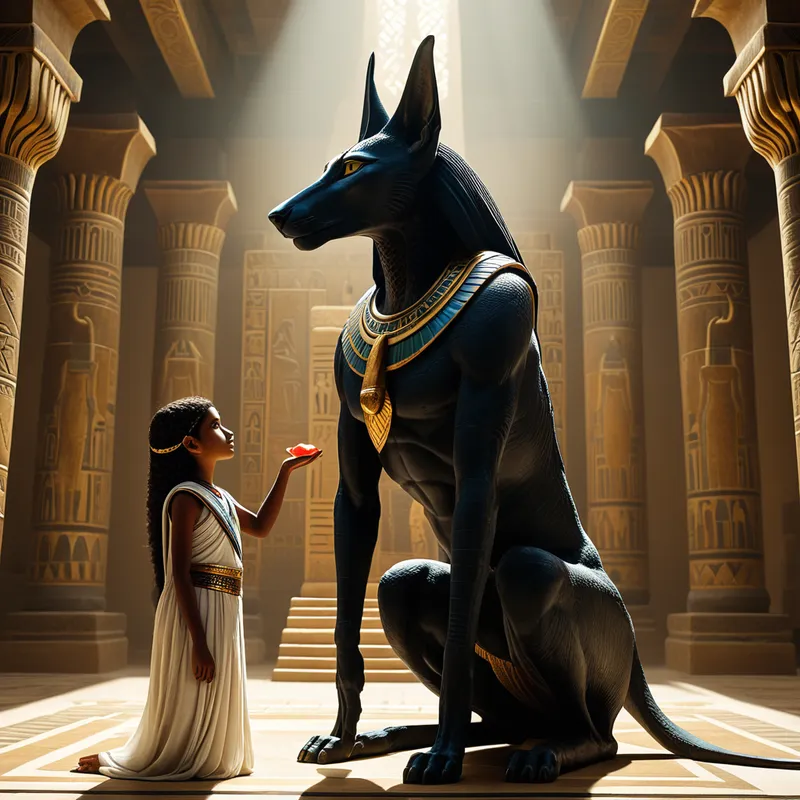
At the center of the hall stands Anubis, his ears pricked, his eyes dark pools of ancient knowledge. With hands both delicate and sure, he leads the soul to the great scales. On one golden plate, he places the Shu feather, plucked from the crown of Ma’at herself. It is pure, weightless, perfect. On the other plate, he must place the heart of the deceased.
But the heart is not a simple organ here. It is the seat of memory, of desire, of action—the record of a lifetime. It is heavy with secrets, sticky with guilt, but perhaps, if the life was just, also lightened by moments of kindness. The soul watches, breathless, as Anubis reaches for it. This is the moment of ultimate exposure.
Nearby, the scribe god Thoth stands ready, stylus and papyrus in hand, to record the verdict. And in the gloom, a creature waits—Ammit, part lion, part hippopotamus, part crocodile. Her jaws are slack, her hunger eternal. If the heart outweighs the feather, she will consume it, and the soul will cease to be, suffering the second death.
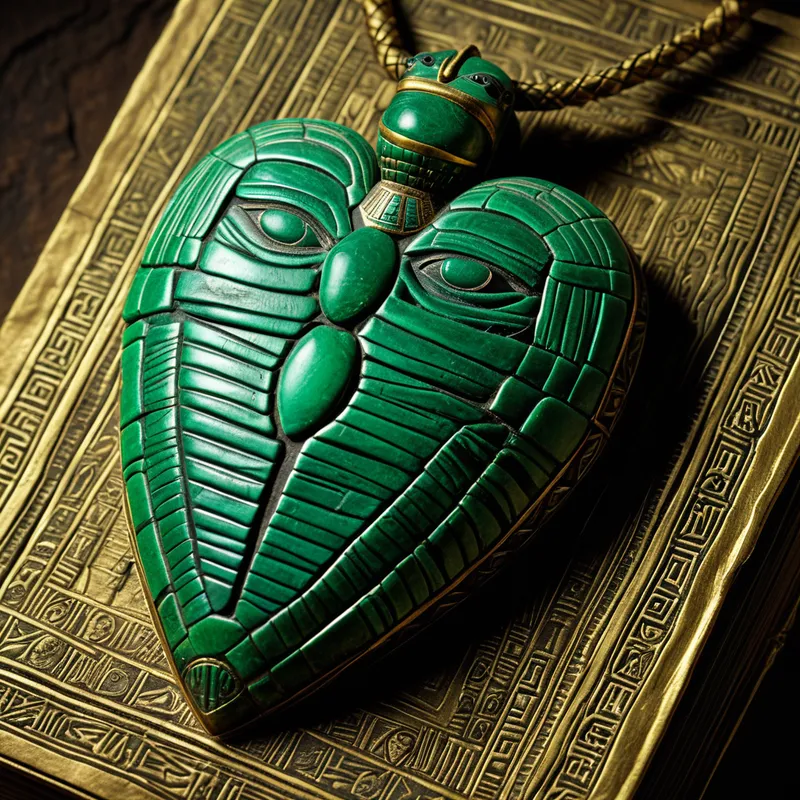
But the wise ones prepared for this. Upon the linen wrappings of their chest, a talisman rests: the Heart Scarab. Carved from green stone, often inscribed with a spell from the Book of the Dead, it is more than jewelry. It is a advocate, a magical weight. As the heart is placed upon the scale, the scarab’s power stirs.
Then, the soul must speak. It must address its own heart, not as a master, but as a separate witness. The words, learned in life and carved on the scarab, rise in the silent hall: “O my heart of my mother! O my heart of my mother! O my heart of my different forms! Do not stand up as a witness against me, do not be opposed to me in the tribunal, do not be hostile to me in the presence of the Keeper of the Balance…”
This is the incantation, the plea, the final confession. It is not a denial of deeds, but a reconciliation with the self. The soul begs its own heart not to betray it, to remember also its virtues, to find equilibrium. The scarab glows with a soft, verdant light. The scales tremble. The feather and the heart sway… and then, stillness. Perfect balance. Thoth records the result. Ammit slinks back into the shadows, denied her meal. The soul may now pass on to the Field of Reeds, its existence affirmed, its truth accepted.
Cultural Origins & Context
The myth of the Heart Scarab is not a single story told around a fire, but a central, evolving doctrine embedded in the fabric of Egyptian funerary practice for nearly two millennia. It finds its most concrete expression in Chapter 30B of the Book of the Dead, a text that was itself a democratization of earlier royal pyramid texts. This spell was often meticulously inscribed on the base of a scarab amulet, which was then placed over the mummy’s heart during the elaborate 70-day mummification ritual.
The myth was propagated by priests, the learned scribal class, and the artisans who carved the scarabs. Its societal function was profound and dualistic. On one hand, it served a deeply practical, magical purpose: to ensure a positive outcome in the literal, believed-in afterlife judgment. It was a form of spiritual insurance. On the other hand, it served a powerful ethical and social function. The concept of the heart being weighed against Ma’at reinforced the core cultural value of living a life in harmony with truth, justice, and right order. It taught that one’s inner reality—the content of one’s heart—was ultimately what mattered, and that it would be witnessed by the divine. This myth was a primary tool for inculcating morality and social cohesion, making the cosmic personal.
Symbolic Architecture
At its core, the myth presents a powerful map of the psyche facing its own totality. The Hall of Two Truths is not a geographical place, but the inner court of conscience where the self is divided into witness, defendant, and judge.
The Heart symbolizes the integrated self, the repository of all one has done, felt, and intended. It is the “record keeper” of the soul. The Feather of Ma’at represents the objective, impersonal standard of truth and integrity. It is not a harsh law, but the fundamental principle of right relationship—with others, with the world, with oneself.
The ultimate judgment is not between the self and a god, but between the self and its own truth.
Anubis, as the weigher, embodies the function of discernment—the ability to measure and evaluate without prejudice. Thoth is consciousness itself, observing and recording the process. The terrifying Ammit represents the psychological consequence of failure in this inner trial: annihilation of meaning, dissolution into chaos, or what we might call utter psychic disintegration.
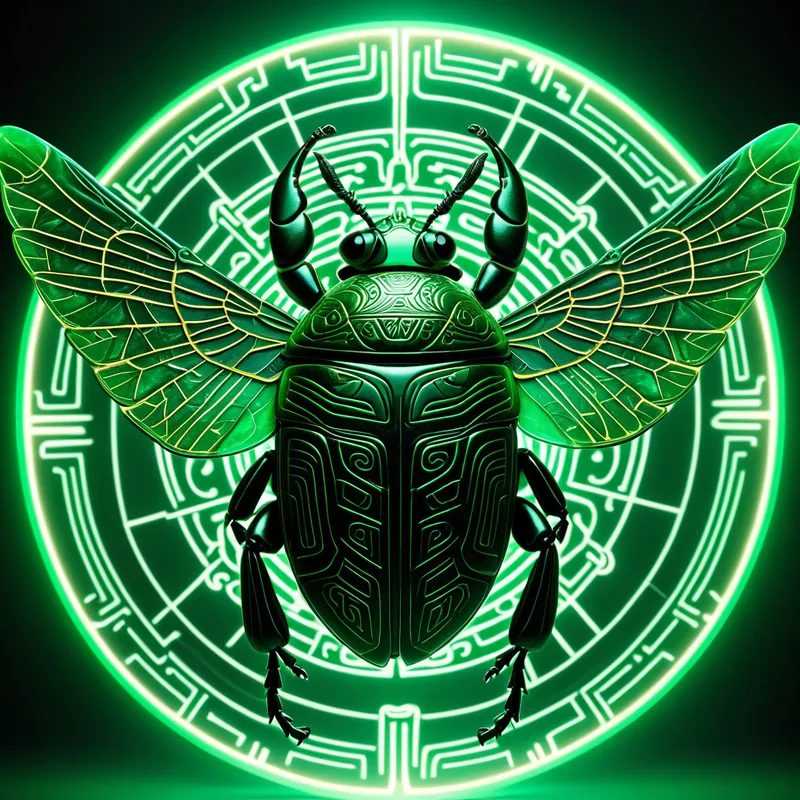
The Scarab Beetle (Khepri) is the master symbol of transformation. Observing the beetle roll its ball of dung, the Egyptians saw a metaphor for the sun god rolling the sun across the sky, a cycle of death and rebirth. Placed upon the heart, the scarab amulet symbolizes the conscious, transformative act of taking responsibility for one’s psychic contents. It is the applied will to evolve, to “roll” the heaviness of one’s past into something new. The spell spoken to the heart is the act of conscious dialogue with the unconscious, a plea for wholeness over self-sabotage.
The Dreamer’s Resonance
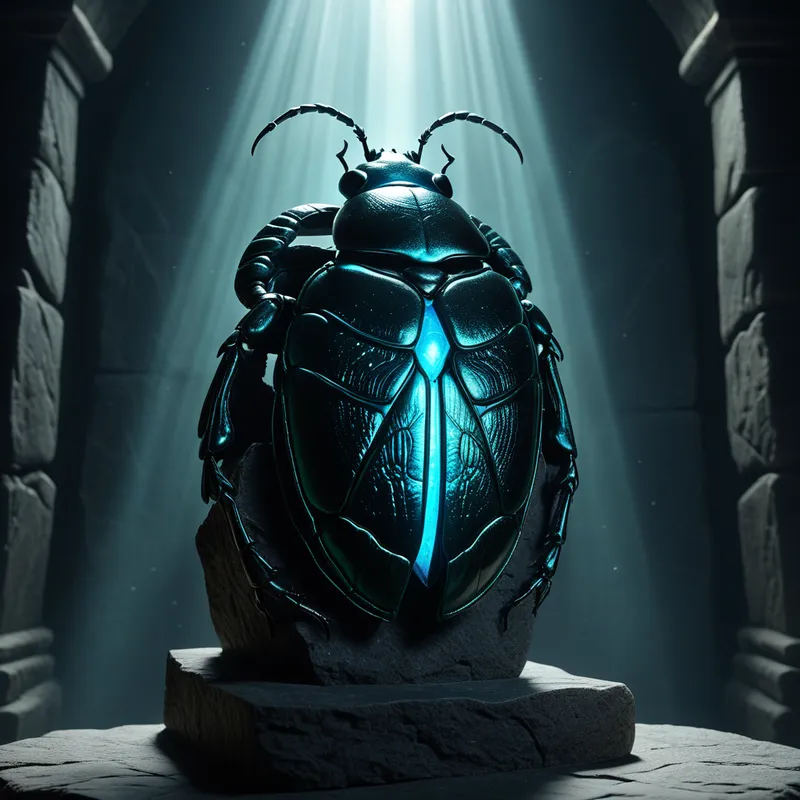
When this mythic pattern stirs in the modern dreamer, it signals a profound moment of self-assessment. One may dream of being on trial, of having one’s possessions or actions weighed, or of a specific, ominous scale. The dreamer might encounter a fierce, hybrid animal (a modern Ammit) that threatens to consume them, or find a small, potent insect—a beetle—in a place of significance, like their chest or hand.
Somatically, this can feel like a tightening in the chest, a literal “heavy heart,” or a sense of dread before an unseen judgment. Psychologically, the dreamer is undergoing a process of moral and existential inventory. Life may have presented a crisis—the end of a relationship, a career failure, a betrayal—that forces a confrontation with one’s own actions and character. The dream is the psyche’s innate ritual, its Hall of Two Truths, where the ego is brought before the totality of the Self to account for its stewardship. The anxiety is the fear of being found wanting, of being “devoured” by shame, regret, or meaninglessness.
Alchemical Translation
The journey through this myth is a precise model for the alchemical and Jungian process of individuation—becoming who one truly is. The initial state is one of burdened consciousness, carrying the unexamined weight (the heart) of complexes, repressed memories, and unlived life.
The Nigredo, or blackening, is the descent into the Duat—the confrontation with the shadow. This is the painful awareness of one’s flaws, failures, and contradictions. Placing the heart on the scale is this act of brutal self-honesty.
The Albedo, or whitening, is represented by the feather of Ma’at. It is the clarifying principle, the commitment to truth over self-deception. The dialogue with the heart—the spell—is the crucial work of conjunction. Here, the conscious mind (the speaking soul) does not battle the unconscious (the heart), but engages it, pleads with it, seeks integration.
The goal is not to have a heart lighter than a feather, but to have a heart in perfect balance with it—to own one’s darkness with the same clarity as one’s light.
The Rubedo, the reddening or golden dawn, is the achievement of balance. The scarab’s magic is the symbol of the transcendent function—the psychic process that arises from holding the tension of opposites (good and bad deeds, light and shadow) until a new, third position emerges. This is the birth of the integrated Self. Ammit is neutralized not by being slain, but by being rendered irrelevant; the devouring power of unconscious guilt is transformed through conscious acceptance.
To live this myth is to regularly enter one’s own Hall of Two Truths. It is to weigh one’s actions against one’s deepest values, to speak honestly to one’s own heart, and through that sacred, difficult dialogue, to transmute the leaden weight of the past into the golden scarab of a more conscious, authentic, and whole being. The Field of Reeds is not a paradise elsewhere, but the fertile ground of a life lived in truth.
Associated Symbols
Explore related symbols from the CaleaDream lexicon: