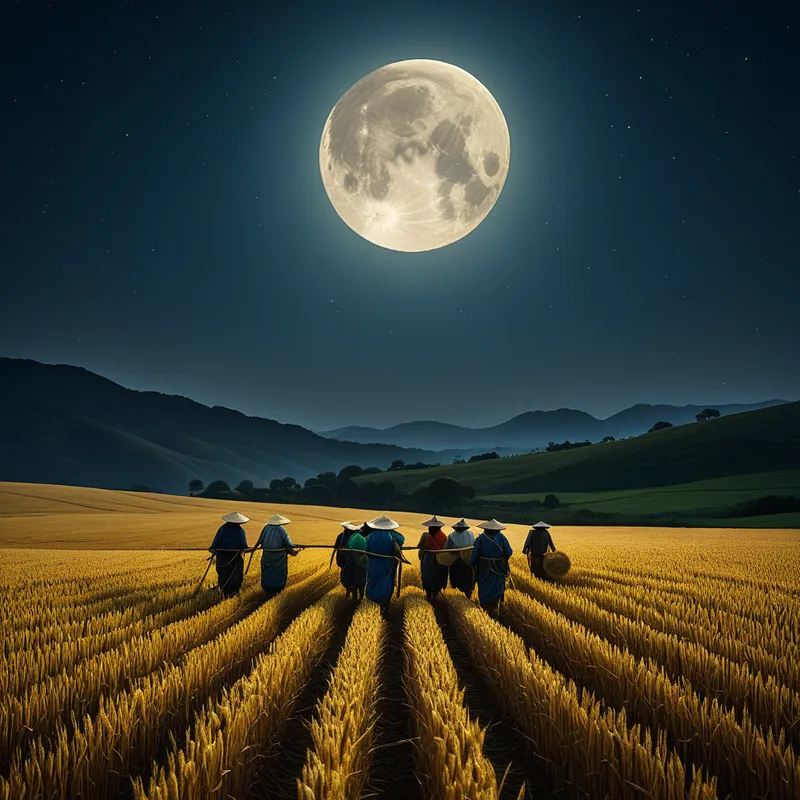
The Harvest Moon Festival Myth Meaning & Symbolism
A myth of celestial negotiation where humanity's gratitude and sacrifice under the full moon ensures the eternal return of the harvest and the balance of life.
The Tale of The Harvest Moon Festival
Listen. Listen to the whisper of the wind through the ripe stalks, heavy with the promise of bread. This is not a story of gods on high thrones, but of the earth and the sky in a sacred conversation, with humanity as the trembling, grateful tongue.
In the time before calendars, when time was measured by the belly’s hunger and the sun’s arc, there came the Pregnant Time. The fields, tended by calloused hands and hopeful hearts, bowed under the weight of grain. But a deep, unspoken dread settled in the village. The sun, Sol Invictus, had done his work, but the bounty was not yet theirs. It belonged to the silent, watchful dark—to the Luna Plena, the Harvest Moon. She was not cruel, but she was exacting. She was the keeper of cycles, the weigher of worth. To take without acknowledgment was to invite a long, silent winter of the soul.
And so, on the night when the moon swelled to its most profound roundness, hanging low and golden like a ripe fruit itself, the people would gather. Not in celebration, but in solemn treaty. The air was thick with the scent of cut straw and damp soil. The only light was her light, bleaching the world of color, leaving only silver and shadow.
The Custodian of the Sheaf, the oldest among them, would step forward. In their hands, they did not hold the finest grain for their own storehouse. They held the First Sheaf—the very first stalks cut from the field, the embodiment of the year’s hope and toil. This was not a gift given lightly. It was a sacrifice, a returning. The Custodian would lift the sheaf, its kernels glowing like captured moonlight, and in a voice cracked with age and emotion, they would speak the old words—not a prayer of demand, but a litany of gratitude. Gratitude for the sun’s heat, the rain’s kiss, the soil’s depth, and the moon’s watching eye.
They would lay the sheaf upon a simple altar of stone at the field’s edge. And they would wait. The world would hold its breath. The wind would still. In that silence, under the moon’s unblinking gaze, the pact was felt. If the offering was true—if the gratitude was genuine, not just for the full belly but for the cycle itself, for the death of the seed that brought life—then the moon’s light would seem to soften, to accept. A gentle breeze would rise, rustling the remaining stalks, sounding like a sigh of assent. The harvest could begin. The people had not taken; they had received. And in that receiving, they pledged their part in the endless, turning wheel.

Cultural Origins & Context
This myth is the bedrock of every culture that has ever turned soil and awaited rain. It is not the property of one people, but a global agricultural truth, worn into the collective psyche through millennia of dependence on the caprices of nature. It was passed down not in grand temples, but in the rhythmic actions of harvest: the swing of the scythe, the gathering of the bundle, the evening fires where the smell of the first baked loaf of the new grain filled the air.
The tellers were the elders—the ones who remembered the lean years, who could read the signs in the sky and the soil. The myth’s societal function was profound pragmatism wrapped in sacred ritual. It codified the delay of gratification (you cannot eat until you have given thanks), enforced community cohesion (the offering was from and for all), and provided a psychological framework for dealing with the terrifying uncertainty of subsistence. It transformed the harvest from a mere act of survival into a participatory ceremony in the cosmos’s order. The festival that followed—the feasting, the music, the sharing—was the release of tension, the celebration of the pact successfully renewed for another turn of the wheel.
Symbolic Architecture
At its heart, this myth is a masterclass in the psychology of reciprocity and the acknowledgment of a debt larger than oneself. The Luna Plena represents the objective, impersonal cycle of nature—the law of sowing and reaping, of cause and effect. She is the Great Mother in her aspect of the Completer, but also the Withholder. She demands consciousness.
The First Sheaf is the ego’s most prized possession, offered back to the Self to ensure the continued flow of life.
The First Sheaf is the symbol of conscious sacrifice. It is not the leftovers, but the prime. Psychologically, it represents the ego’s willingness to give up its immediate, “ripe” gratification—its pride, its certainty, its hoarded resources—to a higher, transpersonal order (the cosmic cycle). The Custodian of the Sheaf is the archetypal function of the wise elder or the mediating consciousness that understands this necessary transaction. The ritual is an act of symbolic payment, an acknowledgment that life is a gift, not a possession. The tense silence before the moon’s “acceptance” is the critical moment of inner alignment—the feeling that one’s offering, one’s gratitude, is sincere and sufficient.
The Dreamer’s Resonance
When this myth stirs in the modern dreamer, it rarely appears as a literal festival. It manifests as dreams of anxious preparation for a crucial event that never arrives, of finding a treasure but being unable to touch it until you say a specific word you’ve forgotten, or of standing before a vast, silent authority figure (a judge, a moonlit landscape, a vast machine) waiting for permission to proceed.
Somatically, this can feel like a clutching in the gut, a held breath, a sense of being “on the verge.” Psychologically, the dreamer is at the “Pregnant Time” in some area of their life. The work is done—the project is complete, the relationship has deepened, the inner insight has been gained—but there is a blockage to integrating it, to “harvesting” its benefits. The myth reveals the blockage: an unconscious refusal to make the symbolic offering. This could be an inability to feel genuine gratitude, to acknowledge help received, to sacrifice a bit of pride or control, or to consciously accept an ending as part of a cycle. The dream is the psyche’s Luna Plena, holding the bounty hostage until the correct inner attitude is presented.
Alchemical Translation
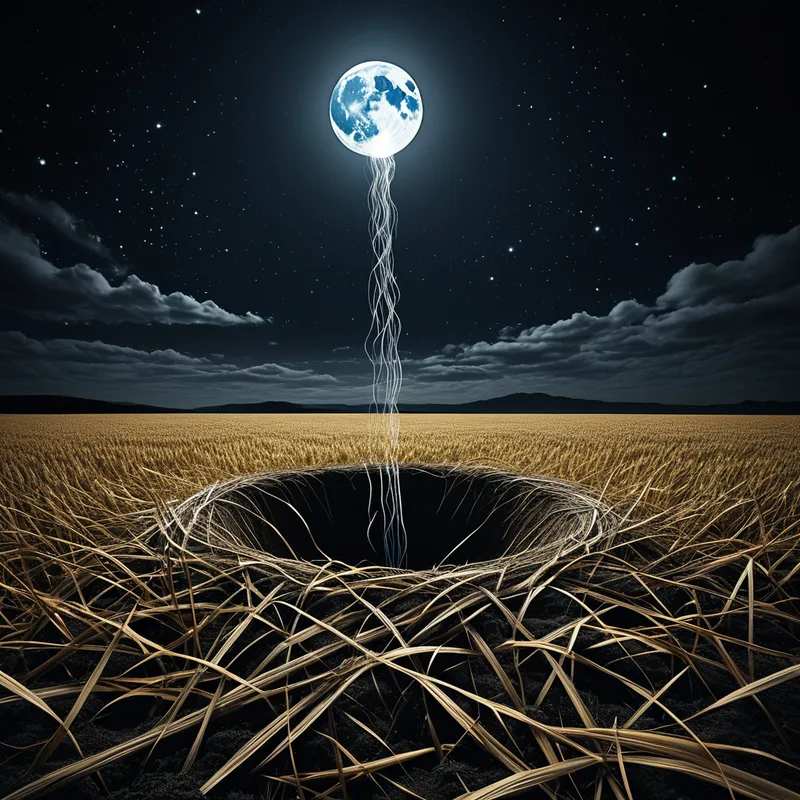
The alchemical process mirrored here is Solutio (dissolution) followed by Coagulatio (coagulation). The ripe, solid grain (the achieved ego position, the finished work) must be dissolved in the “liquid silver light” of lunar consciousness—that is, it must be surrendered to the larger cycle of meaning, to gratitude, and to the acceptance of transience. One must let go of identifying solely with the accomplishment.
Individuation requires not just the reaping of insights, but the conscious offering of them back to the psyche’s own depths, fertilizing the soil for the next growth.
The modern individual’s “Harvest Moon” moment occurs at any point of culmination. It is the promotion earned, the creative work finished, the hard-won peace after conflict. The instinct is to consume it immediately for ego-inflation. The alchemical instruction of the myth is to pause. To create a ritual space—even if just a moment of silent reflection. To consciously offer the “first sheaf” of that achievement: to dedicate it to something beyond yourself, to express genuine thanks to those who made it possible, to acknowledge the role of fate and grace. This act of conscious sacrifice transmutes the harvest from mere personal gain into psychic nourishment that feeds the whole Self. It ensures that your winter—your next period of fallow introspection or struggle—will not be barren, because you have honored the cycle. You have not just taken from life; you have entered into a sacred pact with it, becoming both the cultivator and the grateful harvest itself, forever part of the turning wheel.
Associated Symbols
Explore related symbols from the CaleaDream lexicon: