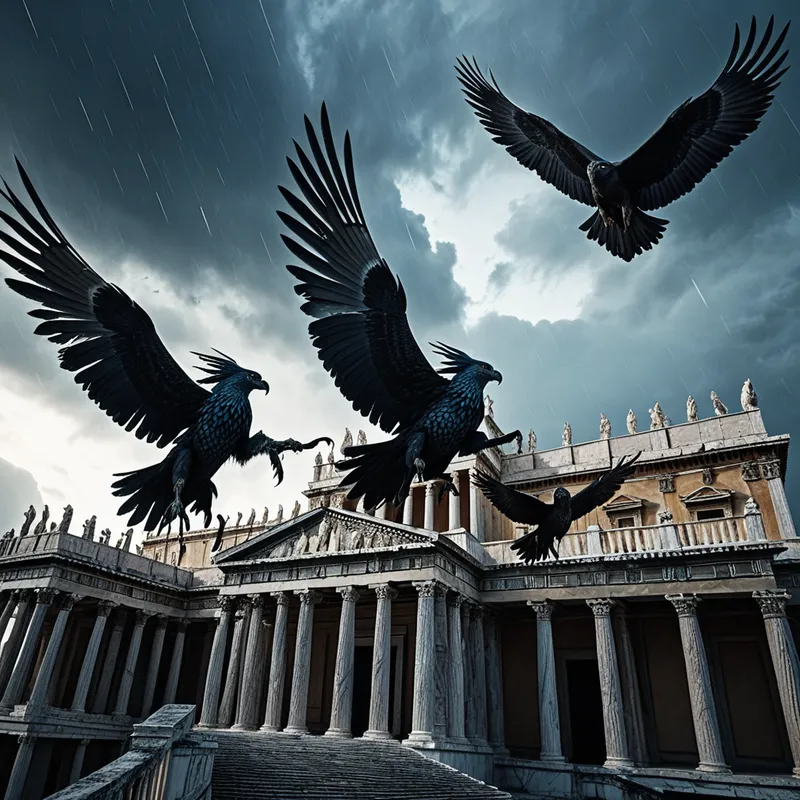
The Harpies Myth Meaning & Symbolism
Winged spirits of divine punishment, the Harpies torment the blind king Phineus, embodying the psyche's confrontation with its own inescapable, devouring shadows.
The Tale of The Harpies
Hear now the tale of the Snatchers, the Hounds of Zeus, whose very name is a curse whispered on [the wind](/myths/the-wind “Myth from Various culture.”/). It begins not in the sunlit halls of the gods, but in a shadowed kingdom by [the sea](/myths/the-sea “Myth from Greek culture.”/), where a king sat in a prison of his own making.
His name was Phineus, and though his eyes were clouded and blind, his inner sight pierced the veils of time. This gift became his torment. For in his pride, he had revealed too much of the gods’ secret designs. In wrath, Zeus sent a punishment more cruel than any blade: the [Harpies](/myths/harpies “Myth from Greek culture.”/).
They came with the sudden fury of a squall. The air, once still, grew thick with the stench of a charnel house. Then, the sound—a thunderous beating of vast, leathern wings. They descended upon the palace of Phineus: [three sisters](/myths/three-sisters “Myth from Native American culture.”/), Aello, Ocypete, and Celaeno. Their faces were of haunting, cruel beauty, but their bodies were those of monstrous birds, with talons of black iron and feathers the color of a gathering storm.
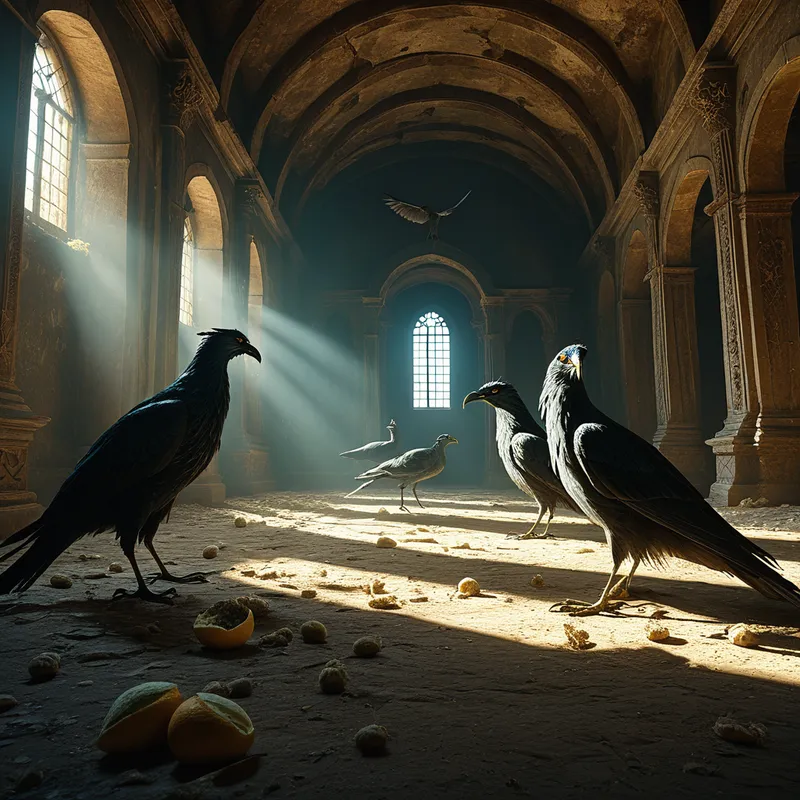
Their task was precise and exquisitely torturous. Whenever a table was laid for the starving Phineus, they would shriek from the heavens, a sound to freeze the blood. In a whirlwind of filth, they would snatch the food from the king’s very lips, leaving behind only a foul, inedible slime upon what remained. They were the embodiment of tantalizing despair, ensuring the king was perpetually on the brink of sustenance, only to have it ripped away, his body weakening, his spirit fraying at the edges. The palace, once a seat of power, became a reeking cage of perpetual hunger and defilement.
This was the state of the kingdom when a ship with a prow of sacred oak cut through the waves—the Argo. Aboard were heroes, but two among them were born of the North Wind: Zetes and Calais. Hearing the lament of Phineus, who promised them guidance in exchange for salvation, they took pity. As the next meal was laid and the dread shrieks echoed once more, the winged brothers took to the air.
A mighty chase ensued, across the wine-dark sea and over the jagged cliffs. The Harpies, swift as guilty thoughts, could not outpace the sons of the storm-wind. It is said the brothers drew their swords, ready to strike, when the messenger goddess Iris intervened, descending on her rainbow path. She declared the Harpies were instruments of Zeus’s will and could not be slain. But she swore an oath: if the Boreads ceased their pursuit, the Harpies would flee beyond the known world, to the islands called the Strophades, and never again torment Phineus.
The pact was made. The Harpies, shrieking their frustration, vanished to their remote prison. In the sunlit hall of Phineus, a clean table was set. For the first time in years, the king ate his fill, the taste of bread untainted by rot. The curse was lifted, not by destruction, but by a sacred binding. The Snatchers were banished, and the king, purified by his long torment, spoke the prophecies that would guide the heroes to their destiny.
Cultural Origins & Context
The myth of the Harpies is woven from ancient threads, likely predating the classical Greek era. Their earliest mentions are in the epic cycles, most prominently in Hesiod’s Theogony and the Argonautica of Apollonius of Rhodes. They were not mere monsters of folktale but divine instruments, Erinyes of [the sky](/myths/the-sky “Myth from Persian culture.”/). Their function was societal as much as narrative: they embodied the inescapable consequences of transgression against cosmic law, specifically the sin of betraying divine secrets or violating the sacred guest-host relationship ([xenia](/myths/xenia “Myth from Greek culture.”/)).
Bards and poets recited this tale as a stark lesson on the limits of human knowledge and the price of hubris. Phineus, the seer, represents the danger of wisdom without discretion. The Harpies were his personalized fate, a poetic [justice](/myths/justice “Myth from Tarot culture.”/) where the man who revealed too much was condemned to have his most basic sustenance perpetually revealed and stolen. The story served as a cultural container for anxieties about pollution, starvation, and the terrifying caprice of divine wrath, while the eventual rescue by [the Argonauts](/myths/the-argonauts “Myth from Greek culture.”/) reinforced the Hellenic ideal of the heroic quest restoring order.
Symbolic Architecture
The Harpies are not random monsters; they are a precise symbolic manifestation of a poisoned inner state. They represent the psychic complex that arises from a fundamental transgression against [the Self](/myths/the-self “Myth from Jungian culture.”/) or the moral order. Phineus’s [blindness](/symbols/blindness “Symbol: Represents a lack of awareness, insight, or refusal to see truth, often tied to emotional avoidance or spiritual ignorance.”/) is not just physical; it is the blindness of his earlier hubris. The Harpies are the visible, personified consequences of that blind spot, now made horrifically tangible.
They are the embodied guilt that snatches away nourishment, the anxiety that defiles peace, the repetitive thought-pattern that ruins every moment of potential satisfaction.
Their form is a profound union of opposites: the beautiful, [human](/symbols/human “Symbol: The symbol of a human represents individuality, complexity of emotions, and social relationships.”/) face and the vicious, predatory [body](/symbols/body “Symbol: The body in dreams often symbolizes the dreamer’s self-identity, personal health, and the relationship they have with their physical existence.”/). This speaks to the insidious [nature](/symbols/nature “Symbol: Nature symbolizes growth, connectivity, and the primal forces of existence.”/) of such psychic [torment](/symbols/torment “Symbol: A state of intense physical or mental suffering, often representing unresolved inner conflict, guilt, or psychological distress.”/). It often originates from or attaches itself to something once cherished or beautiful (an ideal, a [relationship](/symbols/relationship “Symbol: A representation of connections we have with others in our lives, often reflecting our emotional state.”/), a personal gift like [prophecy](/symbols/prophecy “Symbol: A foretelling of future events, often through divine or supernatural means, representing destiny, fate, and hidden knowledge.”/)) and corrupts it into a [source](/symbols/source “Symbol: The origin point of something, often representing beginnings, nourishment, or the fundamental cause behind phenomena.”/) of [terror](/symbols/terror “Symbol: An overwhelming, primal fear that paralyzes and signals extreme threat, often linked to survival instincts or deep psychological trauma.”/) and depletion. They are “the Hounds of Zeus” because they execute an impersonal, divine law within the personal [psyche](/myths/psyche “Myth from Greek culture.”/). Their [punishment](/symbols/punishment “Symbol: A dream symbol representing consequences for actions, often tied to guilt, societal rules, or internal moral conflicts.”/) is not fiery [torment](/symbols/torment “Symbol: A state of intense physical or mental suffering, often representing unresolved inner conflict, guilt, or psychological distress.”/) but a perpetual, tantalizing lack—the very essence of psychological torture.
The salvation comes not from killing them, but from chasing them to their destined place. The winged sons of the North Wind represent the mobilizing, conscious, heroic [aspect](/symbols/aspect “Symbol: A distinct feature, quality, or perspective of something, often representing a partial view of a larger whole.”/) of the psyche—the directed will and [effort](/symbols/effort “Symbol: Effort signifies the physical, mental, and emotional energy invested toward achieving goals and personal growth.”/) that can confront and pursue these tormenting forces. Their inability to kill the Harpies is crucial: one cannot simply eradicate a deep-seated complex born of transgression. It must be integrated, contained, or banished to its proper sphere. The Strophades become that sphere—the isolated, bounded region of the psyche where such destructive patterns are confined, no longer allowed to ravage the central seat of [consciousness](/symbols/consciousness “Symbol: Consciousness represents the state of awareness and perception, encompassing thoughts, feelings, and experiences.”/) (Phineus’s hall).
The Dreamer’s Resonance
When the archetype of the Harpies stirs in the modern dreamer, it rarely appears as classical mythic figures. Its presence is felt in the pattern of the dream narrative. The dreamer may experience scenarios of being perpetually thwarted: reaching for sustenance that is always pulled away, working on a vital task that is constantly sabotaged by unseen forces, or being in a pristine environment suddenly defiled by a foul, inexplicable substance.
Somatically, upon waking, one might feel a residue of profound frustration, a clenching in the gut, or a sense of being unclean despite no physical cause. This is the signature of the Harpy-complex at work. Psychologically, the dreamer is likely caught in a cycle where a part of their own psyche is “snatching” their emotional or creative nourishment. This often correlates with a deep, perhaps unacknowledged, sense of guilt, a belief that one does not deserve sustenance or success due to a past action, choice, or a perceived betrayal of one’s own values. The dream is staging the torment, making the invisible dynamic visible and visceral.

Alchemical Translation
The myth of Phineus and the Harpies is a precise allegory for the alchemical stage of [nigredo](/myths/nigredo “Myth from Alchemical culture.”/)—the blackening, the confrontation with [the shadow](/myths/the-shadow “Myth from Jungian culture.”/) and the experience of profound despair and stagnation. Phineus in his defiled hall is the soul in [the nigredo](/myths/the-nigredo “Myth from Alchemical culture.”/), paralyzed, starving in the midst of potential plenty, poisoned by its own unresolved past.
The heroic journey here is an internal one. The arrival of the Argonauts—the call to adventure—symbolizes the emergence of a conscious attitude willing to engage with the torment. Zetes and Calais, the winged saviors, represent the transcendent function—the psychic capacity born from the tension of opposites (human and wind-god) that can ascend to meet the problem on its own aerial, non-rational level.
The chase is the active, often exhausting, work of analysis, introspection, and shadow-work—pursuing the snatching, defiling thoughts to their source.
The oath sworn by Iris is the critical moment of alchemical transmutation. Iris, the rainbow, is the promise of transformation after the storm. She mediates a new order: the tormenting complex cannot be destroyed (it is part of the psyche’s architecture, an instrument of divine law/Jupiter/Zeus), but it can be re-contained. Its energy can be bound to a specific, remote location within the psychic geography. The Strophades, the “Islands of Turning,” become that bound place. The complex is not gone, but its power to ravage the central ego is broken.
For the modern individual, the alchemical translation is this: liberation comes not from pretending our inner Harpies do not exist, nor from a futile war of annihilation against them. It comes from the courageous, winged pursuit (conscious engagement), leading to a sacred pact (acceptance and re-contextualization) that confines their chaotic activity to a defined sphere. Only then is the hall of the Self cleansed, and the king within—the guiding, prophetic center of consciousness—able to receive true nourishment and speak with clarity once more. The curse becomes a confined history, and the psyche, purified by its ordeal, is freed to continue its journey.
Associated Symbols
Explore related symbols from the CaleaDream lexicon: