The Hanging Gardens of Babylon Myth Meaning & Symbolism
A king builds a mountain of gardens in the desert for his queen, a monument of impossible love and human ambition against the indifferent sky.
The Tale of The Hanging Gardens of Babylon
Hear now the tale of a love so vast it sought to move the earth itself. In the land between the rivers, where the sun is a hammer and the wind carries the dust of forgotten kings, stood the city of Babylon. Its walls touched the heavens, its gates were forged by gods, but its heart was a desert.
And in this city of baked brick and ambition ruled Nebuchadnezzar, a man whose will was law. He had conquered nations, piled treasures to the sky, yet his greatest conquest was a queen from a distant, green land. Amytis was her name, and she carried the scent of mountain forests in her hair and the shadow of cypress trees in her eyes. Babylon, for all its gold, was flat, dry, and alien to her. A silent sorrow took root in her spirit. She grew pale, gazing ever northward, longing for the folded hills and murmuring streams of her homeland—a longing that became a silent desert between her and the king.
The king saw the light fading from her eyes, a withering no physician could cure. His love, a fierce and possessive force, met this sorrow and transformed into a madness of creation. He would not bring her to the mountains; he would bring the mountains to her. He summoned his architects, his engineers, his slaves from every corner of the empire, and issued an impossible decree: “Build a mountain in my city. Not of stone, but of life. Let it be a garden that hangs in the air, a forest built upon my palace, a homeland sculpted from the sky.”
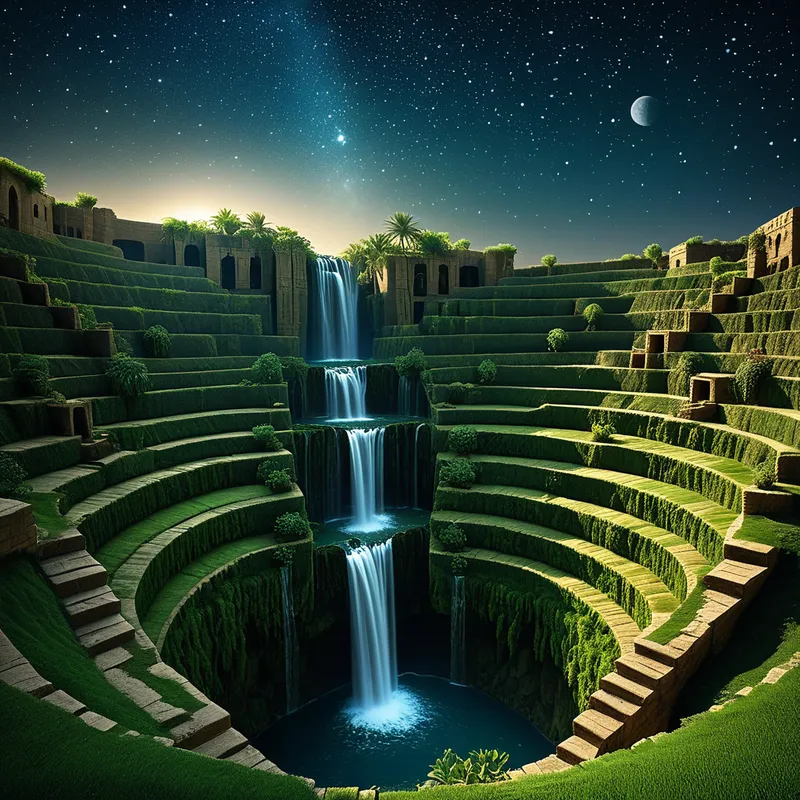
And so they built. A great ziggurat of vaults and terraces rose, tier upon tier, a mountain of human ingenuity. They hauled stones from quarries unseen, forged screws of bronze to lift the river’s heart upward. They planted a world upon the sky: cedars from Lebanon, date palms, pomegranates, and vines heavy with fruit. They built channels where water, defying its nature, flowed upward and then tumbled down in cool, misting falls, singing a constant, liquid hymn. The scent of damp earth and blooming jasmine filled the air where once there was only dust.
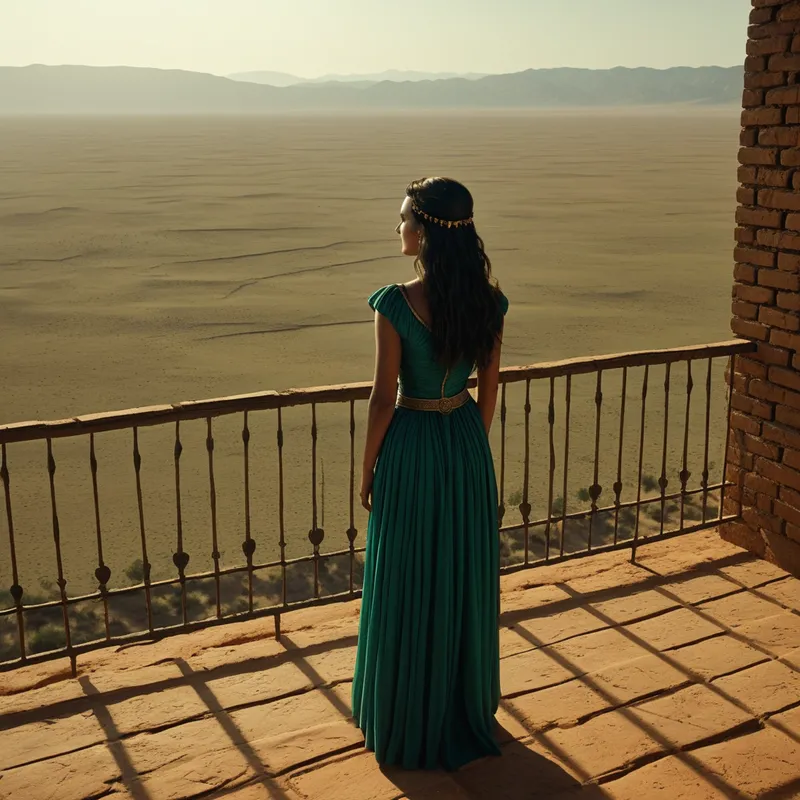
On the highest terrace, the king led his queen. The endless, tawny plain stretched below, but here, surrounded by the rustle of leaves and the murmur of artificial streams, she stood in a stolen piece of her soul. The color returned to her cheeks, not from the sun, but from the dappled green light. The garden hung between heaven and earth, a testament to a love that sought to conquer nature itself. For a time, paradise was not a memory or a promise, but a structure, maintained by countless hands, a breath held against the encroaching desert.
Cultural Origins & Context
The Hanging Gardens are a specter in the historical record, shimmering in the accounts of later classical writers like Berossus and Diodorus Siculus, yet frustratingly absent from the extensive Babylonian texts of the time. This very elusiveness is its first lesson. It exists in the realm of reported wonder, a story told by travelers, embellished by poets, and yearned for by a Mediterranean world fascinated by the ancient, colossal East.
Its societal function was multifaceted. For the classical world, it served as a benchmark of ultimate human achievement, one of the Seven Wonders. It was a symbol of the exotic, luxurious, and technically miraculous Orient. Within the implied narrative, it served as the ultimate romantic gesture and a demonstration of absolute royal power—the power to alter geography for personal solace. It was a propaganda of love and dominion, a story that said a king could remedy even the soul-sickness of homesickness through sheer will and resource. It was passed down not as a sacred myth with deities, but as a secular legend of human emotion and ambition writ impossibly large.
Symbolic Architecture
The Gardens are not merely a building; they are a profound psychological glyph. They represent the human attempt to build an Eden within the context of a fallen, or in this case, a barren world. The desert is the given reality—the flat, harsh, unforgiving landscape of our circumstances, our history, our psychological aridity. The longing of Amytis is the soul’s yearning for its own inner landscape, for beauty, memory, and vitality that feels alien to its current existence.
The Hanging Garden is the psyche’s attempt to cultivate its own oasis, to build a structure of meaning and beauty that defies the inner desert.
The king’s response is the ego’s monumental, often hubristic, project of compensation. It is the drive to fix, to build, to create external solutions for internal wounds. The ingenious irrigation—water flowing upward—is the ultimate symbol of this reversed, effortful process: forcing life (the unconscious, the emotional water) to ascend into the realm of conscious design and control. The garden is breathtaking, but it is also an immense burden, a system requiring constant maintenance against the inevitable entropy of the desert. It is paradise as a sustained effort, not a given state.

The Dreamer’s Resonance
To dream of the Hanging Gardens is to dream of a monumental personal project born of deep longing. You may dream of building an intricate, beautiful, but precarious structure. You may be watering plants on a high balcony, or searching for a source of water that must be pumped upward. The somatic feeling is often one of awe mixed with profound anxiety—the beauty is palpable, but the effort to maintain it is exhausting.
This dream pattern emerges when the dreamer is engaged in a labor of love that is also a labor of immense psychological upkeep. It might manifest when caring for a relationship that feels like it exists against all odds, sustaining a creative project in an unsupportive environment, or maintaining a facade of happiness while internally feeling barren. The dream asks: What inner landscape are you trying to artificially reconstruct? What desert are you trying to defy, and at what cost to your own resources? The garden in the dream is both the achievement and the symptom of the wound.
Alchemical Translation
The alchemical process modeled here is not a sudden transmutation, but the arduous, sustained work of elevatio—the lifting of the heavy, base material (the prima materia of the desert, the queen’s sorrow) into something radiant and alive. The king’s decree is the initial nigredo, the dark recognition of the problem and the fierce, often blind, will to solve it. The construction is the long, detailed albedo and citrinitas—the whitening and yellowing—the stages of purification and effortful organization.
The individuation journey here is the realization that the garden cannot remain an external, maintained monument. It must become an internalized landscape.
The ultimate alchemical gold, the rubedo, is not the eternal preservation of the physical gardens, but the integration of their essence. It is the moment the queen’s healing becomes her own, not dependent on the terraces. It is when the dreamer understands that the true oasis is not built against the desert, but by finding and accepting the hidden water tables within it. The gardens, in history, fade into legend. In the psyche, they must fade as an exhausting external project to be reborn as an innate, self-sustaining inner reality. The triumph is not in holding paradise aloft forever, but in discovering that its seed was within the desert all along, waiting not for an aqueduct, but for a deeper, more accepting kind of attention.
Associated Symbols
Explore related symbols from the CaleaDream lexicon: