The Hanging Gardens Myth Meaning & Symbolism
A king builds a miraculous garden to heal his queen's longing for her lost, verdant homeland, creating a paradise suspended between memory and reality.
The Tale of The Hanging Gardens
Hear now a tale not of gods clashing in the heavens, but of a love so deep it moved [the earth](/myths/the-earth “Myth from Hindu culture.”/) itself. In the heart of Babylon, where the Euphrates flows like a vein of life through dust and sun, there ruled a king named Nebuchadnezzar. His power was vast, his walls unbreachable, his city a wonder of baked brick and ambition. Yet, in his palace of lapis and gold, a shadow grew.
His queen, Amiytis, was a daughter of the highlands, where forests whispered and cool streams danced over stone. Babylon, for all its splendor, was a kingdom of flat, sun-scorched plains. The air here carried not the scent of pine and damp earth, but of hot clay and the distant, metallic tang of [the river](/myths/the-river “Myth from Buddhist culture.”/). A homesickness took root in her spirit, a longing so palpable it dimmed the light in her eyes. She would stand on the highest balcony, her gaze stretching beyond the mighty walls to the eastern horizon, seeing not the endless beige of [the desert](/myths/the-desert “Myth from Biblical culture.”/), but the lost green peaks of her youth.
The king watched this sorrow consume her. He offered jewels from Mizraim, silks from the east, musicians who could make the very air tremble. But her smile remained a ghost of itself. Her heart was a bird in a gilded cage, beating its wings against the memory of open sky and wild, growing things. He understood then that no treasure of man could cure a sickness of the soul born from a severed connection to the land.
And so, he vowed to perform a miracle not of conquest, but of creation. He would not bring the mountain to Babylon; he would build the mountain. He summoned his architects, his engineers, his slaves of a thousand nations, and issued an impossible decree: “Raise a garden that climbs to [the sky](/myths/the-sky “Myth from Persian culture.”/). Let its roots be in my kingdom, but let its soul be in hers.”
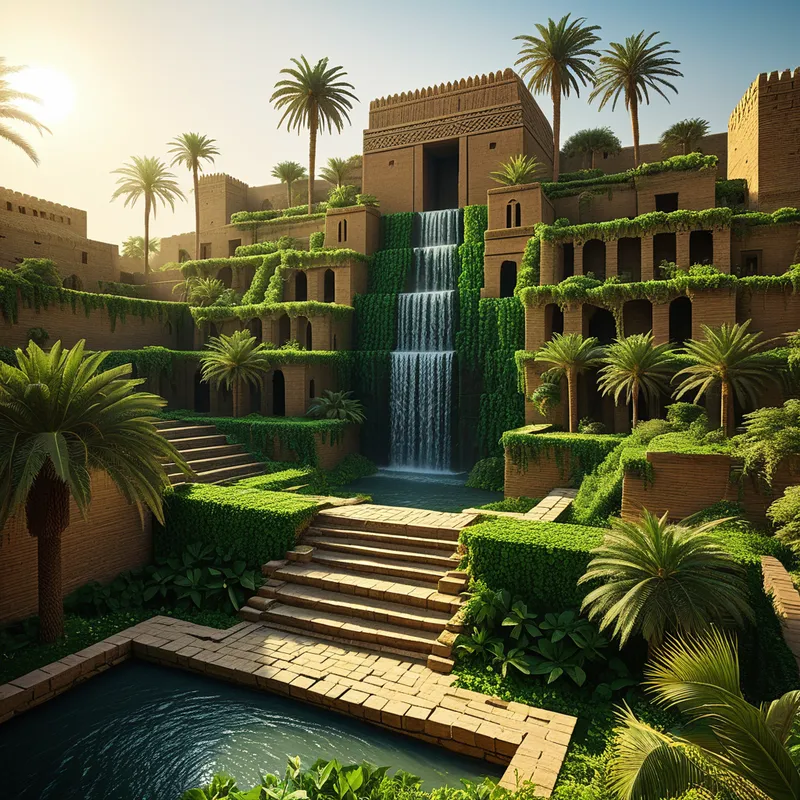
What rose from the plains was a mountain of human will. A great [ziggurat](/myths/ziggurat “Myth from Mesopotamian culture.”/), not for a god, but for a mortal heart. Tier upon tier of vaulted stone terraces ascended, each a world unto itself. Soil, brought from distant, fertile lands, was piled deep upon these stone bones. Then came the [water](/myths/water “Myth from Chinese culture.”/), the lifeblood, lifted from the river by hidden screws of bronze, whispering through a [labyrinth](/myths/labyrinth “Myth from Various culture.”/) of channels to weep from terrace to terrace in glistening veils. And in this manufactured earth, they planted a kingdom of green: towering date palms, fragrant cypress, fig trees heavy with fruit, vines laden with grapes, and flowers of every hue known to the sun.
The day came when he led her, blindfolded, to the base of this new mountain. When the cloth fell from her eyes, she did not see brick or engineering. She saw a vision. A lush, sloping forest, impossibly suspended in the dry Babylonian air. The sound of water was everywhere. The cool, damp breath of the earth, her earth, kissed her face. She climbed, her fingers brushing leaves still wet with spray, and at [the summit](/myths/the-summit “Myth from Taoist culture.”/), surrounded by the murmur of life and the scent of blooming [jasmine](/myths/jasmine “Myth from Persian culture.”/), she looked out not with longing, but with wonder. The king had built a memory made real, a piece of her soul given form and soil. In that suspended paradise, her spirit took root and bloomed once more.
Cultural Origins & Context
[The Hanging Gardens of Babylon](/myths/the-hanging-gardens-of-babylon “Myth from Global/Universal culture.”/) occupy a unique space between history, legend, and national myth. While attributed in later classical sources (like those of Berossus and Diodorus Siculus) to Nebuchadnezzar II, no contemporary Babylonian inscription has been found that describes them. This very absence is telling. The myth likely functioned as an etiological narrative—a story explaining a profound cultural achievement. It wasn’t merely about a garden; it was a testament to Babylonian engineering genius and the king’s absolute power to reshape reality for a noble cause.
The story was passed down not by Babylonian bards in the city squares, but by foreign historians and travelers, captivated by the idea of such a marvel. It served as the ultimate symbol of imperial capability and romantic devotion, blending the Mesopotamian reverence for monumental architecture (the Etemenanki) with a deeply human, personal motive. In a culture where kingship was divinely ordained and the king was the steward of the land’s fertility, the myth presented a perfect fusion: the ruler using his divine mandate not just for the state, but to enact a healing, personal miracle that mirrored the gods’ own acts of creation and order over chaos.
Symbolic Architecture
At its core, the myth is a profound [symbol](/symbols/symbol “Symbol: A symbol can represent an idea, concept, or belief, serving as a powerful tool for communication and understanding.”/) of the [psyche](/myths/psyche “Myth from Greek culture.”/)‘s [capacity](/symbols/capacity “Symbol: A measure of one’s potential, limits, or ability to contain, process, or achieve something, often reflecting self-assessment or external demands.”/) to build bridges between irreconcilable realities. The Gardens are not a natural formation; they are a conscious, arduous [construction](/symbols/construction “Symbol: Construction symbolizes creation, building, and the process of change, often reflecting personal growth and the need to build a solid foundation.”/) at the [intersection](/symbols/intersection “Symbol: An intersection symbolizes the crossroads of decision-making, presenting choices and the potential for change.”/) of longing and [reality](/symbols/reality “Symbol: Reality signifies the state of existence and perception, often reflecting one’s understanding of truth and life experiences.”/), [memory](/symbols/memory “Symbol: Memory symbolizes the past, lessons learned, and the narratives we construct about our identities.”/) and the present [moment](/symbols/moment “Symbol: The symbol of a ‘moment’ embodies the significance of transient experiences that encapsulate emotional depth or pivotal transformations in life.”/).
The Hanging Garden is the soul’s architecture, a deliberate construction where the living waters of emotion are lifted by the screws of will to irrigate the transplanted soil of memory.
Amiytis represents the feeling function in [exile](/symbols/exile “Symbol: Forced separation from one’s homeland or community, representing loss of belonging, punishment, or profound isolation.”/)—the part of us connected to our inner [landscape](/symbols/landscape “Symbol: Landscapes in dreams are powerful symbols representing the dreamer’s emotional state, personal journey, and the broader context of life situations.”/), our emotional homeland. Her sickness is the depression and alienation that sets in when that inner world is denied [expression](/symbols/expression “Symbol: Expression represents the act of conveying thoughts, emotions, and individuality, emphasizing personal communication and creativity.”/) in our outer [life](/symbols/life “Symbol: The symbol of ‘Life’ represents a journey of growth, interconnectedness, and existential meaning, encompassing both the joys and challenges that define human experience.”/). Nebuchadnezzar symbolizes the directed, [problem](/symbols/problem “Symbol: Dreams featuring a ‘problem’ often symbolize internal conflicts or challenging situations that require resolution and self-reflection.”/)-solving thinking function and the will of the conscious ego. The garden itself is the coniunctio oppositorum—the sacred [marriage](/symbols/marriage “Symbol: Marriage symbolizes commitment, partnership, and the merging of two identities, often reflecting one’s feelings about relationships and social obligations.”/). It is the synthesized third [thing](/myths/thing “Myth from Norse culture.”/), born from the [tension](/symbols/tension “Symbol: A state of mental or emotional strain, often manifesting physically as tightness, pressure, or unease, signaling unresolved conflict or anticipation.”/) between the [queen](/symbols/queen “Symbol: A queen represents authority, power, nurturing, and femininity, often embodying leadership and responsibility.”/)‘s longing (feeling) and the [king](/symbols/king “Symbol: A symbol of ultimate authority, leadership, and societal order, often representing the dreamer’s inner power or external control figures.”/)‘s power (thinking, [action](/symbols/action “Symbol: Action in dreams represents the drive for agency, motivation, and the ability to take control of situations in waking life.”/)). It is a living symbol of [the Self](/myths/the-self “Myth from Jungian culture.”/), a psychic [structure](/symbols/structure “Symbol: Structure in dreams often symbolizes stability, organization, and the framework of one’s life, reflecting how one perceives their environment and personal life.”/) that can hold and nurture our most vulnerable, homesick parts.
The Dreamer’s Resonance
To dream of the [Hanging Gardens](/myths/hanging-gardens “Myth from Persian culture.”/) is to encounter a psyche actively engaged in a work of profound interior reconciliation. The dreamer may be experiencing a deep sense of displacement—in their career, relationships, or within themselves. The somatic feeling is often one of weightlessness combined with rootedness, a paradoxical sense of being both precariously suspended and firmly supported.
The dream image might manifest as an impossibly lush room in a modern skyscraper, a forgotten rooftop oasis in an urban jungle, or a tree growing upside-down from a ceiling. The key is the element of miraculous irrigation—water flowing against logic to feed life in an unlikely place. This signals that the unconscious is engineering a solution, channeling emotional energy (the water) to a part of the personality that has been arid and neglected (the transplanted soil of a lost or suppressed aspect of the self). The dream is a testament to the psyche’s innate drive to heal fragmentation by building integrative structures.
Alchemical Translation
The myth models the individuation process as an act of sacred, loving construction. The initial state is one of [separatio](/myths/separatio “Myth from Alchemical culture.”/): the queen’s inner world (feeling, memory, the anima) is utterly disconnected from the king’s outer world of power, action, and identity (the [persona](/myths/persona “Myth from Greek culture.”/), the conscious ego). This causes a [nigredo](/myths/nigredo “Myth from Alchemical culture.”/), a darkening of the spirit, a depressive stagnation.
The king’s decision to build is the beginning of the alchemical opus. It represents [the ego](/myths/the-ego “Myth from Jungian culture.”/)‘s commitment to serve the needs of the deeper Self, however impossible the task seems. The gathering of materials—the soil from afar, the water from below, the stones from the earth—is the laborious process of gathering psychic material from the unconscious (memories, affects, instincts) and the resources of consciousness (discipline, skill, patience).
Individuation is not a return to a lost paradise, but the conscious, brick-by-brick construction of a new one that can exist in the present reality.
The final garden, the [lapis philosophorum](/myths/lapis-philosophorum “Myth from Alchemical culture.”/) or [philosopher’s stone](/myths/philosophers-stone “Myth from Alchemical culture.”/) of this myth, is the achieved state of inner wholeness. It is not the original homeland; it is something new and more complex. It is a psychic structure that allows one to inhabit their current life (Babylon) while being nourished by the authentic waters of their deepest nature. The garden “hangs”—it is sustained by ongoing effort, by the continuous “screw pump” of attention and care. It teaches that wholeness is not a static state of bliss, but a living, breathing, cultivated achievement, a paradise we are forever responsible for maintaining, a suspended bridge between who we were, who we are, and who we are becoming.
Associated Symbols
Explore related symbols from the CaleaDream lexicon: