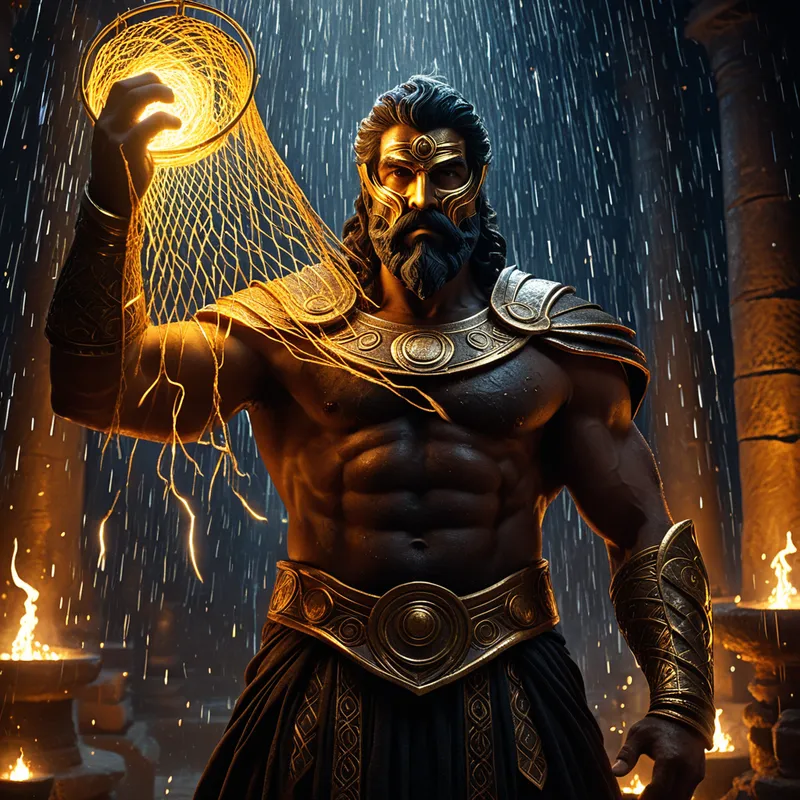
The hands of Hephaestus Myth Meaning & Symbolism
The rejected god, cast from Olympus, whose broken hands learn to forge beauty from pain, crafting divine artifacts from the fire of his own exile.
The Tale of The hands of Hephaestus
Hear now the tale not of thunder, but of the fire beneath the mountain. The story begins not with a cry of triumph, but with a fall that lasted a day and a night.
In the golden halls of Olympus, where the air is nectar and laughter rings like crystal, a child was born to the Queen of Heaven, Hera. But when she beheld him, her joy turned to ice. The babe was not like the others—not perfectly formed like Ares or radiant like Aphrodite. His legs were twisted, his gait would never be graceful. In a moment of divine shame and terror, Hera snatched the infant from his cradle. Without a word, she hurled him from the cloud-veiled peaks of Olympus.
He fell, a silent star of anguish, through the vault of heaven. The wind screamed in his infant ears; the world below rushed up to meet him. He did not strike the earth, but the wine-dark sea. The impact was a cataclysm of foam and shattered light. The sea-nymphs, Thetis and Eurynome, found him sinking into the abyss. Their hearts, softer than the Olympians’, stirred with pity. They lifted his broken form and carried him not upward, but inward—to a secret grotto at the world’s root, a hidden womb of stone.
For nine years, he dwelled in that submarine twilight. His legs, useless for running, found their purpose in stillness. His hands—oh, his hands! They became his world. In the dark, he felt the coolness of shells, the smoothness of whalebone, the rough promise of ore washed down from distant rivers. With nothing but need and a slow-burning fire in his spirit, he began to make. First, simple trinkets for his kind guardians: a clasp of pearl, a comb of coral. Then, more. He built his own tools from flotsam and mystery. He discovered a vein of fire in the rock and coaxed it forth with his breath and will.
His hands, once empty, now held power. They learned the language of metal—the song of bronze as it glowed, the whisper of gold as it flowed. In the absolute silence of his exile, he forged a throne. Not a simple seat, but a masterpiece of cunning artifice, inlaid with gems that held the memory of starlight, articulated with joints finer than a spider’s web. It was a work of such sublime beauty that it was also a perfect trap. He sent it to Olympus, a gift for his mother.
When Hera sat upon it, the throne came alive. Invisible bands of gold clasped her wrists and ankles, holding the Queen of Heaven fast. No god could free her. Laughter died in the golden halls. Only one being in all creation knew the secret of the lock. They had to summon the forger himself.
And so Hephaestus returned. Not crawling, not pleading, but walking with a slow, deliberate, thunderous gait, supported by a staff of his own making. He ascended to Olympus, not as a cast-off child, but as a power. The gods looked upon his soot-smudged face, his mighty shoulders, and the hands that could bind a goddess or unmake the world. He freed Hera, not out of filial love, but from a bargain struck: a place among them, a forge of his own, and the hand of Aphrodite in marriage. The rejected one was now indispensable. The fire he tended was no longer just his own; it became the heart of the world’s making.

Cultural Origins & Context
The myth of Hephaestus originates from the complex tapestry of ancient Greek religion and oral tradition, crystallized in the epic verses of Homer’s Iliad and Odyssey and later elaborated by poets like Hesiod. Unlike the tales of heroes recited in public squares, the story of the lame god likely resonated in more intimate settings—among artisans, smiths, and those who worked with their hands, transforming raw, earthly materials into objects of utility and beauty. It served as a divine charter for the craftsperson’s life: a validation of physical labor, technical skill (techne), and creative intelligence (metis) as forces worthy of Olympus itself.
Societally, it functioned as a profound theodicy—an explanation for imperfection within a supposedly perfect divine order. It asked: what is the place of the broken, the limping, the outwardly un-beautiful in a cosmos ruled by ideals of power and grace? The answer was not pity, but a redefinition of power. Hephaestus’s myth asserted that true authority is born not from inherited status (his divine birth granted him nothing) but from cultivated mastery, and that the deepest creativity often springs from the well of profound personal suffering and isolation.
Symbolic Architecture
The hands of Hephaestus are the central, living symbol of the entire myth. They represent the alchemical faculty that transforms raw, painful experience (prima materia) into conscious, creative power.
The first forge is not the hearth of stone, but the crucible of the soul. What is thrown away becomes the substance of creation.
His fall symbolizes a necessary descent—not a punishment, but an initiation into the depths of the material and psychological world. Olympus represents the conscious ego, idealistic and rejecting of what is “flawed.” The sea and the grotto are the unconscious, the nurturing yet challenging womb where the rejected parts of the self are received and incubated. His lameness is the emblem of the “creative wound,” the perceived limitation that forces a specialization of spirit, compelling energy away from conventional paths (walking, fighting) and into a focused, interior direction (making, crafting).
His return and binding of Hera is the ultimate psychological integration. The mother archetype, which initially rejected him, is now held captive by his art. This is not revenge, but a necessary re-balancing of power. The conscious ego (represented by the Olympian pantheon) must acknowledge its dependence on the creative, transformative, and often “shadow” functions (the forge, the dark, skilled hands). He is paid homage not despite his difference, but because of it.
The Dreamer’s Resonance
When the motif of Hephaestus’s hands appears in modern dreams, it signals a profound somatic and psychological process underway. The dreamer may be experiencing a period of felt exile—from a social group, a cherished self-image, or a state of grace. There is a deep sense of being “cast out” due to some perceived inadequacy or difference.
Somatically, this can manifest as dreams of falling, of being underwater or underground, or of intense focus on the hands—dreams of building, repairing, or holding something incredibly fragile and hot. The hands in the dream are often highlighted: they may be glowing, oversized, stained, or incredibly dexterous. This points to the psyche mobilizing its resources toward creation as compensation. The unconscious is asserting that the power to reshape one’s reality lies not in seeking approval from the “heights” from which one fell, but in attending to the raw materials of one’s current, grounded experience. The dream is an invitation to build your throne from the substance of your exile.
Alchemical Translation
The Hephaestian journey is a master blueprint for the alchemical process of individuation—the forging of a cohesive, authentic Self. It begins with the nigredo, the blackening: the brutal, often humiliating experience of rejection and descent (Hera’s throw, the sea-impact). This is the necessary dissolution of the old, false identity tied to external validation.
The nine years in the grotto represent the albedo, the whitening: a long, silent period of incubation and purification. Here, in the solitude of the unconscious, the prima materia of pain, anger, and grief is worked upon. The hands are the active, conscious ego learning to cooperate with the transformative fire of the instinctual self. This is the stage of acquiring techne—the personal, hard-won skill of processing experience.
The god is not born in the light, but made in the dark. The Self is not found, it is forged.
The creation of the throne is the citrinitas, the yellowing: the creation of a conscious artifact (a new attitude, a creative work, a psychological insight) from the processed material. It is a product of the depths, beautiful but also potent and dangerous to the old order.
The return to Olympus and the binding/reconciliation is the rubedo, the reddening: the integration of the forged consciousness back into the totality of the personality. The once-rejected creative function now has a permanent, honored seat at the table of the psyche. The individual no longer seeks to be “un-lame” by the old standards, but recognizes that their unique gait—their particular mode of being and creating—is the very source of their sovereignty and indispensable power. The fire of the forge becomes the illuminating, warming center of one’s own world.
Associated Symbols
Explore related symbols from the CaleaDream lexicon: