The Hall of Ma'at Myth Meaning & Symbolism
The soul's journey to the afterlife hall where the heart is weighed against the Feather of Truth, determining eternal fate by the measure of a life lived.
The Tale of The Hall of Ma’at
Listen. [The river of life](/myths/the-river-of-life “Myth from Hindu culture.”/) has run its course. The sun-baked body lies still, but the Ka and the Ba are restless, drawn by a current older than the Nile itself. They travel not by boat, but by necessity, through the Duat, a landscape of whispering reeds and silent stars, of trial and memory.
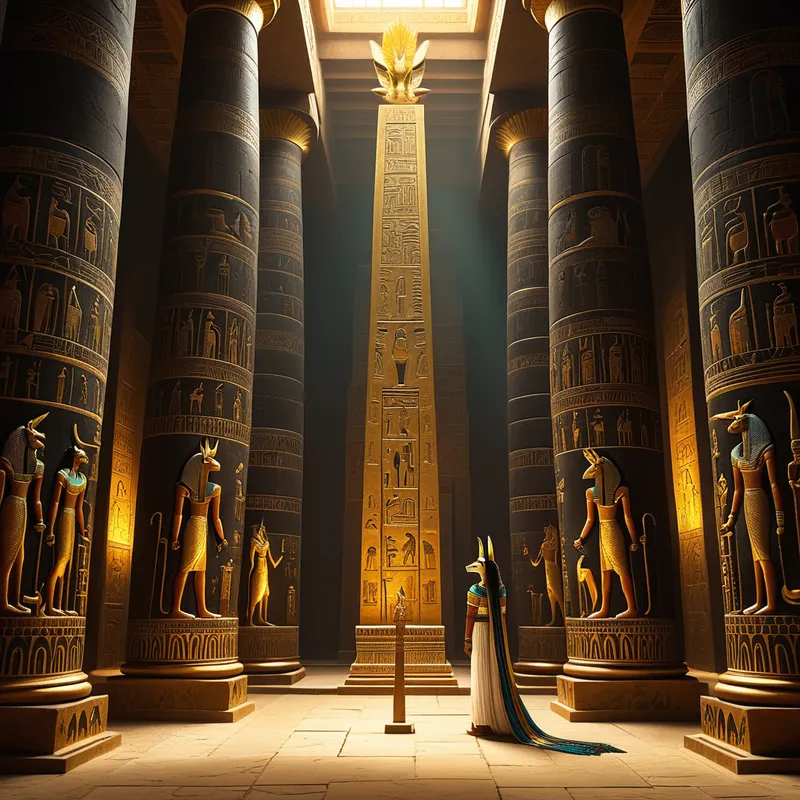
The journey ends before a portal of obsidian and fire. This is the Hall of Two Truths. Within, the air is not air, but a substance of pure consequence. Shadows cling to forty-two pillars, and in those shadows, forms stir—the Assessors, the Forty-Two Judges. Their eyes are not eyes, but voids that see the shape of your deeds.
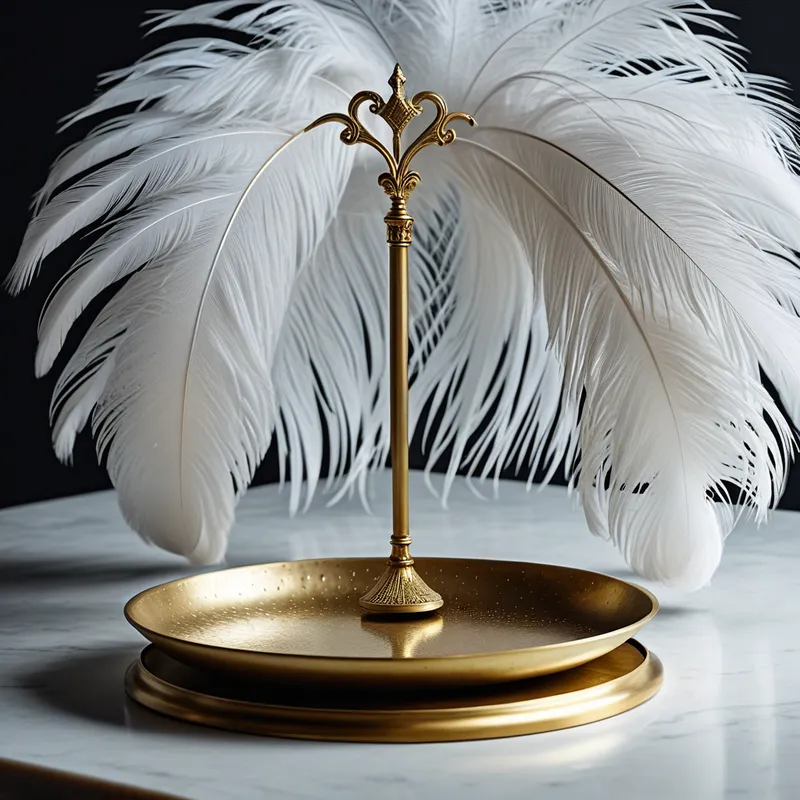
At the hall’s heart, beneath a ceiling painted with the eternal circuit of the sun, stands the apparatus of destiny. Anubis, his ears pricked for the truth, presides over the golden scales. His fingers, precise as a surgeon’s, prepare the balance. On one pan, he places the Shu, a feather so white it hums with silence, the perfect weight of cosmic order.
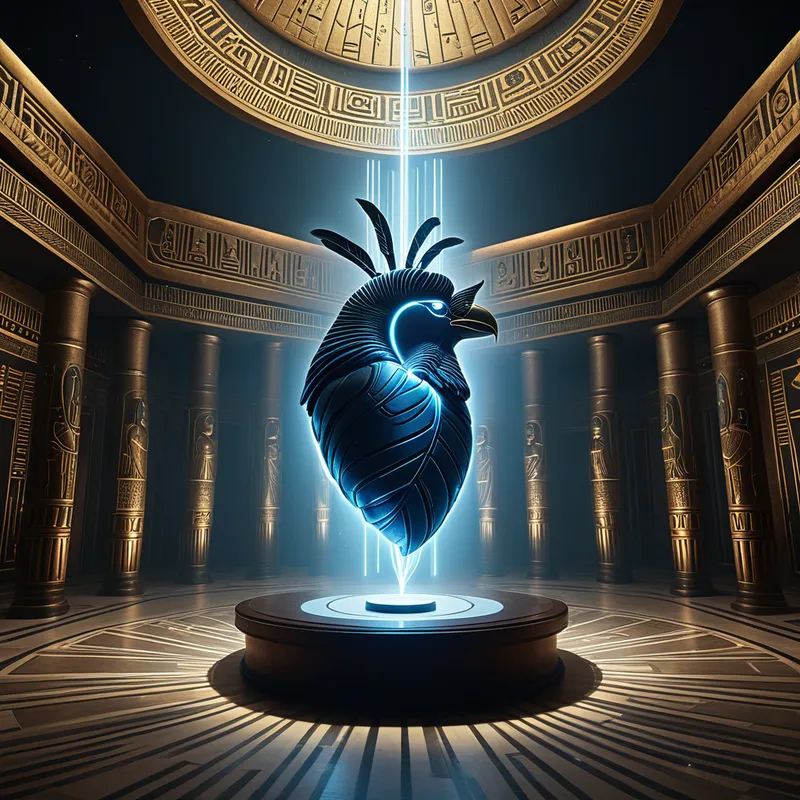
Then he turns to you. Not to your face, but to the center of your being. With a gesture both gentle and irrevocable, he draws forth your Ib—your heart. It is not the muscle of flesh, but its essence: a luminous, weighty orb, swirling with every laugh withheld, every kindness given, every lie nursed, every bread shared. It holds the heat of your rage and the chill of your indifference. This is what is placed upon the empty scale.
[The world](/myths/the-world “Myth from Tarot culture.”/) holds its breath. The feather, immutable. The heart, the sum of a lifetime. The needle trembles. If the heart is heavy with the lead of misdeeds—Isfet—it will sink. The dread Ammit crouches nearby, her maw dripping with [the void](/myths/the-void “Myth from Buddhist culture.”/) of oblivion, waiting to consume the heart and erase the soul forever.
But if the scales balance… if the heart is as light as the feather… a presence manifests. [Ma’at](/myths/maat “Myth from Egyptian culture.”/) herself, crowned with her own feather, offers a nod of infinite serenity. Then, the scribe of the gods, [Thoth](/myths/thoth “Myth from Global/Universal culture.”/), records the verdict with a reed pen on a [papyrus](/myths/papyrus “Myth from Egyptian culture.”/) of stars. You are led before the enthroned [Osiris](/myths/osiris “Myth from Global/Universal culture.”/), green-skinned lord of the resurrected, who grants the right to speak your name and enter the Sekhet-Aaru, to live forever in the light of truth.
Cultural Origins & Context
This was not merely a story told to frighten or comfort. It was the central operating system of Egyptian ethics and cosmology for over three millennia. The myth is detailed in funerary texts like the Book of the Dead, placed in tombs as a guidebook for the deceased. It was recited by priests during burial rites, a performative magic to ensure the soul remembered the truths to speak and the path to follow.
Its societal function was profound. The [Hall of Ma’at](/myths/hall-of-maat “Myth from Egyptian culture.”/) was the ultimate divine court, a concept that projected the Pharaonic ideal of [justice](/myths/justice “Myth from Tarot culture.”/) onto the cosmos. Just as [the Pharaoh](/myths/the-pharaoh “Myth from Egyptian culture.”/) was meant to uphold Ma’at on earth, so would every individual be held to account by it in death. This myth democratized morality. A peasant’s heart was weighed with the same scales as a king’s. It provided a cosmic incentive for social harmony and personal integrity, weaving the principle of Ma’at into the very fabric of daily life, law, and religion.
Symbolic Architecture
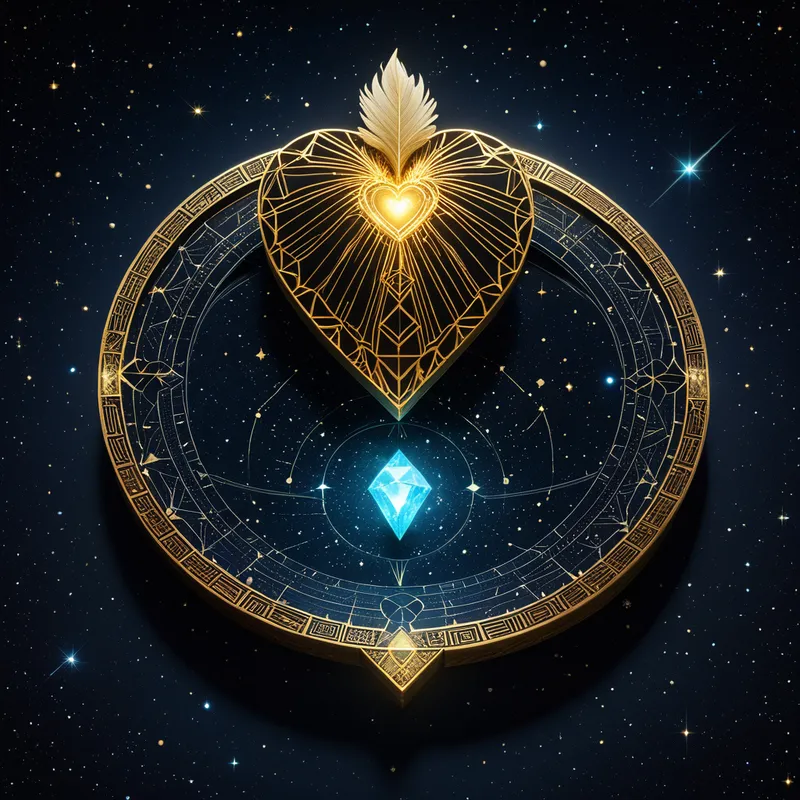
The Hall is not a place, but a state of being—the ultimate [moment](/symbols/moment “Symbol: The symbol of a ‘moment’ embodies the significance of transient experiences that encapsulate emotional depth or pivotal transformations in life.”/) of existential accounting. The [heart](/symbols/heart “Symbol: The heart symbolizes love, emotion, and the core of one’s existence, representing deep connections with others and self.”/) (Ib) symbolizes the total psychic record, the unconscious [ledger](/symbols/ledger “Symbol: A symbolic record of accounts, debts, and balances, representing life’s moral, emotional, and transactional reckonings.”/) of all we have been and done. The [feather](/symbols/feather “Symbol: A feather represents spiritual elevation, lightness, and the freedom of the spirit. It often symbolizes messages from the divine and connection to ancient wisdom.”/) is not just “[truth](/symbols/truth “Symbol: Truth represents authenticity, honesty, and the quest for knowledge beyond mere appearances.”/),” but [the principle](/symbols/the-principle “Symbol: A fundamental truth, law, or doctrine that serves as a foundation for a system of belief, behavior, or reasoning, often representing moral or ethical standards.”/) of harmonious order, the [weight](/symbols/weight “Symbol: Weight symbolizes burdens, responsibilities, and emotional loads one carries in life.”/) of a [life](/symbols/life “Symbol: The symbol of ‘Life’ represents a journey of growth, interconnectedness, and existential meaning, encompassing both the joys and challenges that define human experience.”/) in alignment with the fundamental [pattern](/symbols/pattern “Symbol: A ‘Pattern’ in dreams often signifies the underlying structure of experiences and thoughts, representing both order and the repetitiveness of life’s situations.”/) of the [cosmos](/symbols/cosmos “Symbol: The entire universe as an ordered, harmonious system, often representing the totality of existence, spiritual connection, and the unknown.”/).
The judgment is not between good and evil, but between congruence and contradiction. The heart weighed is the self measured against its own deepest, truest pattern.
The Forty-Two Assessors represent the myriad social and moral laws, the collective conscience. Anubis is [the psychopomp](/myths/the-psychopomp “Myth from Various culture.”/), the guide who facilitates this profound inner confrontation. Ma’at is the archetypal principle of objective [reality](/symbols/reality “Symbol: Reality signifies the state of existence and perception, often reflecting one’s understanding of truth and life experiences.”/) and ethical law, against which all subjective experience is finally judged. Ammit is the terrifying [symbol](/symbols/symbol “Symbol: A symbol can represent an idea, concept, or belief, serving as a powerful tool for communication and understanding.”/) of psychic annihilation, the total [disintegration](/symbols/disintegration “Symbol: A symbol of breakdown, loss of form, or fragmentation, often reflecting anxiety about personal identity, control, or stability.”/) that awaits a life built on denial and falsehood.
The Dreamer’s Resonance
When this myth stirs in modern dreams, the dreamer is in a profound state of self-assessment. The dream may not feature Egyptian iconography directly. Instead, one might dream of being audited by a faceless committee, of taking a final exam for a class they never attended, or of trying to cross a chasm on a bridge that grows thinner with each step.
The somatic feeling is one of naked exposure and intense scrutiny. The psychological process is the unconscious forcing a confrontation with [the shadow](/myths/the-shadow “Myth from Jungian culture.”/)—all the disowned parts, the unpaid debts of the spirit, the compromises that have accumulated psychic mass. The dream is the soul’s own Anubis, guiding [the ego](/myths/the-ego “Myth from Jungian culture.”/) to the scales it has avoided. The anxiety is the heart’s own weight being felt for the first time.
Alchemical Translation
The journey through the Hall of Ma’at is the archetypal blueprint for the psychological process of individuation—becoming whole. The alchemical operation here is [putrefactio](/myths/putrefactio “Myth from Alchemical culture.”/) and [separatio](/myths/separatio “Myth from Alchemical culture.”/) followed by a possible mortificatio or exaltatio.
First, the “death” of the ego’s self-image (the journey to [the Duat](/myths/the-duat “Myth from Egyptian culture.”/)). Then, the separation and extraction of the heart—the core of one’s being—from the protective identifications of the [persona](/myths/persona “Myth from Greek culture.”/). This heart is subjected to the ultimate objective measure: not the opinions of others, but [the law](/myths/the-law “Myth from Biblical culture.”/) of one’s own deepest truth (Ma’at).
The feather is the Self, the total, integrated personality. The heart is the ego-complex. Individuation is the lifelong work of making the ego congruent with the Self, so that, in the end, they weigh the same.
The devouring by Ammit symbolizes the psychic death that occurs when the ego refuses this integration, clinging to its heaviness of illusion. The audience with Osiris symbolizes rebirth into a new, conscious order—the ego now in service to [the Self](/myths/the-self “Myth from Jungian culture.”/). For the modern individual, the Hall is entered daily in moments of brutal self-honesty, in the quiet after a failure, in the courage to make amends. It is the internal court where we are both the accused and the divine judge, and our task is to render a verdict that allows our heart, finally, to be as light as a feather.
Associated Symbols
Explore related symbols from the CaleaDream lexicon: