The Haenyeo Sea Women Spirits Myth Meaning & Symbolism
A myth of women who dive into the abyss to commune with the sea goddess, returning with life's bounty and the soul's hidden knowledge.
The Tale of The Haenyeo Sea Women Spirits
Listen, and let the salt air fill your lungs. Let the crash of the Donghae waves against the black volcanic rocks of Jeju Island become the drumbeat of this story. In the time before time, when the world was raw and spirits walked the shorelines, the people were hungry. The land was stingy, its soil thin over stone. Men sailed out on boats, but the storms were cruel, and the nets often came back empty, slick with tears.
The women watched. They felt the hunger of their children like a stone in their own bellies. They stood at the water’s edge, not as supplicants, but as equals, feeling the push and pull of the tide in their own blood. One among them, a woman with eyes the color of a deep pool and a spirit as untamed as the wind, could bear it no longer. While others slept, she walked into the sea. Not to drown, but to listen.
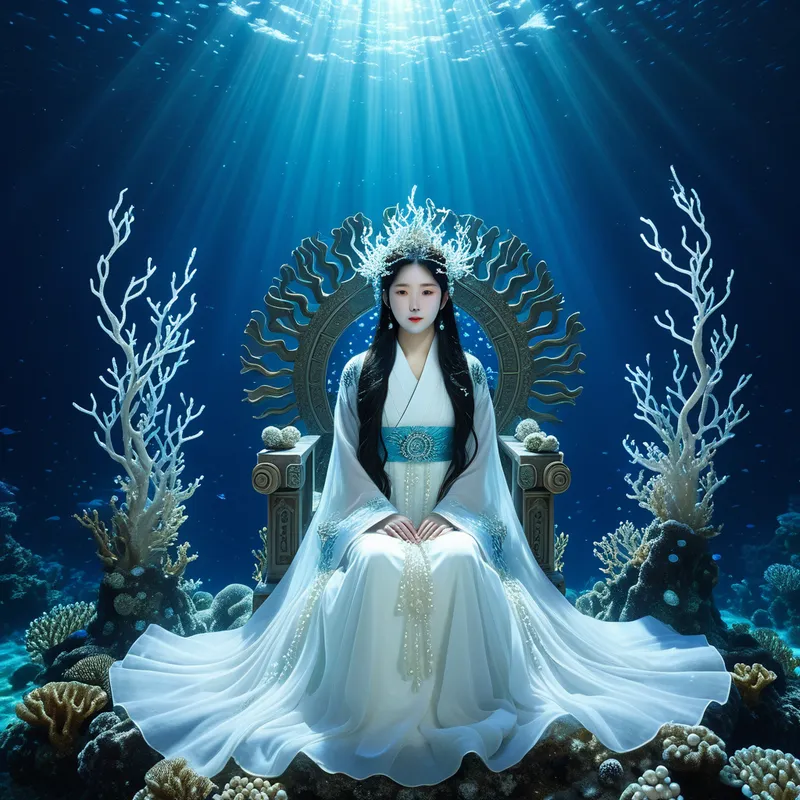
The cold was a knife. The pressure was a mountain on her chest. But she did not fight. She opened her eyes in the green gloom and let her last breath become an offering. As her consciousness frayed at the edges, a presence gathered. It was vast, ancient, and feminine. It was Jamsugut, the Lady of the Depths. Her form was of shifting water and the iridescent flash of scale, her hair a forest of kelp, her voice the groan of continental shelves.
“You have given me your breath, the essence of your life above,” the goddess murmured, a sound felt in the bones, not the ears. “What do you seek?”
“Life for my people,” the woman answered with her spirit, for her lungs were empty. “Not scraps from the surface, but the bounty you guard below.”
Jamsugut considered. She saw the woman’s courage, her sacrifice born not of foolishness but of a fierce, protective love. “The ocean’s wealth is not for the taking,” she declared. “It is for the knowing. To know it, you must know death. You must visit my realm on the edge of the void and return, again and again. You must learn the language of the abyss—the song of the urchin, the whisper of the abalone, the warning tremor of the octopus. I will teach you this tongue. I will grant you the strength to hold the sea on your chest and the wisdom to read its moods. But the price is your comfort. The price is a life lived between two worlds, belonging fully to neither.”
The woman, her body screaming for air, accepted. In that moment, Jamsugut breathed into her—not air, but a kind of knowing. A pact was sealed. The woman surged upward, breaking the surface with a great, gasping sob that was also a song. In her hands, she held a harvest no net could catch: sea urchins, octopus, gleaming abalone.
She taught the other women. They learned to master the single breath, to dive deep on a thread of life, to work in the silent, weightless world. They became the Haenyeo, and their spirits, tempered in the cold dark, became the Sea Women Spirits. They were the bridge. In their daily dance with drowning, they carried the prayers of the village down and brought the mercy of the goddess up. Their whistle—the sumbisori—was the sound of that returning spirit, a sharp, triumphant exhalation that told the world, “I have been to the kingdom of death, and I have returned with life.”
Cultural Origins & Context
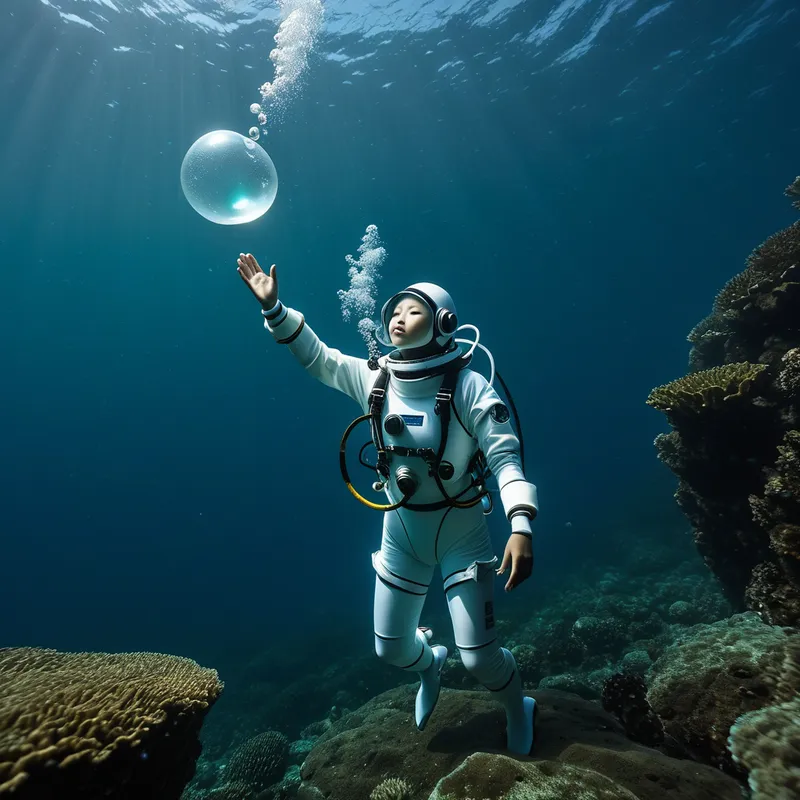
This myth is not a relic of a distant past but the living breath of Jeju Island’s Muism. It is the sacred narrative woven into the very practice of the Haenyeo, a matrifocal diving society that dates back centuries. The story was not written in books but sung in the sumbisori, enacted in every dive, and formalized in the Jamsu-gut ceremonies.
Told by Mudang and elder divers, its function was profoundly practical and spiritual. It served as an initiatory charter, explaining the origin of the Haenyeo’s dangerous vocation and sanctifying it. It provided a psychological framework for confronting mortal fear daily. By framing their work as a sacred covenant with Jamsugut, the divers transformed an act of economic necessity into a ritual of communion and courage. The myth cemented their identity not as laborers, but as priestesses of the threshold, mediating between the human community and the unpredictable, generous, and deadly divine feminine of the ocean.
Symbolic Architecture
At its core, this is a myth of conscious descent. The [Ocean](/symbols/ocean “Symbol: The ocean symbolizes the vastness of the unconscious mind, representing deeper emotions, intuition, and the mysteries of life.”/) is the primordial [Mother](/symbols/mother “Symbol: The symbol of ‘Mother’ represents nurturing, protection, and the foundational aspect of one’s emotional being, often associated with comfort and unconditional love.”/), but also the [realm](/symbols/realm “Symbol: The symbol of ‘Realm’ often signifies the boundaries of one’s consciousness, experiences, or emotional states, suggesting aspects of reality that are either explored or ignored.”/) of the [Shadow](/symbols/shadow “Symbol: The ‘shadow’ embodies the unconscious, repressed aspects of the self and often represents fears or hidden emotions.”/)—everything hidden, repressed, and teeming with latent [life](/symbols/life “Symbol: The symbol of ‘Life’ represents a journey of growth, interconnectedness, and existential meaning, encompassing both the joys and challenges that define human experience.”/). The Haenyeo does not fall into it passively; she chooses to enter.
The hero’s journey is not always outward to slay dragons, but inward to hold the tension of opposites: breath and suffocation, life and death, surface and depth.
Her single [Breath](/symbols/breath “Symbol: Breath symbolizes life, vitality, and the connection between the physical and spiritual realms.”/) is the totality of her conscious ego-life, which she voluntarily surrenders. This is the ultimate Sacrifice. In the silent void that follows, where the ego’s chatter is extinguished, she encounters the Self in the form of Jamsugut. The [goddess](/symbols/goddess “Symbol: The goddess symbolizes feminine power, divinity, and the nurturing aspects of life, embodying creation and wisdom.”/) represents the organizing, guiding principle of the deep psyche. The bounty she grants—the Fish, the abalone—are the psychic contents and vital energies that can only be retrieved through such a brave engagement with the [depths](/symbols/depths “Symbol: Represents the subconscious, hidden emotions, or foundational aspects of the self, often linked to primal fears or profound truths.”/).
The cyclical dive and return model the process of [Death](/symbols/death “Symbol: Symbolizes transformation, endings, and new beginnings; often associated with fear of the unknown.”/) and [Rebirth](/symbols/rebirth “Symbol: A profound transformation where old aspects of self or life die, making way for new beginnings, growth, and renewal.”/) that is central to psychological growth. The Haenyeo’s [body](/symbols/body “Symbol: The body in dreams often symbolizes the dreamer’s self-identity, personal health, and the relationship they have with their physical existence.”/) is the [Temple](/symbols/temple “Symbol: A temple often symbolizes spirituality, sanctuary, and a deep connection to the sacred aspects of life.”/) where this [alchemy](/symbols/alchemy “Symbol: A transformative process of purification and creation, often symbolizing personal or spiritual evolution through difficult stages.”/) occurs daily.
The Dreamer’s Resonance
When this myth stirs in the modern Dream, it often manifests as dreams of diving into deep, dark water, of holding one’s breath under pressure, or of finding luminous objects on a murky seafloor. The dreamer is not necessarily a diver; they are undergoing a somatic and psychological process of diving into their own depths.
The somatic feeling is one of compression, of being weighed down yet purposeful. Psychologically, it signifies a point in life where surface solutions have failed. The ego is being compelled, or is choosing, to “go deep” into a repressed emotion, a forgotten trauma, or an unexplored talent. The fear of running out of air is the fear of the ego dissolving, of losing control. Finding a “treasure” in the dream—a pearl, a key, a chest—symbolizes retrieving a vital insight, a memory, or a piece of one’s authentic self from the shadowy depths of the personal unconscious. The dream is an enactment of the psyche’s innate healing intelligence, urging a courageous descent to find the resources needed for wholeness.

Alchemical Translation
For the modern individual, the Haenyeo myth provides a profound model for Individuation. Our “village” is our persona, our adapted self that feels the “hunger” of meaninglessness or stagnation. The conscious ego is the woman on the shore.
The alchemical work begins not with adding more, but with a willing surrender of the very breath of one’s current identity.
The “dive” is the act of turning inward, away from collective norms and egoic certainties, into the cold, unfamiliar waters of the unconscious. This requires discipline (the single, focused breath) and courage (tolerating the anxiety of the unknown). The encounter with Jamsugut is the critical moment of engaging with the archetypal Self. It is the point where one moves from being a victim of unconscious complexes to forming a conscious relationship with the deeper guiding center of the psyche.
The retrieved “bounty” is the integrated content: perhaps a reclaimed passion (art, music), a acknowledged wound that can now heal, or a new, more grounded sense of purpose. The return to the surface and the triumphant sumbisori is the act of bringing this new knowledge back into daily life, enriching not only oneself but one’s community. One learns to live “between two worlds”—fully engaged in the practical world, yet perpetually in dialogue with the deep, nourishing, and sometimes terrifying mystery within. The cycle repeats, each dive refining the soul, each return making the ego a more transparent vessel for the Self.
Associated Symbols
Explore related symbols from the CaleaDream lexicon:
- Ocean — The vast, unknown unconscious mind, the source of all life and potential, and the realm of the Great Mother archetype.
- Breath — The spirit, the vital force of conscious life, and the fragile thread that connects the ego to the deeper Self during the perilous dive inward.
- Sacrifice — The voluntary surrender of ego control and comfort necessary to gain communion with the deeper psyche and its transformative powers.
- Mother — The archetypal feminine as creator, nourisher, and the encompassing, often demanding, realm of nature and the unconscious from which all life emerges.
- Death — The symbolic end of an old state of being, attitude, or identity, which is a prerequisite for psychological rebirth and renewal.
- Rebirth — The emergence of a new, more conscious and integrated self after a courageous engagement with the depths of the psyche.
- Fish — The living contents and treasures of the unconscious mind—instincts, insights, and creative potentials—that must be “caught” or integrated.
- Temple — The human body and psyche as the sacred vessel where the alchemical process of descent, encounter, and transformation takes place.
- Goddess — The personified, numinous aspect of the deep Self (Jamsugut), who grants wisdom and bounty to those who approach with respect and courage.
- Dream — The natural, nightly state where the psyche autonomously enacts the process of diving, encountering, and retrieving symbolic content from the personal unconscious.
- Journey — The cyclical, lifelong process of individuation, modeled by the dive, the sojourn in the depths, and the return to consciousness with new understanding.
- Shadow — All that is hidden, repressed, or unknown within the personal and collective unconscious, which holds both danger and immense transformative potential.