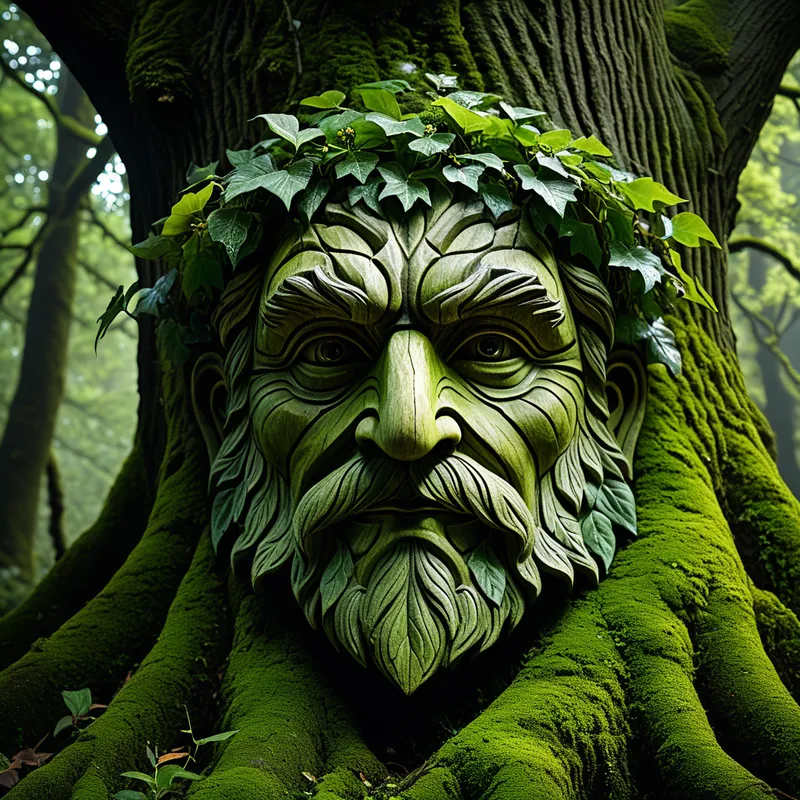
The Green Man of European folk Myth Meaning & Symbolism
An ancient vegetative spirit of the wild woods, embodying the untamed cycle of life, death, and rebirth within the European psyche.
The Tale of The Green Man of European folk
Listen. Listen to the whisper in the roots of the oldest oak, the sigh in the heart of [the hawthorn hedge](/myths/the-hawthorn-hedge “Myth from Celtic culture.”/). He is there, in the green gloom where the sunlight fractures. He is the one who was never born and will never die, not truly. They call him the [Green Man](/myths/green-man “Myth from Celtic culture.”/).
In the deep time before steeples, when [the world](/myths/the-world “Myth from Tarot culture.”/) was a cathedral of trees, he was the first priest. His face was the bark of the elder, his breath the morning mist rising from the forest floor. He did not walk; he emerged. From the loam, from the split stone, from the hollow where [the owl](/myths/the-owl “Myth from Celtic culture.”/) nested. He was the watchful silence of the woods, the intelligence in the twisting vine that seeks the sun.
But the world turned. The axe-bit rang, and the great trees sighed as they fell. Men built walls of stone and words of scripture, and they called the wild places profane. They feared the dark beneath the leaves, for it was the dark of their own forgotten blood. [The Green Man](/myths/the-green-man “Myth from Global/Universal culture.”/) watched from the edge of the clearing, his eyes the glint of fox-fire in the dusk. He was being forgotten, pushed back into the realm of story and bad dream.
Yet, he is a stubborn god. He does not fight with sword or flame, but with a quieter, more insistent magic. He began to appear where he was least welcome, yet most needed. In the very heart of the new order, in the cold stone of the great churches, the masons—men whose hands still remembered the shape of living wood—would carve him. High on a capital, hidden in a shadowy misericord, his leafy face would burst forth from the pillars. Oak and ivy and [hawthorn](/myths/hawthorn “Myth from Celtic culture.”/) would spill from his mouth, his eyes, his ears. He was a secret kept in plain sight, a pagan psalm sung in a Christian choir.
Children would point, and old women would cross themselves, but they would also feel a strange comfort. For in the dead of winter, when the altar was bare, his stone foliage remained, a promise etched in rock. And when spring returned, with its riot of green and shout of birdsong, people would glance at the carving and feel, in their bones, that the church was not just built on the land, but of it. The wild had been invited inside, not as a demon, but as a silent, leafy saint. He was the memory the stone refused to forget. He is there still, breathing silently in the shadows, holding the tension between the carved order of man and the chaotic, fecund will of the living earth.

Cultural Origins & Context
The Green Man is not a singular figure from a single, codified myth. He is a psychic archetype who seeped into European consciousness from a confluence of streams. His lineage is tangled like wild rose. We see his ancestors in the Silvanus of the Romans, the vegetative deities of the Celts, and the wild, untamed spirits of Germanic folklore. He is the genius of the locus, the specific spirit of a particular grove or spring, generalized into a universal face.
His primary transmission was not through epic poetry, but through stone and story. As Christianity spread, it often built its churches on ancient sacred sites—groves, wells, hilltops. The Green Man survived this transference by becoming a foliate mask in the very fabric of the new religion’s architecture. From the 11th century onward, he proliferated across Europe, a silent, stone testament to a spirituality that could not be fully erased. He was also kept alive in seasonal folk customs—the Jack-in-the-Green of May Day celebrations, the wild man of the woods in mummers’ plays. His societal function was profound: to mediate the human relationship with the natural world, to serve as a living reminder that culture springs from nature, and that to deny one’s roots is to wither.
Symbolic Architecture
The Green Man is the embodied [symbol](/symbols/symbol “Symbol: A symbol can represent an idea, concept, or belief, serving as a powerful tool for communication and understanding.”/) of the [anima](/symbols/anima “Symbol: The feminine archetype within the male unconscious, representing soul, creativity, and connection to the inner world.”/) mundi—the world [soul](/symbols/soul “Symbol: The soul represents the essence of a person, encompassing their spirit, identity, and connection to the universe.”/)—as it manifests in the vegetative [realm](/symbols/realm “Symbol: The symbol of ‘Realm’ often signifies the boundaries of one’s consciousness, experiences, or emotional states, suggesting aspects of reality that are either explored or ignored.”/). He represents the irreducible, untamed [life](/symbols/life “Symbol: The symbol of ‘Life’ represents a journey of growth, interconnectedness, and existential meaning, encompassing both the joys and challenges that define human experience.”/) force that precedes and underpins all [human](/symbols/human “Symbol: The symbol of a human represents individuality, complexity of emotions, and social relationships.”/) order.
He is the face of nature not as a passive resource, but as a sovereign, sentient, and utterly amoral presence. His gaze is the gaze of the wilderness that watches our civilized endeavors with ancient, indifferent eyes.
Psychologically, he symbolizes the instinctual, vegetative [layer](/symbols/layer “Symbol: Layers often symbolize complexity, depth, and protection in dreams, representing the various aspects of the self or situations.”/) of the [psyche](/myths/psyche “Myth from Greek culture.”/) itself—the autonomic, growing, decaying, and regenerating processes of the unconscious. The foliage spewing from his orifices is a powerful [image](/symbols/image “Symbol: An image represents perception, memories, and the visual narratives we create in our minds.”/) of creativity and [knowledge](/symbols/knowledge “Symbol: Knowledge symbolizes learning, understanding, and wisdom, embodying the acquisition of information and enlightenment.”/) born directly from the [body](/symbols/body “Symbol: The body in dreams often symbolizes the dreamer’s self-identity, personal health, and the relationship they have with their physical existence.”/) and the instinctual world, not from the rational mind. He is the embodied [truth](/symbols/truth “Symbol: Truth represents authenticity, honesty, and the quest for knowledge beyond mere appearances.”/) that all our thoughts and arts ultimately [sprout](/symbols/sprout “Symbol: A new beginning emerging from potential, representing growth, vulnerability, and the earliest stage of development.”/) from the dark [soil](/symbols/soil “Symbol: Soil symbolizes fertility, nourishment, and the foundation of life, serving as a metaphor for growth and stability.”/) of our biological and psychic substrate. He holds the [tension](/symbols/tension “Symbol: A state of mental or emotional strain, often manifesting physically as tightness, pressure, or unease, signaling unresolved conflict or anticipation.”/) between growth and decay, reminding us that these are not opposites but points on the same cycle. In a culture that prizes [consciousness](/symbols/consciousness “Symbol: Consciousness represents the state of awareness and perception, encompassing thoughts, feelings, and experiences.”/), light, and order, the Green Man is the necessary [shadow](/symbols/shadow “Symbol: The ‘shadow’ embodies the unconscious, repressed aspects of the self and often represents fears or hidden emotions.”/)—the dark, fecund, and chaotic ground from which consciousness itself emerges.
The Dreamer’s Resonance
When the Green Man appears in a modern dream, he rarely comes as a gentle gardener. He arrives as an eruption. To dream of one’s face becoming leafy, of vines growing from one’s skin, or of being lost in a forest where the trees have watchful faces, signals a profound somatic and psychological process.
This is the psyche’s attempt to re-wild a consciousness that has become too arid, too controlled, or too dissociated from its instinctual roots. The dreamer may be undergoing a period where their cultivated identity—their job, their [persona](/myths/persona “Myth from Greek culture.”/), their intellectual life—feels barren. The Green Man emerges from the dream soil to insist on a different kind of knowing: a knowing that is felt in the gut, that follows seasonal rhythms, that accepts decay as part of fertility. It can be a terrifying dream, for it involves a loss of control—the civilized self is literally being overgrown by the wild self. But the terror is often followed by a deep, somatic relief, a sense of coming home to a more authentic, embodied state. It is the unconscious initiating a process of re-greening, of restoring a vital connection to the vegetative, creative, and cyclical powers within.
Alchemical Translation
The journey of the Green Man from the wild forest to the carved cathedral is a perfect map for the alchemical process of individuation. It models the psychic transmutation from a state where the instinctual (the wild) is split off and feared, to a state where it is integrated and revered as the foundation of the spiritual edifice.
The initial state is separation: the civilized ego clears the forest of the unconscious, building walls of rationality and order. The Green Man is repressed, pushed to the periphery. The [nigredo](/myths/nigredo “Myth from Alchemical culture.”/), or blackening, is the barrenness that results—a life that is structured but lifeless, ordered but devoid of spontaneous creativity. The appearance of the Green Man in the church, the hidden carving, represents the beginning of the albedo, the whitening. Here, the unconscious content makes itself known in the very center of the conscious attitude, but in a disguised, symbolic form that [the ego](/myths/the-ego “Myth from Jungian culture.”/) can tolerate.
The ultimate alchemical goal is not to destroy the cathedral of consciousness, but to build it with the living green stone of the instinctual self, creating a sacred space that honors both spirit and nature.
The final integration, the [rubedo](/myths/rubedo “Myth from Alchemical culture.”/) or reddening, is achieved when the individual no longer sees the wild and the cultivated, the instinctual and the spiritual, as opposites. They recognize that their highest creativity, their deepest wisdom, and their most authentic spirituality are all branches growing from the same ancient, leafy trunk. The individuated Self becomes like the cathedral that houses the Green Man: a structure of conscious order and discipline, built upon and forever nourished by the dark, fecund, and eternally resurgent earth of the soul.
Associated Symbols
Explore related symbols from the CaleaDream lexicon: