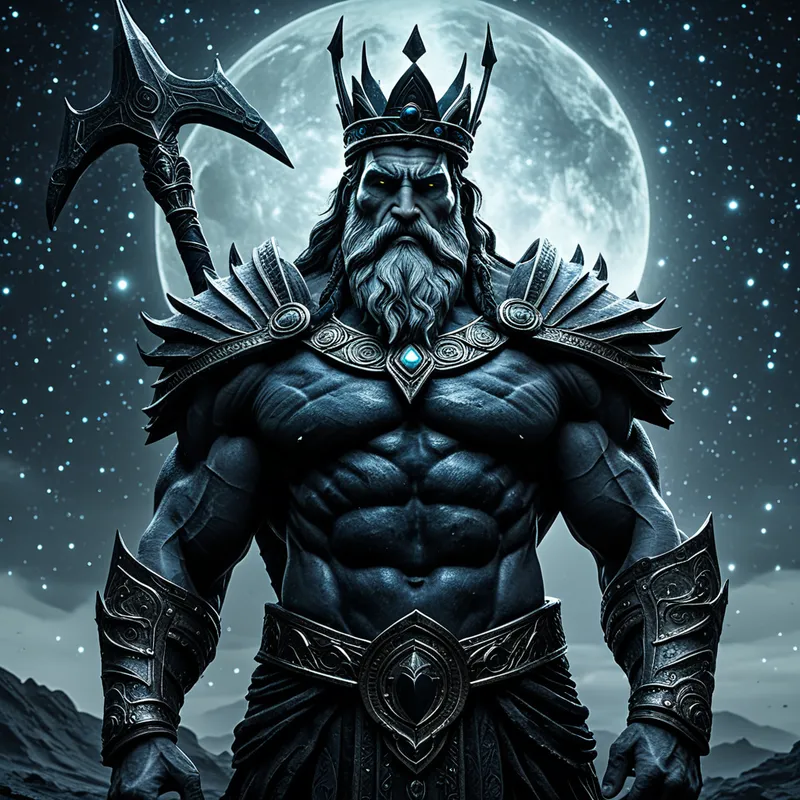
The Greek Titan Cronus (Saturn Myth Meaning & Symbolism
A myth of primal fear and cyclical time, where a father consumes his offspring to preserve his reign, only to be overthrown by the son he could not swallow.
The Tale of The Greek Titan Cronus (Saturn
Before the gods of Olympus, there was a raw and terrible age. The universe was a churning mass of formless potential, until [Ouranos](/myths/ouranos “Myth from Global/Universal culture.”/), [the Sky](/myths/the-sky “Myth from Persian culture.”/), lay heavy upon Gaia, [the Earth](/myths/the-earth “Myth from Hindu culture.”/), in a suffocating embrace. Their children, the monstrous Titans, the one-eyed Cyclopes, and the hundred-handed Hecatoncheires, were born into darkness, trapped within their mother’s aching womb, the deep places of [the world](/myths/the-world “Myth from Tarot culture.”/).
Gaia groaned under the weight. In her pain, she forged a weapon of adamant, grey and sharp as a shard of eternity. She called her bravest Titan son, Cronus. His heart was cold and ambitious, and he saw in his father’s tyranny his own prison. When night fell and Ouranos descended to cover Gaia once more, Cronus emerged from hiding. With a single, ruthless sweep of the jagged sickle, he severed the Sky from the Earth. Ouranos recoiled, bleeding light and thunder into [the void](/myths/the-void “Myth from Buddhist culture.”/), cursing his son as he retreated to the heavens, forever separate. From the blood that fell upon the earth, the Erinyes and the fierce Giants were born.
Cronus claimed the throne of the cosmos. He took his sister Rhea as his queen, and a [golden age](/myths/golden-age “Myth from Universal culture.”/) was proclaimed. But the curse of his father echoed in his mind. A prophecy whispered that he, too, would be overthrown by his own child. Fear, cold and devouring, took root in his heart where ambition once grew.
So, when Rhea bore their first glorious child—[Hestia](/myths/hestia “Myth from Global/Universal culture.”/)—Cronus did not cradle her. He opened his vast maw and swallowed the infant whole, imprisoning her within his own divine flesh. One by one, the children came: Demeter, Hera, [Hades](/myths/hades “Myth from Greek culture.”/), [Poseidon](/myths/poseidon “Myth from Greek culture.”/). Each was met with the same terrible fate, consumed at birth to preserve the father’s reign. [The golden age](/myths/the-golden-age “Myth from Greek culture.”/) grew tarnished, its shine a lie over a gut full of silenced futures.
Rhea’s grief became a mountain. When she felt the stirrings of her sixth child, she could bear the cycle no more. On the advice of Gaia, she fled to the deep, sheltered valleys of Crete. There, in a cave echoing with the cries of the Kouretes who clashed their spears to mask the infant’s wails, she gave birth to Zeus. She wrapped a stone in swaddling clothes and presented this bundle to Cronus. The Titan, in his paranoid haste, devoured the stone, believing his victory complete.
But Zeus grew strong in secret, nourished by the goat Amalthea. When he came of age, he confronted his father. With cunning and a potion prepared by the Titaness [Metis](/myths/metis “Myth from Greek culture.”/), he caused Cronus to disgorge his swallowed children, whole and grown, and the stone that had deceived him. Thus began the Titanomachy, a war that shook the pillars of the world. The old order, ruled by fear and consumption, was shattered by the new. Cronus was cast down, bound in the dark pit of [Tartarus](/myths/tartarus “Myth from Greek culture.”/), or fled to a distant, dreaming land. The stone of his deceit was placed at Delphi, the navel of the world, as a monument to the end of an age.
Cultural Origins & Context
The myth of Cronus is a foundational stratum of Greek cosmology, recorded most comprehensively in Hesiod’s Theogony (c. 700 BCE). This was not mere entertainment; it was a sacred narrative explaining the origin of the world, the nature of sovereignty, and the painful, necessary transition from one cosmic order to another. It was a story told to explain why the world is not ruled by the primordial, chaotic forces of earth and sky, nor by the tyrannical, static rule of [the Titans](/myths/the-titans “Myth from Greek culture.”/), but by the more complex, relational, and politically-minded Olympians.
The equation of Cronus with the Roman [Saturn](/myths/saturn “Myth from Alchemical culture.”/) created a powerful syncretic figure. In Roman tradition, [Saturn](/myths/saturn “Myth from Alchemical culture.”/)’s reign was remembered as a lost Golden Age, a nostalgic fantasy of a time before labor and strife. The [Saturnalia](/myths/saturnalia “Myth from Roman culture.”/) festival temporarily resurrected this age through social inversion, where masters served slaves and rules were relaxed. This duality—Cronus [the child](/myths/the-child “Myth from Alchemy culture.”/)-devourer and [Saturn](/myths/saturn “Myth from Alchemical culture.”/) the lord of a peaceful golden age—encapsulates the myth’s core tension: time as both a nurturing harvest and a relentless, devouring force.
Symbolic Architecture
Cronus is the [archetype](/symbols/archetype “Symbol: A universal, primordial pattern or prototype in the collective unconscious that shapes human experience, behavior, and creative expression.”/) of the tyrannical [father](/symbols/father “Symbol: The father figure in dreams often symbolizes authority, protection, guidance, and the quest for approval or validation.”/), the established order that refuses to yield. His act of swallowing his children is the ultimate [image](/symbols/image “Symbol: An image represents perception, memories, and the visual narratives we create in our minds.”/) of psychological repression. It represents any [system](/symbols/system “Symbol: A system represents structure, organization, and interrelated components functioning together, often reflecting personal or social order.”/)—be it familial, cultural, or internal—that consumes potential, innovation, and the future to preserve its own stagnant power.
The sickle of Cronus is the first act of separation, the necessary cut that creates consciousness by dividing unity into opposites: sky and earth, past and future, self and other.
The [stone](/symbols/stone “Symbol: In dreams, a stone often symbolizes strength, stability, and permanence, but it may also represent emotional burdens or obstacles that need to be acknowledged and processed.”/), the [Omphalos](/myths/omphalos “Myth from Greek culture.”/), that Cronus swallows is rich with meaning. It is the undigestible [truth](/symbols/truth “Symbol: Truth represents authenticity, honesty, and the quest for knowledge beyond mere appearances.”/), the hard, unyielding core of [reality](/symbols/reality “Symbol: Reality signifies the state of existence and perception, often reflecting one’s understanding of truth and life experiences.”/) that cannot be assimilated by [the ego](/myths/the-ego “Myth from Jungian culture.”/)’s control. It is the seed of the new [consciousness](/symbols/consciousness “Symbol: Consciousness represents the state of awareness and perception, encompassing thoughts, feelings, and experiences.”/), which, when regurgitated, becomes the [foundation](/symbols/foundation “Symbol: A foundation symbolizes the underlying support systems, values, and beliefs that shape one’s life, serving as the bedrock for growth and development.”/) (Delphi) for a new world order. Cronus, therefore, is not merely evil; he is a necessary stage. He is [the principle](/symbols/the-principle “Symbol: A fundamental truth, law, or doctrine that serves as a foundation for a system of belief, behavior, or reasoning, often representing moral or ethical standards.”/) of [chronos](/symbols/chronos “Symbol: Ancient Greek personification of time as a destructive, all-devouring force, representing inevitable change, decay, and the cyclical nature of existence.”/)—sequential, quantitative, devouring time. He must be overthrown by [kairos](/myths/kairos “Myth from Global/Universal culture.”/)—the opportune, qualitative time of Zeus, the right [moment](/symbols/moment “Symbol: The symbol of a ‘moment’ embodies the significance of transient experiences that encapsulate emotional depth or pivotal transformations in life.”/) for [revolution](/symbols/revolution “Symbol: A fundamental, often violent transformation of social, political, or personal structures, representing upheaval, liberation, and the overthrow of established order.”/) and new creation.
The Dreamer’s Resonance
To dream of Cronus is to encounter the deep, somatic fear of being consumed by one’s own history, lineage, or outdated self-concept. One may dream of a vast, shadowy figure eating something precious, of being trapped in a dark, interior space (the belly of the father), or of trying to hide a vulnerable, new part of oneself from an authoritarian presence.
This dream pattern signals a critical moment in the [psyche](/myths/psyche “Myth from Greek culture.”/). The dreamer is likely grappling with an internalized “old order”—perhaps a rigid parental complex, a stifling career path, or a set of beliefs that once provided structure but now prevent growth. The somatic feeling is often one of constriction, weight, and silent panic. The psyche is announcing that a future potential (a “divine child” archetype) is in danger of being swallowed by the fear-driven, conservative forces within. The dream is a call to find one’s “Rhea”—the nurturing, cunning aspect of [the Self](/myths/the-self “Myth from Jungian culture.”/) that can hide and protect what is nascent until it is strong enough to challenge the throne.
Alchemical Translation
The Cronus myth is a brutal but precise map for the alchemical process of individuation, the journey toward psychic wholeness. [The first stage](/myths/the-first-stage “Myth from Alchemical culture.”/), [nigredo](/myths/nigredo “Myth from Alchemical culture.”/), is represented by the oppressive union of Ouranos and Gaia—a state of undifferentiated, unconscious suffering. Cronus’s sickle is the [separatio](/myths/separatio “Myth from Alchemical culture.”/), the first conscious act that breaks this fusion, allowing for the emergence of a distinct ego.
However, this ego (Cronus as ruler) immediately falls into shadow, becoming a paranoid tyrant that consumes all emerging contents of the unconscious (his children) to maintain its supremacy. The work of the modern individual is to undergo the “regurgitation.” This is the painful, often chaotic process of revisiting and retrieving what has been swallowed: repressed emotions, abandoned talents, and un-lived futures.
The goal is not to destroy the Cronus within, but to depose him from absolute authority, transforming the raw, chronological drive into a conscious relationship with time and legacy.
The final stage is the integration of the stone—[the Omphalos](/myths/the-omphalos “Myth from Greek culture.”/). This is the discovery of one’s own inner center, the immutable, guiding truth that was always present but disguised and rejected by the controlling ego. To place this stone at the center of one’s being is to move from being ruled by the fear of time (chronos) to being anchored in the purpose of the timely moment (kairos). One becomes, like the later Zeus, a ruler not through consumption, but through relationship, wisdom, and the conscious stewardship of the potentials one has liberated from the dark.
Associated Symbols
Explore related symbols from the CaleaDream lexicon: