The Greek myth of Gaia Myth Meaning & Symbolism
The primordial Earth Mother emerges from Chaos, births the cosmos, and endures the rise and fall of gods, embodying the deep, enduring psyche of the world.
The Tale of The Greek myth of Gaia
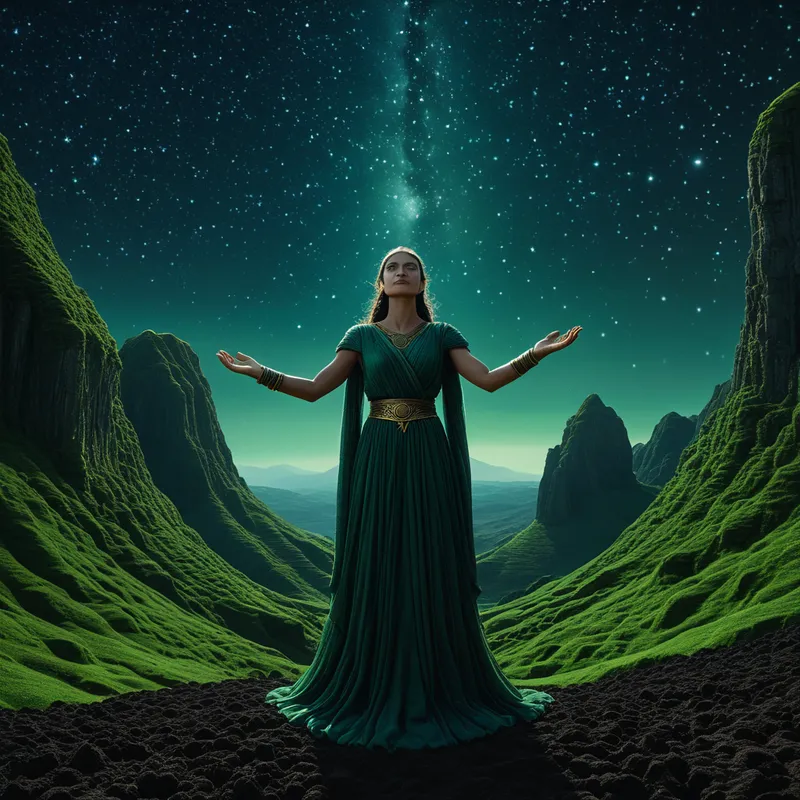
In the beginning, there was no beginning. There was only Chaos, a yawning, silent chasm of unbeing. And from that nothingness, she arose. Not born, but simply being. Gaia, the broad-breasted one, the deep-bosomed Earth. She was the first solid thing, the first here. From her own boundless body, without sweet union, she brought forth Ouranos, to be her equal and to cover her completely. She bore the tall, wild mountains, where the nymphs would one day dwell, and Pontus, the deep, salt-wooed sea.
With Ouranos, she lay, and from their union sprang a race of mighty beings. First, the Titans, twelve in number, vast and powerful as the continents. Then, the one-eyed Cyclopes, makers of thunder, and the hundred-handed Hekatoncheires, whose strength was terrifying to behold.
But Ouranos, the sky, was a jealous and fearful father. He hated his strange, powerful children. As each was born from Gaia’s deep womb, he would not allow them to see the light. He pushed them back, forcing them into the dark hollows of the Earth, causing Gaia immense and grinding pain. Her body groaned under the weight of her own imprisoned offspring. The mountains strained, and the sea churned with her agony.
In her torment, Gaia’s love turned to a cold, deep rage. From her own substance, she fashioned grey adamant and forged a great, jagged sickle. She called her imprisoned children forth and offered them a choice. Only the youngest Titan, Kronos, bold and cunning, dared to answer her call. That night, when Ouranos descended to embrace Gaia, stretching his starry body across hers, Kronos emerged from his hiding place. With one swift, terrible stroke, he wielded the sickle of his mother and severed Ouranos from his creative power, casting it into the sea.
From the blood that fell upon Gaia, new forms sprang: the fierce Erinyes, the giant Gigantes, and the graceful Meliae. From the foam that gathered around what was cast into the sea, Aphrodite was born. The sky, wounded, receded forever, creating the space between heaven and earth. Gaia had acted, and the world was forever changed.
Yet the cycle continued. Kronos, now ruler, feared the prophecy that his own child would overthrow him. He swallowed his children whole. His wife, Rhea, Gaia’s daughter, came to her mother in despair. Together, they devised a trick. When Zeus was born, Rhea gave Kronos a stone wrapped in swaddling clothes to swallow, and the infant god was hidden in a cave on Gaia’s body, in Crete. Gaia nurtured him, and in time, Zeus forced Kronos to disgorge his siblings and waged war. Gaia offered Zeus a final prophecy: he would win if he freed her first children, the Hekatoncheires, from their prison in Tartarus. He did, and with their hundred-handed might, the Olympians were victorious.
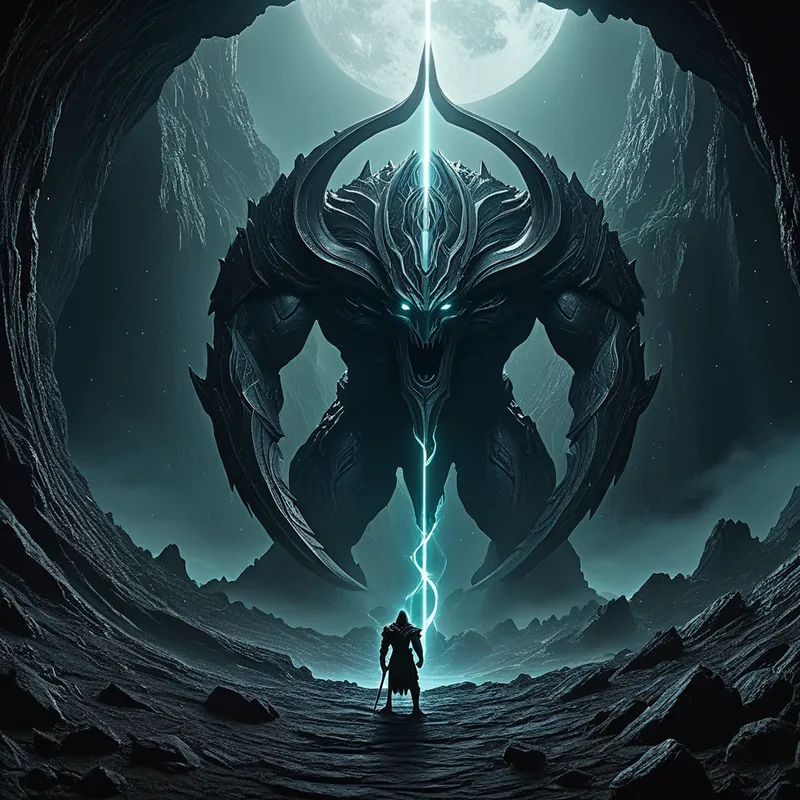
But even the new king did not fully heed the ancient Earth. When Zeus imprisoned the defeated Titans in Tartarus, Gaia groaned again with the burden. In her final great rebellion, she coupled with Tartarus and bore her last child, the monstrous Typhon, to challenge the Olympian order. Though Zeus, with his thunderbolts, eventually cast Typhon too beneath the earth, where his rage still fuels volcanoes, Gaia’s power was acknowledged. She was the first, and she would be the last. She retreated, not defeated, but enduring, the silent, foundational ground upon which all dramas of gods and men are played.
Cultural Origins & Context
The myth of Gaia is not a single story but a foundational stratum woven throughout the earliest Greek cosmogonic poetry, most authoritatively in Hesiod’s Theogony (c. 700 BCE). This was an oral tradition long before it was written, recited by bards as a sacred narrative that explained the origin and structure of the cosmos. Its function was profoundly societal and psychological: it established a divine order, explained natural phenomena (earthquakes were Gaia’s groans), and provided a genealogy of power that mirrored and legitimized patriarchal, kingly rule. Yet, at its core, it preserves a far older, pre-Olympian layer of thought—a chthonic (earth-centered) religion where the Earth itself was the primary, generative, and numinous force. Gaia is the ultimate ancestor, the court of first and last resort for gods in conflict, the source of prophecy and ultimate justice. Her myth served as a constant reminder that civilization, and even the gods themselves, rested upon a living, sentient, and potentially wrathful foundation.
Symbolic Architecture
Gaia is not merely a personification of dirt and rock. She is the archetype of the prima materia—the original, undifferentiated substance from which all forms emerge and to which they ultimately return. She symbolizes the unconscious itself in its primordial, creative, and devouring aspects.
She is the womb and the tomb, the giver of life and the receiver of the dead. Her body is the literal ground of being.
Her rebellion against Ouranos represents the necessary separation of consciousness (sky) from the unconscious (earth). The act of creation requires distinction, but oppression—the refusal to let new life see the light—creates a psychic pressure that demands revolution. Kronos’s sickle is the tool of differentiation, the painful but necessary cut that allows for growth and the birth of a new psychic order. Yet, Gaia’s subsequent conflicts with her own offspring illustrate the cyclical, often traumatic nature of psychic evolution. Each new ruling complex (Ouranos, Kronos, Zeus) attempts to suppress or control the raw, generative power of the unconscious, only to be challenged by it in new, often monstrous forms (the Titans, Typhon). Gaia is the enduring, underlying psychic substrate that outlives all temporary ego-consciousness.
The Dreamer’s Resonance
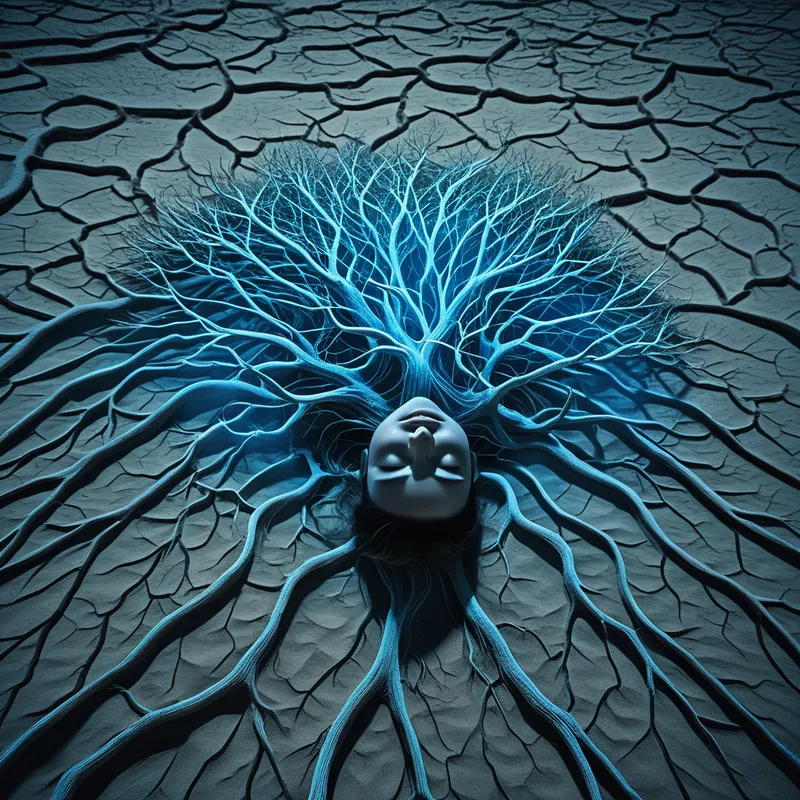
To dream of Gaia is to encounter the somatic unconscious. It is not a dream of figures, but of place and substance. One may dream of vast, rolling landscapes that feel alive and watching; of being swallowed by or emerging from a cave or rich, dark soil; of deep, resonant groans coming from the foundations of a house or one’s own body. These dreams often surface during life transitions that feel foundational: the birth of a child, the death of a parent, a profound ecological grief, or a crisis of identity that asks, “What ground do I stand on?”
The psychological process is one of re-grounding. The dreamer is being called back to their most basic, instinctual, and embodied self, beneath the structures of persona and ambition. Gaia in a dream can be a nourishing presence, offering solace and stability, or a terrifying one, shaking the dreamer’s world apart. This reflects the dual nature of the archetype: the need for both nurturing support and the sometimes-violent upheaval required for new growth. It is the psyche reminding the conscious mind that it is built upon, and dependent on, a deeper, older, and more powerful reality.
Alchemical Translation
The alchemical journey mirrored in Gaia’s myth is the opus contra naturam—the work against nature, which is paradoxically a work with nature’s deepest laws. It is the process of bringing the unconscious to consciousness, not to conquer it, but to relate to it.
The initial state is Chaos, the massa confusa of the unexamined psyche. Gaia’s emergence is the first coagulation, the formation of the prima materia or the Self in its potential. The tyranny of Ouranos represents the oppressive dominance of an unconscious, undifferentiated state where nothing new can be born—a psychic stagnation. The sickle’s cut is the separatio, the painful but essential act of analysis, discrimination, and setting boundaries that allows latent parts of the psyche (the Titans, the Cyclopes) to emerge into the light of awareness.
The goal is not to become Zeus, ruling from a detached Olympus, but to become like Gaia: the conscious, containing ground that can hold both creative and destructive forces without being destroyed by them.
Kronos’s subsequent tyranny and Zeus’s final ordering represent successive stages of ego-formation and cultural adaptation. But the individuated psyche must finally make peace with the Gaia principle. This is the alchemical stage of coagulatio—returning to earth, becoming embodied and grounded. It means acknowledging the foundational, often messy, biological, and instinctual layers of one’s being. It is to honor the prophecies that arise from the deep self, to bear the weight of one’s own history (the imprisoned Titans), and to integrate the monstrous, typhonic energies of rage and passion, not by banishing them, but by finding a conscious place for them. To achieve this is to become whole: not a god above the world, but a human being in right relationship with the living earth within and without.
Associated Symbols
Explore related symbols from the CaleaDream lexicon: