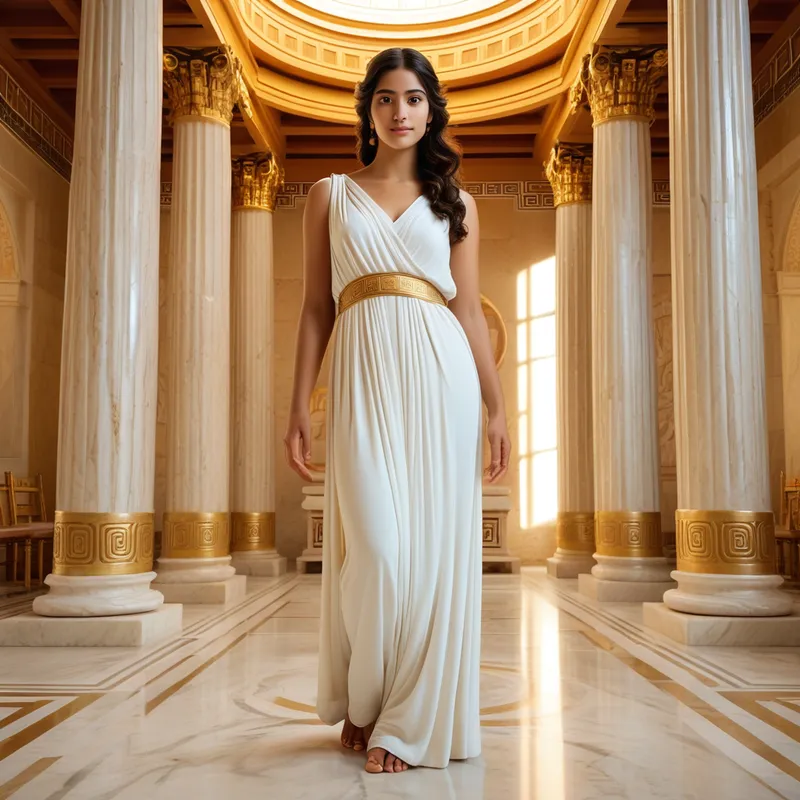
The Greek goddess Hestia Myth Meaning & Symbolism
The first-born Olympian who renounced throne and conflict to become the eternal, still flame at the heart of home, cosmos, and self.
The Tale of The Greek goddess Hestia
Before the clamor of thunder, before the salt-spray of the sea, before the first arrow was notched or the first vine was planted, there was a silent, consuming warmth. In the great, formless churn of becoming, Kronos, fearing the prophecy of his own overthrow, opened his terrible maw and swallowed his children whole. First among them, the first to be devoured into that inner darkness, was a daughter. Not with a cry, but with a quiet acceptance. She was the first spark in the belly of time.
Years wheeled. The last-born son, Zeus, freed his siblings from that divine prison. They erupted into the light—a storm of potential, ambition, and raw power. And among them, she stepped forth, not with a battle cry, but with a slow, steady exhalation. She was Hestia. Her presence was not an announcement but a settling, like embers finding their bed after a blaze.
When the victorious Olympians divided the cosmos, a throne of gleaming crystal awaited her on Mount Olympus. The air crackled with the energy of rulership. Poseidon grasped his trident, his eyes already charting the deep roads of the oceans. Hades’ hand closed around the cool metal of his helmet of invisibility. But Hestia looked upon the splendid seat, then past it, to the great, empty central space of the celestial hall. She felt no pull to the elevated stone, only to the heart of the floor.
With a voice that was the sound of fire consuming dry wood, steady and complete, she spoke. “I renounce this throne. Let my brother take it. My dominion shall not be from a height, but from a center.” And she turned her back on the prize of power. She walked to the very middle of the divine dwelling, knelt, and with a breath drawn from the core of the world, she kindled a flame upon the bare stone. Not a roaring fire, but a perfect, unwavering pyramid of light and heat. It did not flicker in the winds of divine argument; it held. The smell of burning cedar and sanctity filled the air. From that moment, every discussion of the gods, every feast, every oath, was sworn in the sight of her silent, witnessing flame.
Even when the mighty gods Poseidon and Apollo came as suitors, seeking her hand, she met them not with coquetry or fear, but with that same immovable calm. She placed her hand upon the hearthstone, feeling its enduring warmth. “I too am courted,” she said, “but I belong to this. To the first and the last fire. I vow to remain a virgin, not in lack, but in wholeness. My being is complete here.” And the great gods, humbled by a power that asked for nothing but to be the center around which all else moved, bowed and withdrew.
So she remains. In every city, her public hearth burned, and the fire for new colonies was carried from its logs. In every home, the first offering of wine and fat was poured to her, into the cooking fire. She asks for no temples, no statues. She is the temple. She is the stillness in the storm, the warmth in the void, the first ember from which all hearths are lit, and the last to be extinguished when the world goes dark.
Cultural Origins & Context
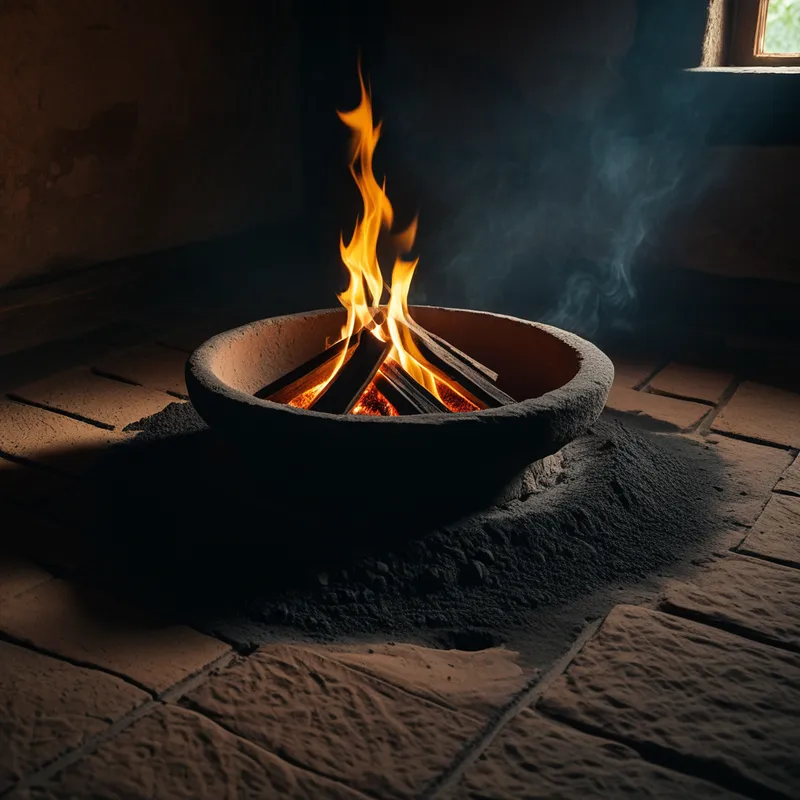
Hestia’s worship was woven into the most fundamental fabric of ancient Greek life, both domestic and civic. As <abbr title="The goddess of the hearth, home, and family">Hestia</abbr>, she presided over the hestia—the round, raised hearth that was the literal and spiritual center of the Greek home. This was not a minor domestic spirit; she was the first-born of Rhea and Kronos, and the first to be honored in every household sacrifice. Her flame was never allowed to die out, symbolizing the continuity and life of the family.
Culturally, her myth was transmitted not through epic poems of adventure, but through ritual practice and the unspoken laws of xenia (sacred hospitality). Her public cult centered on the <abbr title="The communal hearth of a city, often in its main civic building">Prytaneion</abbr>, where her eternal fire burned. Ambassadors, victorious athletes, and honored citizens were feasted there. When a Greek colony was founded, settlers carried coals from their mother-city’s hearth to kindle the new colony’s fire, making Hestia the tangible link between old and new, the root of civilization itself. Her societal function was one of binding and centering: she created sacred space, mandated hospitality, and represented the inviolable core of both family and state. In a pantheon of dramatic personalities, her power was in her pervasive, quiet absence of drama.
Symbolic Architecture
Hestia is the archetype of the Sacred Center. She represents not what we do, but where we are from. She is the psychological hearth—the still point of the turning world within the individual psyche.
To honor Hestia is to recognize that the most profound power lies not in expansion, but in containment; not in acquisition, but in rooted presence.
Her primary symbols are profound in their simplicity. The Hearth is the axis mundi of the personal world, the place of warmth, nourishment, and gathering. It is the defended center. The Flame is her manifest spirit: unwavering, pure, transforming raw fuel (experience) into warmth (meaning) and light (consciousness). It is alive yet constant, consuming yet giving. Her Renunciation of the Olympian throne and marriage is not a story of lack or defeat, but of supreme spiritual focus. She chooses essence over status, being over having, the center over the periphery. She embodies the <abbr title="A state of being whole and complete unto oneself">virgin</abbr> in the ancient sense—one who is intact, self-sufficient, and belonging to herself.
Psychologically, Hestia represents the ego’s capacity to create and maintain an inner sanctum. In a world of relentless outer stimuli and internal conflicts (the other, noisy Olympians), the Hestia function is the ability to withdraw, to tend the inner flame of one’s essential nature, and to find completeness within. She is the antidote to centrifugal force, the gravity that prevents the psyche from flying apart.
The Dreamer’s Resonance
When Hestia’s pattern stirs in the modern unconscious, it often manifests in dreams of profound centering or its disturbing absence.
A dreamer may find themselves in a familiar house, but drawn irresistibly to a previously unnoticed room—a warm, round chamber with a fire burning low and steadily. There is no one there, yet it feels deeply inhabited and safe. This is the psyche announcing the discovery or activation of the inner sanctum. The somatic sensation upon waking is often one of grounded warmth, a deep sigh of relief in the body, as if a core tension of striving has been released.
Conversely, the Hestia complex in shadow may appear as dreams of a house with no center—endless corridors, rooms that lead nowhere, or a chilling coldness throughout. The dreamer searches frantically for a fireplace, only to find it bricked up, full of ashes, or blowing with a cold wind. This signals a psyche that has lost its center, its sense of inner home and self-containment. The individual may feel existentially adrift, over-extended, and unable to find rest or nourishment within themselves. The psychological process here is one of re-collection—gathering the scattered fragments of the self back to a central, nurturing point.
Alchemical Translation
The alchemical journey modeled by Hestia is not the heroic peregrinatio (journey) but the sacred fixatio (fixing). In the opus of individuation, after phases of dissolution (solutio) and confrontation (nigredo), the essential work is the creation of the inner vessel—the vas hermeticum—where transformation can occur. Hestia is that vessel.
Her myth teaches the alchemy of conscious renunciation. To achieve psychic wholeness, one must, like Hestia, consciously relinquish certain thrones—the ego’s demands for constant recognition, drama, and external validation. One must turn away from the peripheral battles and tend the central fire. This is the process of valuing being over seeming.
The ultimate transmutation is not of lead into gold, but of scattered energy into focused presence. It is the creation of an inner hearth so stable that it can receive and transform all that life offers—joy, grief, conflict, love—into the steady light of consciousness.
The modern individual engages in this alchemy through practices of centering: meditation, ritual, creating a physical space of peace, or simply the daily discipline of turning inward. It is the commitment to make one’s own psyche a sacred space, where the flame of individual essence is honored as the first and last priority. In doing so, one becomes, like Hestia, a still point. One does not go out to conquer the world, but becomes the hearth around which a meaningful world can coherently form. This is the triumph of containment, the mastery of the center, and the quiet, unshakable power of homecoming—to oneself.
Associated Symbols
Explore related symbols from the CaleaDream lexicon: