
The Greek goddess Aphrodite Myth Meaning & Symbolism
The goddess born from sea-foam and severed sky, embodying the irresistible, creative, and often chaotic force of erotic love and primal attraction.
The Tale of The Greek goddess Aphrodite
Listen. Before time was measured in heartbeats, there was a war in heaven. Ouranos, the Sky, lay heavy upon Gaia, the Earth, a suffocating embrace that allowed no light, no space, no life to stir between them. From this torment, a terrible plan was forged. Gaia gave her youngest son, Kronos, a blade of adamant. In the dim space where sky met land, he reached up and with one savage stroke, severed the Sky from the Earth.
Ouranos roared his agony and recoiled into the eternal blue. But from the wound, life spilled. His blood fell upon the land, giving birth to fearsome beings. Yet, from the place where his severed flesh met the salt-churn of the sea, something else began. A foam, white and iridescent, gathered and swelled upon the restless waves. It was no ordinary spume, but a luminous broth of potential, stirred by the primal forces of creation and violence.
The foam coalesced, rising into a gentle mound upon the deep. And from its luminous heart, a figure emerged. First, a shell—a great, pearlescent scallop—then upon it, a woman. She was not born of a mother’s womb, but of the celestial castration and the churning, creative sea. The winds themselves stilled to behold her. Zephyrus breathed softly, carrying her across the wine-dark sea. The Horai, the Seasons, awaited her on the shore of Cyprus, their arms laden with robes of immortal weave.
She stepped onto the sand, and where her feet touched, flowers sprang forth. Grass turned greener, the air sweeter. She was beauty incarnate, but not a gentle beauty. It was the compelling, terrifying beauty of a force of nature—the magnetic pull that draws things together, the ache of desire that begins all things. The gods named her Aphrodite, “she who rises from the foam.” And with her arrival, the world, which had known only strife and separation, now knew longing.

Cultural Origins & Context
The Aphrodite of the poets—Homer and Hesiod—is a complex figure woven from threads both foreign and native to the Greek world. Hesiod’s Theogony gives us the dramatic birth from the sea-foam, establishing her as a primordial force older than Zeus himself, born directly from the act that shaped the cosmos. This version ties her to the very fabric of existence, an elemental power.
Yet, her cult and many of her epithets suggest a deep syncretism. She is Kypris, the goddess of Cyprus, and Kythereia, of Cythera, islands that were crossroads of ancient trade. Scholars trace her lineage back to earlier Near Eastern goddesses like Astarte and Inanna, deities who wielded sovereignty, sexual power, and ferocity in equal measure. In Greece, this raw, sometimes warlike aspect was tempered but never fully erased; she remained Aphrodite Ourania (the celestial) and Aphrodite Pandemos (the common), governing both transcendent and profane love.
Her myths were not mere stories but societal mirrors. They were performed in rituals, sung by bards, and depicted on pottery, serving to explain the irrational, overwhelming power of eros—a force that could bind societies through marriage or unravel them through passion, as seen in the tale of Helen of Troy. Aphrodite’s domain was the dangerous, essential glue of the human and divine worlds.
Symbolic Architecture
Aphrodite is not merely “love” in a sentimental sense. She is the archetypal principle of Eros in its original, cosmic meaning: the force of attraction that brings disparate elements into relationship, creating new wholes.
She is the spark in the void, the magnetic pull that ends isolation and begins the dance of creation, for better or for worse.
Her birth from the severed genitals of Ouranos is profoundly symbolic. It represents the emergence of creative, generative energy from an act of violent separation. Psychologically, this mirrors how our own capacity for deep connection (Eros) often first consciousness after a primal wounding, a cutting away from a state of undifferentiated unity. She is the beautiful, terrifying result of that necessary fracture.
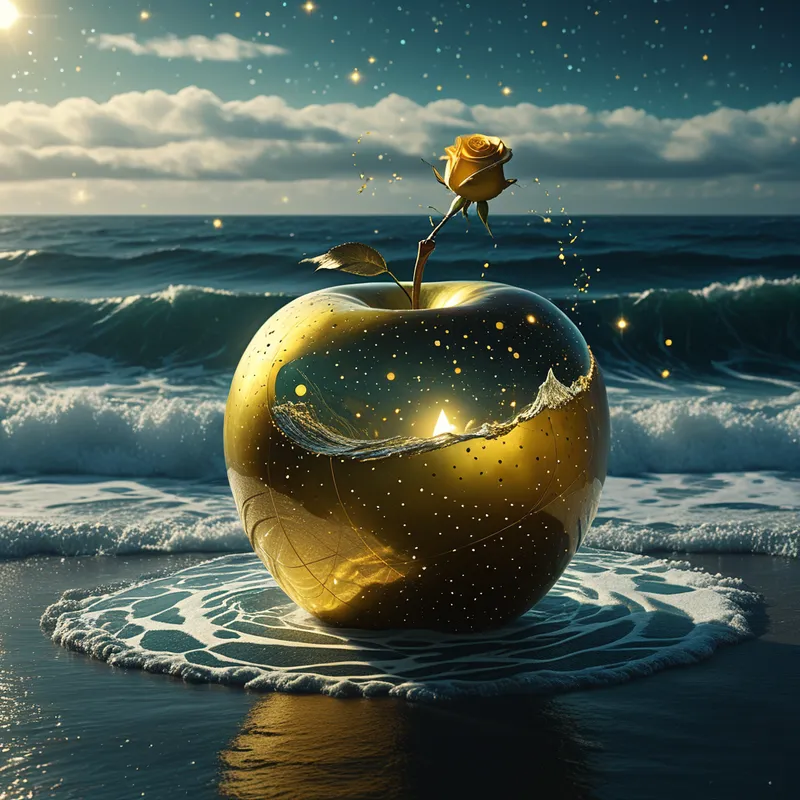
Her accessories are her lexicon. The kestos himas, her enchanted girdle, symbolizes the irresistible allure that is both a gift and a weapon. The scallop shell is a womb-like vessel, a symbol of the feminine principle arising from the waters of the unconscious. The golden apple, awarded to her by Paris, is the fruit of discord and desire, representing the choice to privilege beauty and passion above all else, with all its catastrophic and glorious consequences.
The Dreamer’s Resonance
When Aphrodite surfaces in modern dreams, she rarely appears as a classical statue. She manifests as the feeling-toned complex of irresistible attraction, creative fertility, or profound aesthetic arrest. To dream of her is to encounter the psyche’s own erotic intelligence.
One might dream of a mysterious, overwhelming attraction to a stranger or an object of art, feeling a pull that defies logic. This is the psyche signaling a need to integrate a neglected aspect of one’s own desiring nature, to acknowledge a deep, creative longing. Conversely, a dream of being trapped in a beautiful, gilded cage or entangled in a net of golden threads may point to the shadow side of the archetype: where Eros has become ensnaring possession, vanity, or a compulsion that isolates rather than connects. The somatic experience is key—a flooding warmth, a heart quickening, or a feeling of being “spellbound.” These are the bodily echoes of the archetype activating, calling the dreamer to attend to the quality of their connections and the beauty—or toxicity—of their creations.

Alchemical Translation
The individuation process, the journey toward psychic wholeness, requires a sacred marriage (coniunctio) of opposites. Aphrodite’s myth provides a map for this, not as a gentle guide, but as the necessary, disruptive agent of change.
Her first alchemical act is separatio: she is born from a violent cut. For the individual, this mirrors the often-painful awakening from psychic numbness or fused relationships into a state of distinct desire. One must know what one is separate from to know what one truly longs for. Then comes solutio: her element is the sea, the dissolving waters of the unconscious where rigid forms soften. To heed Aphrodite is to allow oneself to be dissolved by feeling, by beauty, by passion—to be vulnerable to transformation.
The alchemical gold she offers is not a static state of happiness, but the ability to generate life-affirming connection, to create beauty from the raw materials of existence, and to hold the tension between ecstatic union and necessary autonomy.
Finally, her marriage to Hephaestus, the ugly craftsman, is the ultimate alchemical lesson. It marries raw, captivating beauty (Aphrodite) to skilled, transformative labor (Hephaestus). For the modern soul, the triumph is not in being eternally desired, but in uniting one’s capacity for deep feeling and attraction with the disciplined, often unglamorous work of forging lasting vessels—be they relationships, artworks, or a coherent self. The myth warns that when this union is neglected (as when Aphrodite seeks Ares), the result is chaotic entrapment. But when honored, it allows for the creation of something both profoundly beautiful and enduringly strong.
Associated Symbols
Explore related symbols from the CaleaDream lexicon: