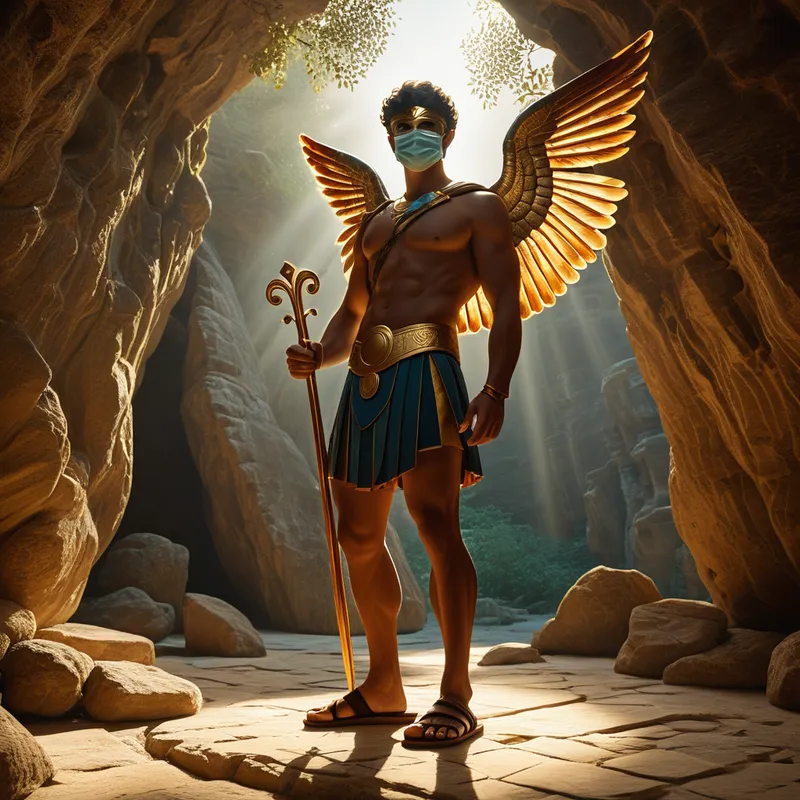
The Greek god Hermes in his ro Myth Meaning & Symbolism
The myth of Hermes' ro is a tale of divine trickery, liminal passage, and the alchemical theft of fire that births new forms of connection and consciousness.
The Tale of The Greek god Hermes in his ro
Before [the world](/myths/the-world “Myth from Tarot culture.”/) knew his name, he stirred in the violet dark of a mountain cave. His first breath was not a cry, but a laugh, sharp and clear as a struck stone. This was [Hermes](/myths/hermes “Myth from Global/Universal culture.”/), son of Zeus and the starry nymph Maia. While his mother slept, exhausted from his swift birth, the infant’s eyes—ancient and gleaming—scanned his cradle of stone. He was hungry, not for milk, but for action, for the thrill of becoming.
He slipped from his swaddling bands, a form already lithe and strong. [The cave](/myths/the-cave “Myth from Platonic culture.”/) mouth beckoned, framing a world silvered by a moon not yet set. And there, at [the threshold](/myths/the-threshold “Myth from Folklore culture.”/), he saw them: the sacred cattle of his elder brother, Apollo
, grazing in the dewy meadows of Arcadia. A plan, perfect and wicked, blossomed in his divine mind. To steal them would be a declaration, a first message sent to the cosmos: I am here.
But he was cunning. He fashioned sandals from bark and myrtle, weaving them so that his tiny feet would leave no trace, only strange, backwards prints that pointed toward the cave, not away. He drove fifty head of the magnificent beasts not by [the open road](/myths/the-open-road “Myth from American Folklore culture.”/), but through the trackless sands of a distant shore, a god herding shadows under the waning moon. At a river’s bend, he sacrificed two of the finest, dividing the meat into twelve portions for the Olympians—a gesture both pious and profoundly audacious. He hid the rest, the evidence of his divine larceny, in a grove.
Returning to his cradle as the first hint of dawn gilded the peaks of Mount Cyllene, he found a [tortoise](/myths/tortoise “Myth from Greek culture.”/) browsing at the cave’s mouth. Another spark. With a deft, ruthless strike, he hollowed its shell, stretched sinews across it, and fashioned the first lyre. His fingers, born just hours before, plucked a melody so hauntingly beautiful it seemed to pull the very sun over [the horizon](/myths/the-horizon “Myth from Various culture.”/).
When Apollo, radiant and furious, descended upon the cave, following the impossible trail, he found not a cowering babe, but a cherub innocently plucking his new instrument. The music disarmed Apollo’s wrath, transmuting it into wonder. Hermes, [the trickster](/myths/the-trickster “Myth from Various culture.”/), became the negotiator. He gifted Apollo the lyre. In return, Apollo gifted him the caduceus, a symbol of his new office, and dominion over herds, commerce, and the roads between all things. Zeus, laughing from his throne, made it official: Hermes was the [Psychopomp](/myths/psychopomp “Myth from Greek culture.”/), the only one who could move with impunity between Olympus, Earth, and the shadowy depths of [Hades](/myths/hades “Myth from Greek culture.”/).

Cultural Origins & Context
This foundational myth is preserved in the Homeric Hymn to Hermes, a text likely composed in the 6th century BCE. It was not a scripture, but a performance piece, recited by rhapsodes at festivals and competitions. Its function was multifaceted: to entertain, to explain the origins of the god’s attributes (the lyre, [the caduceus](/myths/the-caduceus “Myth from Greek culture.”/), his role as cattle-god and guide), and to integrate a potentially disruptive, non-Olympian deity into the established cosmic order.
Hermes was a god of the people—of travelers, merchants, thieves, and orators. His myth reflects the realities and anxieties of a mobile, trading society. The story legitimizes cunning, negotiation, and cleverness as divine virtues necessary for navigating a world of boundaries and exchanges. It served as a charter myth for the social practices of barter, treaty-making, and even acceptable deceit within competitive arenas. By having Apollo, the epitome of cosmic order and law, sanction Hermes’s theft, the culture acknowledged that innovation and new forms of connection often emerge from the margins, through a kind of sacred transgression.
Symbolic Architecture
At its core, the myth of Hermes in his ro (his [infancy](/symbols/infancy “Symbol: A symbol of beginnings, vulnerability, and foundational development, often representing a return to origins or a state of pure potential.”/) and first deeds) is a masterclass in the [archetype](/symbols/archetype “Symbol: A universal, primordial pattern or prototype in the collective unconscious that shapes human experience, behavior, and creative expression.”/) of the liminal [trickster](/symbols/trickster “Symbol: A boundary-crossing archetype representing chaos, transformation, and the subversion of norms through cunning and humor.”/). He is the god of the in-between: between [night](/symbols/night “Symbol: Night often symbolizes the unconscious, mystery, and the unknown, representing the realm of dreams and intuition.”/) and day, theft and gift, [crime](/symbols/crime “Symbol: Crime in dreams often symbolizes guilt, inner conflict, or societal rules that are being challenged or broken.”/) and diplomacy, [life](/symbols/life “Symbol: The symbol of ‘Life’ represents a journey of growth, interconnectedness, and existential meaning, encompassing both the joys and challenges that define human experience.”/) and [death](/symbols/death “Symbol: Symbolizes transformation, endings, and new beginnings; often associated with fear of the unknown.”/).
Hermes does not create from nothing; he transmutes what he finds at the threshold. The tortoise becomes a lyre, theft becomes a treaty, and transgression becomes a new office.
Psychologically, Hermes represents the swift, mercurial intelligence of the unconscious—the sudden [insight](/symbols/insight “Symbol: A sudden, deep understanding of a complex situation or truth, often arriving unexpectedly and illuminating hidden connections.”/), the creative “hack,” the dream [symbol](/symbols/symbol “Symbol: A symbol can represent an idea, concept, or belief, serving as a powerful tool for communication and understanding.”/) that bridges waking [logic](/symbols/logic “Symbol: The principle of reasoning and rational thought, often representing order, structure, and intellectual clarity in dreams.”/) and nocturnal [mystery](/symbols/mystery “Symbol: An enigmatic, unresolved element that invites curiosity and exploration, often representing the unknown or hidden aspects of existence.”/). His backward-facing footprints symbolize the trickster’s method: to progress by appearing to regress, to solve a [problem](/symbols/problem “Symbol: Dreams featuring a ‘problem’ often symbolize internal conflicts or challenging situations that require resolution and self-reflection.”/) by approaching it from the opposite [direction](/symbols/direction “Symbol: Direction in dreams often relates to life choices, guidance, and the path one is following, emphasizing the importance of navigation in personal journeys.”/) of conscious intent. The theft of Apollo’s cattle (symbols of [material](/symbols/material “Symbol: Material signifies the tangible aspects of life, often representing physical resources, desires, and the physical world’s influence on our existence.”/) [wealth](/symbols/wealth “Symbol: Wealth in dreams often represents abundance, security, or inner resources, but can also symbolize burdens, anxieties, or moral/spiritual values.”/) and solar power) and their transformation into the first sacrificial feast and the [lyre](/symbols/lyre “Symbol: The lyre symbolizes harmony, creativity, and the connection between the divine and human experiences.”/) represents the [alchemical process](/symbols/alchemical-process “Symbol: A symbolic transformation of base materials into spiritual gold, representing inner purification, integration, and the journey toward wholeness.”/) of taking raw, instinctual [energy](/symbols/energy “Symbol: Energy symbolizes vitality, motivation, and the drive that fuels actions and ambitions.”/) (the “cattle” of the [psyche](/myths/psyche “Myth from Greek culture.”/)) and refining it into culture, art, and social accord.

The Dreamer’s Resonance
When the pattern of Hermes’s ro appears in modern dreams, it signals a profound psychic initiation. The dreamer is at a threshold. They may dream of:
- Theft or clever deception that feels justified, even exhilarating.
- Finding or crafting a novel object (like the lyre) from an unlikely source.
- Meeting a charming, elusive guide at a crossroads, airport, or digital interface.
- Moving effortlessly between realms—from a city street into a forest, from a office into a cave.
Somatically, this can feel like a buzzing energy, a restless ingenuity, or a lightness at the edges of perception. Psychologically, it is the process of the nascent Self, still in its “infancy,” attempting its first autonomous act. It is the psyche’s own cunning plot to steal energy from a dominant, perhaps too-ordered complex (the “Apollo” within—our rigid ideals, perfect plans, or sunny [persona](/myths/persona “Myth from Greek culture.”/)) to fuel a more integrated, creative, and fluid way of being. The anxiety and excitement in the dream mirror Hermes’s own daring—the risk and reward of psychological differentiation.

Alchemical Translation
The Hermetic journey models the individuation process as one of sacred cunning. It begins not with heroic conquest, but with a felix culpa—a “fortunate fault.” [The first stage](/myths/the-first-stage “Myth from Alchemical culture.”/) is the recognition of a primal hunger, an instinctual drive that the conscious, solar personality (Apollo) has pastured but ignored. The Hermes within urges us to “steal” this energy—to reclaim our creative fire, our assertive voice, our right to move.
The alchemy occurs in the negotiation. The raw, stolen cattle must not be hoarded; they must be sacrificed and transformed. The instinct must become art; the rebellious impulse must become a new capacity for communication.
The crafting of the lyre from the tortoise shell is pivotal. The tortoise, an earth-bound creature that carries its home, symbolizes withdrawn, protective consciousness. To hollow it out is a violent but necessary act of making space, of creating a resonator. Stringing it with sinew is to connect disparate parts under tension, creating the potential for harmony. This is the individuating ego learning to contain and express the stolen, instinctual energies as music—as a personal myth, a creative work, or a new mode of relating.
Finally, the reconciliation with Apollo represents the integration of this mercurial trickster energy into the total personality. We are not meant to remain perpetual thieves. The goal is to become authorized messengers, carrying the caduceus—the symbol of reconciled opposites (the serpents) around a central axis of Self. We become our own Psychopomp, able to navigate the roads between our own Olympus and Hades, between our highest aspirations and our deepest shadows, turning every transgressive insight into a new form of connection.
Associated Symbols
Explore related symbols from the CaleaDream lexicon: