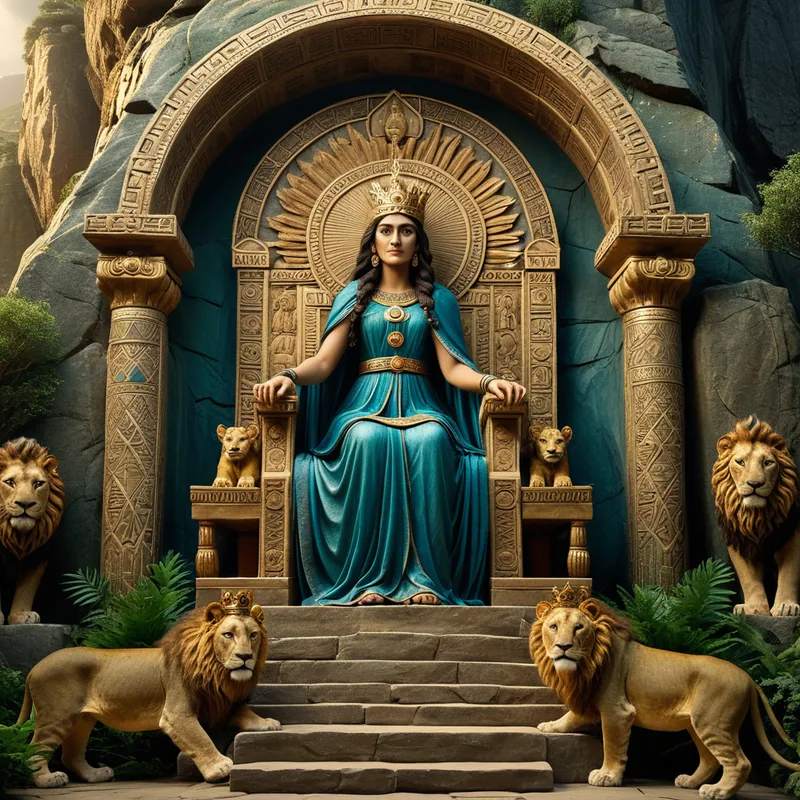
The Great Mother / Magna Mater Myth Meaning & Symbolism
The story of the primordial goddess of wild nature, whose sacred rites reveal the terrifying and nourishing cycles of life, death, and rebirth.
The Tale of The Great Mother / Magna Mater
Listen. Before the ordered pantheons of Zeus or Jupiter, the earth herself dreamed. And from that dreaming, from the raw, uncut stone of the Phrygian mountains, she awoke. She was Cybele, the Magna Mater. Her breath was the wind in the pines, her voice the rumble of avalanches, her body the very flesh of the world—wild, untamable, and fecund beyond measure.
She loved solitude, the deep quiet of the high places where eagles nest. Yet, a longing stirred in the stone of her heart. From the blood of the castrated sky-god, Uranus, falling upon her soil, life sprang. And from that life came a being of impossible beauty, Attis. He was the spirit of the blooming almond tree, the swift deer, the green shoot piercing winter’s crust. Cybele saw him and her vast, silent love became a consuming fire. She made him her priest, her companion, the guardian of her sacred rites.
But the fire of youth is restless. In the verdant valley below Mount Ida, Attis encountered a nymph, a daughter of the river Sangarius. A mortal passion, sweet and fleeting, ignited in his heart. He forgot his vow. He turned from the mountain to the riverbank.
The moment of betrayal echoed through the rocks. Cybele did not rage; her grief was a tectonic shift. She appeared before him not as a lover scorned, but as the implacable force of destiny. The pine trees around him groaned. The laughter of the nymph turned to a cry of terror as the very ground claimed her, transforming her into a gnarled, leafless tree.
Madness, sent by the goddess, descended upon Attis like a shroud. Under the cold, watchful stars, driven by a divine frenzy he could neither understand nor resist, he fled back to the holy mountain. At the foot of a sacred pine, in a final, terrible act of atonement and ecstatic liberation, he took a sharp stone and castrated himself. His lifeblood watered the roots of the tree, and as his vision faded, he whispered her name: Cybele.
The goddess came. Her wrath was spent, transformed into a sorrow as deep as creation. She did not let him die. She changed his fallen body, making it incorruptible. His hair continued to grow, his little finger would move forever. He became her eternal, sleeping consort, a symbol of life that falls only to rise again in another form. And from his blood, violets bloomed.

Cultural Origins & Context
The myth of the Magna Mater is not a neat, Homeric tale but a ritual thunderclap echoing from the ancient highlands of Anatolia. Her worship centered in Phrygia, at Pessinus, where a black, aniconic meteorite stone was venerated as her embodiment—a piece of the starry sky that had become earth. This was a religion of ecstasy, of direct, visceral contact with the raw power of nature, carried by the rhythmic, driving beat of the tympanum and the shrill cry of the aulos.
Her cult entered the Greco-Roman world through a crack in the rational order. In 204 BCE, during the desperate straits of the Second Punic War, the Roman Senate, acting on a cryptic prophecy from the Sibylline Books, formally invited the goddess to Rome. Her sacred stone was transported from Pessinus with immense ceremony. She was seen as a savior, a primal power who could protect the city when its own gods seemed distant. Yet, her wild, foreign rites—particularly the ritual castration of her Galli priests—were both fascinating and terrifying to the Roman mind, confined to specific festivals like the Megalensia and the Hilaria. She existed at the boundary of the civilized world, a necessary, terrifying reminder of the chaos and fertility that underpins all order.
Symbolic Architecture
The myth presents not a moral allegory but a symbolic map of psychic reality. Cybele is the archetypal Great Mother in her dual aspect: the Mater Nutrix (Nourishing Mother) who gives life and the Mater Terribilis (Terrible Mother) who takes it back. She is the totality of nature—both the nurturing womb and the devouring grave.
The Great Mother does not love as humans love; she is the cycle. To be chosen by her is to be consumed by the process of life itself.
Attis represents the individual consciousness, the “ego” born from her substance. His initial devotion symbolizes a necessary, primal connection to the unconscious source. His betrayal is the inevitable movement of the conscious mind toward differentiation, toward the “worldly” engagement (the nymph). The goddess’s reaction is not petty jealousy, but the unconscious enforcing its own law of wholeness. You cannot take from the source and give yourself entirely to the surface.
The act of castration is the central, shocking symbol. It is not merely a punishment, but a radical, alchemical sacrifice. It represents the severing of a purely biological, generative, and possessive drive. It is the sacrifice of the ego’s claim to autonomous, self-propelled creation. In psychological terms, it is the necessary “cutting off” of an old identity, a rigid pattern of desire, to serve a larger, transpersonal purpose.
The Dreamer’s Resonance
When this myth stirs in the modern psyche, it often manifests in dreams of overwhelming natural forces: being caught in a landslide, a tidal wave, or a roaring wildfire that feels both destructive and purifying. One might dream of a vast, silent, maternal figure made of stone or earth, who is comforting yet immovable, or of a beautiful, youthful figure (the dreamer themselves or another) undergoing a sudden, shocking transformation or wounding.
Somatically, this can correlate with processes of profound life-phase transition—the end of a creative project, a career, or a relationship that once defined the self. It is the psychological terrain of the “dark night,” where the old ways of being and creating (the Attis-ego) must fall away. The dreamer is not being punished; they are being reclaimed by a deeper layer of their own nature, forced to surrender a limited identity to the larger, often terrifying, process of rebirth. The emotional tone is one of sacred terror, grief, and a strange, nascent peace.
Alchemical Translation
The alchemical journey modeled here is the mortificatio—the blackening, the dissolution, the death of the old king. For the modern individual, the “Attis complex” is any passionate, life-giving attachment that has become an absolute identity. It could be our role as a professional, a parent, an artist, or a lover. Cybele’s call is the summons from the Self, the total psyche, demanding a sacrifice of this identification for the sake of a more integrated wholeness.
The pine tree, ever-green, is the promise. The conscious mind (Attis) is not annihilated but transformed into a permanent, sacred vessel for the divine (Cybele).
The process is brutal but initiatory. We must “castrate” our attachment to the fruit of our actions, to the need for our identity to be perpetually generative in its old form. This is not a literal cessation but a symbolic offering of our willful, possessive drive to the greater cycle. The goal is not to become a barren eunuch, but to become like the Galli: a vessel of ecstatic service to a power greater than the personal ego.
The triumph is not in avoiding the fall, but in the nature of the transformation that follows. Attis becomes eternal, his hair ever-growing. In our lives, this translates to the discovery of a resilience and a creativity that is no longer tied to our personal biography or biological urges, but sourced from the impersonal, eternal wellspring of the archetype itself. We move from being the hero who conquers, to the priest who tends the sacred, ever-dying, ever-reborn life of the soul. The violets bloom from the blood, signifying that beauty and new, delicate life are the direct offspring of our most profound, voluntary sacrifice.
Associated Symbols
Explore related symbols from the CaleaDream lexicon: