The Great Inuit Flood Myth Meaning & Symbolism
A myth of divine wrath and human survival where a father's grief floods the world, leaving a daughter to navigate the waters of a new beginning.
The Tale of The Great Inuit Flood
Listen, and hear the story whispered on the wind that cuts across the ice. It is a tale from the time when the world was softer, its edges not yet hardened by endless cold.
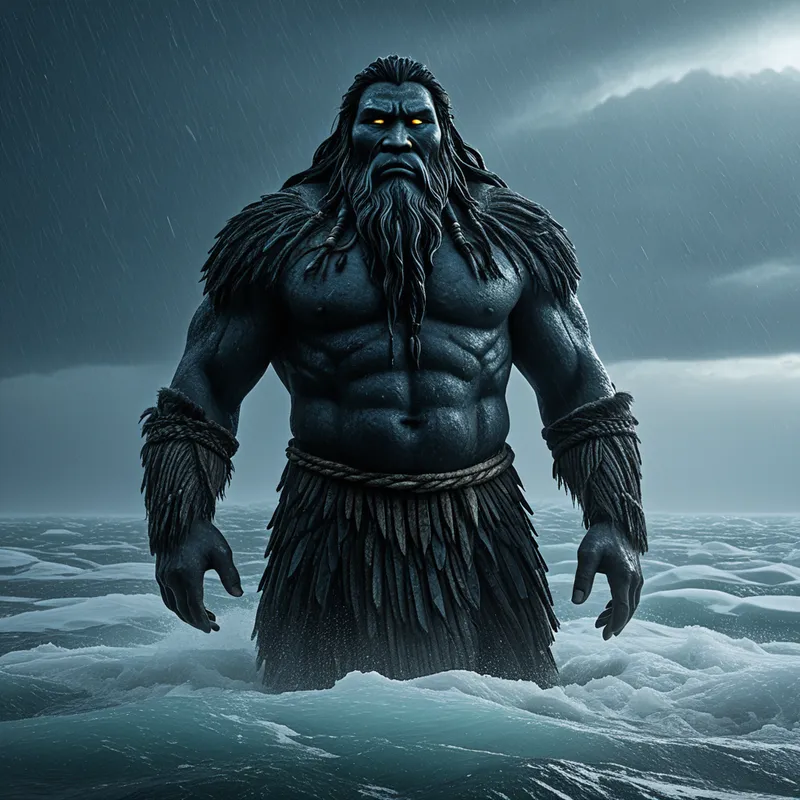
In the beginning, there was a father, Anguta. His heart was a cavern of ice, not from malice, but from a grief so vast it had frozen solid. His daughter, the beautiful Sedna, had grown willful. She refused all the suitors from their own people, men who were hunters and providers. Instead, her eye was captured by a mysterious stranger—a fulmar in the guise of a man, promising a life of ease in a warm land across the sea. Against her father’s storm-warning pleas, Sedna left with the bird-man.
But promises woven from feathers are undone by the wind. The stranger’s land was not warm, but desolate; his nest was not a home, but a prison of cliffs and gull-shrieks. Sedna knew the bitter taste of betrayal. Her cries were carried by the currents back to her father. When Anguta learned of her suffering, the frozen grief in his heart shattered, and what poured forth was a rage as deep and cold as the ocean trench.
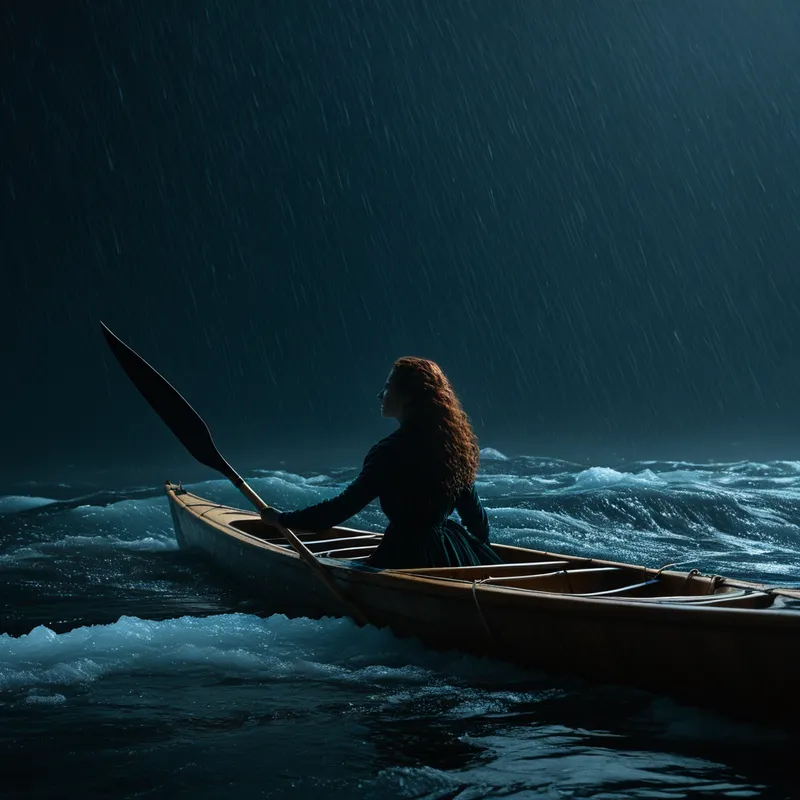
He set out across the heaving sea in his kayak. He found Sedna, and in a furious silence, he pulled her into his boat to bring her home. But the fulmar-husband summoned a great storm, a wall of wind and water that sought to swallow the tiny kayak whole. As the waves pitched and the sky screamed, Anguta looked at his daughter, and in his heart, the storm outside met the storm within. A terrible, dark thought took root. She was the cause. Her choice had brought this wrath upon them.
“The sea demands a price!” he roared over the gale. And in that moment of primal fear and fury, he did not offer himself. He seized Sedna and cast her over the side. As she clung to the gunwale, her fingers white on the hide, he took his knife. Not in a swift mercy, but in a frantic, horrifying act of survival. He struck at her hands. Once. Twice. Thrice. Her fingers, severed, fell into the raging foam.
But they did not sink. As Sedna herself was swallowed by the depths, her fingers transformed. They became the first seals, the first whales, the first walruses—all the creatures of the sea. And Anguta’s act did not calm the storm. It became the storm. His grief, his guilt, his rage—it overflowed. His tears were not water, but the ocean itself rising in answer to his anguish. The Great Flood began. The waters rose, swallowing the land, washing away the old world in a tide of divine sorrow.
Only the quick-witted and the brave survived. Some say it was a shaman who warned them, others that the animals themselves showed the way. They lasched their kayaks and umiaks together, a fragile island of life upon the chaos. They sent a dive—a loon, then a raven—to find land. And from the depths, a handful of mud was brought forth. Placed upon the waters, it grew. It expanded. It became the new earth, raw and wet, born from the abyss. The waters receded, leaving a world washed clean, harsh, and new, with Sedna now ruling the rich, terrifying kingdom below.
Cultural Origins & Context
This myth, in its many regional variations, is central to the Inuit worldview. It was not mere entertainment but a vital mythos told by elders and shamans (angakkuq) during the long winter nights. Its telling was a ritual act, reinforcing the precarious balance of life in the Arctic. The story explained the origin of sea mammals—the very source of life—and established the sacred, fraught relationship between humanity, the animal spirits, and the capricious deities.
The societal function was profound. It codified taboos, especially those concerning Sedna. If hunters failed to show respect, if communities broke social laws, Sedna’s hair (represented by sea kelp) would become tangled. The shaman (angakkuq) would then undertake a perilous spirit journey to the sea floor to comb her hair, appeasing her and releasing the animals for the hunt. Thus, the flood myth was the foundational trauma that set the terms for survival: the world exists because of a catastrophic failure of care, and continued existence depends on ritualized atonement and respect for the wounded powers that sustain it.
Symbolic Architecture
The myth is a powerful [drama](/symbols/drama “Symbol: Drama signifies narratives, emotional expression, and the exploration of human experiences.”/) of psychic forces made literal. Anguta represents the ruling principle of the psyche—the [father](/symbols/father “Symbol: The father figure in dreams often symbolizes authority, protection, guidance, and the quest for approval or validation.”/), the ego, the established order. His [grief](/symbols/grief “Symbol: A profound emotional response to loss, often manifesting as deep sorrow, yearning, and a sense of emptiness.”/), unprocessed, transforms into annihilating rage when challenged. His attempt to “cut away” the [problem](/symbols/problem “Symbol: Dreams featuring a ‘problem’ often symbolize internal conflicts or challenging situations that require resolution and self-reflection.”/) (Sedna’s clinging dependence/transgression) does not solve it but transforms it into the very substance of the unconscious (the sea).
The flood is the unconscious, once contained, now erupting to drown the conscious world. It is the inevitable return of what has been violently repressed.
Sedna is the complex itself—the feeling, desiring, betrayable [soul](/symbols/soul “Symbol: The soul represents the essence of a person, encompassing their spirit, identity, and connection to the universe.”/)-force. Cast out and mutilated, she does not die but becomes the [source](/symbols/source “Symbol: The origin point of something, often representing beginnings, nourishment, or the fundamental cause behind phenomena.”/) of all nourishment and [danger](/symbols/danger “Symbol: The symbol of ‘Danger’ often indicates a sense of threat or instability, calling for caution and awareness.”/). She is the ultimate [orphan](/symbols/orphan “Symbol: Represents spiritual abandonment, primal vulnerability, and the quest for belonging beyond biological ties. Often signifies a soul’s journey toward self-reliance.”/), residing in the [depths](/symbols/depths “Symbol: Represents the subconscious, hidden emotions, or foundational aspects of the self, often linked to primal fears or profound truths.”/), governing the bounty we need to survive yet forever reminding us of the cost. The surviving humans on their [raft](/symbols/raft “Symbol: A raft symbolizes stability and safety in turbulent waters, reflecting the need for support during life’s challenges.”/) are the nascent [consciousness](/symbols/consciousness “Symbol: Consciousness represents the state of awareness and perception, encompassing thoughts, feelings, and experiences.”/) after the [cataclysm](/symbols/cataclysm “Symbol: A sudden, violent upheaval or disaster of immense scale, often representing profound transformation, destruction, or the collapse of existing structures.”/), forced to negotiate with this new, deeper [reality](/symbols/reality “Symbol: Reality signifies the state of existence and perception, often reflecting one’s understanding of truth and life experiences.”/).
The Dreamer’s Resonance
When this myth pattern stirs in modern dreams, it often signals a flood of repressed emotional material. The dreamer may experience dreams of tidal waves, of being overwhelmed by water, or of tragic conflicts with parental figures. Somatic sensations can include a feeling of suffocation, immense pressure, or cold dread.
This is not a dream of fear alone, but of necessary dissolution. The psyche is announcing that an old structure—a way of thinking, a long-held identity, a frozen grief—has become untenable. The “knife” of a harsh, survivalist logic within has already cut away something vital (a connection, a creativity, a vulnerability), and now the consequences are rising up. To dream of navigating the floodwaters, or of seeing creatures emerge from them, indicates the beginning of the alchemical process: the terrifying waters also contain the seeds of new life, new resources from the depths of one’s own experience.
Alchemical Translation
The individuation journey modeled here is brutal and direct. It begins with the nigredo, the blackening: the catastrophic flood, the overwhelming by shadow content (Anguta’s wrath). The ego’s world is drowned. The first task is not to fight the water, but to build a raft—a temporary, cohesive point of awareness amidst the chaos.
The central alchemical act is the descent to and recognition of Sedna. Psychologically, this is the journey into one’s own foundational wounds, the sources of one’s deepest pain and, paradoxically, one’s greatest potential. We must “comb Sedna’s hair”—not to fix her, but to attend to the tangles of our own neglected soul, the matted knots of shame, betrayal, and isolation. This attentive, ritualized care is what transforms the stagnant depths into a flowing source of sustenance.
The new earth does not come from avoiding the flood, but from having the courage to send a part of oneself (the diving bird) into it to retrieve the primal mud of a new beginning.
The myth concludes not with a victory, but with an eternal, sacred negotiation. The transformed individual lives on the new earth, aware that the nourishing sea is also the realm of the wounded goddess. Survival and sanity depend on this respectful, ongoing relationship with the deep, turbulent, and creative unconscious.
Associated Symbols
Explore related symbols from the CaleaDream lexicon:
- Water — The primordial element of the unconscious, emotion, and chaos, which both destroys the old world and becomes the medium from which new life is born.
- Flood — The cataclysmic eruption of repressed psychic content, overwhelming the conscious ego and necessitating a complete re-formation of the inner world.
- Father — Represents the archetypal authority, law, and ego structure whose unprocessed emotional state (grief, rage) can become a world-destroying force.
- Ocean — The vast, unknown realm of the deep psyche, home to both terrifying monsters and life-sustaining bounty, ruled by the wounded goddess.
- Goddess — Embodied as Sedna, she is the archetypal wounded feminine, the source of all nourishment who resides in darkness and demands ritual attention.
- Sacrifice — The violent cutting away (of Sedna’s fingers) that is not a true offering but a trauma, which paradoxically generates the substance of a new reality.
- Rebirth — The emergence of the new earth from the floodwaters, symbolizing the psyche’s capacity to regenerate from its own deepest crises.
- Journey — The shaman’s descent to the sea floor, modeling the necessary psychic voyage into one’s own depths to achieve reconciliation and healing.
- Rage — The uncontained, destructive energy of thwarted love and grief that floods the world, representing a primary shadow emotion that must be integrated.
- Spirit — The animating force of the animals born from Sedna, representing the transformed energy of trauma that becomes available to the conscious self.
- Dream — The entire mythic narrative functions as a collective dream, illustrating the dramatic, symbolic processes that govern psychic life and transformation.
- Shadow — The totality of the repressed—Anguta’s grief, Sedna’s betrayal and mutilation—that rises up to confront the individual with what has been denied.