
The Great Highland Bagpipe Myth Meaning & Symbolism
A myth where a bard's sacrifice births the Great Highland Bagpipe, an instrument forged from his body to become the eternal voice of the land and its people.
The Tale of The Great Highland Bagpipe
Listen. Before the stones of the broch were laid, before the clans were named, the land itself was silent. Oh, it had its voices—the shriek of the eagle, the roar of the stag, the endless sigh of the wind through the heather. But it had no true voice. No sound that could hold the sorrow of its glens, the fury of its storms, the iron memory of its bones.
There was a bard, then. Not a king, nor a warrior, but a man whose soul was a hollow reed through which the world breathed. His name is lost, for names are for those who are separate from a thing. He was not separate. He walked the high passes and knew the secret language of the peat bogs. He heard the land’s longing, a deep, wordless drone in the bedrock, and it grieved him that he could not give it tongue. His own harp, his own voice, were but whispers against that immensity.
One bitter winter, when the Cailleach had locked the lochs in ice and the people huddled starving in their huts, the silence became a suffocating weight. The bard climbed to the highest corrie, a bowl of stone beneath a leaden sky. He stood there, and he made a vow to the spirit of the place, to the numen of the mountain.
“I am your instrument,” he said, his breath a white plume in the frozen air. “But I am flawed. My breath fails. My fingers tire. Take me. Remake me. Let my failure become your vessel.”
The mountain did not speak. But the wind died. In that perfect stillness, the bard felt a terrible pressure, not from without, but from within. It began in his lungs, a burning expansion. He fell to his knees as his own breath, his very life’s air, was trapped inside him, swelling his chest into a great, taught bag of skin and spirit. His arm bones lengthened, hardened, polished by an unseen hand into the long drones that fell across his shoulder. His spine straightened, hollowed, becoming the bass drone that anchored the sky to the earth. From his fingers grew the chanter, with its secret, double-bored soul.
The pain was a fire that forged. He was unmade, not into death, but into a new anatomy of sound. His ribs became the stiffeners for the bag. His heart’s final beats settled into the steady pressure needed to feed the reed—a sliver of his own spirit, now carved from the Arundo donax that grew by the hidden spring.
And then, he played. Or rather, the land played through him. The first note was not a note, but the birth-cry of the hills. It was the groan of glaciers carving glens, the shriek of the sea-cliff, the lowing of the cattle in the mist. It was a pibroch—a ceòl mòr—that had no beginning and would have no end. It rolled down from the high corrie, and where it touched, the ice cracked. The people heard it, and they did not hear music. They heard their own blood remembered. They heard the voice of their home.
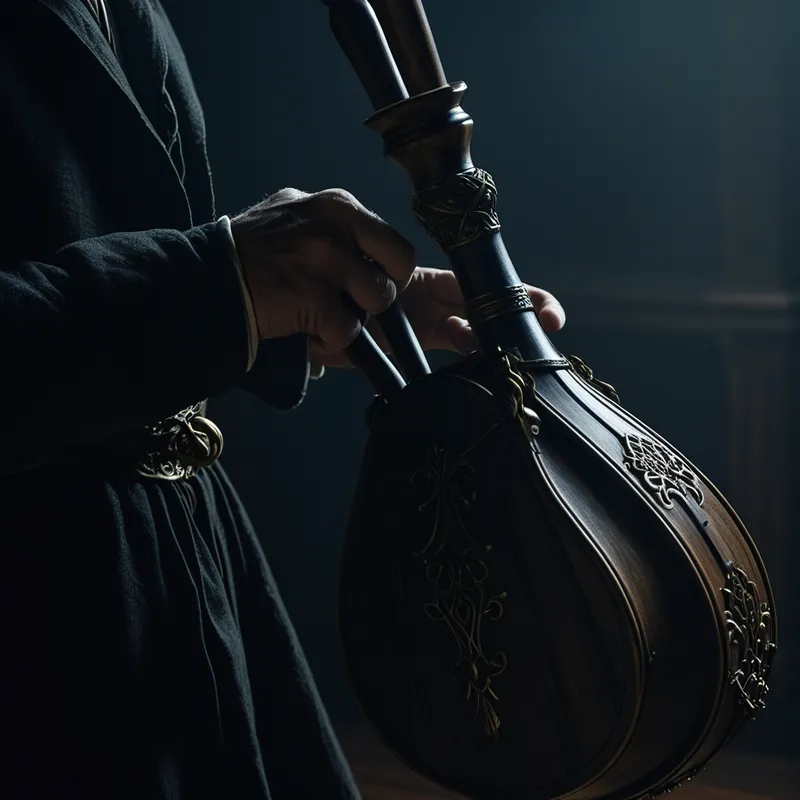
The bard was gone. In his place stood the first Great Highland Bagpipe, a being of wood, skin, and cane, animated by a sacrifice. It was not played; it was awakened. And its voice became the sovereign voice of the people, calling them to battle, laying them to rest, and forever binding their story to the story of the stones.
Cultural Origins & Context
This foundational myth, passed down in fragments through bardic lineages and around ceilidh hearths, does not belong to a single text or era. It is an aetiological myth for the instrument’s profound cultural dominance. Historically, the Great Highland Bagpipe (a’ phìob mhòr) emerged as a martial instrument around the 15th-16th centuries, but its mythic roots reach back to a pre-Christian, animistic understanding of the world.
The story was told not to chronicle history, but to explain a psychological and spiritual reality. The bagpipe’s sound is physically overwhelming; it is worn on the body, its air supply continuous, its tone penetrating and visceral. The myth provides a reason for this profound physicality: the instrument is a body, a transformed human body. It was transmitted by keepers of tradition—the bards, the seanchaidh, and later, the pipers themselves—to cement the pipe’s role as more than entertainment. It was the audible soul of the clan, its “voice” in both ceremony and war. The myth sanctioned its use in pivotal moments of collective life and death, framing the piper not merely as a musician, but as a priest of this embodied spirit, channeling a power born of ultimate sacrifice.
Symbolic Architecture
At its core, the myth is a profound map of transformation through surrender. The bard represents the individual ego or talent that recognizes its own insufficiency in the face of a greater calling—the soul of the land, the needs of the tribe, the collective unconscious.
The true instrument is not played; it is incarnated. The musician must cease to be a performer and become the passage through which the numinous flows.
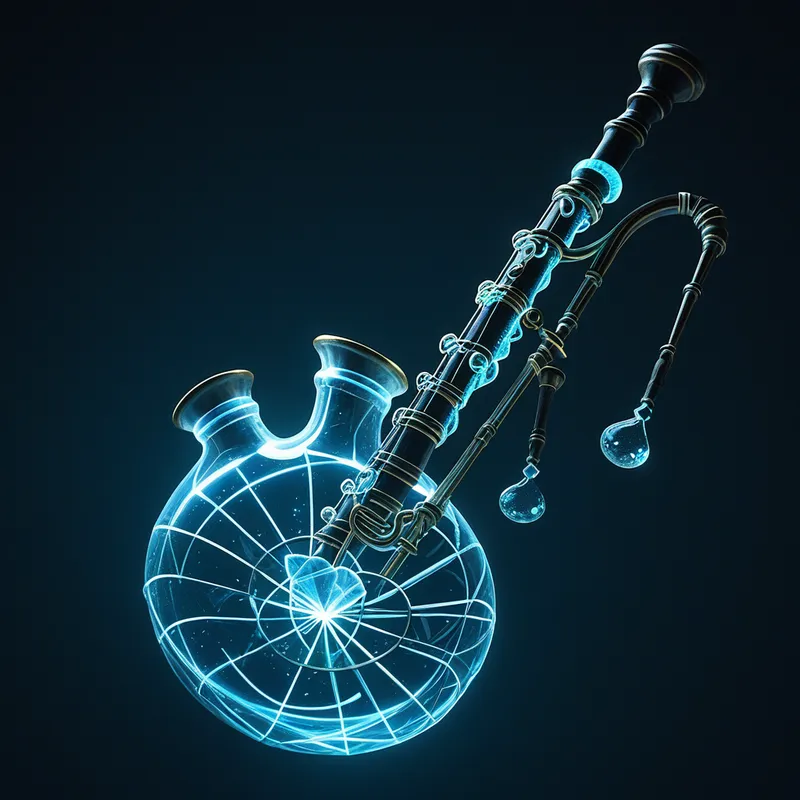
The brutal, alchemical transformation of his body into the bagpipe’s components is rich in symbolism. The bag (from his lungs and torso) becomes the reservoir of spirit and breath, the unconscious itself, which must be kept under constant, steady pressure. The drones (from his limbs and spine) represent the eternal, unchanging foundations—the ancestral past, the laws of the land, the constant backdrop of fate. Their single, harmonizing note is the ground of being. The chanter (from his fingers and breath) is the individuated voice, the melody of the present moment and the conscious will, which can only sing because it is supported by the drones and fed by the bag.
The sacrifice is not a death, but a re-purposing. The ego is dismantled so that the Self—the larger, transpersonal identity of people and place—can find expression. The bagpipe thus becomes a symbol of individuation achieved through service to something beyond oneself.
The Dreamer’s Resonance
When this mythic pattern stirs in the modern dreamer, it often manifests as dreams of profound physical transformation or haunting, inescapable sound. One might dream of their own chest cavity hollowing out, becoming a resonant chamber, or of their arms becoming rigid, tube-like structures. The somatic experience is one of pressure, expansion, and a restructuring of the very vessel of the self.
Psychologically, this signals a critical juncture where a deep, perhaps dormant, aspect of the psyche—a talent, a calling, a burden of heritage—is demanding embodiment. The “land” that is silent in the dream is the dreamer’s own inner landscape, their unlived life or unexpressed identity. The conflict is between the familiar, individual “harp” (the current, inadequate mode of expression) and the call to become the “bagpipe” (a more integrated, powerful, and demanding vessel). The dream may feel terrifying, a violation of the ego’s boundaries, because it is. It is the psyche initiating its own alchemical process, pressing the dreamer toward a form of expression that requires personal sacrifice for a greater authenticity.

Alchemical Translation
The myth of the Great Highland Bagpipe is a manual for psychic transmutation. It outlines the stages of the Magnum Opus as applied to creative and spiritual identity.
First, Recognizing the Silence (Nigredo): The bard’s despair is the dark night of the soul, the nigredo. The dreamer feels their current mode of being is insufficient, a whisper against the roar of their potential or destiny.
Second, The Sacrificial Vow (Mortificatio): The conscious ego’s surrender—“Take me, remake me”—is the mortificatio. This is the willingness to let old identities, comforts, and structures be broken down. It is not self-destruction, but a offering of the ego’s raw materials to the Self.
Third, Transmutation of Substance (Albedo & Rubedo): The horrific yet glorious reshaping of bone into drone, breath into bag, is the albedo and rubedo. Base physicality (the human body) is purified and recombined into a sacred tool. In our lives, this is the slow, often painful process where our wounds (the ribs), our strengths (the spine), and our spirit (the breath) are reorganized into a new, functional wholeness oriented toward a purpose.
Finally, The Sovereign Voice (Projection): The resulting music is not “self-expression” in a petty sense. It is the voice of the integrated psyche projected into the world. The individual becomes a channel for archetypal energies—of lament, of courage, of memory. They no longer “have” a talent; they are the instrument of a larger life. Their breath, their work, becomes continuous, sustaining, and foundational to their community, whether that community is a family, a field of endeavor, or their own fully realized soul. The pipe’s cry, once born of sacrifice, becomes the sound of sovereign being.
Associated Symbols
Explore related symbols from the CaleaDream lexicon: