The Great Flood Amazon
Amazonian flood myths tell of catastrophic deluges that reshape the world, often involving divine punishment, survival, and the renewal of life and culture.
The Tale of The Great Flood Amazon
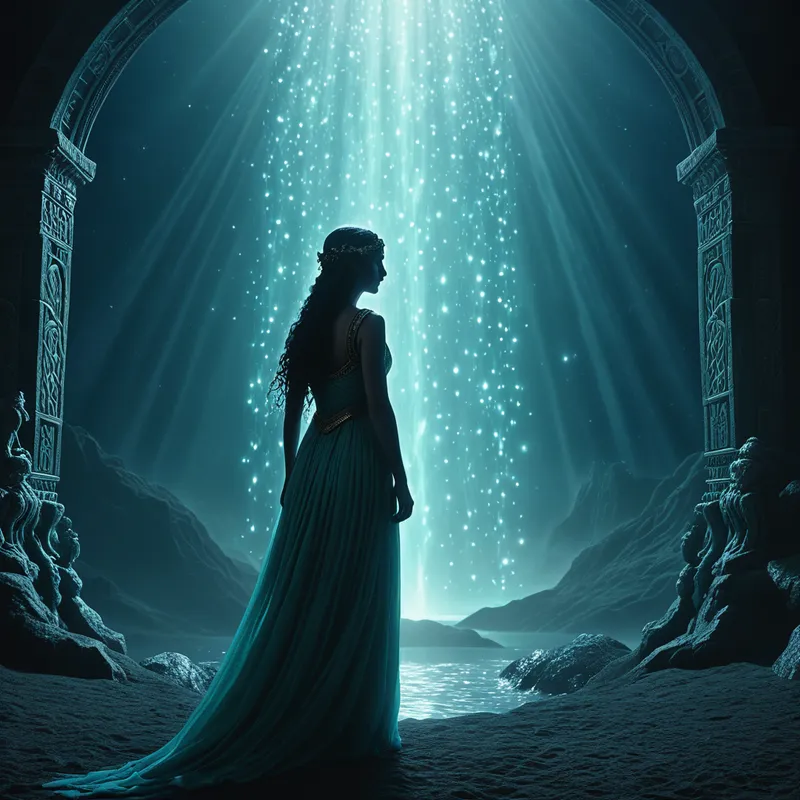
In the beginning, before the rivers had names and the trees knew their own height, [the world](/myths/the-world “Myth from Tarot culture.”/) was a great, dry plain. The people lived without memory, their days a flat circle of existence. Then, the great celestial anaconda, Yacu Mama, the Mother of All Waters, stirred in her sleep beneath [the earth](/myths/the-earth “Myth from Hindu culture.”/). She had witnessed the people’s growing arrogance. They felled the grandfather trees without ceremony, hunted the [spirit animals](/myths/spirit-animals “Myth from Various culture.”/) without gratitude, and spoke to each other with hearts of stone, forgetting the sacred web that bound all life. The balance of [the world](/myths/the-world “Myth from Tarot culture.”/), a delicate basket woven of breath and leaf, began to unravel.
A profound sadness filled Yacu Mama, a sadness as deep as the oldest river channel. This sorrow was not a human feeling, but a cosmic correction—a tear in the fabric of the world that must be washed clean. From her eyes, the first warm, heavy drops began to fall. They were not like ordinary rain; they carried the weight of forgotten songs and broken promises. [The sky](/myths/the-sky “Myth from Persian culture.”/) darkened, not with clouds, but with the gathered shadows of all the disregarded spirits of the forest. The rain became a curtain, then a wall, then the sky itself falling in a single, endless cascade.
The waters rose from below as well, as Yacu Mama uncoiled her immense body. Springs burst from the earth, and the rivers reversed their flow, swallowing their own banks. The great plain became a churning, brown ocean. The world of solid ground was erased, drowned in the primal memory from which it had first emerged. The people cried out, but their voices were lost in the roar. Their tools and weapons became anchors, pulling them into the deep. The forest giants groaned and fell, becoming floating islands, then mere driftwood.
Yet, in this totality of dissolution, a point of consciousness remained. A shaman, a man who had listened to the whispers of the vines and understood the language of the jaguar’s cough, had been warned in a dream. As the first strange rains fell, he acted not from panic, but from ritual knowledge. He did not build an ark of wood, but of spirit. He took the sacred maraca, the gourd rattle that held the first sound of creation, and a single ember from the community fire, kept alive on a piece of termite mound clay. With his sister, who knew the secrets of all seeds, he climbed not a mountain, but the tallest surviving cecropia tree, the tree of the sloth, a tree hollowed by spirit.
They did not wait for the waters to recede. They became part of [the flood](/myths/the-flood “Myth from Biblical culture.”/). [The shaman](/myths/the-shaman “Myth from Siberian culture.”/) shook his maraca, singing the song of origins into the face of the [chaos](/myths/chaos “Myth from Greek culture.”/), a tiny, persistent rhythm against the universal roar. His sister nurtured the ember and the seeds, protecting the spark of life and the memory of future nourishment. For forty days and forty nights, they existed in this liminal state, perched between [the drowned](/myths/the-drowned “Myth from Norse culture.”/) old world and the unborn new one, their humanity pared down to its essential elements: breath, song, fire, and seed.
Finally, Yacu Mama’s tears were spent. Her grief had been expressed, her cleansing complete. The waters began to slow, to settle, to seek new courses. The great anaconda coiled back into the depths of the earth, leaving a transformed world. The vast floodplain had been sculpted into a new landscape of winding rivers, oxbow lakes, and rich, dark sediment. The old, flat world was gone. In its place was a complex, breathing organism of land and [water](/myths/water “Myth from Chinese culture.”/)—the Amazon basin as it is known.
The shaman and his sister descended from their tree onto the soft, new mud. It was a world naked and full of potential. The sister planted her seeds in the fertile sludge, and the first new greens pushed toward the sun. The shaman used the sacred ember to light a new fire, and its smoke carried their songs of gratitude to the cleansed sky. They were no longer merely a man and a woman; they were the new First People, born not from clay, but from the union of survival and sacred duty. From them, all the new tribes would learn the laws of this reborn world: to live in reciprocity, to remember the flood that sleeps in [the river](/myths/the-river “Myth from Buddhist culture.”/)’s heart, and to understand that creation is not a one-time event, but a cycle forever balanced between dissolution and renewal.
Cultural Origins & Context
This narrative is not a single, monolithic story, but a deep, flowing current found across numerous Amazonian cultures, from the Tupi-Guarani peoples to the societies of the Upper Xingu and the Northwestern Amazon. For these cultures, the environment is not a backdrop but a primary actor—a conscious, sentient entity. The annual flooding of the Amazon River and its countless tributaries is not merely a meteorological event; it is the world breathing, the land being fertilized, and a constant, gentle reminder of the great primordial deluge. Life here is fundamentally amphibious, requiring an intimate knowledge of both forest (terra firme) and the flooded forest (várzea).
The flood myth, therefore, is an etiological narrative that explains the very nature of their reality. It answers why the world is a mosaic of land and water, why the soil is so devastatingly fertile, and why human life is precarious and dependent on right relationship. The concept of divine punishment is present, but it is nuanced. The “sin” is rarely one of simple morality, but of ecological and spiritual imbalance—a failure of reciprocity. When humans take without giving thanks, hunt without offering apology, or forget their place within, not above, the web, the world itself must recalibrate. The flood is that recalibration, a violent return to the undifferentiated, watery state of potential that precedes all forms.
The survivors are almost always cultural heroes defined by specific knowledge: the shaman with his spiritual tools (maraca, sacred songs) and the woman with her practical, life-sustaining knowledge (seeds, fire). This underscores a fundamental duality necessary for survival: the masculine principle of connection to the spirit world and the feminine principle of nurturing biological life. Together, they form the complete template for a renewed humanity.
Symbolic Architecture
The [architecture](/symbols/architecture “Symbol: Architecture in dreams often signifies structure, stability, and the framing of personal identity or life’s journey.”/) of this myth is one of immersive transformation. The flood represents the ultimate [dissolution](/symbols/dissolution “Symbol: The process of breaking down, dispersing, or losing form, often representing transformation, release, or the end of a state of being.”/) of ego and fixed structures. The old, dry, “certain” world is the [psyche](/myths/psyche “Myth from Greek culture.”/) in a state of hubris and [separation](/symbols/separation “Symbol: A spiritual or mythic division between realms, states of being, or consciousness, often marking a transition or loss of connection.”/). The [deluge](/symbols/deluge “Symbol: A massive, overwhelming flood representing cleansing, destruction, or emotional inundation.”/) is the overwhelming influx of the unconscious—all that has been repressed, ignored, or dishonored. It is not a [punishment](/symbols/punishment “Symbol: A dream symbol representing consequences for actions, often tied to guilt, societal rules, or internal moral conflicts.”/) from an external god, but the [psyche](/myths/psyche “Myth from Greek culture.”/)’s own corrective, self-regulating [action](/symbols/action “Symbol: Action in dreams represents the drive for agency, motivation, and the ability to take control of situations in waking life.”/) when conscious [life](/symbols/life “Symbol: The symbol of ‘Life’ represents a journey of growth, interconnectedness, and existential meaning, encompassing both the joys and challenges that define human experience.”/) becomes too one-sided, too rigid.
The flood is the world dreaming itself back to a state of potential, washing away the accumulated calcifications of habit and arrogance to reveal the soft, fertile mud of the soul’s own bottom.
The survival in the [tree](/symbols/tree “Symbol: In dreams, the tree often symbolizes growth, stability, and the interconnectedness of life.”/) is profoundly significant. The tree is the [axis](/symbols/axis “Symbol: A central line or principle around which things revolve, representing stability, orientation, and the fundamental structure of reality or consciousness.”/) mundi, the world pillar. By surviving within it, the heroes are not just escaping the [water](/symbols/water “Symbol: Water symbolizes the subconscious mind, emotions, and the flow of life, representing both cleansing and creation.”/); they are positioning themselves at the very center of the [cosmos](/symbols/cosmos “Symbol: The entire universe as an ordered, harmonious system, often representing the totality of existence, spiritual connection, and the unknown.”/) during its [rebirth](/symbols/rebirth “Symbol: A profound transformation where old aspects of self or life die, making way for new beginnings, growth, and renewal.”/). They become the [axis](/symbols/axis “Symbol: A central line or principle around which things revolve, representing stability, orientation, and the fundamental structure of reality or consciousness.”/) around which the new world forms. The hollow [tree](/symbols/tree “Symbol: In dreams, the tree often symbolizes growth, stability, and the interconnectedness of life.”/) is a [womb](/symbols/womb “Symbol: A symbol of origin, potential, and profound transformation, representing the beginning of life’s journey and the unconscious source of creation.”/), a [vessel](/symbols/vessel “Symbol: A container or structure that holds, transports, or protects something essential, representing the self, emotions, or life journey.”/) of [incubation](/symbols/incubation “Symbol: A period of internal development, rest, or hidden growth before emergence, often associated with healing, creativity, or transformation.”/). Their forty-day vigil is a [period](/symbols/period “Symbol: Periods in dreams can symbolize cyclical patterns, renewal, and the associated emotions of loss or change throughout life.”/) of [gestation](/symbols/gestation “Symbol: A period of development and preparation before a significant birth or emergence, symbolizing potential, transformation, and the journey toward manifestation.”/), where the old [human](/symbols/human “Symbol: The symbol of a human represents individuality, complexity of emotions, and social relationships.”/) [identity](/symbols/identity “Symbol: Identity represents the sense of self, encompassing personal beliefs, cultural background, and social roles.”/) dissolves, and a new one, forged in the [crucible](/symbols/crucible “Symbol: A vessel for intense transformation through heat and pressure, symbolizing spiritual purification, testing, and alchemical change.”/) of absolute dependency on the sacred, is formed.
The new world that emerges is not a return to [paradise](/symbols/paradise “Symbol: A perfect, blissful place or state of being, often representing ultimate fulfillment, harmony, and transcendence beyond ordinary reality.”/), but an advancement. It is more complex, more intertwined, more beautiful in its interdependence. The myth posits that true creation often requires a prior, terrifying un-creation. The fertile várzea ecology—the most productive on [earth](/symbols/earth “Symbol: The symbol of Earth often represents grounding, stability, and the physical realm, embodying a connection to nature and the innate support it provides.”/)—is the literal and symbolic [fruit](/symbols/fruit “Symbol: Fruit symbolizes abundance, nourishment, and the fruits of one’s labor in dreams.”/) of this cycle: life born from periodic, necessary [death](/symbols/death “Symbol: Symbolizes transformation, endings, and new beginnings; often associated with fear of the unknown.”/).
The Dreamer’s Resonance
To dream of [the Great Flood](/myths/the-great-flood “Myth from Biblical culture.”/) Amazon is to feel the foundations of one’s personal world softening and giving way. It speaks to moments of profound emotional or psychological inundation—a grief, a trauma, a sudden life change that seems to erase all familiar landmarks. The dream-ego may be scrambling for high ground, watching beloved structures wash away. This is not a nightmare of meaningless destruction, but a profound initiation.
The myth invites the dreamer to ask: What in my life has become arid, arrogant, or out of balance? What rigid structures of belief, behavior, or identity need to be dissolved so that something new, more fluid and adaptive, can emerge? The terror of the flood is real, but the myth assures us that within it lies the seed of renewal. The question is not if the waters will rise, but how we will meet them. Will we cling to sinking logs of old pride, or will we find our cecropia tree—our connection to something timeless and spiritual (the maraca’s song, the guarded ember) that can sustain us through the dissolution?
The emergence onto the new mud is the promise. It signifies the period after the crisis, when the pain has receded but everything feels raw, tender, and full of shocking potential. It is a call to plant the seeds of a new way of being in the freshly turned soil of the soul.
Alchemical Translation
In the alchemical vessel of the Amazonian soul, the [Great Flood](/myths/great-flood “Myth from Mesopotamian culture.”/) is the stage of [solutio](/myths/solutio “Myth from Alchemical culture.”/)—dissolution. The fixed, dry elements of the conscious personality (the terra firma) are dissolved in [the universal solvent](/myths/the-universal-solvent “Myth from Alchemical culture.”/) of the unconscious (the [prima materia](/myths/prima-materia “Myth from Alchemical culture.”/), often symbolized as water). This is a necessary step to break down hardened complexes and prepare the material for transformation.
The shaman’s maraca and fire are the lapis philosophorum, the philosopher’s stone in potentia. They represent the indestructible core of spirit and consciousness that must be preserved through the nigredo, the blackening, of the flood. They are the guarantee that the dissolution will lead to coagulation, not to annihilation.
The process follows the alchemical sequence: [Nigredo](/myths/nigredo “Myth from Alchemical culture.”/) (the blackening, the flood’s chaos and [death](/myths/death “Myth from Tarot culture.”/)), [Albedo](/myths/albedo “Myth from Alchemical culture.”/) (the whitening, the cleansing by water, the emergence of the new mud), and Citrinitas (the yellowing, the planting of seeds and the first green shoots). The final [Rubedo](/myths/rubedo “Myth from Alchemical culture.”/) (the reddening) is the mature, interconnected ecosystem—and the enlightened human community—that arises, a golden reality born from the leaden weight of imbalance. The myth is a perfect map of the opus contra naturam: the work against nature’s entropy, using nature’s own most destructive force to achieve a higher, more conscious order.
Associated Symbols
Explore related symbols from the CaleaDream lexicon:
- Water — The primordial substance of life and the unconscious, capable of both nurturing creation and enacting dissolution.
- Tree — The [axis mundi](/myths/axis-mundi “Myth from Various culture.”/) and world pillar; a sanctuary of life and a connector between realms during cosmic upheaval.
- Seed — The encapsulated potential for future life, preserved through catastrophe to found a new world.
- Flood — The catastrophic dissolution of a worn-out order, a necessary return to the formless state that precedes rebirth.
- Survival Instinct — The primal drive to preserve not just biological life, but the essential spiritual knowledge that defines humanity.
- Mud — The fertile, chaotic mixture of earth and water that represents the raw material of a new creation.
- Ritual — The prescribed actions (song, fire-keeping) that maintain a connection to the sacred and structure reality during chaos.
- Rebirth — The emergence of a new, more complex and conscious order from the ashes of the old.
- Forest — The complex, interconnected web of life that is both destroyed and regenerated by the cyclical flood.
- River — The ever-flowing, ever-changing artery of the landscape, carrying both life-giving water and the memory of the great deluge.