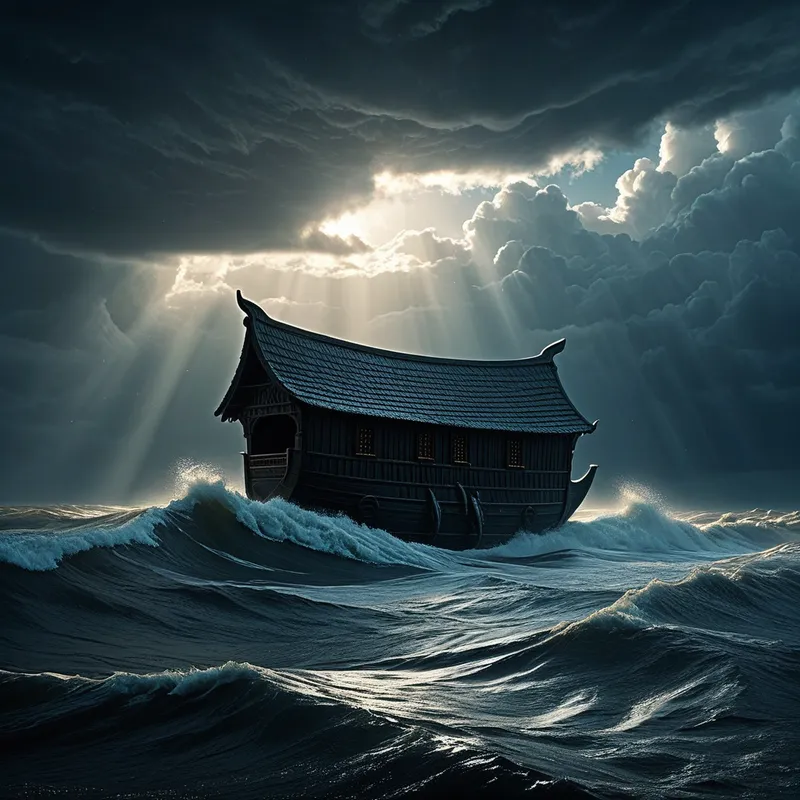
The Great Flood Myth Meaning & Symbolism
A world cleansed by divine waters, a lone ark carrying the seed of all life, and a covenant sealed by a rainbow in the cleansed sky.
The Tale of The Great Flood
In the beginning of days, when [the world](/myths/the-world “Myth from Tarot culture.”/) was young and thick with the breath of life, a sickness grew in the heart of humankind. It was a creeping [thing](/myths/thing “Myth from Norse culture.”/), a shadow in the thought, a violence in the hand. [The earth](/myths/the-earth “Myth from Hindu culture.”/), which had been a garden of [ruach](/myths/ruach “Myth from Hebrew culture.”/), became filled with the noise of corruption. Every imagination of the thoughts of their hearts was only evil continually.
And YHWH saw it. The Great Weaver looked upon the tapestry of His creation and saw that the threads were stained black with blood and deceit. Grief, a profound and terrible grief, settled in the heart of the Divine. Regret was a bitter taste. “I will blot out man whom I have created from the face of the ground,” came the decree, a sound like a mountain cracking from within. “For I am sorry that I have made them.”
But in the generations of men, there walked one who was different. His name was Noah, a man righteous in his time, who walked with the Divine. To him alone, a whisper came through the storm of judgment: a command, a blueprint for salvation. “Make yourself an ark of gopher wood.”
And so, under a sun that did not yet know its purpose was to witness an end, Noah labored. For years, the rhythmic sound of the adze and the mallet was a counter-beat to [the drum](/myths/the-drum “Myth from West African / Diasporic culture.”/) of coming doom. He built a vessel of immense proportions, a floating mountain of timber, pitched within and without with tar. He built rooms. He built a window. He built a door. And the people of the earth saw and mocked, their laughter a final chorus of the old world.
Then the animals came. Not by Noah’s herding, but drawn by a deeper law. From every kind of bird, of animal, of creeping thing, pairs came, male and female, their instincts singing of a refuge only one man provided. They entered the dark belly of the ark, and the great door, that single threshold between annihilation and continuity, was shut by the hand of the Divine Himself.
And then the fountains of the great deep burst forth. Not with a roar, but with a sigh that shook the foundations of the world. The windows of the heavens were opened. It was not merely rain; it was the unbottling of the celestial seas, the unleashing of the primal waters that Tehom had once been. [Water](/myths/water “Myth from Chinese culture.”/) rose from below and fell from above in a terrible, unifying embrace. For forty days and forty nights, [the deluge](/myths/the-deluge “Myth from Mesopotamian culture.”/) continued, until every high mountain under the whole heaven was covered. All flesh died that moved on the earth. The ark alone floated on the face of the waters.
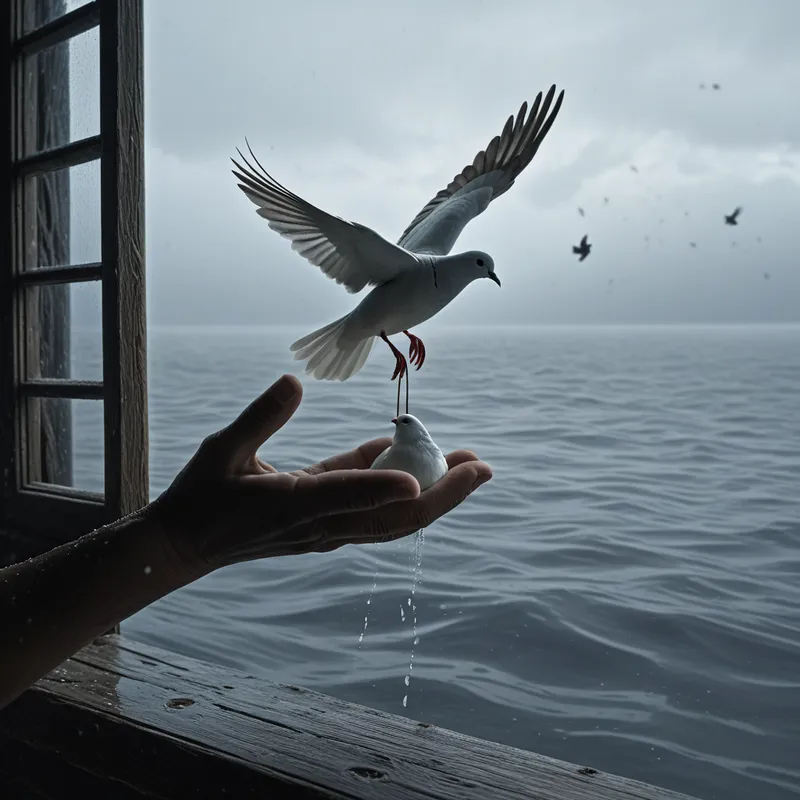
For one hundred and fifty days, the great deeps ruled. Then ruach moved again—not to create, but to abate. A wind passed over the earth, and the waters receded. The ark came to rest on the mountains of Ararat. Noah sent forth a [raven](/myths/raven “Myth from Haida culture.”/), which flew to and fro. He sent a dove, which found no rest and returned. He waited. He sent the dove again, and it returned with a freshly plucked olive leaf in its beak. A green promise in a world of brown mud. He sent it a third time, and it did not return.
Then the voice spoke again: “Go out from the ark.” And Noah, his wife, his sons, and their wives, and every living creature emerged onto a silent, washed-clean world. The first thing Noah built was an altar. He offered sacrifices, and the scent was not of burning flesh, but of gratitude and atonement, a sweet savor to the Divine.
And YHWH spoke a covenant into the quiet air. “Never again.” A promise hung in the atmosphere, a new law for the cosmos. “I set my bow in the cloud.” And there, against the retreating storm, a prism of light appeared—a rainbow. Not a weapon of war, but a bridge of peace, a divine signature etched in water and light, a reminder to Himself of the everlasting covenant between God and every living creature of all flesh that is on the earth.
Cultural Origins & Context
The Biblical Flood narrative is not an isolated story but a powerful strand in the tapestry of ancient Near Eastern myth. Its direct literary ancestors are found in Mesopotamian epics, most notably the Epic of [Gilgamesh](/myths/gilgamesh “Myth from Mesopotamian culture.”/), where the hero [Utnapishtim](/myths/utnapishtim “Myth from Mesopotamian culture.”/) builds a boat to survive a god-sent deluge. The Biblical authors, likely during or after the Babylonian Exile (6th century BCE), engaged with this widespread cultural memory but radically reinterpreted it within their monotheistic framework.
In this context, the myth functioned as a foundational theodicy—an explanation for divine [justice](/myths/justice “Myth from Tarot culture.”/) and mercy. It was told not as mere history, but as sacred theology, establishing key tenets: the profound seriousness of human ethical failure (chamas), the absolute sovereignty and moral will of YHWH, and the possibility of grace through righteous obedience. It served as a societal anchor, explaining the world’s fragility and the conditional nature of humanity’s place within it, all under the ultimate promise of a divine covenant that orders creation itself.
Symbolic Architecture
At its core, [the Flood](/myths/the-flood “Myth from Biblical culture.”/) is an archetypal [symbol](/symbols/symbol “Symbol: A symbol can represent an idea, concept, or belief, serving as a powerful tool for communication and understanding.”/) of cataclysmic transformation. The waters represent the unconscious, chaotic, and formless state from which creation first emerged (Tehom) and to which it symbolically returns for a purgative [rebirth](/symbols/rebirth “Symbol: A profound transformation where old aspects of self or life die, making way for new beginnings, growth, and renewal.”/).
The flood is not merely punishment; it is the necessary dissolution of a corrupted form so that a new, more conscious one may emerge from the waters.
The Ark is the [vessel](/symbols/vessel “Symbol: A container or structure that holds, transports, or protects something essential, representing the self, emotions, or life journey.”/) of [consciousness](/symbols/consciousness “Symbol: Consciousness represents the state of awareness and perception, encompassing thoughts, feelings, and experiences.”/) itself—the fortified [psyche](/myths/psyche “Myth from Greek culture.”/) or the enduring principle of [life](/symbols/life “Symbol: The symbol of ‘Life’ represents a journey of growth, interconnectedness, and existential meaning, encompassing both the joys and challenges that define human experience.”/) and order that can navigate the overwhelming tides of the unconscious or collective [chaos](/symbols/chaos “Symbol: In Arts & Music, chaos represents raw creative potential, uncontrolled expression, and the breakdown of order to forge new artistic forms.”/). Noah, the [caregiver](/symbols/caregiver “Symbol: A spiritual or mythical figure representing nurturing, protection, and unconditional support, often embodying divine or archetypal parental energy.”/) [archetype](/symbols/archetype “Symbol: A universal, primordial pattern or prototype in the collective unconscious that shapes human experience, behavior, and creative expression.”/), is not a [warrior](/symbols/warrior “Symbol: A spiritual archetype representing inner strength, discipline, and the struggle for higher purpose or self-mastery.”/)-[hero](/symbols/hero “Symbol: A hero embodies strength, courage, and the ability to overcome significant challenges.”/) but a preserver, a patient builder who follows a divine [pattern](/symbols/pattern “Symbol: A ‘Pattern’ in dreams often signifies the underlying structure of experiences and thoughts, representing both order and the repetitiveness of life’s situations.”/) (the torah or instruction for the ark). He represents [the ego](/myths/the-ego “Myth from Jungian culture.”/) capable of heeding a call from [the Self](/myths/the-self “Myth from Jungian culture.”/) (the Divine) to prepare for an inevitable psychic [crisis](/symbols/crisis “Symbol: A crisis symbolizes turmoil, urgent challenges, and the need for immediate resolution or change.”/).
The [sequence](/symbols/sequence “Symbol: The symbol of ‘sequence’ often signifies the order of events and the progression towards a desired outcome or goal.”/) of the birds—the [raven](/symbols/raven “Symbol: The raven is often seen as a messenger of the divine and a symbol of transformation, wisdom, and the mysteries of life and death.”/), the dove, the olive [leaf](/symbols/leaf “Symbol: A leaf symbolizes growth, renewal, and the cycles of life, reflecting both the natural world and personal transformations.”/)—maps a psychological process of testing [reality](/symbols/reality “Symbol: Reality signifies the state of existence and perception, often reflecting one’s understanding of truth and life experiences.”/). The [raven](/symbols/raven “Symbol: The raven is often seen as a messenger of the divine and a symbol of transformation, wisdom, and the mysteries of life and death.”/), a scavenger, finds temporary sustenance in the floating [death](/symbols/death “Symbol: Symbolizes transformation, endings, and new beginnings; often associated with fear of the unknown.”/) but offers no hope. The dove, a symbol of [spirit](/symbols/spirit “Symbol: Spirit symbolizes the essence of life, vitality, and the spiritual journey of the individual.”/) and [peace](/symbols/peace “Symbol: Peace represents a state of tranquility and harmony, both internally and externally, often reflecting a desire for resolution and serenity in one’s life.”/), must make multiple journeys out from the [safety](/symbols/safety “Symbol: Safety represents security, protection, and the sense of being free from harm or danger, both physically and emotionally.”/) of the ego (the ark) to discern if the world is ready for reinhabitation. The olive [leaf](/symbols/leaf “Symbol: A leaf symbolizes growth, renewal, and the cycles of life, reflecting both the natural world and personal transformations.”/) is the first signal that life and reconciliation (oil was used for anointing and healing) are possible again.
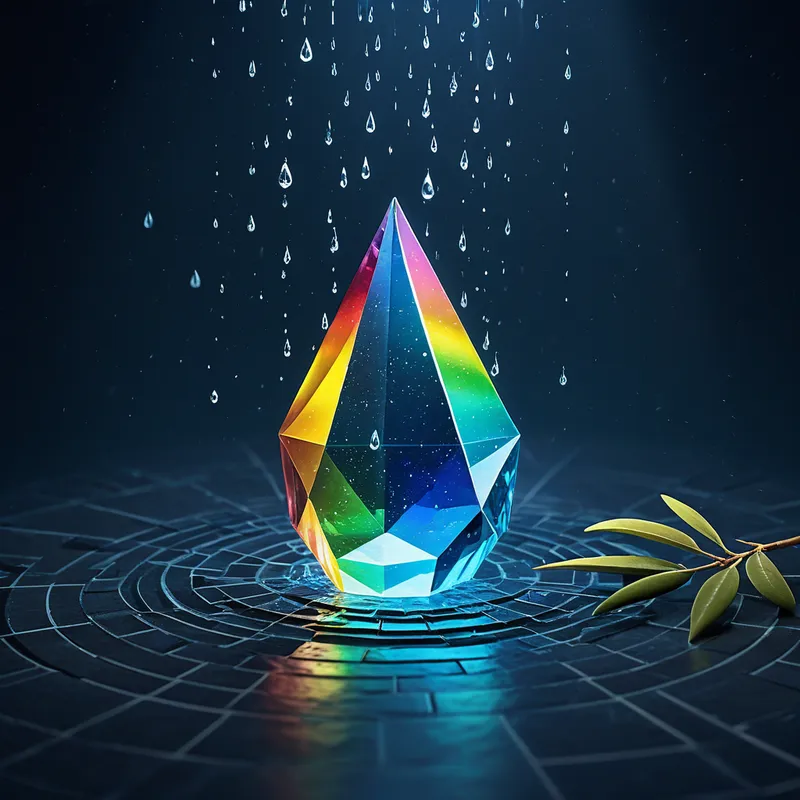
Finally, the [Rainbow](/symbols/rainbow “Symbol: Rainbows symbolize hope, promise, and the beauty found after turmoil, often viewed as a bridge between the earthly and divine.”/) is a supreme symbol of [integration](/symbols/integration “Symbol: The process of unifying disparate parts of the self or experience into a cohesive whole, often representing psychological wholeness or resolution of internal conflict.”/). It is light refracted through the very medium of the flood—[water](/symbols/water “Symbol: Water symbolizes the subconscious mind, emotions, and the flow of life, representing both cleansing and creation.”/) droplets. It signifies that the terrifying power of the unconscious (the storm) and the [guiding light](/symbols/guiding-light “Symbol: This symbol represents hope, truth, and the illumination of one’s path, serving as a beacon in times of uncertainty.”/) of consciousness (the sun) can, after the ordeal, create a bridge, a [covenant](/symbols/covenant “Symbol: A binding agreement or sacred promise between parties, often carrying deep moral, spiritual, or social obligations and consequences.”/) of wholeness.
The Dreamer’s Resonance
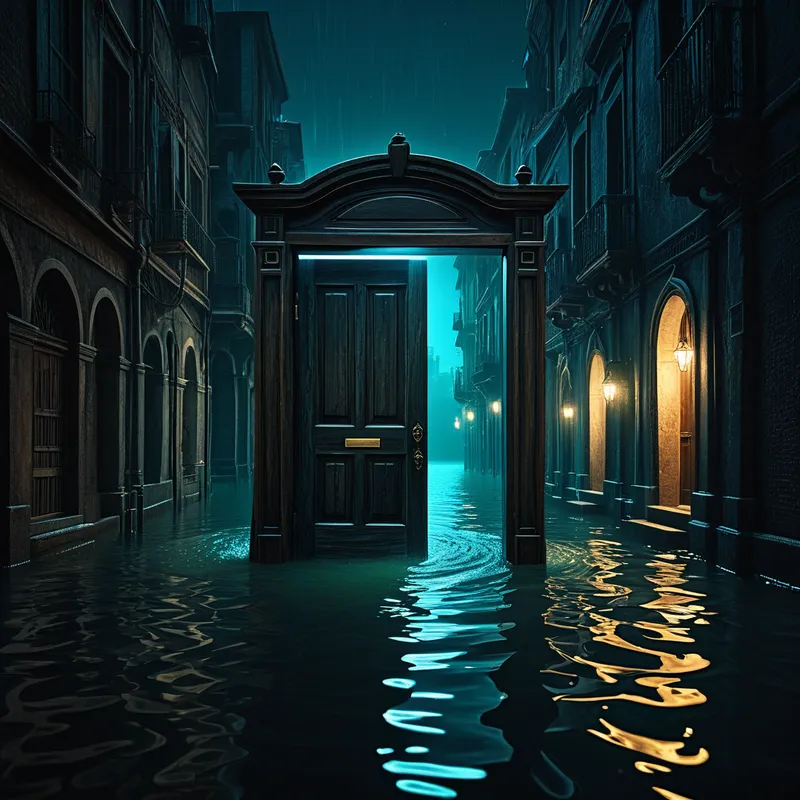
When the [Great Flood](/myths/great-flood “Myth from Mesopotamian culture.”/) rises in modern dreams, it seldom manifests as a literal Biblical scene. More often, it appears as overwhelming tidal waves, rising floodwaters in one’s childhood home, or the frantic search for high ground. This is the psyche signaling a profound emotional or psychological overwhelm.
The somatic experience is one of drowning, of being engulfed by feelings too vast to process—grief, rage, or the accumulated “corruption” of unlived life or unresolved trauma. The dream-ego is in the position of pre-flood humanity: facing an existential crisis where old adaptations and behaviors have led to an internal state of unsustainable “evil” or sickness. The dream is the bursting of the great deep; the unconscious forces are breaking through the ego’s defenses because the current structure of the personality can no longer contain them.
The crucial question in such a dream is: Where is your ark? Is there a part of you building it? Or are you mocking the builder, in denial of the coming storm? To dream of being inside an ark, however turbulent the ride, indicates a capacity for containment and preservation of core identity through the dissolution.
Alchemical Translation
The alchemical journey mirrored in the Flood is the [nigredo](/myths/nigredo “Myth from Alchemical culture.”/), the necessary descent into darkness and dissolution for purification. The ego’s old world, built on shadowy compromises and inflated certainties, must be drowned.
The ark is the alchemical vessel, the vas hermeticum, where the opposing pairs of the psyche (the animals, male and female) are sealed together to endure the transformative process.
Noah’s patient, obedient construction is the labor of building a conscious container—a practice, a therapy, a disciplined introspection—strong enough to hold the conflict. The forty days and nights in the flood represent a full period of incubation, where all familiar landmarks are submerged, and one must rely entirely on the integrity of [the vessel](/myths/the-vessel “Myth from Alchemical culture.”/) and the original, guiding blueprint (the Self’s intention).
The resting on Ararat is the albedo, the emergence of the “dry land” of a new, clarified consciousness from the waters of the unconscious. The sending forth of the birds is the cautious re-engagement of psychic functions (intuition, feeling) to test the new inner reality.
Finally, the sacrifice and the rainbow signify the [rubedo](/myths/rubedo “Myth from Alchemical culture.”/), the reddening or culmination. The sacrifice is the offering up of the old ego’s achievements in gratitude, not to appease a god, but to acknowledge the transformative process itself. The rainbow is the [lapis philosophorum](/myths/lapis-philosophorum “Myth from Alchemical culture.”/), the symbol of the achieved covenant between the conscious and the unconscious. It is the promise that future storms (psychic conflicts) will not be annihilating, because a bridge of awareness now exists. The individual emerges not just saved, but in a sacred covenant with the depths of their own soul, tasked with repopulating their life with conscious choice.
Associated Symbols
Explore related symbols from the CaleaDream lexicon: