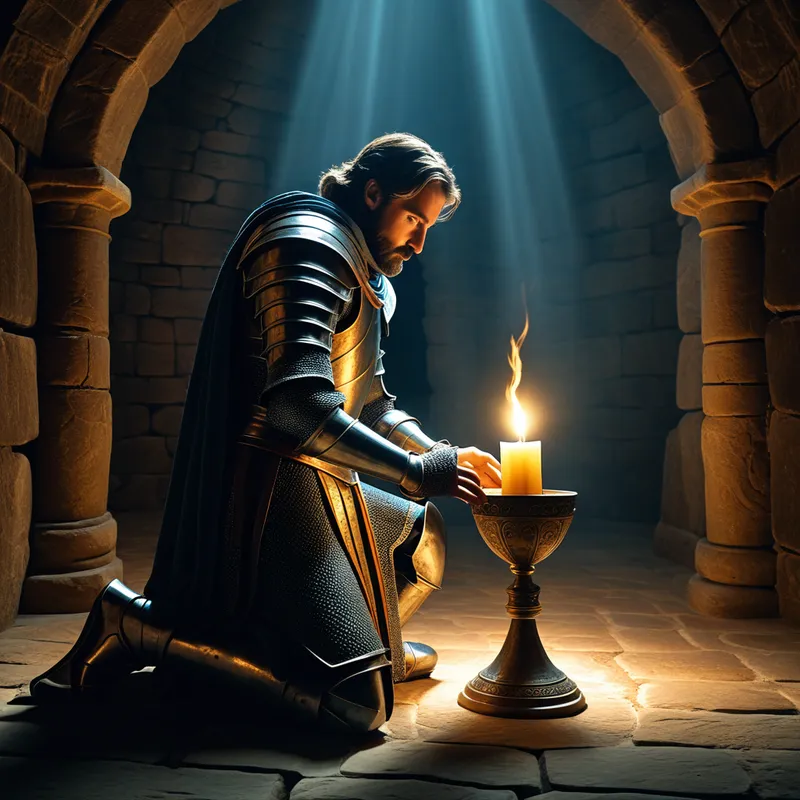
The Grail Seeker Myth Meaning & Symbolism
A wounded king and a wasteland can only be healed by a pure knight who asks the right question of the mystical Grail.
The Tale of The Grail Seeker
Listen, and hear the tale of [the Wasteland](/myths/the-wasteland “Myth from Arthurian culture.”/).
In the time of the great king Amfortas, a blight fell upon the land of Logres. The rivers ran thin and bitter. The fields, once golden, hardened into grey stone and thorn. The very air grew heavy with a silent lament. In the heart of this desolation stood Carbonek, [the Grail Castle](/myths/the-grail-castle “Myth from Celtic culture.”/), where the king himself lay dying of a wound that would not heal—a grievous hurt to the thigh, a wound of life and lineage. His pain was the land’s pain; his sterility, [the world](/myths/the-world “Myth from Tarot culture.”/)’s.
Yet within Carbonek’s highest chamber, a mystery endured. Each evening, a solemn procession would pass before the suffering king. A radiant maiden bore a lance from whose tip a single drop of blood eternally fell. Another carried a dish of silver. And finally, a youth held aloft the [Grail](/myths/grail “Myth from Christian culture.”/) itself—not jeweled or gilded, but a vessel of simple, awe-inspiring presence. From it flowed light and sustenance, yet it healed not the king. For a spell lay upon all: none may ask the vital question.
Into this cursed realm came the knights of the [Round Table](/myths/round-table “Myth from Arthurian culture.”/), sworn to adventure. Many rode forth, seeking [the Grail](/myths/the-grail “Myth from Arthurian culture.”/) to restore the land. They were the proud, the strong, the virtuous. [Sir Lancelot](/myths/sir-lancelot “Myth from Arthurian culture.”/), greatest in arms, was blinded by his earthly passion and saw the castle only as a phantom. [Sir Gawain](/myths/sir-gawain “Myth from Arthurian culture.”/), brave and courteous, rode too fast and asked nothing. The forest of trials turned them aside, for [the Grail](/myths/the-grail “Myth from Arthurian culture.”/) seeks not prowess alone, but a specific quality of soul.
Then came the chosen one, the Grail Knight. In some tellings he is Percival, the naive youth “who through pity learned wisdom.” In others, he is [Galahad](/myths/galahad “Myth from Arthurian culture.”/), “the knight destined to sit in [the Siege Perilous](/myths/the-siege-perilous “Myth from Arthurian culture.”/).” He journeyed not for glory, but drawn by a sorrow he could not name. He endured the pathless forest, resisted temptations of pride and flesh, and kept his heart simple.
At last, guided by grace or fate, he found Carbonek. He witnessed the solemn procession, the bleeding lance, the shining Grail. He saw the king’s agony. A tumult arose in his heart—a burning need to understand, to connect this suffering with the sacred mystery before him. In his first visit, Percival failed. Bound by a tutor’s rule of silence, he swallowed his question, and the castle vanished at dawn, leaving him in the barren moor, cursed to wander for years.
But the true seeker is forged in the fire of failure. He wandered, learning compassion through his own suffering. When fate led him back to the Grail Castle, he was no longer a boy following rules, but a man moved by profound empathy. As the procession passed, he looked from [the sacred vessel](/myths/the-sacred-vessel “Myth from Various culture.”/) to the anguished king, and his soul spoke the words that broke the spell: “Whom does the Grail serve?”
The moment the question hung in the air, the wound was healed. The king rose, whole. The stone cracked, and living [water](/myths/water “Myth from Chinese culture.”/) gushed forth. The grey thorns blossomed. The Wasteland greened. The quest was complete, not by seizing the object, but by uttering the question that acknowledged the sacred connection between king, land, and grace.

Cultural Origins & Context
The Grail myth is a unique fusion within the Arthurian corpus, a Christianized veneer over much older Celtic cauldrons of plenty and sovereignty vessels. Its primary literary sources are the 12th and 13th-century French romances of Chrétien de Troyes (whose [Perceval](/myths/perceval “Myth from Arthurian culture.”/) left the story unfinished), Robert de Boron (who firmly Christianized the Grail as the Cup of [the Last Supper](/myths/the-last-supper “Myth from Christian culture.”/)), and the anonymous Queste del Saint Graal, which infused the tale with Cistercian monastic spirituality.
It was a story told in the courts of nobility, a spiritual counterpoint to the chivalric romances of battle and courtly love. Its societal function was multifaceted: it provided a model for spiritual knighthood, it explored the tension between earthly and divine loyalties, and it served as a profound allegory for the health of the realm. The wounded king (Roi Pêcheur) symbolized a flawed sovereignty; his healing was necessary for the restoration of natural and social order. The myth was passed down not as dogma, but as a soul-map for an elite warrior class seeking a higher purpose.
Symbolic Architecture
At its core, the Grail [Quest](/symbols/quest “Symbol: A quest symbolizes a journey or search for purpose, fulfillment, or knowledge, often representing life’s challenges and adventures.”/) is not an [adventure](/symbols/adventure “Symbol: ‘Adventure’ signifies exploration, discovery, and the pursuit of new experiences in one’s life journey.”/) for an object, but a transformation by a question. Every element is a psychic [symbol](/symbols/symbol “Symbol: A symbol can represent an idea, concept, or belief, serving as a powerful tool for communication and understanding.”/).
The Wasteland is the state of collective or individual psychic [life](/symbols/life “Symbol: The symbol of ‘Life’ represents a journey of growth, interconnectedness, and existential meaning, encompassing both the joys and challenges that define human experience.”/) when it is cut off from its spiritual or unconscious [source](/symbols/source “Symbol: The origin point of something, often representing beginnings, nourishment, or the fundamental cause behind phenomena.”/). It is depression, meaninglessness, creative [sterility](/symbols/sterility “Symbol: Represents inability to create, grow, or produce, often linked to emotional barrenness, creative blocks, or existential emptiness.”/). The Wounded [King](/symbols/king “Symbol: A symbol of ultimate authority, leadership, and societal order, often representing the dreamer’s inner power or external control figures.”/) represents the ruling principle of [consciousness](/symbols/consciousness “Symbol: Consciousness represents the state of awareness and perception, encompassing thoughts, feelings, and experiences.”/) that is injured—often in its [capacity](/symbols/capacity “Symbol: A measure of one’s potential, limits, or ability to contain, process, or achieve something, often reflecting self-assessment or external demands.”/) for feeling, relatedness, or generativity (the thigh wound). He is [the ego](/myths/the-ego “Myth from Jungian culture.”/) that suffers but cannot heal itself.
The Grail is not a trophy to be won, but a relationship to be remembered.
The Grail itself is the symbol of the transcendent function, the unio mysterium that unites opposites. It is the [vessel](/symbols/vessel “Symbol: A container or structure that holds, transports, or protects something essential, representing the self, emotions, or life journey.”/) of the divine, the container of the [soul](/symbols/soul “Symbol: The soul represents the essence of a person, encompassing their spirit, identity, and connection to the universe.”/)’s deepest nourishment. It is not God, but the means through which grace is experienced. The Bleeding [Lance](/symbols/lance “Symbol: A long thrusting weapon symbolizing focused energy, penetration, direction, and masculine power. It represents both aggression and protection.”/) is its counterpart, the piercing, masculine principle of wounding and awakening, often linked to the [spear](/symbols/spear “Symbol: The spear often symbolizes power, aggression, and the drive to protect or conquer.”/) of Longinus that pierced Christ’s side.
The critical symbol, however, is The Question. “Whom does the Grail serve?” This interrogates the very orientation of the soul. Is life, and its sacred center, meant to serve our ego’s ambitions (the [knight](/symbols/knight “Symbol: The knight symbolizes honor, chivalry, and the pursuit of noble causes, reflecting the ideal of the noble warrior.”/) seeking glory), or are we meant to serve a [mystery](/symbols/mystery “Symbol: An enigmatic, unresolved element that invites curiosity and exploration, often representing the unknown or hidden aspects of existence.”/) greater than ourselves? The question shifts the [paradigm](/symbols/paradigm “Symbol: A fundamental model or framework in arts and music that shapes creative expression, perception, and cultural understanding.”/) from conquest to service, from knowing to wondering.
The Dreamer’s Resonance
When this myth stirs in the modern unconscious, it rarely appears as knights and castles. The dreamer may find themselves in a decaying house (the personal Carbonek) where a parent lies ill (the wounded king), while a forgotten, glowing heirloom sits in the attic (the Grail). The somatic feeling is one of anxious urgency coupled with paralysis—knowing something is deeply wrong but being unable to name or fix it.
The dreamer is in the grip of what Jung called the individuation imperative. The “wound” that appears is often a core psychological or relational pattern that causes repeated suffering. The “wasteland” is the felt experience of life around that wound: joyless, repetitive, barren. The dream is presenting the condition and, crucially, pointing toward the healing vessel (the Grail) that is already present but ignored or misunderstood. The psychological process is the slow, often painful, gathering of the courage to confront the central, taboo question of one’s life.

Alchemical Translation
The alchemy of [the Grail Quest](/myths/the-grail-quest “Myth from Arthurian culture.”/) is the transmutation of the seeker’s consciousness from leaden literalism to golden participation. The [prima materia](/myths/prima-materia “Myth from Alchemical culture.”/) is the naive ego (Percival [the fool](/myths/the-fool “Myth from Tarot culture.”/)). The first failure in the castle is the [nigredo](/myths/nigredo “Myth from Alchemical culture.”/), the blackening—the descent into the shame and confusion of the long wanderings. This is the essential dissolution of the old, rule-bound personality.
The years of wandering represent the albedo, the whitening, where the seeker is purified not by battle, but by the humbling experiences of the road, learning compassion. He integrates his shadow, becoming more whole.
The healing is in the asking. The quest ends not with an answer, but with a relationship inaugurated by a question.
The return to Carbonek and the utterance of the question is the [rubedo](/myths/rubedo “Myth from Alchemical culture.”/), the reddening or culmination. The conscious ego (the knight) finally engages [the Self](/myths/the-self “Myth from Jungian culture.”/) (the Grail) with the correct attitude—not demand, but reverent inquiry. The king’s healing symbolizes the integration of the wounded, previously autonomous complex into the whole [psyche](/myths/psyche “Myth from Greek culture.”/). The flowing waters and blooming land signify the liberation of psychic energy (libido) that was bound in maintaining the wound and the wasteland. The Grail, once a distant goal, is now the sustaining center of a renewed psychic ecology.
For the modern individual, this models the journey from seeking outer solutions and accolades (the chivalric adventure) to undertaking the inner quest. Our “Grail” is the unique, numinous core of our being—the Self. Our “wound” is the fundamental split from that core. The work is not to find a magical cure, but to cultivate the quality of soul—the pity, the simplicity, the courage—that allows us to finally ask of our own life: “What is this all truly serving?” The answer is never a [thing](/myths/thing “Myth from Norse culture.”/), but a state of being: whole, connected, and participating in the mystery.
Associated Symbols
Explore related symbols from the CaleaDream lexicon: