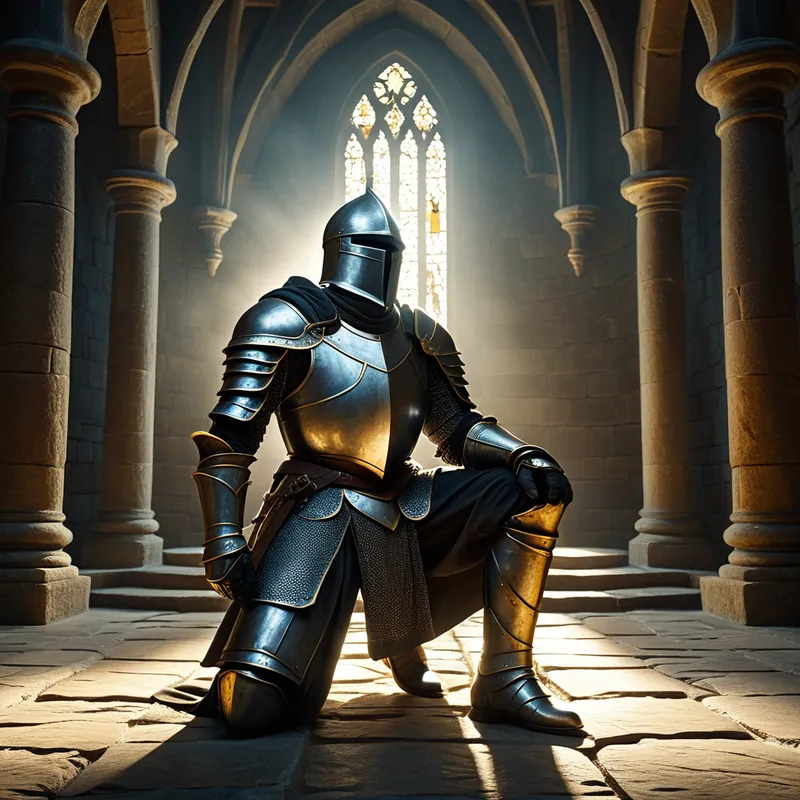
The Grail Quest Myth Meaning & Symbolism
A knight's perilous search for a sacred vessel to heal a wounded king and a barren land, revealing that the true quest is an inward journey.
The Tale of The Grail Quest
Listen, and hear a tale not of conquest, but of a question. In the twilight of Camelot, when the high ideals of the Round Table began to tarnish with pride, a strange silence fell upon the great hall. The air grew thick, not with smoke, but with a collective yearning none could name. Then, in a shaft of light that pierced the high windows, it appeared: the Grail, veiled in samite cloth, floating in a nimbus of unearthly radiance. It filled the hall with a fragrance of spices and spring rain, offered a glimpse of impossible grace, and vanished.
A great sigh arose from every knight. In that moment, they knew their battles for land and glory were as dust. A higher calling, a sacred hunger, had been awakened. They swore a vow to seek the vessel, to leave Camelot and not return until they had seen the Grail clearly. And so they rode out, the flower of chivalry, into a world grown strange.
The forests were deeper, the paths more treacherous. This was no ordinary country, but the Wasteland, a realm where springs ran dry, crops withered, and the hearts of men grew cold. Here, the knights were tested not by dragons, but by phantoms of their own souls. Sir Gawain chased will-o’-the-wisps of adventure. Sir Lancelot, burdened by his forbidden love for Guinevere, was blinded by his own unworthiness. Sir Percival, pure of heart but simple, stumbled through wonders he did not understand.
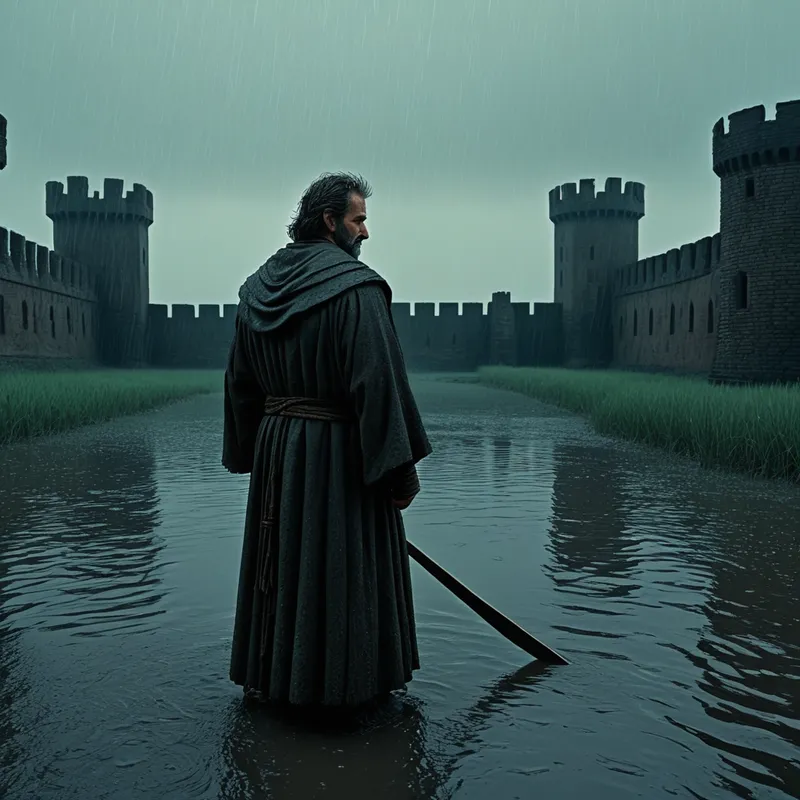
The heart of the Wasteland was the Castle of the Fisher King. Its lord, the King, sat eternally fishing in the waters of his own moat, a wound in his thigh that would not heal, bleeding the vitality from the land. To this castle, the chosen knight—be it the pure Galahad, or the humbled Percival—would one day come. He would be led through torch-lit halls to a great chamber. There, a solemn procession would pass: a young man with a bleeding spear, maidens bearing candelabras, and finally, a maiden carrying the Grail itself, now a simple, glowing vessel.
A feast would be laid, but the food was empty, tasteless. The entire castle held its breath. The test was a single, compassionate question: “Whom does the Grail serve?” or “What ails you, my lord?” To ask was to see the connection between the King’s agony and the land’s despair. To ask was to offer healing. But many knights, bound by courtly silence, failed to speak. The castle would vanish, leaving them alone on the barren hillside, the chance lost.
For the one who asked, the miracle unfolded. The King’s wound closed. The springs burst forth. The Wasteland bloomed. The Grail, its purpose fulfilled, would ascend to the heavens, and the knight’s quest would end not in possession, but in revelation. He had healed the king by seeing him, and in doing so, had healed a part of the broken world.
Cultural Origins & Context
The Grail legend is a profound fusion of Celtic myth, Christian mysticism, and feudal romance, coalescing in the 12th and 13th centuries. Its earliest literary forms, by poets like Chrétien de Troyes (Perceval) and Robert de Boron, transformed older Celtic cauldrons of plenty and sovereignty—vessels of life and kingship—into the Sangreal, the Holy Grail. This was not official church doctrine, but a vibrant, heretical mysticism that flourished in the courts of Europe.
The stories were performed by troubadours and written by clerks for an aristocratic audience living in the tension between martial violence and spiritual aspiration. The Quest served as a narrative container for this tension, redirecting the knight’s violent energy inward, toward a spiritual battle. It functioned as a societal mirror, questioning the limits of earthly chivalry and proposing that the highest duty was a sacred, personal pilgrimage. The myth was passed down, evolving through texts like the Vulgate Cycle and Malory’s Le Morte d’Arthur, each layer adding to its psychological and symbolic depth, ensuring its survival long after the feudal world it depicted had faded.
Symbolic Architecture
At its core, the Grail Quest is a supreme metaphor for the psyche’s journey toward integration. The Wasteland is the state of collective and individual life when it is cut off from the nourishing waters of the unconscious, the spiritus. It is a life of repetitive action, empty ritual, and spiritual aridity.
The Grail is not an object to be found, but a state of consciousness to be remembered. It is the hidden, nourishing center of the Self.
The Fisher King represents the wounded masculine principle—the ruling consciousness that is impotent, unable to create or foster life. His thigh wound, a symbol of generative failure, shows that the ruling psyche is injured in its very capacity to relate and to be fertile. He fishes in the shallow waters of his own conscious mind, unable to dive deep.
The knights represent different aspects of the ego setting out on the path of individuation. Most fail because they project the goal outward (Gawain’s adventure) or are crippled by guilt (Lancelot’s sin). The successful knight—Galahad as transcendent spirit, Percival as the humbled, learning ego—succeeds through a shift from seeking to seeing, from conquest to compassionate inquiry. The critical question, “Whom does the Grail serve?”, inverts the worldly logic. It reveals that the sacred does not serve our ego’s ambitions; we must learn to serve the sacred, the wholeness of the Self.

The Dreamer’s Resonance
When this myth stirs in the modern dreamer, it often manifests as a profound sense of searching in a barren landscape. One might dream of wandering through endless, identical office corridors (the sterile Carbonek), looking for a lost file or a room that doesn’t exist. There is a somatic quality of thirst, of dryness in the throat, or a heaviness in the legs (the Fisher King’s wound).
The dream may present a mentor figure who is ill or incapacitated, or a simple, potent object—a cracked bowl, a shining stone—that appears in a mundane setting, glowing with significance. The psychological process is one of the ego becoming aware of the Wasteland condition. It is the painful, necessary realization that one’s adapted life, however successful, has become arid. The dream calls the dreamer to become the “knight,” to leave the familiar round of daily life (the Round Table) and attend to the inner wound that is draining life of its meaning and vitality.

Alchemical Translation
The Quest is a precise map of the alchemical opus, the work of psychic transmutation. The knight’s departure from Camelot is the nigredo—the descent into darkness, the acknowledgment of the Wasteland. The bewildering adventures are the albedo, the washing in the moon’s light, where the ego is stripped of its certainties and purified of its inflated identity.
The healing question is the rubedo, the crimson dawn of a new consciousness. It is the moment when the heart’s compassion catalyzes a union of the seeking mind and the suffering soul.
Finding the Grail Castle symbolizes encountering the inner temenos, the sacred precinct of the Self. The King’s healing is the integration of the wounded archetype, the reclaiming of life-giving authority. The blooming of the Wasteland is the final stage, the proof of the work: the transformed individual’s energy now fertilizes their outer world, relationships, and creations. The Grail’s ascent signifies that the goal is never possessed; it is a transformative experience that leaves the individual in service to a reality greater than themselves. For the modern seeker, the instruction is clear: attend to the wound you carry, for it holds the key to the drought in your world. Ask the compassionate question. The healing of your king is the restoration of your world.
Associated Symbols
Explore related symbols from the CaleaDream lexicon:
- Issue
- Assignment
- Pickup
- Quest
- Challenge
- Self-Driving Car
- Invisible Road
- Illusive Walking Stick
- Holy Grail
- Epic Quest Map
- Triathlon Medal
- Challenge Accepted
- Point Score
- Novel Maze
- Enchanting Land Rover
- Tattered Flag
- Tattered Map
- Journeyman’s Quest
- Trail Markers
- Hajj Pilgrimage
- Optative
- Risingaction
- Rite
- Seeker