
The Grail Knight's Armor Myth Meaning & Symbolism
A knight's sacred armor, forged for the Grail Quest, becomes a crucible of the soul, testing purity against the weight of divine purpose.
The Tale of The Grail Knight’s Armor
Listen, and hear a tale not of a sword pulled from stone, but of armor donned for a purpose that would break lesser men. The air in Camelot was thick with a new fragrance—not of roast meat and ale, but of sacred anxiety. The Holy Grail had appeared, a vision of unbearable light, and vanished, leaving a silence deeper than any winter. From this silence grew a cacophony of clattering steel as every knight swore the oath, their voices booming in the great hall, their eyes bright with a zeal that smelled of pride.
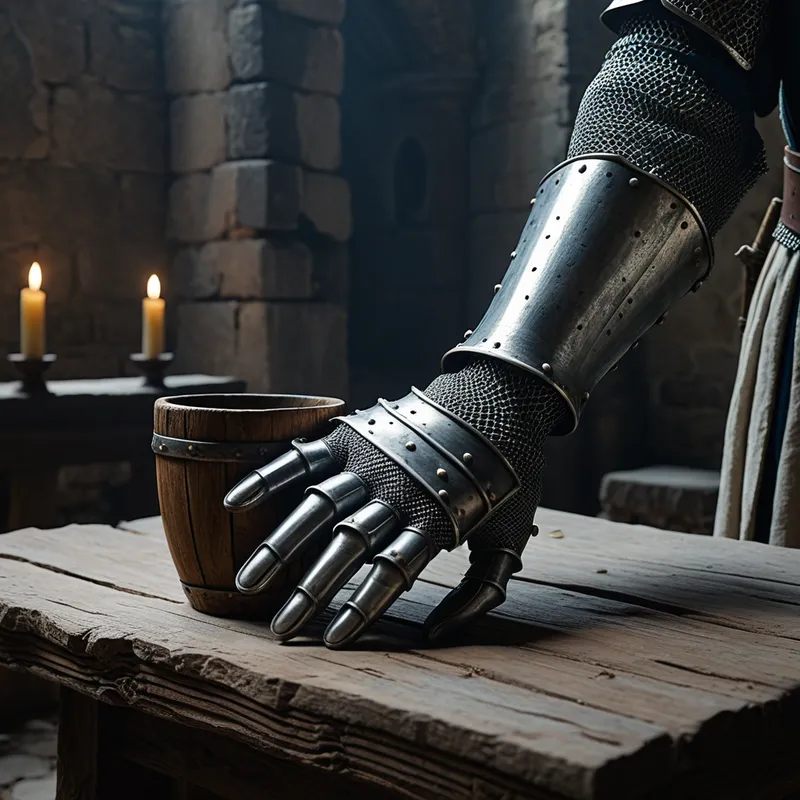
But for one—often he is called Percival, or in older breaths, Perceval—the call was not a trumpet blast to glory. It was a whisper that chilled the blood. He walked to the armory not with chest puffed, but with a soul humbled. The smiths presented him not with common mail, but with armor that seemed to have been waiting in the gloom. It was not ornate; its beauty was in its terrible adequacy. The breastplate was a mirror polished to a finish that showed not his face, but the flicker of his intent. The pauldrons were shaped like wings weighed down by duty. As each piece was fastened—the greaves, the vambraces, the gauntlets—a profound change occurred. The world’s noise faded. The cheers of the court became distant echoes. He heard instead the rustle of his own breath, the thunder of his own heart, a drumbeat now enclosed in a sacred bell.
His journey was into a forest that grew stranger with each league, a Waste Land of the spirit. The armor did not grow lighter with familiarity; it became the tangible weight of the question he carried: Whom does the Grail serve? In it, he was protected from mortal blows, yet hyper-exposed to spiritual ones. A demon’s taunt would ring against the helmet like a physical strike. A moment of lust or pride would make the metal burn with a cold fire. The armor became a crucible, conducting every moral failure directly to the skin.
The climax came not in a battle against a dragon, but in a state of utter defenselessness. Reaching the mysterious Grail Castle, he was led to a chamber where the air tasted of myrrh and old sorrow. There, upon a simple altar, sat the Grail—a vessel of plain wood, radiating a peace that dismantled all pretense. Compelled by a force beyond chivalry, he began to remove the armor. Each piece—the clanging breastplate, the heavy pauldrons, the gauntlets that had wielded sword and shield—fell to the stone floor with a final, hollow sound. Standing alone, in simple tunic and breeches, he felt a vulnerability more terrifying than any battlefield. This was the true test. The knight, shorn of his defining steel, approached the divine. And in that moment of perfect, unarmored offering, the Grail’s light did not scorch him; it filled him. The question was answered not by his mouth, but by his naked soul.
Cultural Origins & Context
The motif of the Grail Knight’s Armor is not a single, codified myth, but a profound pattern woven through the rich tapestry of the Arthurian cycle, particularly the high medieval Grail Romances of the 12th and 13th centuries. Writers like Chrétien de Troyes, Wolfram von Eschenbach, and the anonymous authors of the Vulgate Cycle transformed the Grail quest from a mere adventure into a supreme allegory for spiritual knighthood.
In this context, armor was not just military equipment; it was the visible sign of the knight’s ordo—his sacred social and spiritual function. The Grail Knight’s specific armor, therefore, transcends its physicality. It was a narrative device used by monastic-influenced writers to explore the paradox of the Christian warrior: called to act in the world while purifying the soul for divine communion. The stories were told in courts and possibly refectories, serving as both entertainment and implicit sermon. Their function was to model an idealized interior journey for an aristocratic warrior class, teaching that the highest battle was against the flaws within one’s own heart, and that true strength culminated in holy surrender.
Symbolic Architecture
The armor in this myth is the ultimate symbol of the Persona—the constructed identity we present to the world. For the knight, this persona is magnificent, noble, and strong, designed for a sacred purpose. Yet, the myth reveals this persona’s dual nature: it is both necessary and ultimately imprisoning.
The armor that protects the life also shields the soul from the transformative touch of the sacred.
It represents structured virtue, discipline, and the container of a sworn oath. Psychologically, it is our career identity, our moral code, our reputation—all the hard, polished surfaces we create to navigate the world and pursue our “quests.” However, the myth insists that this container must become conscious. It becomes a mirror, reflecting the knight’s hidden motives (pride, ambition, lust) back at him, forcing a confrontation with his Shadow. The burning cold of the metal when he fails is the somatic guilt of the ego when it betrays the Self’s deeper calling.
The act of removing the armor at the climax is thus not a failure, but the supreme achievement. It symbolizes the dissolution of the ego-persona in the face of the numinous, represented by the Grail. The knight realizes his crafted identity, however noble, is a barrier to direct experience of the divine or the deepest Self. True power is found not in being invulnerable, but in choosing sacred vulnerability.

The Dreamer’s Resonance
When this myth stirs in the modern unconscious, it may manifest in dreams of significant, often burdensome, clothing or gear. One might dream of wearing ceremonial armor to a business meeting, finding a suit of plate mail in a childhood closet, or struggling to remove a heavy, ornate helmet that has fused to the skin. The somatic feeling is key: a profound weight, constriction around the chest, or a metallic taste of isolation.
Psychologically, this signals a critical point in the dreamer’s process of Individuation. The “armor” represents an identity that has served its purpose—perhaps the “responsible parent,” the “tough executive,” the “always-strong friend”—but has now become an obstacle. It protects but also prevents authentic feeling and connection. The dream is highlighting the cost of this persona. The struggle to remove it mirrors the real-life fear: “Who am I without this role? Will I be annihilated?” The dream invites the dreamer to identify what sacred, Grail-like purpose (authentic self, creative truth, deep love) they are armoring themselves against.

Alchemical Translation
The myth of the armor is a perfect map for the alchemical opus, the process of psychic transmutation. The knight begins in the base state of nigredo—the blackening, represented by the initial prideful oath and the ensuing journey through the dark, confusing Waste Land. Here, the armor is the sealed vessel, the vas hermeticum, in which the difficult work of dissolution occurs. His failures and doubts are the heat applied to the raw material of his psyche.
The confrontation at the Grail Castle is the albedo—the whitening. The removal of the armor is the stripping away of impurities, the peeling back of layers of ego-identity to reveal the prima materia, the essential, vulnerable self beneath. This is not destruction, but purification.
The ultimate treasure is not found by adding more to the self, but by the courageous subtraction of all that is not the Self.
Finally, the filling by the Grail’s light represents rubedo—the reddening, the culmination. The conscious, vulnerable self is united with the transcendent purpose (the Self). The knight is remade, not as a man in armor, but as an integrated vessel himself. For the modern individual, this translates to the painful, necessary work of examining the identities we cling to. It asks: What role have I outgrown? What vulnerability must I embrace to receive my own “Grail”—be it wholeness, authentic creativity, or unconditional love? The myth teaches that our greatest protection is not a wall, but an open, redeemed heart.
Associated Symbols
Explore related symbols from the CaleaDream lexicon: