
The Grail Knight Myth Meaning & Symbolism
A wounded knight's quest for a sacred vessel to heal a barren king and land, revealing the path of inner transformation and sovereignty.
The Tale of The Grail Knight
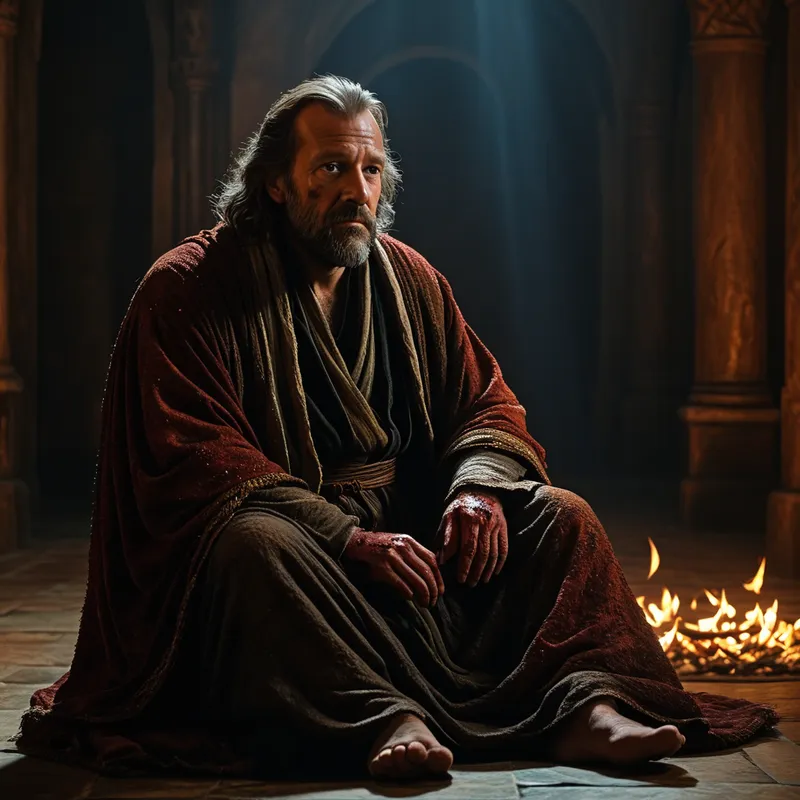
Listen. The land is sick. The rivers run thin and brackish. The trees bear no fruit, and the cattle give sour milk. In the heart of this wasting stands a castle, not of gleaming stone, but of sorrow made manifest. This is the castle of the [Fisher King](/myths/fisher-king “Myth from Arthurian culture.”/). A wound festers in his thigh, a wound that will not close, a wound that bleeds the vitality from the soil itself. He can do nothing but sit by the waters, fishing in the shallow streams, a king reduced to a patient, anguished watcher.
Into this blighted realm comes a knight. He is not the brightest, nor the strongest of the [Round Table](/myths/round-table “Myth from Arthurian culture.”/). His name is [Perceval](/myths/perceval “Myth from Arthurian culture.”/). He is young, raw, raised in the green silence of the forest, ignorant of courtly ways but pure of heart. He rides through [the Wasteland](/myths/the-wasteland “Myth from Arthurian culture.”/), where the sun is a pale coin behind perpetual mist. The very air tastes of ash and forgotten prayers.
As dusk bleeds into a strange, green twilight, he comes upon a boat on a river, and within it, [the Fisher King](/myths/the-fisher-king “Myth from Arthurian culture.”/). The king, his face etched with a pain beyond years, invites the knight to his castle. Perceval follows, and the gates open not with a fanfare, but with a sigh of ancient timber.
In the great hall, a procession begins. A squire carries a lance, white as bone, from whose tip a single, perfect drop of blood wells and falls. Then two more squires with candelabras whose flames do not flicker. Finally, a maiden of unearthly stillness enters, bearing in her hands a vessel. It is not of gold or gem, but seems to be of simple, worn wood or dull stone—a graal. Yet from it pours a light that is not of the hall, a radiance that speaks of feasts beyond hunger and healing beyond herbs. It passes before the wounded king, and for a moment, a ghost of peace touches his brow.
Perceval is struck dumb. He has been taught that a knight must not speak out of turn, must observe courtesy above all. A question burns on his tongue—Whom does [the Grail](/myths/the-grail “Myth from Arthurian culture.”/) serve?—but fear of error seals his lips. He says nothing. The procession vanishes. He sleeps, and upon waking, the castle is empty, a shell of grey stone. The Wasteland outside is unchanged. He has failed.
His quest now begins in earnest, a pilgrimage of years through a world that mirrors his inner desolation. He seeks the castle that cannot be found by seeking, to ask the question he failed to ask. He battles shadows that are his own ignorance, endures winters that are his own doubt. The knight becomes the land, wounded and wandering.
Until one day, guided not by map but by a broken and humbled heart, he finds [the river](/myths/the-river “Myth from Buddhist culture.”/), the boat, the king. The hall is darker, the king’s wound more livid. The procession begins anew. The lance, the candles, the maiden with [the vessel](/myths/the-vessel “Myth from Alchemical culture.”/). This time, Perceval’s voice, rough from silence and salted with tears, breaks free. He looks upon the suffering king and asks, not as a courtier, but as a fellow wounded soul: “My lord… what ails you? Whom does the [Grail](/myths/grail “Myth from Christian culture.”/) serve?”
The king lets out a breath held for a lifetime. “It serves you,” he whispers. “The Grail serves the one who asks.” And as the words are spoken, the wound in the king’s thigh closes. The sound of rushing [water](/myths/water “Myth from Chinese culture.”/) fills the hall—the rivers running clean. Beyond the windows, a sound unheard for years: the first, tender shoots of green breaking through the hard earth. The king rises, whole. The knight kneels, fulfilled. The land breathes again.
Cultural Origins & Context
The tale of the Grail Knight, as we know it, is a profound fusion. Its deepest roots tap into the pre-Christian Celtic [otherworld](/myths/otherworld “Myth from Celtic culture.”/), a realm of [Sídhe](/myths/sdhe “Myth from Celtic / Irish culture.”/) and magic cauldrons. The earliest literary versions, like Chrétien de Troyes’s Perceval, or the Story of the Grail (c. 1180), are French romances, yet they are steeped in Celtic motifs borrowed from bards and transmitted through the vibrant, cross-cultural courts of Britain and Brittany.
The Grail itself likely evolves from Celtic vessels of plenty and sovereignty, such as the Dagda’s Cauldron or the Cauldron of Bran. These were not just physical objects but symbols of the tribe’s right relationship with the land and the divine. The wounded king and the Wasteland reflect a core Celtic cosmological principle: the health of the sovereign is directly tied to the fertility of the realm. A king with a geis broken or a wound unhealed renders the land barren.
Told by bards and later by court poets, this story functioned as more than entertainment. It was a narrative map of initiation, outlining the passage from naive boyhood (the forest-dwelling Perceval) to responsible, conscious adulthood (the questioning knight). It taught that true sovereignty—over a kingdom or one’s own soul—requires not just strength, but compassion, intuition, and the courage to speak a healing word.
Symbolic Architecture
At its [heart](/symbols/heart “Symbol: The heart symbolizes love, emotion, and the core of one’s existence, representing deep connections with others and self.”/), this is a myth of the fractured Self and the [quest](/symbols/quest “Symbol: A quest symbolizes a journey or search for purpose, fulfillment, or knowledge, often representing life’s challenges and adventures.”/) for [integration](/symbols/integration “Symbol: The process of unifying disparate parts of the self or experience into a cohesive whole, often representing psychological wholeness or resolution of internal conflict.”/). The Wasteland is not an external place, but the inner [landscape](/symbols/landscape “Symbol: Landscapes in dreams are powerful symbols representing the dreamer’s emotional state, personal journey, and the broader context of life situations.”/) of psychic stagnation, where our vitality has been blocked or wounded.
The Grail is not an object to be possessed, but a state of consciousness to be served. It represents the hidden, nourishing core of the psyche—the Self.
The Fisher [King](/symbols/king “Symbol: A symbol of ultimate authority, leadership, and societal order, often representing the dreamer’s inner power or external control figures.”/) embodies our deepest, most chronic wound—often a [trauma](/symbols/trauma “Symbol: A deeply distressing or disturbing experience that overwhelms the psyche, often manifesting in dreams as unresolved emotional wounds or psychological injury.”/) of [identity](/symbols/identity “Symbol: Identity represents the sense of self, encompassing personal beliefs, cultural background, and social roles.”/), [passion](/symbols/passion “Symbol: Intense emotional or physical desire, often linked to love, creativity, or purpose. Represents life force and deep engagement.”/), or creative [life](/symbols/life “Symbol: The symbol of ‘Life’ represents a journey of growth, interconnectedness, and existential meaning, encompassing both the joys and challenges that define human experience.”/)-force (symbolized by the thigh/groin). He is the ruling principle of our inner [kingdom](/symbols/kingdom “Symbol: A kingdom symbolizes authority, belonging, and a sense of identity within a larger context or community.”/) that has become passive, fishing in the shallow waters of [consciousness](/symbols/consciousness “Symbol: Consciousness represents the state of awareness and perception, encompassing thoughts, feelings, and experiences.”/), unable to act. Perceval is the nascent ego, the part of us that sets out on [life](/symbols/life “Symbol: The symbol of ‘Life’ represents a journey of growth, interconnectedness, and existential meaning, encompassing both the joys and challenges that define human experience.”/)’s quest, initially following external rules (“good manners”) but lacking the essential, empathetic question.
The failure of the first visit is not a moral failing, but a necessary stage. It is the failure of the unconscious life. We see the symbols of transformation (the [lance](/symbols/lance “Symbol: A long thrusting weapon symbolizing focused energy, penetration, direction, and masculine power. It represents both aggression and protection.”/), the Grail) but do not engage with them personally. Only after wandering the “Wasteland” of consequence—experiencing alienation, [guilt](/symbols/guilt “Symbol: A painful emotional state arising from a perceived violation of moral or social standards, often tied to actions or inactions.”/), and [despair](/symbols/despair “Symbol: A profound emotional state of hopelessness and loss, often signaling a need for transformation or surrender to deeper truths.”/)—does [the ego](/myths/the-ego “Myth from Jungian culture.”/) become humble enough to ask from the heart. The healing question, “What ails you?” is an act of profound relational [psychology](/symbols/psychology “Symbol: Psychology in dreams often represents the exploration of the self, the subconscious mind, and emotional conflicts.”/). It turns the quest from a conquest into a communion.
The Dreamer’s Resonance
When this myth stirs in modern dreams, it often signals a critical juncture in the dreamer’s process of individuation. You may dream of a neglected, decaying house (the castle) with a hidden, beautiful room. You may encounter a wise but sad elder figure (the Fisher King) or find yourself holding a simple, yet incredibly significant, container like a bowl or cup.
Somatically, this can coincide with feelings of stagnation, a “wound” that manifests as chronic fatigue, creative block, or a sense of life being barren and repetitive—a personal Wasteland. The [psyche](/myths/psyche “Myth from Greek culture.”/) is presenting the condition of the inner king or queen. The dream is the nocturnal procession of the Grail, showing you the symbols of your own potential wholeness.
The crucial psychological process here is the movement from passive observation to active, compassionate questioning. The dream-ego is being challenged to stop merely analyzing its pain and to instead address it directly, to ask the wound itself what it needs. The failure to ask in the dream often leaves a residue of profound frustration upon waking, mirroring Perceval’s initial failure. It is a call to develop what was lacking: not more knowledge, but the courage for vulnerable engagement.

Alchemical Translation
The alchemy of the Grail myth is the transmutation of the leaden Wasteland into the golden, flowing kingdom. It models the entire arc of Jungian individuation.
[The first stage](/myths/the-first-stage “Myth from Alchemical culture.”/), [nigredo](/myths/nigredo “Myth from Alchemical culture.”/) (the blackening), is the Wasteland and the initial failure—the confrontation with one’s shadow, ignorance, and the black despair of missed opportunity. Perceval’s long wanderings represent the albedo (the whitening), a purification through suffering and the dissolution of the naive ego. He is stripped of his knightly identity and must wander without his former certainty.
The healing question is the rubedo (the reddening)—the moment of conscious, loving confrontation that releases the trapped libido (life energy) symbolized by the king’s bleeding wound.
Asking “What ails you?” of our inner Fisher King is the ultimate alchemical operation. It applies the aqua permanens, the permanent water of compassion, to the sealed, festering wound. The answer—“The Grail serves you”—is the revelation of the [lapis philosophorum](/myths/lapis-philosophorum “Myth from Alchemical culture.”/), the Philosopher’s Stone. It means the nourishing, guiding center of the psyche ([the Self](/myths/the-self “Myth from Jungian culture.”/)) is not external, but awaits within, ready to serve the ego that finally turns to it in sincere need.
For the modern individual, this translates to a sacred quest turned inward. Our culture is obsessed with finding the external Grail—success, status, the perfect solution. The myth insists the true quest is to find the wound we have neglected, to sit with our personal Fisher King in his shadowy hall, and from a place of genuine empathy, ask the simple, terrifying, healing question. The restoration that follows is not just personal, but cosmic. It is the greening of our own world, the return of flow to our creative and emotional lives. We become, at last, the sovereigns of a healed realm.
Associated Symbols
Explore related symbols from the CaleaDream lexicon: