
The Grail Fragment Myth Meaning & Symbolism
A tale of a knight who finds a broken piece of the Holy Grail, learning that true healing lies not in possession, but in the act of bearing the wound.
The Tale of The Grail Fragment
Listen. [The world](/myths/the-world “Myth from Tarot culture.”/) is not whole. It never was. After the [Round Table](/myths/round-table “Myth from Arthurian culture.”/) was shattered and the king taken to Avalon, a great silence fell upon the land. It was a silence that spoke of a thirst no earthly spring could quench. In this twilight, a knight wandered. He was not of the famous names; his shield bore no glorious device. He was simply a man who had seen the light of the [Grail](/myths/grail “Myth from Christian culture.”/) pass over [the world](/myths/the-world “Myth from Tarot culture.”/) and vanish, leaving only the memory of its glow etched upon his soul like a brand.
His quest was not for the Cup itself—that was a dream for brighter ages. His was a humbler, more desperate pilgrimage: to find any echo, any trace of that lost sanctity. He wandered through forests where the trees whispered of older magic, and over moors where [the wind](/myths/the-wind “Myth from Various culture.”/) carried the ghosts of forgotten vows. His armor grew dull, his cloak threadbare. He lived on roots and the kindness of hermits who spoke in riddles of a “broken blessing.”
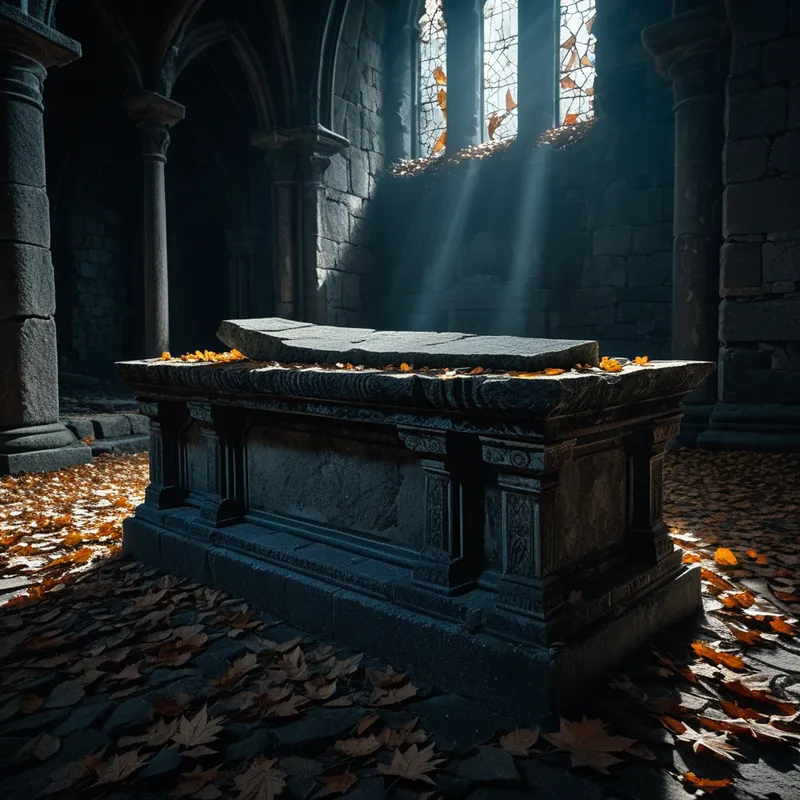
One night, during a storm that tore [the sky](/myths/the-sky “Myth from Persian culture.”/) asunder, he took shelter in the husk of a chapel. Its roof was open to the weeping clouds, its altar a slab of cold stone. As lightning flashed, he saw not a cross upon it, but a faint, phosphorescent gleam. Approaching, his breath caught. There, upon the stone, lay a Fragment. It was no larger than a oak leaf, curved and sharp. It was not gold nor silver, but seemed forged from solidified moonlight and sorrow. It was a piece of the very rim of the Grail.
When he touched it, a vision seized him. Not of glory, but of the Cup’s fracturing—a moment of cosmic anguish when the divine touched the mortal realm and could not hold its form. The vision was not a gift, but a wound. He saw the fragmentation of the world’s soul mirrored in his own. The knight, trembling, wrapped the shard in the last clean strip of his tunic and placed it against his chest. It did not warm him. It drew the warmth from him, a sacred, chilling weight.
His journey back was the true quest. The Fragment did not grant power; it imposed a terrible clarity. Every injustice he saw bled more brightly. Every falsehood rang like a cracked bell. The relic did not heal the land; it made him feel its sickness in his own bones. He became a living wound, a walking witness to a broken covenant. In a village plagued by a spiritual malaise, he did not perform a miracle. He simply sat in [the square](/myths/the-square “Myth from Platonic culture.”/), the Fragment’s presence a silent, painful mirror, until the people, shamed and stirred by a longing they could not name, began to clean their own wells and mend their own fences. The healing was theirs; he merely bore the splinter that reminded them it was possible.
He never rebuilt the Cup. He learned that was not his task. His purpose was to carry the Fragment—to be the man who knew the whole was lost, yet honored the piece. In the end, he did not return to a court. He became a quiet legend, the Knight of the Shard. Where he walked, the land did not bloom, but the poison of despair receded, inch by painful inch. He carried the broken blessing until his steps slowed and finally stopped by a quiet stream. As he passed, the hand holding the Fragment relaxed. The shard slipped into the [water](/myths/water “Myth from Chinese culture.”/), not lost, but returned, its work transferred from one vessel to another, from a weary heart to the ever-flowing world.
Cultural Origins & Context
The motif of the Grail Fragment is not found in the earliest Arthurian cycles of Chrétien de Troyes or the Mabinogion. It emerges later, in the fragmented aftermath of the High Medieval period itself, often in peripheral tales, local folklore, and post-Malory narratives. This is a myth born from loss. It reflects a cultural consciousness that had witnessed the zenith of [the Grail quest](/myths/the-grail-quest “Myth from Arthurian culture.”/) as a collective ideal—in stories like the Queste del Saint Graal—and was now living in its long, disillusioned shadow.
These tales were likely told not in great halls, but by firesides and in monastic scriptoria on the edges of Christendom. They were stories for a world that felt incomplete, for a faith that sensed the divine was present but fractured, accessible only in glimpses and shards. The teller was often a wanderer, a monk, or a village elder—a keeper of a broken tradition. Societally, the myth functioned as a corrective to grandiose ambition. It shifted the focus from the impossible, singular achievement of a Grail Winner to the humble, enduring responsibility of every wounded seeker. It democratized sacredness, suggesting that holiness could be carried in failure and incompletion as potently as in perfection.
Symbolic Architecture
The Grail Fragment is the ultimate [symbol](/symbols/symbol “Symbol: A symbol can represent an idea, concept, or belief, serving as a powerful tool for communication and understanding.”/) of the unfinished. It represents the part that stands for the whole, but crucially, a whole that can never be reassembled in its original form. It is the sacred [trauma](/symbols/trauma “Symbol: A deeply distressing or disturbing experience that overwhelms the psyche, often manifesting in dreams as unresolved emotional wounds or psychological injury.”/) that cannot be undone, only carried.
The Fragment is not a prize, but a responsibility. It is the consciousness of a fracture that, once known, forever separates one from the sleep of ignorance.
Psychologically, the [knight](/symbols/knight “Symbol: The knight symbolizes honor, chivalry, and the pursuit of noble causes, reflecting the ideal of the noble warrior.”/) represents [the ego](/myths/the-ego “Myth from Jungian culture.”/) that has glimpsed [the Self](/myths/the-self “Myth from Jungian culture.”/)—the totality of the [psyche](/myths/psyche “Myth from Greek culture.”/), symbolized by the whole Grail—and has been shattered by the encounter. The [quest](/symbols/quest “Symbol: A quest symbolizes a journey or search for purpose, fulfillment, or knowledge, often representing life’s challenges and adventures.”/) for the whole Grail is the drive for total, transcendent [integration](/symbols/integration “Symbol: The process of unifying disparate parts of the self or experience into a cohesive whole, often representing psychological wholeness or resolution of internal conflict.”/), which often leads to [inflation](/symbols/inflation “Symbol: A dream symbol representing feelings of diminishing value, loss of control, or expansion beyond sustainable limits in one’s life or psyche.”/) or spiritual bypassing. The finding of the Fragment, however, signifies a descent into a more honest, painful, and [human](/symbols/human “Symbol: The symbol of a human represents individuality, complexity of emotions, and social relationships.”/) mode of being. The [knight](/symbols/knight “Symbol: The knight symbolizes honor, chivalry, and the pursuit of noble causes, reflecting the ideal of the noble warrior.”/)’s wound is his [awareness](/symbols/awareness “Symbol: Conscious perception of self, surroundings, or internal states. Often signifies awakening, insight, or heightened sensitivity.”/). The chilling [weight](/symbols/weight “Symbol: Weight symbolizes burdens, responsibilities, and emotional loads one carries in life.”/) of the shard is the burden of [consciousness](/symbols/consciousness “Symbol: Consciousness represents the state of awareness and perception, encompassing thoughts, feelings, and experiences.”/) itself, the price of seeing the world and oneself as they truly are: beautiful, broken, and in need of care rather than conquest.
The Dreamer’s Resonance
When this myth stirs in the modern unconscious, it manifests in dreams of finding broken sacred objects: a piece of a stained-glass window, a chipped family heirloom, a single page from a holy book. The dreamer feels a profound mix of awe and sorrow. They feel compelled to protect the fragment, yet it often feels heavy, radioactive, or painfully cold to the touch.
Somatically, this can mirror a process of coming to terms with a core wound—a trauma, a loss, a fundamental sense of inadequacy or fragmentation within the personality. The psychological process is not one of immediate healing, but of acknowledgement and bearing. The dream ego is learning to hold a piece of its own shattered wholeness without rushing to glue it back into a false whole. It is the beginning of shadow-work, where the rejected, broken parts of the self are recognized not as trash to be discarded, but as sacred fragments to be reintegrated with reverence. The coldness of the shard is the shock of this truthful, often uncomfortable, self-recognition.

Alchemical Translation
The alchemical journey mirrored here is not the [Magnum Opus](/myths/magnum-opus “Myth from Alchemical culture.”/) in its glorious completion, but the crucial, gritty stage of mortificatio and [separatio](/myths/separatio “Myth from Alchemical culture.”/)—the dying of the old, idealized self and the separation of the essential from the dross. The knight’s weathered armor represents the worn-out [persona](/myths/persona “Myth from Greek culture.”/). The storm that drives him to the chapel is the necessary crisis that breaks open the conscious mind. The discovery of the Fragment on a ruined altar is the lapis exilis, the despised stone that is the true beginning of the work.
The alchemy of the Fragment is the transmutation of narcissistic injury into compassionate witness. The lead of personal brokenness is not turned into the gold of perfection, but into the more valuable gold of conscious, wounded humanity.
For the modern individual, this myth models the path of individuation as a mending, not a making whole. We are not tasked with becoming perfect, integrated beings free of flaw. We are tasked with gathering our fragments—our failures, our traumas, our awkwardnesses—and recognizing their sacred origin. They are pieces of our own Grail. The work is to carry them consciously, to let their painful edges keep us honest and compassionate. The [triumph](/myths/triumph “Myth from Roman culture.”/) is not in ceasing to be a vessel that cracks, but in understanding that the light often shines most clearly through the very cracks we spend our lives trying to hide. We become, like the knight, a carrier. Our life becomes the chapel, and our conscious, wounded heart becomes the altar upon which the Fragment rests, transforming our very brokenness into a site of quiet, resonant grace.
Associated Symbols
Explore related symbols from the CaleaDream lexicon: