The Grail Feast Myth Meaning & Symbolism
A wounded king, a barren land, and a hero's perilous quest to restore the sacred vessel and heal the fractured world.
The Tale of The Grail Feast
Listen now, and let the hearth-fire dim. Let the world outside the hall fade to a murmur of wind in the oaks. I will tell you of a time when the land itself was ailing, and the feast was a memory of dust.
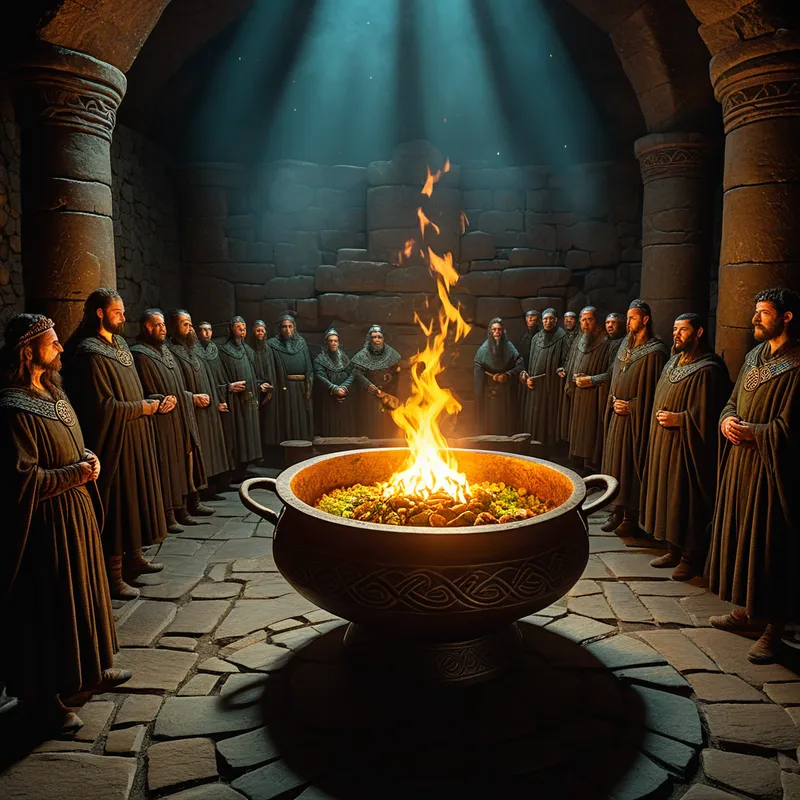
In the high hall of Peredur, or in some tales, the court of the Maimed King, a chill had settled that no fire could dispel. The king, a lord who once strode the borders of this world and the Annwn, sat slumped upon his throne of oak and bronze. A grievous wound marred his thigh, a wound that would not close, that wept and festered, stealing his vitality with each passing season. His pain was not his alone. The kingdom mirrored its sovereign. Fields that once groaned with grain lay fallow and hard. Rivers ran thin and silent. The cattle gave no milk, and the women bore no children. The very sap of the world seemed frozen.
Yet, in the heart of this desolation, a mystery persisted. In the great hall, a feast was laid each night—a feast of cruel paradox. Upon the long tables sat platters of exquisite craftsmanship, but they held only the semblance of food that turned to ash in the mouth. The cups were filled with wine that tasted of brine and sorrow. And at the king’s right hand stood the Cauldron of Plenty. It was a vessel of ancient making, silver and studded with moon-pale gems. Once, it had brimmed with endless sustenance, capable of feeding the multitudes and reviving the slain. Now, it sat cold and empty, a hollow symbol of a broken covenant.
Into this twilight court came the hero. Not in a blaze of glory, but often lost, often questioning—a Perceval who did not know his own name, or a Gawain tested by wandering. He arrived as the shadowed feast began. He saw the king’s pallor, felt the hall’s despair, and witnessed the procession: a maiden, perhaps, or a silent youth, bearing the hallowed Cauldron from a hidden chamber. It passed through the hall, a ghost of its former self, and returned unseen.
And here, the moment of fate hung suspended. The custom, the unspoken law of the Waste Land, demanded a question. “Whom does the Grail serve?” or “What ails thee, King?” But the hero, constrained by a world’s politeness or his own unformed heart, remained silent. He ate the ash-food, drank the bitter wine, and slept. Upon waking, the hall was empty, the castle ruins, and the land more desolate than before. The chance was lost. The quest had to begin anew, a circuit of hardship, a facing of specters and giants, until the hero’s own heart was wounded, humbled, and made wise.
When he returned—if he returned—the scene repeated. The ailing king, the mournful feast, the solemn procession of the vessel. But this time, the hero’s eyes were clear. His own suffering had carved the question onto his soul. He spoke. He asked of the wound, of the sorrow, of the vessel’s purpose. And with that question, a sound like a great sigh passed through the stones. The king’s head lifted. The wound, touched by the virtue of the spoken truth, began at last to close. Color returned to his face. And as life flowed back into the sovereign, it flowed back into the land. The Cauldron, placed before the king, shimmered and filled, not with mere food, but with a radiant, living essence. The true feast began—a feast of restoration, where every bite healed, and every cup overflowed with the water of life. The king was whole. The land was green. The vessel served, and was served.

Cultural Origins & Context
The myth of the Grail Feast is not a single, codified story, but a powerful constellation of motifs woven from the deep fabric of Celtic narrative tradition. Its most direct roots lie in the early Welsh Mabinogion, particularly in the tales of Peredur and the magical Cauldron of Diwrnach. These stories were preserved by medieval Welsh bards and scribes, but their essence is far older, echoing pre-Christian Celtic concepts of sacred kingship and the sovereignty of the land.
In ancient Celtic society, the king was not merely a political ruler; he was the living embodiment of the tribe’s contract with the land. His physical and spiritual integrity was directly tied to the fertility and well-being of the kingdom. A wounded or impotent king meant a Waste Land. This myth was likely told in the courts of chieftains, not just as entertainment, but as a profound societal reminder. It reinforced the sacred responsibility of leadership and the cosmic consequences of its failure. The storyteller, the fili or bard, was the keeper of this truth, using the allegory of the feast to speak of spiritual and communal health. The “Grail” itself evolves from the pagan cauldron of plenty and rebirth—a central symbol of the Druidic tradition—later fused with Christianized romance in the continental Arthurian cycles. But its Celtic heart remains: a vessel of transformative, life-giving power that is accessed only through right relationship and courageous inquiry.
Symbolic Architecture
At its core, the Grail Feast is a masterful map of a psychic crisis and its resolution. The wounded king represents the ruling principle of the psyche—the ego, or the dominant conscious attitude—that has been injured and can no longer function properly. This wound is a stagnation, a fixation, a trauma that has severed the connection to the vital, nourishing depths of the unconscious (the land).
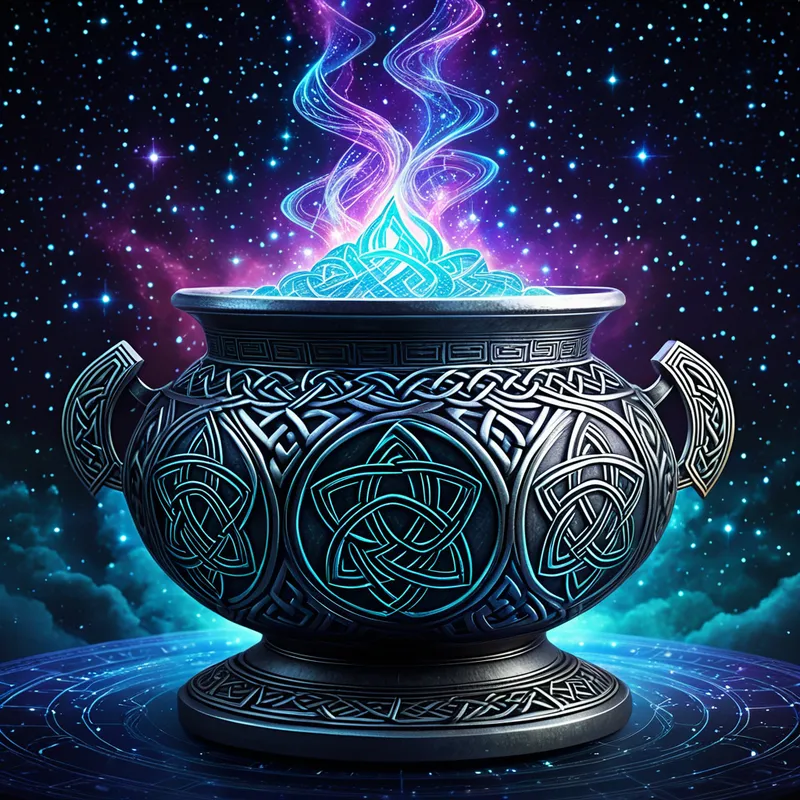
The Grail is the symbol of the transcendent function, the psychic organ that mediates between the conscious and unconscious, offering the nourishment of meaning and the water of life.
The barren land is the resultant state of the inner world: creativity dries up, emotion becomes sterile, life loses its savor. The false feast is the ego’s continued, hollow performance—going through the motions of life while being utterly cut off from its source. The hero who initially fails represents the first, naive approach of consciousness to the mystery. He sees the symptom but lacks the psychological maturity to ask the crucial question, to engage the suffering directly. His subsequent wandering is the necessary descent, the confrontation with shadow elements (the giants and specters) that humble and educate him.
The pivotal question—“What ails you?”—is the act of conscious attention directed toward the core wound. It is the willingness to see and name the pain, rather than ignore it or perform around it. This compassionate inquiry is the key that unlocks the healing. The restoration of the king and the land symbolizes the re-establishment of a dynamic flow between the conscious mind and the unconscious wellspring, resulting in a personality that is once again whole, fertile, and sovereign.
The Dreamer’s Resonance
When this mythic pattern stirs in the modern dreamer, it often manifests as a profound sense of inner barrenness amidst apparent functionality. You may dream of a lavish, empty banquet; of a beautifully set table with plastic or rotting food; of trying to drink from a cup that is always just out of reach or that holds sand. The setting is often a familiar place—your childhood home, your workplace—rendered desolate and silent.
Somatically, this can correlate with a feeling of “living on empty,” of chronic fatigue or low-grade depression where life has lost its texture and taste. Psychologically, you are in the hall of the wounded king. The dream is presenting the state of your psychic ecosystem. The figure of the ailing authority (a boss, a parent, an older version of yourself) is the personification of an inner ruling principle that is injured—perhaps by burnout, by a betrayal of your own values, or by an unlived life. The dream is the procession of the Grail itself: your deepest Self, your potential for wholeness, is being shown to you in symbolic form, asking silently for the question to be posed. To ignore it is to remain in the Waste Land. To engage with the discomfort, to ask “What is truly wounded here?” within your waking life, is to begin the quest.

Alchemical Translation
The myth of the Grail Feast is a precise alchemical recipe for individuation. The initial state is the nigredo: the blackening, the wounding, the despair of the Waste Land. The king’s festering injury is the prima materia, the base, suffering state of the soul that contains within it the seed of transformation.
The quest is not for an external object, but for the question that must be asked of one’s own suffering. The answer is not given; it is enacted through the asking.
The hero’s failed first attempt is a necessary calcinatio—a burning away of naive certainties and worldly pride. His subsequent trials in the wilderness represent the solutio, a dissolution in the waters of the unconscious, facing the shadowy, fluid aspects of oneself. The return and the posing of the question is the coagulatio: the conscious insight that crystallizes from the ordeal, giving new, solid form to the personality.
Finally, the healing of the king and the flowing of the Grail symbolize the rubedo and the albedo—the reddening and whitening, the integration of passion and spirit, body and soul. The vessel, now overflowing, is the lapis philosophorum, the philosopher’s stone: the achieved state of psychic wholeness where the individual becomes a vessel for life itself. The feast is no longer a passive consumption but a participatory sacrament. You are no longer a guest at the table of life; you are, simultaneously, the wounded king who heals, the questing hero who asks, and the sacred vessel that contains the transformative elixir. You become the sovereign of your own restored inner landscape.
Associated Symbols
Explore related symbols from the CaleaDream lexicon: