The Grail Chapel Myth Meaning & Symbolism
A knight's quest leads to a hidden, ruined chapel where the Grail appears, testing his purity and revealing the sacred within the desolate.
The Tale of The Grail Chapel
Listen, and let the mists of Logres gather. The tale is not of grand Camelot, but of a place forgotten, a wound in the world where the veil is thin. It begins not with a fanfare, but with a silence so deep it rings in the ears.
A knight—often it is Percival, or sometimes the doomed, fervent Galahad—has wandered far from the known roads. His quest for the Sangreal has led him through forests that remember older gods, across rivers that whisper with the voices of the dead. He is weary, his armor stained not with blood, but with the grime of endless searching. The courtly world feels like a dream dreamed long ago.
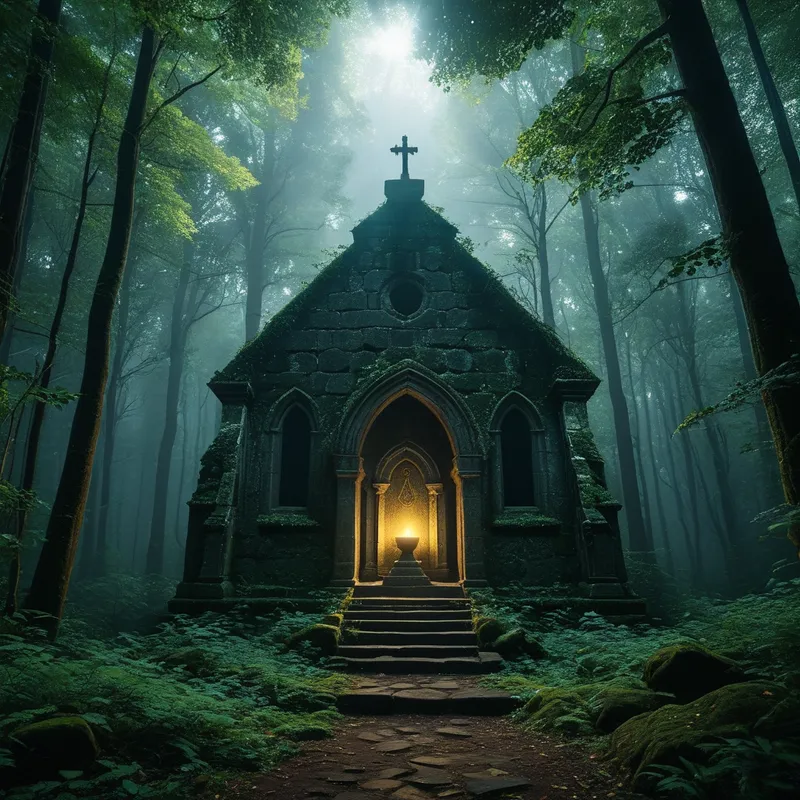
Then, he finds it. Not a castle, not a hermitage, but a chapel. It is a place of profound neglect. Ivy strangles its squat tower; its stones are green with moss and grey with age. The oak door hangs from a single hinge, groaning a welcome to the wind. Inside, the air is cold and still, thick with the scent of damp earth and old stone. No candles burn. No priest tends the altar, which is a simple slab of rock, cracked and barren. The windows are empty eyes, framing a sky the color of lead.
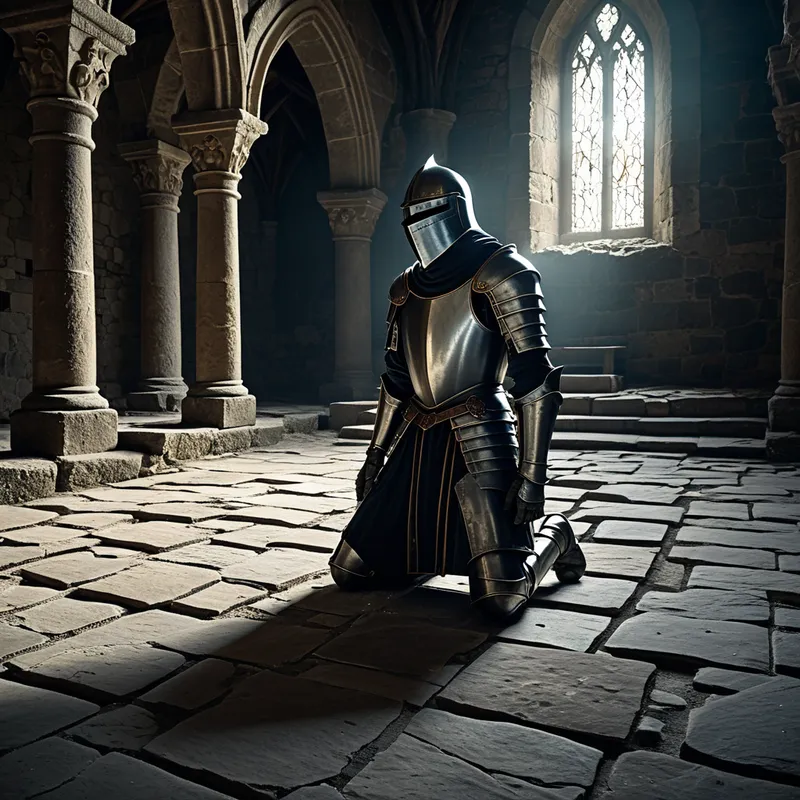
The knight enters, his footsteps echoing in the hollow nave. He feels a fool. This is not a place of glory, but of decay. He kneels nonetheless, not in piety, but in exhaustion, before the empty altar. He prays not for the Grail, but for a sign—any sign—that his quest is not madness. The silence answers, deeper than before.
And then, the light changes. No sun breaks through the cloud. But from the very air, a gentle, gold-tinged luminescence begins to gather. It pools upon the barren altar. And there, as if condensing from light and longing itself, it appears. The Grail. It is not jewel-encrusted or borne by angels. It is often described as simple, a chalice of plain wood or humble metal, yet radiating a peace that stills the heart. It is both utterly present and infinitely distant. A fragrance fills the chapel—not of incense, but of blooming orchards and clean rain.
The knight is transfixed. This is the moment. The object of all his striving is before him, in the most forsaken of places. The tales spoke of glorious questions to be asked: “Whom does the Grail serve?” But here, in this crushing, sacred silence, words die in his throat. He is not filled with triumph, but with a terrible, clarifying humility. He sees not the Grail alone, but the truth of the chapel: this ruin is the sanctuary. The divine does not dwell in perfection, but reveals itself through the cracks in our world, and in the soul. The vision lasts only a moment. The light fades, the Grail vanishes, and the chapel is once more a cold, ruined shell. But the knight is remade. He rises, and walks back into the world, carrying not a trophy, but a secret written in silence upon his heart.
Cultural Origins & Context
The motif of the Grail Chapel is not a single, fixed story, but a recurring, haunting image woven through the later tapestry of the Arthurian Vulgate and Post-Vulgate cycles, particularly those focused on the Grail Quest. It emerges in the 13th century, a time when the chivalric romance was being infused with intense Christian mysticism and Cistercian spirituality. This was no longer merely a tale of adventure; it was an allegory of the soul’s journey to God.
The tellers were likely monks or clerics adapting older Celtic motifs of magical cauldrons and hidden otherworldly realms into a Christian framework. The chapel itself is a powerful syncretic symbol: a Christian place of worship, often described in the desolate, “waste land” terms reminiscent of Celtic tales of blight and enchantment. Its societal function was dual. For the aristocratic audience, it reinforced the ideal of the knight as a spiritual aspirant, whose highest duty was not battlefield prowess but inner purity. For a broader audience, it modeled a form of piety that was personal, direct, and encountered in solitude and humility, away from the grand cathedrals and complex theology of the high medieval church.
Symbolic Architecture
The Grail Chapel is the psyche’s temenos—a sacred precinct that exists not in geography, but in the interior landscape. It represents the paradoxical locus of the Self, the central organizing principle of the psyche in Jungian thought.
The chapel is always found in a state of ruin because the sacred center of the personality is not a polished monument of the ego, but a place that has been neglected, forgotten, or wounded by life.
The knight’s arduous journey symbolizes the conscious effort of the ego to seek meaning and wholeness. The chapel’s ruined state mirrors the condition of the soul before the quest: a spiritual life in disrepair, where genuine feeling and connection to the numinous have been overgrown by convention, despair, or worldly duty. The Grail appearing within this ruin signifies that the transcendent function—the reconciling symbol that unites conscious and unconscious—manifests not when everything is perfect, but precisely through the acknowledgment of one’s own brokenness and incompleteness. The knight’s speechless awe is the necessary ego-surrender; the intellect must fall silent for the symbolic, transformative experience to occur.

The Dreamer’s Resonance
When this mythic pattern stirs in the modern dreamer, it often manifests as dreams of discovering a hidden, dilapidated room in a familiar house, a forgotten basement, or an overgrown, sacred structure in the woods. The somatic feeling is one of hushed awe, a chilling stillness, mixed with a profound sense of melancholy and recognition.
Psychologically, this dream signals a critical moment in what might be called “soul-making.” The dreamer is approaching a deeply buried aspect of the Self. The ruin represents a part of the personality or a core value that has been abandoned—perhaps creativity, spirituality, or a genuine passion—in the service of building a “presentable” life (the intact parts of the house or the known world). The appearance of a radiant, simple object (the Grail symbol) in that space indicates that the libido, or psychic energy, is beginning to re-invest in this neglected center. The process is one of re-collection, of gathering the scattered and forsaken pieces of one’s authentic being back into a meaningful whole. It is often a prelude to a significant life reorientation.
Alchemical Translation
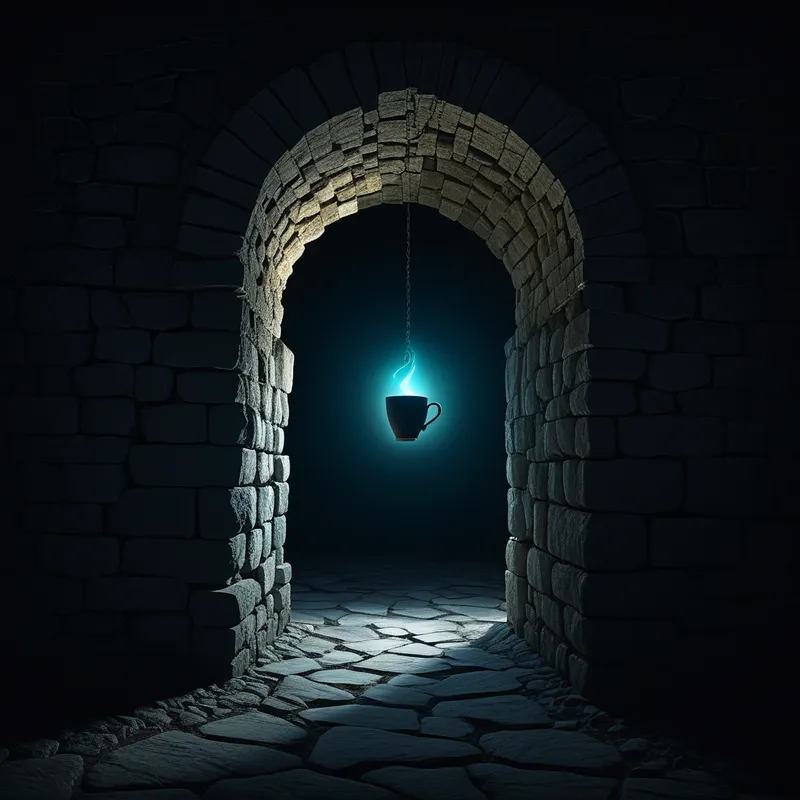
The myth of the Grail Chapel is a perfect map of the alchemical opus, the great work of individuation. The knight’s initial state is that of the nigredo—the blackening, the weary, confused quest in the dark forest of the unconscious. The discovery of the chapel is the albedo, the whitening: a finding of the sacred vessel, the vas, which is both the container for the work and the chapel-space of the soul itself.
The revelation occurs not by adding something new, but by perceiving the eternal gold already hidden within the leaden weight of ordinary, neglected experience.
The crucial alchemical stage depicted is solutio—dissolution. The knight’s ego-driven purpose, his chivalric identity, dissolves in the face of the numinous. He does not seize the Grail; he is witnessed by it. This is the transmutation. The humble, ruined vessel of the chapel (the psyche) is revealed to be the only true container for the divine spark (the Grail). For the modern individual, this translates to the painful yet liberating realization that wholeness is not achieved by building a flawless persona, but by returning with humility to one’s own foundational wounds, limitations, and forgotten spaces, and there, in that honest ruin, discovering an unexpected and sustaining grace. The quest ends where it began, but the seeker is irrevocably changed, having learned that the Grail does not serve the knight, but the knight must learn to serve the truth the Grail reveals.
Associated Symbols
Explore related symbols from the CaleaDream lexicon: