The Grail Castle's Hidden Chamber Myth Meaning & Symbolism
A knight, guided by a wounded king, seeks a hidden chamber within the Grail Castle, confronting a forgotten vow to heal a wasteland and himself.
The Tale of The Grail Castle’s Hidden Chamber
Listen, and let the mists of Avalon gather around you. The tale is not of a grand battle, but of a silence. It is whispered in the halls of Corbenic, carried on the breath of the wounded Fisher King.
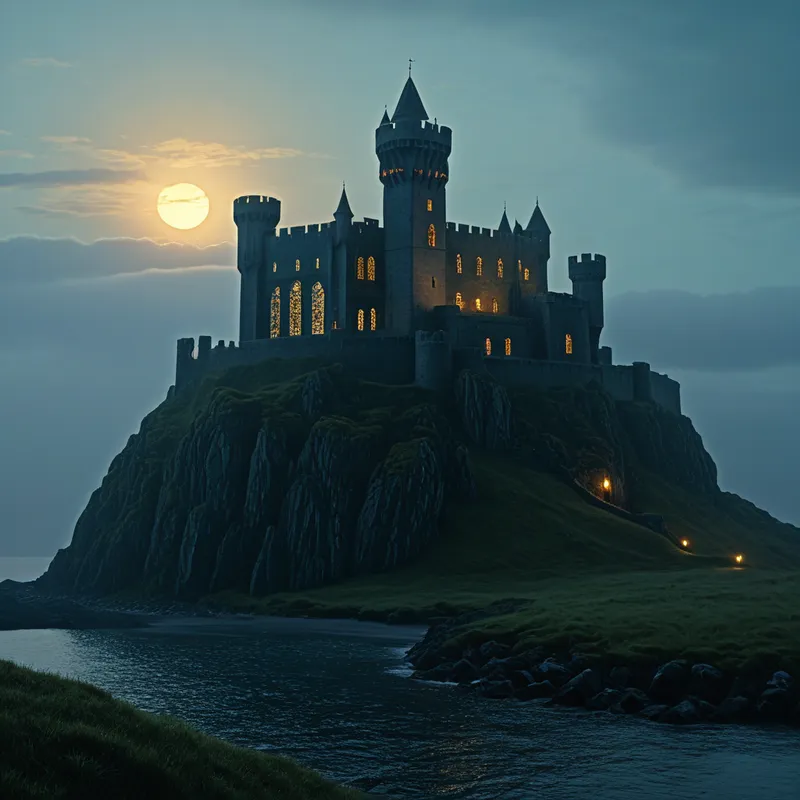
The world is a wasteland. Rivers run slow and thick. Trees bear no fruit, and the people move as if in a deep sleep, their hearts parched by an invisible drought. In the heart of this blight stands the Grail Castle, a phantom of shimmering stone, visible only to those whose destiny is knotted with its own. Many a knight of the Round Table has sought it, drawn by tales of a radiant Grail that passes through its hall, feeding all but healing none.
Our knight—call him Bors, or Percival, or a soul yet unnamed—finds himself there not through strength of arms, but through a failure of heart. He has witnessed the Grail procession in the great hall: the spear that drips eternally, the silver platter, and the Chalice itself, blazing with a light that is neither sun nor fire. And he, bound by a courtly code of silence, asked no question. He slept, and awoke on a barren hillside, the castle vanished, the chance lost.
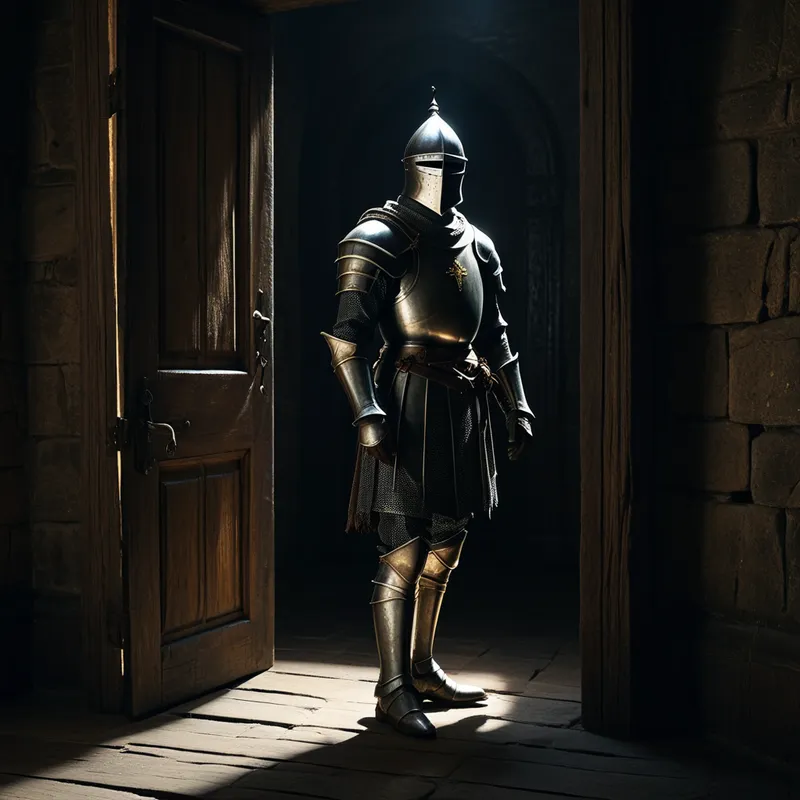
But the castle calls its own back. A second chance is given, rarer than the first. Guided by a hermit’s wisdom or a fool’s intuition, the knight returns. This time, the Fisher King, his face grey with pain, meets him not in the hall, but in a narrow, cold corridor far from the castle’s heart. “You saw the spectacle,” the King whispers, his voice like dry leaves. “But you did not seek the source. The hall nourishes; the chamber heals.”
He leads the knight past tapestries depicting forgotten griefs, up a spiral stair that seems to turn in upon itself. The air grows still and heavy, not with magic, but with the weight of something long untouched. They stop before a door. It is plain oak, unmarked, without lock or latch. “It is not hidden by glamour,” says the King, leaning on his lance, “but by remembrance. The key is the vow you made before you knew you made it. The vow you forgot when you took up sword and shield.”
The knight stands before the door. The grandeur of the Grail is absent here. There is only the wood grain, the smell of old stone, and the echoing, labored breath of the King. Conflict rages—not against a foe, but against the self. Should he force it? Plead? Speak the question he failed to ask? He remembers a moment from childhood, a quiet promise made to a dying parent, or to the sky, or to his own soul: a promise of compassion over glory. The memory is the key. He does not touch the door. He speaks the forgotten vow aloud, his voice cracking in the silence.
The door swings inward, not onto a treasure room, but onto a space that feels both like a tiny cell and the vault of heaven. In the center, on a simple stone altar, rests the Grail. But here, it is not blinding. It is a humble vessel, containing only a stillness so profound it feels like the first moment of creation. A light, gentle as dawn, spills from it and washes over the knight. He turns to see the Fisher King standing straighter, color returning to his face. And through a high, narrow window, he sees a single green shoot breaking through the cracked earth of the wasteland far below.
Cultural Origins & Context
This narrative strand, the Hidden Chamber, is not a single, standardized tale from The Mabinogion or Chrétien de Troyes. It is the deeper pattern that emerges from reading between the lines of the major Grail quests, particularly the stories of <abbr title=“The naive, “pure fool” knight who succeeds in the Grail quest”>Perceval and Galahad. It is the esoteric heart within the chivalric romance, passed down not only by bards but by monastic scribes and alchemists who saw in the Grail a symbol of inner transformation.
Its societal function was dual. For the courtly audience, it reinforced that true nobility lay beyond martial prowess, in spiritual vigilance and compassionate inquiry (the “Question” Perceval fails to ask). For a smaller, more mystically inclined group, it served as an allegorical map. The Castle was the psyche, the Wounded King the ailing spirit or soul, the Grail the divine spark, and the Hidden Chamber the sanctum sanctorum—the innermost, guarded self where integration and healing occur. The tale was a coded instruction: the quest is inward, the enemy is forgetfulness, and the healing of the land (society) depends entirely on the healing of the king (the individual’s ruling principle or soul).
Symbolic Architecture
The myth’s power lies in its symbolic architecture. The Grail Castle itself is the totality of the psyche—a vast, mysterious structure with known halls (the conscious ego) and forgotten wings (the personal and collective unconscious). The splendid, public Grail procession represents numinous energy flowing through the psyche, offering sustenance but not cure. It is grace available, but not yet integrated.
The Hidden Chamber is the sealed memory, the core wound, or the sacred vow the ego has abandoned in its adaptation to the world.
The Fisher King is the archetype of the wounded ruler—the Self, or the soul’s guiding function, which is incapacitated. His wound, often in the thigh (the seat of generative power), symbolizes a spiritual or creative impotence. He cannot heal himself; he needs the knight, the active, striving consciousness, to complete the task. The knight’s initial failure is the ego’s failure to ask the meaningful question, to engage with the mystery on a personal level. His success comes not through force, but through anamnesis—the unforgetting of his essential, pre-chivalric vow of compassion. This act of remembrance is the integration of a lost part of the self, which alone can open the final door.
The Dreamer’s Resonance
When this myth stirs in the modern dreamer, it often manifests as dreams of finding a secret room in a familiar house, discovering a forgotten diary, or encountering a sickly but authoritative figure in a place of institutional power (a hospital, a corporate headquarters). The somatic feeling is one of profound significance coupled with frustration—you are so close to the source of a lifelong ailment or quest, but a simple, maddening obstacle remains.
Psychologically, this dream pattern signals a process of nearing a core complex. The “wasteland” is a life period feeling barren, depressive, or creatively stuck. The “Fisher King” may appear as a depressed father figure, a neglected talent, or one’s own body signaling chronic illness. The dream is the psyche’s announcement that a deep, perhaps childhood-based, vow or trauma (the Hidden Chamber) is ready to be approached. The locked door is the defense mechanism or narrative we’ve built to seal it away. The work is not to bash it down, but to recover the authentic feeling or promise that lives on the other side of that defense.
Alchemical Translation
In the alchemy of individuation, this myth models the opus contra naturam—the work against one’s current, habituated nature. The knight begins in a state of nigredo, the blackening: the despair of failure, the wasteland. His guided return to the castle is the albedo, the whitening, a purification of intention from glory to genuine seeking.
The moment before the hidden door is the critical citrinitas, the yellowing, where the light of consciousness illuminates the shadow of what has been forgotten.
Speaking the forgotten vow is the culmination—the rubedo, the reddening. It is the integration of the feeling function (the vow of compassion) with the spiritual quest. This act transmutes the base metal of a life lived by external codes (chivalry) into the gold of an authentic, self-governed existence. The healing of the King is the healing of the connection to the Self, the inner authority. The greening of the wasteland symbolizes the newfound fertility that flows from this union: creative energy, relatedness, and life meaning restored. The Grail in the Hidden Chamber, no longer a dazzling spectacle but a vessel of humble stillness, represents the achieved lapis philosophorum—the philosopher’s stone. It is not an object to possess, but the state of being that results from the complete and compassionate remembrance of who one truly is.
Associated Symbols
Explore related symbols from the CaleaDream lexicon: