
The Grail Castle Myth Meaning & Symbolism
A wounded king awaits a hero who must ask the right question to heal the land, guarded by a procession of sacred, otherworldly objects.
The Tale of The Grail Castle
Listen, and let the mists of the Annwn gather. [The world](/myths/the-world “Myth from Tarot culture.”/) is wounded. The forests are silent, the rivers run shallow, and the fields yield only thorns. This is the Waste Land, and at its heart, hidden by enchantment and sorrow, stands the Castle of [the Grail](/myths/the-grail “Myth from Arthurian culture.”/).
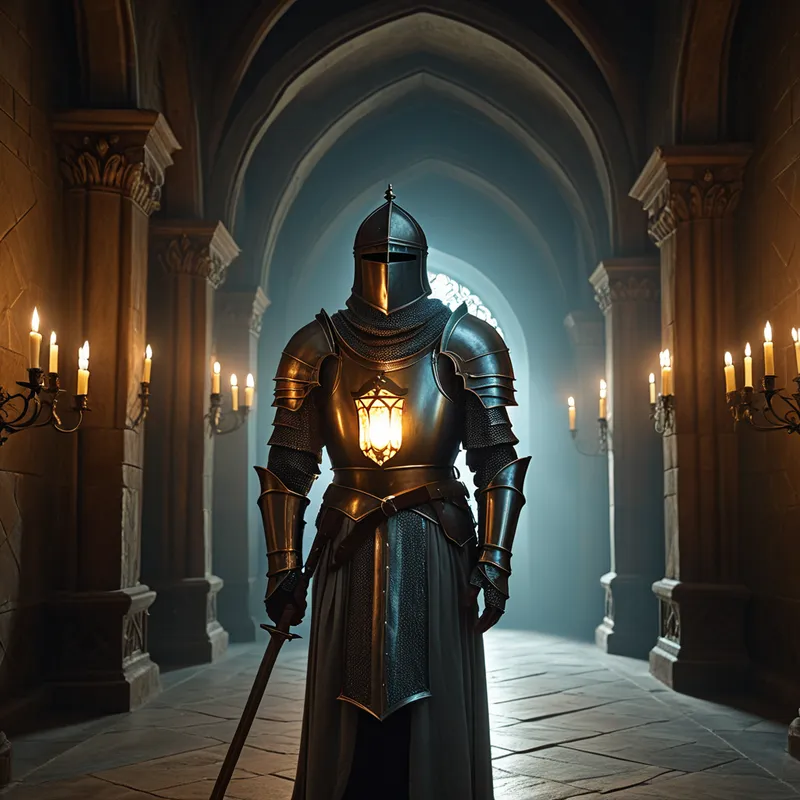
It appears not to those who seek it, but to the one who has lost his way. Such a one was [Perceval](/myths/perceval “Myth from Arthurian culture.”/), a youth of the forest, pure of heart but untutored in the world’s cruel courtesy. Riding through a twilight wood, he came upon a fisherman in a boat on a river, who directed him to shelter. Following the riverbank, as dusk deepened into a starless night, a castle of impossible majesty materialized before him, its grey stones shimmering as if underwater, its towers piercing a sky the colour of a deep bruise.
Within, he was greeted not with fanfare, but with a profound, waiting silence. Servants clad in samite took his horse and led him to a great hall. There, upon a couch of ivory and ebony, lay the [Fisher King](/myths/fisher-king “Myth from Arthurian culture.”/). A great pallor was upon him, and though his robes were rich, his body was twisted with an ancient, unhealing wound—a wound in the thigh, the seat of vitality and generation. A fire roared, yet the hall felt cold. The King welcomed the knight with a voice like dry leaves, and a feast was laid.
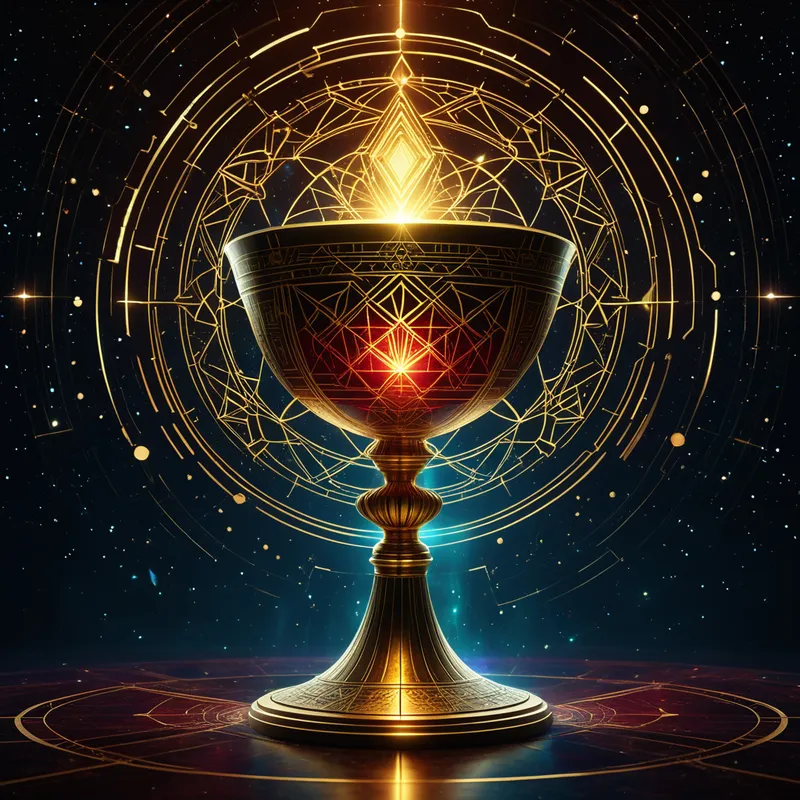
Then, a hush fell deeper than before. From a hidden door came a procession that stilled the blood. First, a squire bearing a lance of white wood, from whose iron tip a single, perfect drop of blood welled and fell, slow and eternal, into a silver cup he carried in his other hand. Behind him came maidens bearing candelabras of gold. Then, a maiden of unearthly beauty, her face veiled in sorrow, carried the vessel. It was not of gold or gem alone, but seemed wrought of captured light and compassion. Some called it the [Grail](/myths/grail “Myth from Christian culture.”/). It passed through the hall, and a fragrance filled the air—of rain on dry earth, of blooming orchards, of a peace long forgotten. Dish after dish of the most exquisite food appeared before each person, summoned by [the vessel](/myths/the-vessel “Myth from Alchemical culture.”/)’s passing.
Perceval’s heart swelled with wonder. A thousand questions danced on his tongue: Whom does the Grail serve? What ails the King? But he remembered the worldly advice of his old mentor: Do not speak too much; it is churlish to pry. So, he sealed his lips. He watched the procession depart. He ate in silence. He slept in a chamber of velvet shadows.
He awoke to a castle empty and echoing. His armor lay beside him, polished. The great hall was deserted, the throne vacant. He rode out across the drawbridge, which groaned shut behind him. When he turned to look back, only [the mist](/myths/the-mist “Myth from Celtic culture.”/)-shrouded forest remained. The castle had vanished, and with it, his chance. A crone by the roadside, her eyes like cracked stones, later told him of his failure. “Because you asked nothing, the King will not be healed. The land will continue to bleed. You had the question in your soul, but fear kept it caged.” The weight of the lost opportunity settled upon him, heavier than any armor, and his true quest—one of wisdom, not just weaponry—began.
Cultural Origins & Context
The tale of the Grail Castle is a profound fusion, a syncretism where deep Celtic substrate wells up through the later soil of medieval chivalric romance. Its earliest literary forms are in the works of Chrétien de Troyes (Perceval, or the Story of the Grail, c. 1180) and the Welsh Peredur son of Efrawg, but its soul is older.
The castle itself is a literary refraction of the [Sídhe](/myths/sdhe “Myth from Celtic / Irish culture.”/) mound, the dwelling of the Tuatha Dé Danann who retreated into the hills and lakes of Ireland. These are not places one finds, but places that reveal themselves to the chosen or the lost. The procession of the bleeding lance and the abundant vessel echoes pagan Celtic cults of sovereignty and fertility, where the health of the king (rí) was directly tied to the health of the land (tír). The wounded king is the land, and his infirmity causes [the Wasteland](/myths/the-wasteland “Myth from Arthurian culture.”/).
These stories were kept alive by the fili and later by bards, serving a societal function far beyond entertainment. They were maps of the [psyche](/myths/psyche “Myth from Greek culture.”/) and the cosmos, teaching codes of conduct (fír flathemon, the ruler’s truth) and illustrating the catastrophic consequences of a broken connection between the human and the divine, the ruler and the realm. [The Grail quest](/myths/the-grail-quest “Myth from Arthurian culture.”/) became the ultimate narrative of the knight’s transition from brute force to spiritual responsibility.
Symbolic Architecture
At its core, the Grail Castle is not a place, but a state of [consciousness](/symbols/consciousness “Symbol: Consciousness represents the state of awareness and perception, encompassing thoughts, feelings, and experiences.”/)—a [moment](/symbols/moment “Symbol: The symbol of a ‘moment’ embodies the significance of transient experiences that encapsulate emotional depth or pivotal transformations in life.”/) of critical [intersection](/symbols/intersection “Symbol: An intersection symbolizes the crossroads of decision-making, presenting choices and the potential for change.”/) between the [human](/symbols/human “Symbol: The symbol of a human represents individuality, complexity of emotions, and social relationships.”/) ego and the numinous, self-regulating psyche.
The Wounded [King](/symbols/king “Symbol: A symbol of ultimate authority, leadership, and societal order, often representing the dreamer’s inner power or external control figures.”/) is the [archetype](/symbols/archetype “Symbol: A universal, primordial pattern or prototype in the collective unconscious that shapes human experience, behavior, and creative expression.”/) of the ruling principle that has become sterile. His wound, often in the thigh or groin, symbolizes a disconnect from the instinctual, creative, and [life](/symbols/life “Symbol: The symbol of ‘Life’ represents a journey of growth, interconnectedness, and existential meaning, encompassing both the joys and challenges that define human experience.”/)-giving energies. He is a consciousness that can receive but cannot act, that presides over [abundance](/symbols/abundance “Symbol: A state of plentifulness or overflowing resources, often representing fulfillment, prosperity, or spiritual richness beyond material needs.”/) but cannot partake in it.
The Grail does not heal the king directly; it awaits the question that will make the king conscious of his own need to be healed.
The Grail Procession represents the autonomous [activity](/symbols/activity “Symbol: Activity in dreams often represents the dynamic aspects of life and can indicate movement, progress, and engagement with personal or societal responsibilities.”/) of the unconscious, presenting its contents—the [lance](/symbols/lance “Symbol: A long thrusting weapon symbolizing focused energy, penetration, direction, and masculine power. It represents both aggression and protection.”/) (phallic [spirit](/symbols/spirit “Symbol: Spirit symbolizes the essence of life, vitality, and the spiritual journey of the individual.”/), penetrating [insight](/symbols/insight “Symbol: A sudden, deep understanding of a complex situation or truth, often arriving unexpectedly and illuminating hidden connections.”/)), the candelabras ([illumination](/symbols/illumination “Symbol: A sudden clarity or revelation, often representing spiritual awakening, intellectual breakthrough, or the dispelling of ignorance.”/)), and the Grail itself (the feminine [vessel](/symbols/vessel “Symbol: A container or structure that holds, transports, or protects something essential, representing the self, emotions, or life journey.”/) of transformation and wholeness)—to the conscious mind. It is the psyche offering its own curative symbols.
Perceval’s Failure is the failure of the conscious mind to engage. It is [the ego](/myths/the-ego “Myth from Jungian culture.”/), trained in superficial manners and fearful of overstepping, refusing the call to [depth](/symbols/depth “Symbol: Represents profound layers of consciousness, hidden truths, or the unknown aspects of existence, often symbolizing introspection and existential exploration.”/). His silence is the greatest sin in the [mythos](/symbols/mythos “Symbol: The collective body of myths, legends, and archetypal narratives that shape cultural identity and spiritual understanding across civilizations.”/): the refusal of relatedness, the denial of [dialogue](/symbols/dialogue “Symbol: Conversation or exchange between characters, representing communication, relationships, and narrative flow in games and leisure activities.”/) with the [soul](/symbols/soul “Symbol: The soul represents the essence of a person, encompassing their spirit, identity, and connection to the universe.”/). The vanished castle is the withdrawn unconscious, which will only re-appear after a long, tortuous [journey](/symbols/journey “Symbol: A journey in dreams typically signifies adventure, growth, or a significant life transition.”/) of self-education and humility.
The Dreamer’s Resonance
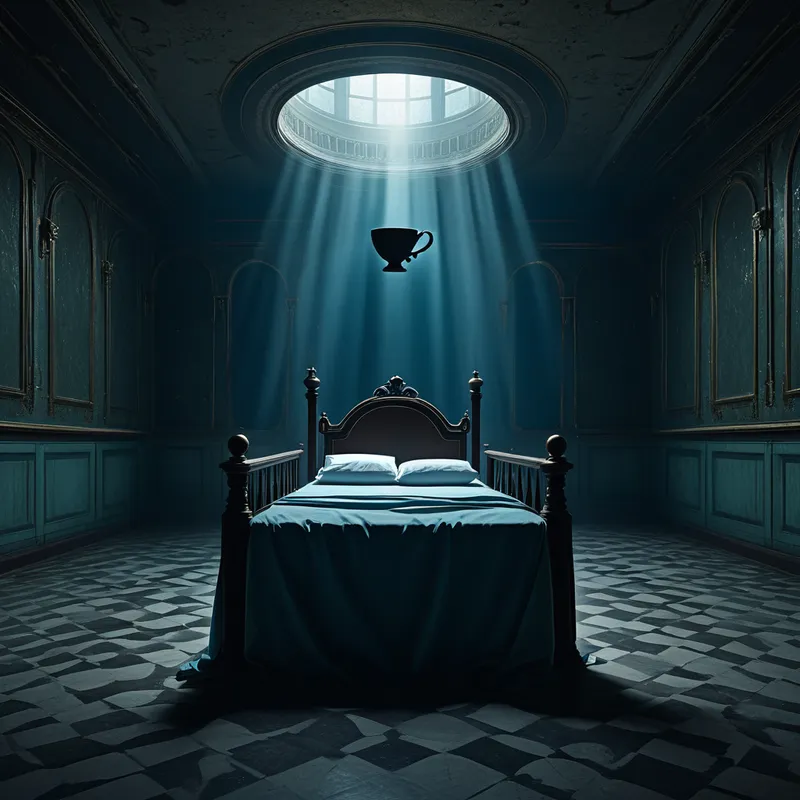
When this mythic pattern stirs in the modern dreamer, it signals a profound crossroads in the process of individuation. To dream of a magnificent, elusive castle or mansion you cannot find again is to grapple with a missed encounter with [the Self](/myths/the-self “Myth from Jungian culture.”/).
The somatic experience is often one of weighted awe—a breathtaking vision followed by a crushing sense of loss or regret upon waking. Psychologically, the dreamer is in a “Perceval phase.” They have been granted a glimpse of their own potential wholeness (the Grail), their own creative power (the lance), or their deepest wound ([the Fisher King](/myths/the-fisher-king “Myth from Arthurian culture.”/) on his couch). But fear, propriety, or a lingering adolescent ego has prevented them from engaging. They observed but did not participate; they felt but did not ask.
The dream is the psyche’s way of stating: “You were at [the threshold](/myths/the-threshold “Myth from Folklore culture.”/). The symbols for your healing were presented. Your task now is not to blindly search for the castle again, but to forge the consciousness that can ask the question when next it appears.” The subsequent feeling of the “Wasteland”—dreams of barren offices, empty relationships, sterile routines—is the consequence of that initial silence.
Alchemical Translation
The Grail myth is a perfect allegory for the alchemical opus, the work of turning leaden consciousness into golden awareness. The Fisher King’s realm is the massa confusa, the sickened, disordered [prima materia](/myths/prima-materia “Myth from Alchemical culture.”/) of the unexamined life.
The knight’s journey to the castle is the [nigredo](/myths/nigredo “Myth from Alchemical culture.”/), the difficult, often lost and blackening descent into the unconscious. The vision in the hall is the albedo, the washing of the soul in the radiant, lunar light of the unconscious’s symbols—a moment of sublime, if passive, illumination. Perceval’s failure and the castle’s disappearance plunge him back into a deeper nigredo, a necessary dissolution of his naive ego.
His subsequent quest, filled with hardship and the slow accumulation of wisdom, is the citrinitas, the yellowing, the dawning of true spiritual understanding. The ultimate return to the castle, when he finally asks, “Whom does the Grail serve?” is the [rubedo](/myths/rubedo “Myth from Alchemical culture.”/), the reddening. This question is the philosopher’s stone. It is not a demand for ownership (“What is the Grail?”) but an inquiry into service and relationship.
The answer, “It serves the Grail King,” reveals the final mystery: the healing symbol serves the deepest, most central archetype of the Self. The ego does not possess the Grail; it serves the totality of which it is a part.
The healing of the king and the greening of the land symbolize the final stage: the conscious ego, now in correct relation to the Self, allows life energy to flow freely again. The individual is no longer a sterile ruler of a barren inner kingdom, but a fertile participant in the endless, nourishing procession of the psyche. The quest ends not with possession, but with a restored and sacred dialogue.
Associated Symbols
Explore related symbols from the CaleaDream lexicon: