The Grail Myth Meaning & Symbolism
A sacred vessel's quest to heal a wounded king and a barren land, symbolizing the soul's search for divine connection and inner completion.
The Tale of The Grail
Listen. The land is sick. The rivers run thin, the fields yield only thistle and stone, and a grey mist hangs over the forests where no birds sing. This is the Waste Land. In its heart, in a castle that appears only to the chosen or the cursed, sits the Maimed King. A wound in his thigh, a wound that will not heal, a wound that weeps in time with the weeping earth.
Into this blight rides [the Fool](/myths/the-fool “Myth from Tarot culture.”/), the Pure. His name is [Perceval](/myths/perceval “Myth from Arthurian culture.”/). Clad in rusted mail and driven by a boy’s courage, he seeks the court of the great Arthur. But his path is diverted by whispers of a greater mystery. Guided by fate and flawed fishermen, he stumbles at dusk upon a castle he did not see at noon. Within, he finds not a feast of boasting, but a solemn procession.
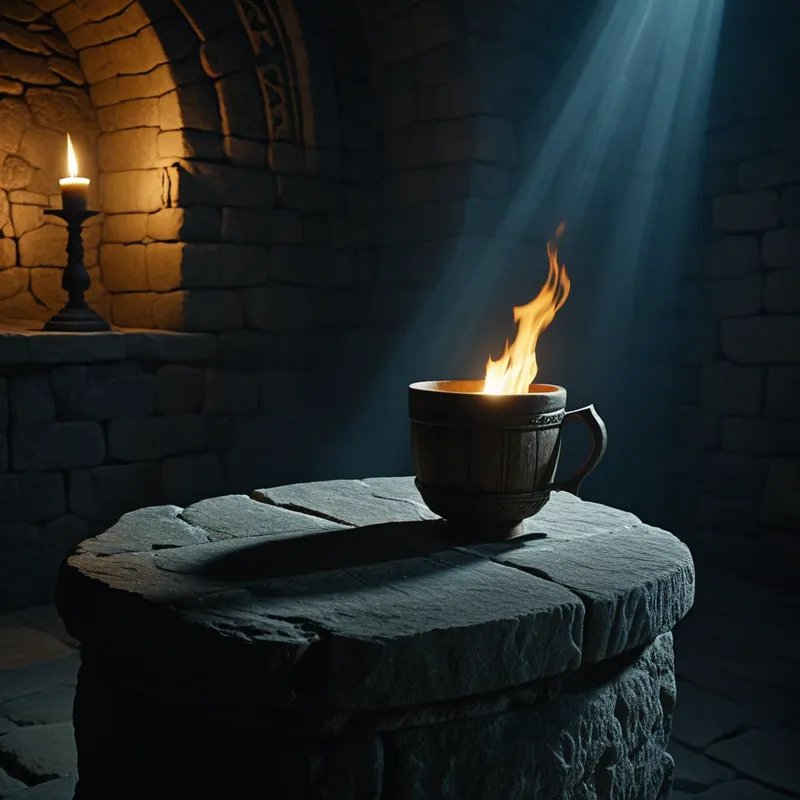
A silence falls, thick as velvet. Through the hall comes a youth bearing a lance that bleeds from its tip, a single crimson drop falling into a silver cup. Then maidens with broken candles. And finally, a maiden bearing it: a vessel. Some say a cup of wood, simple and ancient. Others say a dish, a stone. It is the [Grail](/myths/grail “Myth from Christian culture.”/). It moves through the hall, and from it emanates a light that is not of torch or hearth, a scent of spices that speaks of a paradise lost. It passes before the wounded king, offering sustenance, yet he remains pale and pained.
And Perceval, the chosen witness, sits in dumbstruck awe. A question burns in his throat, a question of compassion: “Whom does the Grail serve?” But he has been taught that a knight speaks not out of turn. So he swallows his words. He says nothing. The Grail departs. The castle vanishes with the morning mist, leaving him on a barren hillside, his chance gone. The land remains waste. The king remains unhealed. And the Fool learns the weight of silence.
His quest then truly begins—a long, harrowing path of atonement, of losing himself to find himself. He must learn to ask not for his own glory, but from a heart cracked open by the suffering of another. Only then might the castle reappear. Only then might he ask the healing question.

Cultural Origins & Context
The Grail myth is not a single story but a tapestry woven from many threads over centuries. Its roots are Celtic, drawing from magical cauldrons of plenty and rebirth in Welsh and Irish lore, like the Cauldron of Annwn. In the 12th and 13th centuries, French poets like Chrétien de Troyes (who left the tale unfinished) and Robert de Boron Christianized and elaborated the legend, fusing it with the burgeoning Arthurian cycle. They linked the Grail to [Joseph](/myths/joseph “Myth from Biblical culture.”/) of Arimathea and the Holy Chalice, transforming it from a pagan symbol of abundance into a relic of divine grace.
The stories were performed in the courts of nobility, serving multiple functions. They were thrilling entertainment, yes, but also mirrors for the aristocratic soul. They presented a new, spiritualized ideal of chivalry, where the knight’s ultimate duty was not to win land or love, but to pursue a holy mystery. [The Grail Quest](/myths/the-grail-quest “Myth from Arthurian culture.”/) became the ultimate narrative of aspiration, a mythic template that asked: what is worth seeking beyond the glory of this world?
Symbolic Architecture
At its core, the Grail is a [symbol](/symbols/symbol “Symbol: A symbol can represent an idea, concept, or belief, serving as a powerful tool for communication and understanding.”/) of the unattainable yet deeply desired object of the [soul](/symbols/soul “Symbol: The soul represents the essence of a person, encompassing their spirit, identity, and connection to the universe.”/)’s longing. It represents the missing [piece](/symbols/piece “Symbol: A ‘piece’ in dreams often symbolizes a fragment of the self or a situation that requires integration, reflection, or understanding.”/), the [source](/symbols/source “Symbol: The origin point of something, often representing beginnings, nourishment, or the fundamental cause behind phenomena.”/) of [life](/symbols/life “Symbol: The symbol of ‘Life’ represents a journey of growth, interconnectedness, and existential meaning, encompassing both the joys and challenges that define human experience.”/) and meaning that has been withdrawn, leaving the inner and outer worlds barren.
The Wasteland is not outside us. It is the psychic condition that arises when the connection to the sacred, the nourishing, and the meaningful is severed.
The Maimed [King](/symbols/king “Symbol: A symbol of ultimate authority, leadership, and societal order, often representing the dreamer’s inner power or external control figures.”/) is the [archetype](/symbols/archetype “Symbol: A universal, primordial pattern or prototype in the collective unconscious that shapes human experience, behavior, and creative expression.”/) of wounded masculine [authority](/symbols/authority “Symbol: A symbol representing power structures, rules, and control, often reflecting one’s relationship with societal or personal governance.”/)—the ruling principle (the [king](/symbols/king “Symbol: A symbol of ultimate authority, leadership, and societal order, often representing the dreamer’s inner power or external control figures.”/)) that is crippled by a spiritual or sexual wound (the thigh). His immobility paralyzes the [kingdom](/symbols/kingdom “Symbol: A kingdom symbolizes authority, belonging, and a sense of identity within a larger context or community.”/) of the [psyche](/myths/psyche “Myth from Greek culture.”/). The Grail, often interpreted as a feminine [vessel](/symbols/vessel “Symbol: A container or structure that holds, transports, or protects something essential, representing the self, emotions, or life journey.”/) of grace and containment, holds the healing balm, but it cannot be accessed by force. It requires the correct approach.
Perceval’s initial failure is the failure of the undeveloped [consciousness](/symbols/consciousness “Symbol: Consciousness represents the state of awareness and perception, encompassing thoughts, feelings, and experiences.”/). He sees but does not connect. He observes the [mystery](/symbols/mystery “Symbol: An enigmatic, unresolved element that invites curiosity and exploration, often representing the unknown or hidden aspects of existence.”/) but remains trapped in the [persona](/symbols/persona “Symbol: The social mask or outward identity one presents to the world, often concealing the true self.”/) of the “well-mannered [knight](/symbols/knight “Symbol: The knight symbolizes honor, chivalry, and the pursuit of noble causes, reflecting the ideal of the noble warrior.”/),” failing to act from genuine [empathy](/symbols/empathy “Symbol: The capacity to understand and share the feelings of others, often manifesting as emotional resonance or intuitive connection in dreams.”/). His subsequent [quest](/symbols/quest “Symbol: A quest symbolizes a journey or search for purpose, fulfillment, or knowledge, often representing life’s challenges and adventures.”/) is the arduous [journey](/symbols/journey “Symbol: A journey in dreams typically signifies adventure, growth, or a significant life transition.”/) toward that [integration](/symbols/integration “Symbol: The process of unifying disparate parts of the self or experience into a cohesive whole, often representing psychological wholeness or resolution of internal conflict.”/), where the [heart](/symbols/heart “Symbol: The heart symbolizes love, emotion, and the core of one’s existence, representing deep connections with others and self.”/)’s [compassion](/symbols/compassion “Symbol: A deep feeling of empathy and concern for others’ suffering, often involving a desire to help or alleviate their pain.”/) (the healing question) is finally united with the [warrior](/symbols/warrior “Symbol: A spiritual archetype representing inner strength, discipline, and the struggle for higher purpose or self-mastery.”/)’s will.
The Dreamer’s Resonance
When this myth stirs in the modern dreamer, it often manifests as a profound sense of searching within a landscape of lack. You may dream of a forgotten, crucial object in a decaying house (the castle), or of being in a meeting or social gathering where a vital opportunity passes by because you failed to speak up (Perceval’s silence).
Somatically, this can feel like a constriction in the chest or throat—the unasked question lodged as physical tension. Psychologically, it is the process of confronting one’s own “wasted” potentials, relationships, or creative energies. The dream is highlighting a moment of failed connection, where an instinct toward compassion or curiosity was suppressed by internalized rules or fear. The healing begins in the recognition of that failure, in the feeling of the longing itself, which is the first stirring of the quest.

Alchemical Translation
The [Grail Quest](/myths/grail-quest “Myth from Arthurian culture.”/) is a master narrative of individuation. The alchemical operation it maps is not the pursuit of gold, but the creation of the vas, [the sacred vessel](/myths/the-sacred-vessel “Myth from Various culture.”/) capable of containing [the divine spark](/myths/the-divine-spark “Myth from Gnostic culture.”/).
The journey starts in the [nigredo](/myths/nigredo “Myth from Alchemical culture.”/), the blackening: [the Wasteland](/myths/the-wasteland “Myth from Arthurian culture.”/), the sense of spiritual aridity and meaninglessness. Perceval’s foolishness and failure are necessary; they are the raw, unrefined state of [the ego](/myths/the-ego “Myth from Jungian culture.”/). His long wanderings represent the albedo, the whitening or purification—a stripping away of knightly pride and a confrontation with shadow.
The healing question, “Whom does the Grail serve?”, is the pivotal moment of the coniunctio, the sacred marriage. It is when the seeker realizes the goal is not to possess the sacred, but to serve it.
The question transforms the quest from an ego-driven conquest into a service to a higher principle. This service heals the split between the masculine (active seeking) and the feminine (receptive vessel), between the king and the Grail. The resulting [rubedo](/myths/rubedo “Myth from Alchemical culture.”/), the reddening, is the restoration of life to the Wasteland—the integration that brings vitality, creativity, and purpose. The Grail, then, is ultimately the symbol of [the Self](/myths/the-self “Myth from Jungian culture.”/), the wholeness achieved when the conscious mind undertakes the perilous, humble journey into the depths to recover what was lost and heal what was wounded.
Associated Symbols
Explore related symbols from the CaleaDream lexicon: