The Graeae Myth Meaning & Symbolism
Three ancient sisters share one eye and one tooth, guarding a secret path. A hero must outwit them to find his destiny in the land of the Gorgons.
The Tale of The Graeae
Listen, and let the salt-spray fill your lungs. Let [the wind](/myths/the-wind “Myth from Various culture.”/), sharp as a flint knife, carry you to the very edge of [the world](/myths/the-world “Myth from Tarot culture.”/). Here, where the wine-dark sea gnaws at the bones of the land, lies a place not found on any map drawn by mortal hand. It is [the threshold](/myths/the-threshold “Myth from Folklore culture.”/) to a land of petrified horror, the path to the Gorgons. And at this threshold stand the gatekeepers.
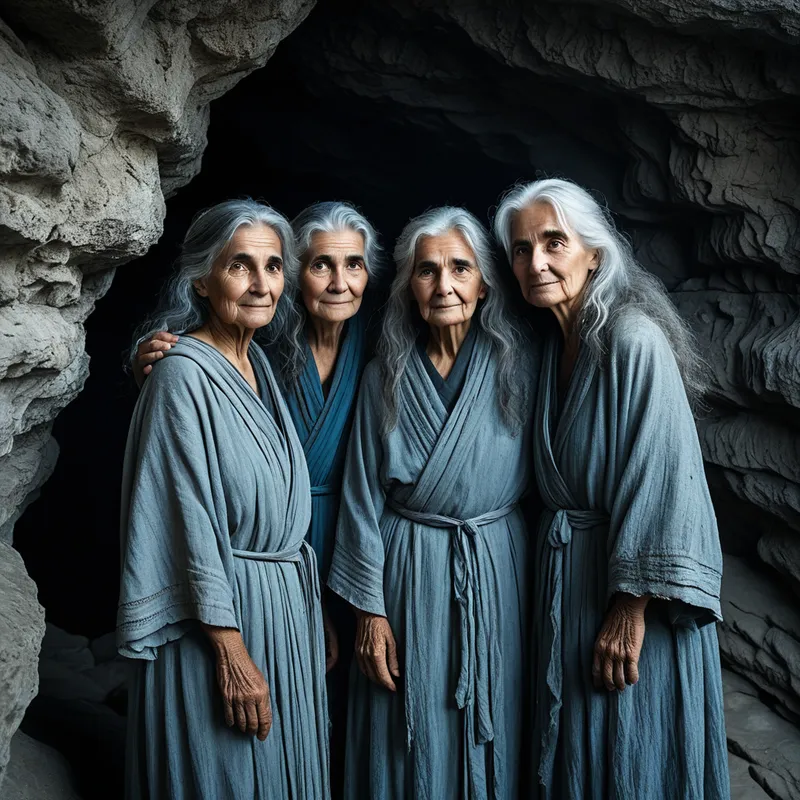
They are the Graeae. [Three sisters](/myths/three-sisters “Myth from Native American culture.”/), born with hair the color of sea-foam on a corpse, skin like ancient parchment stretched over stone. They are old, older than the mountains, older than memory itself. Their names are whispers on the gale: Deino, Enyo, and Pemphredo. They do not see as we see. Among the three of them, they possess but one eye and one tooth.
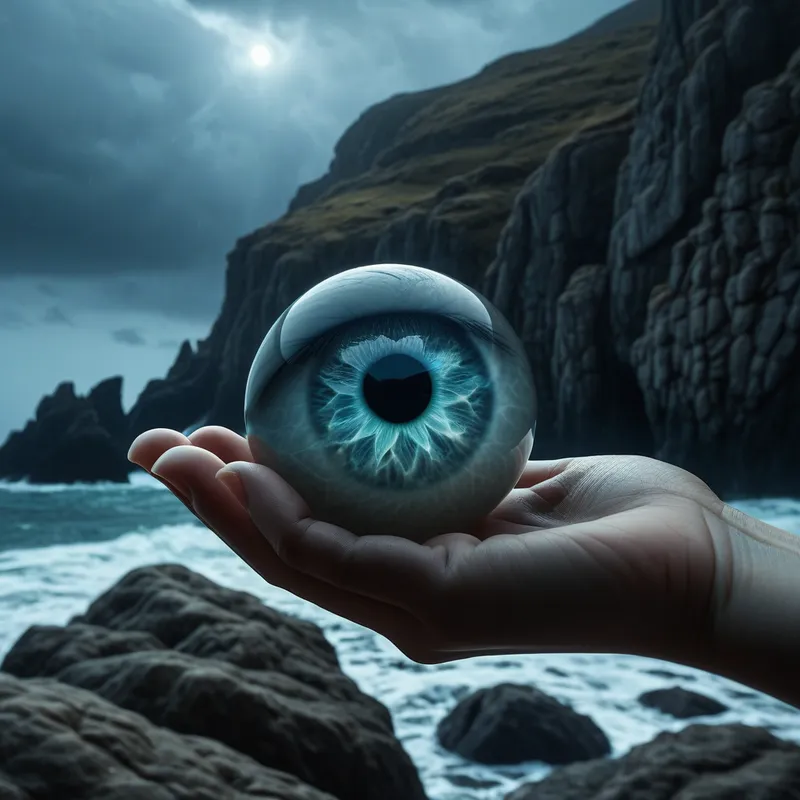
Picture them in their sunless hollow, a cave washed by the ceaseless sigh of the ocean. They pass their singular eye from hand to gnarled hand, a pale, luminous moon that grants a fleeting glimpse of the world—a glimpse of wave, of rock, of the endless grey sky. When the eye is passed, the one who receives it becomes the seer; the others are plunged into a blindness deeper than any night. They share the single, yellowed tooth in the same manner, to gnaw on the tough roots that sustain their ageless vigil. Their existence is a perfect, wretched cycle of shared deprivation and momentary, solitary perception.
Into this desolate rhythm strides a son of destiny. He is [Perseus](/myths/perseus “Myth from Greek culture.”/), armed with nothing but divine guidance and a terrible mission. He must bring back the head of the [Medusa](/myths/medusa “Myth from Greek culture.”/). To find her, he must first find the [Nymphs](/myths/nymphs “Myth from Greek culture.”/) of the North, who hold the tools for his task. And to find the Nymphs, he must learn [the way](/myths/the-way “Myth from Taoist culture.”/) from the Graeae.
He finds them at their grim transaction. One sister holds the eye aloft, its light painting [the cave](/myths/the-cave “Myth from Platonic culture.”/) walls with ghostly shapes. The other two are statues of shadow. Perseus does not charge. He does not plead. He watches. He learns the rhythm of their poverty. Then, with the swiftness of [Hermes](/myths/hermes “Myth from Global/Universal culture.”/) himself, he moves. As the eye is passed from one crone’s palm to another, his own hand darts into the space between. He snatches the eye from the very air.
Suddenly, the cave is filled with a new sound: confusion. The sister who was to receive the eye clutches empty air. The one who gave it is now blind. The third remains in perpetual dark. Their wails are the sound of the cliff cracking. “Give it back! Thief! Give us our sight!” they shriek, their voices like gulls caught in a tempest.
Perseus stands firm, the cold, wet orb pulsing in his hand. “I will return your eye,” he says, his voice cutting through their cries, “when you tell me the path to the Nymphs who guard the Helm of Darkness, the Kibisis, and the Adamantine Harpe.”
Blind and desperate, the sisters have no choice. In a hissed chorus, they spill the secrets of the hidden paths, the unmarked stars to follow, the whispered words that will unlock the Nymphs’ glade. Only when the directions are etched into his mind does Perseus return the eye. He places it into a waiting, trembling hand, and as the light is restored to one, he is already gone, vanished into [the mist](/myths/the-mist “Myth from Celtic culture.”/) with the knowledge he came for, leaving the three ancient sisters to resume their endless, shared watch over the secret way.
Cultural Origins & Context
The myth of the Graeae comes to us primarily from the pen of the poet Hesiod in his Theogony, a foundational text that systematized the genealogy and origins of the Greek gods. They are presented as daughters of the primordial sea deities Phorcys and <abbr title=“A sea monster, the “Hateful”)“>Ceto, making them sisters to the Gorgons and other monstrous beings that inhabit the chaotic edges of the known world.
This placement is crucial. The Graeae were not subjects of widespread cult worship like Zeus or Athena. They were narrative figures, functioning as mythic obstacles. Their story was told by bards and poets as part of the larger epic of Perseus, a classic “hero’s journey” tale. Societally, such myths served to map the psychological and literal frontiers of the Greek world. The Graeae represent the terrifying, obscure knowledge that guards the passage to even greater terrors (the Gorgons). They model the idea that vital information is often held by strange, unappealing, or frightening custodians at the boundary of human experience.
Symbolic Architecture
The Graeae are not mere monsters; they are a profound symbolic complex. They represent the hoarded, fragmented [knowledge](/symbols/knowledge “Symbol: Knowledge symbolizes learning, understanding, and wisdom, embodying the acquisition of information and enlightenment.”/) of the past. Their single eye and single tooth are not just grotesque details but emblems of [scarcity](/symbols/scarcity “Symbol: A dream symbol representing lack, limitation, or insufficient resources, often reflecting fears of deprivation or unmet needs.”/) and incomplete [perception](/symbols/perception “Symbol: The process of becoming aware of something through the senses. In dreams, it often represents how one interprets reality or internal states.”/).
The one eye symbolizes limited, singular perspective. No sister sees the whole picture; each only perceives a fleeting fragment of reality before passing it on. This is the nature of unintegrated knowledge—it is partial, transient, and leaves the holder in darkness as often as in light.
Their greyness (graia) connects them to the [twilight](/symbols/twilight “Symbol: A liminal period between day and night symbolizing transition, ambiguity, and the blending of opposites.”/), the fog, the indeterminate [space](/symbols/space “Symbol: Dreaming of ‘Space’ often symbolizes the vastness of potential, personal freedom, or feelings of isolation and exploration in one’s life.”/) between knowing and not-knowing. They are the guardians of the threshold, the psychic “gatekeepers” who hold the key to the next stage of the [journey](/symbols/journey “Symbol: A journey in dreams typically signifies adventure, growth, or a significant life transition.”/) but who are themselves a [riddle](/symbols/riddle “Symbol: A puzzle or enigmatic statement requiring cleverness to solve, symbolizing hidden truths, intellectual challenge, and the search for meaning.”/) to be solved. Their shared deprivation forces cooperation, but it is a cooperation born of lack, not [abundance](/symbols/abundance “Symbol: A state of plentifulness or overflowing resources, often representing fulfillment, prosperity, or spiritual richness beyond material needs.”/).
Psychologically, they embody the shadowy, archaic contents of the personal and [collective unconscious](/symbols/collective-unconscious “Symbol: The Collective Unconscious refers to the part of the unconscious mind shared among beings of the same species, embodying universal experiences and archetypes.”/). They are the “old ones”—the repressed memories, the ancestral fears, the unprocessed traumas that we share (like the eye) but never fully own or examine. To confront them, as Perseus does, is to confront the strange, off-putting, and seemingly impoverished aspects of our own [psyche](/myths/psyche “Myth from Greek culture.”/) that nonetheless guard the [path](/symbols/path “Symbol: The ‘path’ symbolizes a journey, choices, and the direction one’s life is taking, often representing individual growth and exploration.”/) to our power.
The Dreamer’s Resonance
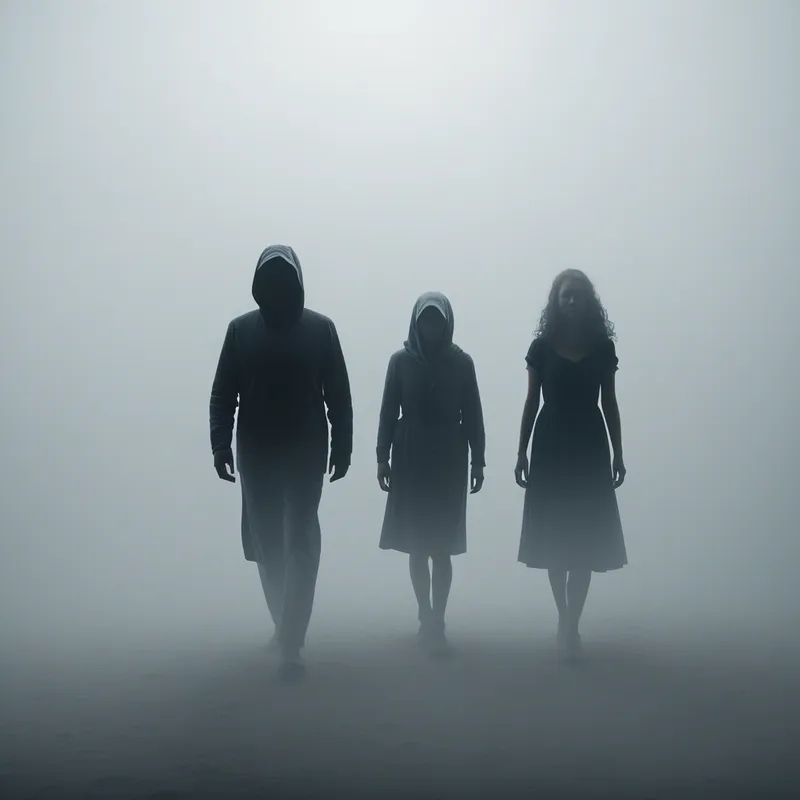
When the pattern of the Graeae emerges in modern dreams, it signals a confrontation with obscured or fragmented knowledge essential for the dreamer’s progress. You may dream of a council of indistinct elders, a group sharing a vital object, or find yourself in a grey, liminal landscape seeking directions from uncooperative figures.
Somatically, this can feel like a “brain fog” or a sense of being stuck at a threshold, knowing you need information but being unable to access it clearly. Psychologically, it is the process of grappling with a truth that is not held by one clear source but is distributed, hidden, or intentionally obscured—perhaps within your family system, your own memory, or a professional environment. The dreamer is in the role of Perseus: on a mission that requires them to outwit the guardians of secrecy. The act of “stealing the eye” in the dream represents the necessary aggression in consciousness required to seize insight, to pull a singular truth from a cycle of shared obscurity, even if it temporarily disrupts an old, dysfunctional system.
Alchemical Translation
The alchemical journey of individuation is not a gentle stroll; it is a quest that requires confronting the grotesque guardians at the border of the unknown self. The Graeae model the first crucial operation: the forcible integration of fragmented knowledge.
The hero does not destroy the sisters; he temporarily disrupts their system to extract what he needs. This is the psychic act of consciously seizing a perspective (the eye) from the automatic, unconscious cycle of our defenses and repressed memories.
Perseus’s cunning is key. He uses observation, timing, and leverage—not brute force. In our own lives, this translates to the psychological work of active attention. We must watch the patterns of our avoidance, the cycles where we only glimpse our truth briefly before passing the “eye” of responsibility or awareness back to our inner shadows. The “tooth,” the means of nourishment, is also shared. This suggests our deepest sustenance—our core beliefs—may be similarly archaic, worn, and insufficient when not made wholly our own.
The ultimate goal is not to become like the Graeae, stuck in a shared poverty of perception, but to use the extracted knowledge to arm oneself for the deeper confrontation ahead (with the Medusa, the ultimate face of the terrifying feminine/Shadow). By outwitting the Graeae, the individual learns that the power to proceed does not come from the outside, but from the courageous act of taking the “seeing” for oneself, of claiming a whole perspective from the fragmented, grey guardians of the personal past. The eye is returned, but the knowledge is kept. The old pattern remains at the threshold, but the seeker has transformed, moving forward equipped with a hard-won map into the darkest realms of transformation.
Associated Symbols
Explore related symbols from the CaleaDream lexicon: