The Graces Myth Meaning & Symbolism
The myth of The Graces reveals the divine dance of charm, beauty, and creativity that weaves joy into the fabric of human connection and the world.
The Tale of The Graces
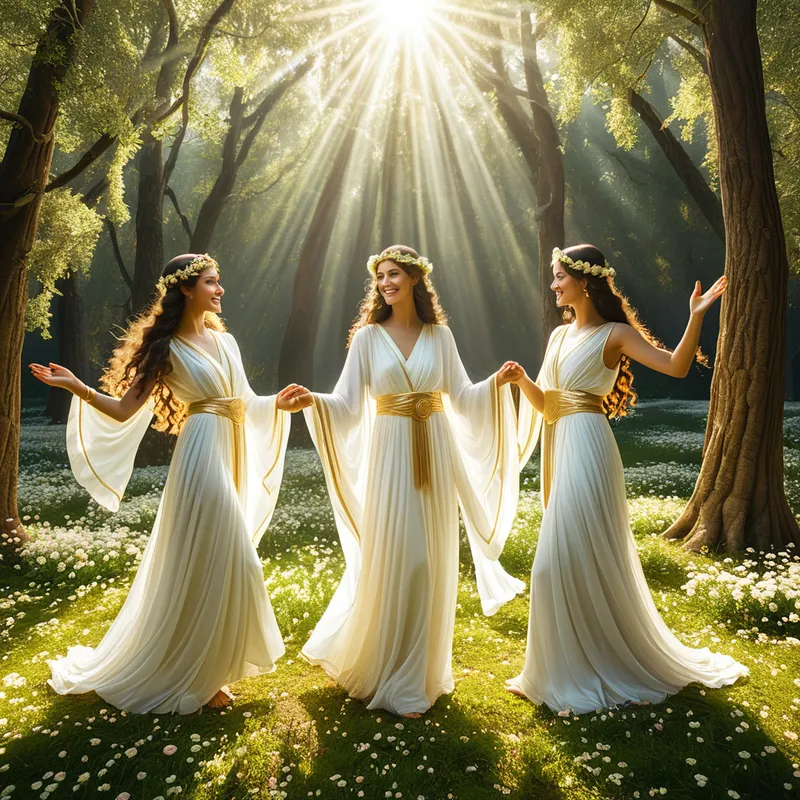
Listen. Before the clamor of heroes and the thunder of gods, there was a softer music. It did not roar from the peak of Olympus, but whispered from its sun-dappled slopes, from the groves where the air itself seemed to laugh. This was the realm of the Charites, whom the Romans would later call the Graces. They were not one, but three, and their power was in their number.
Their mother was Eurynome, the wide-ruling one, daughter of Ocean. Their father was mighty Zeus, the cloud-gatherer. From this union of boundless flow and sovereign order, three daughters were born: Aglaia, Euphrosyne, and [Thalia](/myths/thalia “Myth from Greek culture.”/).
They did not dwell in the marble halls but in the living world. You would find them where the wildflowers nodded in agreement with the breeze, where a clear spring broke from [the earth](/myths/the-earth “Myth from Hindu culture.”/) in a joyful shout. They were always moving, always together. Their dance was not a performance; it was the very pattern of pleasantness. Aglaia would turn, and her radiance would catch the light on a dewdrop, transforming it into a tiny sun. Euphrosyne’s laughter would ripple through the leaves, making them shiver with delight. Thalia’s gentle step would cause hyacinths and violets to push through the soil, unfurling in her wake.
They were the companions of Aphrodite, not as servants, but as the necessary expression of her power. For what is love without the radiance that attracts, the joy that sustains, or the blooming beauty that results? They attended the feasts of the gods, and where they stood, conversation sparkled, wine tasted sweeter, and alliances were forged not through fear, but through mutual delight. Mortals who caught a glimpse of their dance, even in a dream, would wake with a lightness in their heart, a sudden urge to create something beautiful, or to speak a kind word. They wove the invisible threads that bind friend to friend, host to guest, the artist to their art, and all life to the simple, profound pleasure of being.
Cultural Origins & Context
The worship of The Graces was ancient, likely predating the Olympian [pantheon](/myths/pantheon “Myth from Roman culture.”/) as formalized by [Homer](/myths/homer “Myth from Greek culture.”/) and Hesiod. Their roots stretch into the pre-Greek, Minoan world, where goddess triads were central to religious life. They were deities of vegetation, fertility, and the natural cycles of growth—powers later refined into concepts of social and artistic grace.
In historical Greece, they were worshipped not with grand, fearful sacrifices, but with offerings of first fruits, flowers, and dance. Their most famous cult centers were in Orchomenos in Boeotia and on the island of Paros, where they were revered as “the Queens.” Poets from Hesiod to Pindar invoked them at the start of their works, for the Graces governed the charis—the favor, charm, and gratitude—that made poetry pleasing to the gods and humans alike. In a society built on complex codes of hospitality ([xenia](/myths/xenia “Myth from Greek culture.”/)) and reciprocity, the Graces personified the oil that smoothed social machinery. They represented the ideal that human interaction, and indeed all creation, should be infused with beauty and mutual delight.
Symbolic Architecture
The profound [psychology](/symbols/psychology “Symbol: Psychology in dreams often represents the exploration of the self, the subconscious mind, and emotional conflicts.”/) of the myth lies in its triune, relational [nature](/symbols/nature “Symbol: Nature symbolizes growth, connectivity, and the primal forces of existence.”/). The Graces are never alone. Their power is emergent, existing in the between.
Grace is not a solitary virtue; it is the luminous field generated between beings in harmony.
First, they symbolize the components of wholesome attraction. Aglaia is [Radiance](/symbols/radiance “Symbol: A powerful symbol of illumination, divine presence, and inner awakening, often representing clarity, truth, and spiritual energy.”/)—the [inner light](/symbols/inner-light “Symbol: A spiritual symbol representing divine presence, consciousness, enlightenment, or the soul’s essence, often associated with awakening and inner wisdom.”/), talent, or brilliance that draws [attention](/symbols/attention “Symbol: Attention in dreams signifies focus, awareness, and the priorities in one’s life, often indicating where the dreamer’s energy is invested.”/). Euphrosyne is Joy—the warmth, mirth, and [celebration](/symbols/celebration “Symbol: The symbol of ‘celebration’ represents joy, accomplishment, and community, often serving as a collective acknowledgment of achievements or significant life milestones.”/) that makes [connection](/symbols/connection “Symbol: Connection symbolizes relationships, communication, and bonds among individuals.”/) sustainable and pleasurable. Thalia is [Bloom](/symbols/bloom “Symbol: Represents growth, vitality, and the flourishing of potential, often tied to emotional awakening or physical health.”/)—the [beauty](/symbols/beauty “Symbol: This symbol embodies aesthetics, harmony, and the appreciation of life’s finer qualities.”/) and [abundance](/symbols/abundance “Symbol: A state of plentifulness or overflowing resources, often representing fulfillment, prosperity, or spiritual richness beyond material needs.”/) that results from the [relationship](/symbols/relationship “Symbol: A representation of connections we have with others in our lives, often reflecting our emotional state.”/), the [fruit](/symbols/fruit “Symbol: Fruit symbolizes abundance, nourishment, and the fruits of one’s labor in dreams.”/) of the [connection](/symbols/connection “Symbol: Connection symbolizes relationships, communication, and bonds among individuals.”/). One cannot truly exist without the others. [Radiance](/symbols/radiance “Symbol: A powerful symbol of illumination, divine presence, and inner awakening, often representing clarity, truth, and spiritual energy.”/) without Joy is cold spectacle. Joy without [Bloom](/symbols/bloom “Symbol: Represents growth, vitality, and the flourishing of potential, often tied to emotional awakening or physical health.”/) is fleeting [euphoria](/symbols/euphoria “Symbol: An intense, overwhelming feeling of happiness, elation, and well-being, often described as a peak emotional or spiritual state.”/). [Bloom](/symbols/bloom “Symbol: Represents growth, vitality, and the flourishing of potential, often tied to emotional awakening or physical health.”/) without [Radiance](/symbols/radiance “Symbol: A powerful symbol of illumination, divine presence, and inner awakening, often representing clarity, truth, and spiritual energy.”/) has no [source](/symbols/source “Symbol: The origin point of something, often representing beginnings, nourishment, or the fundamental cause behind phenomena.”/).
Second, they model the circle of creative and social reciprocity. Their eternal dance in a circle represents the flow of giving, receiving, and returning. In Greek thought, charis created an [obligation](/symbols/obligation “Symbol: A perceived duty or responsibility imposed by social norms, relationships, or internalized expectations, often involving a sense of being bound to act.”/) of gratitude and return gift. This is the healthy ecosystem of relationship, whether between people, between an [artist](/symbols/artist “Symbol: An artist symbolizes creativity, expression, and the exploration of the human experience through various forms of art.”/) and their muse, or between humanity and the natural world. The dance itself is the [symbol](/symbols/symbol “Symbol: A symbol can represent an idea, concept, or belief, serving as a powerful tool for communication and understanding.”/)—the process is the [product](/symbols/product “Symbol: This symbol represents tangible outcomes of one’s efforts and creativity, often reflecting personal value and identity.”/).
The Dreamer’s Resonance
To dream of The Graces is to dream of connection, but specifically, of the quality of your connections. Dreaming of a solitary, radiant figure may speak to Aglaia—a calling to acknowledge and express your own brilliance, but perhaps a loneliness within it. Dreaming of a joyful feast (Euphrosyne) may highlight a need for celebration or warn of hollow revelry.
Most potently, dreaming of their dance—especially if you are trying to join it, are excluded from it, or are watching it break apart—signals a profound somatic and psychological process. It is the [psyche](/myths/psyche “Myth from Greek culture.”/) working on the architecture of relationship. You may be integrating disparate parts of yourself (your radiance, your joy, your creativity) into a harmonious whole. Or, it may reflect on your external social sphere: Are your relationships reciprocal? Do they generate beauty and growth, or drain and deplete? The feeling in the dream is key: a sense of effortless flow and warmth indicates alignment. A sense of stumbling, forced movement, or coldness reveals where charis is blocked in your waking life.

Alchemical Translation
The individuation process is not a lonely hero’s journey to a mountain top. It is, in part, a graceful dance of integration. The Graces offer an alchemical model for transmuting the raw elements of [the self](/myths/the-self “Myth from Jungian culture.”/) into a cohesive, attractive, and life-affirming personality.
The first operation is to identify the three substances within. What is your Radiance (your unique skill, insight, or spirit)? What is your Joy (what activities, connections, or states make your soul feel festive)? What is your Bloom (what beauty or creation do you bring into [the world](/myths/the-world “Myth from Tarot culture.”/))? The modern ego often fixates on one, to the detriment of the others—pursuing Bloom (success) without Joy, or cultivating a social Joy that lacks authentic Radiance.
The alchemy of the self begins when we stop mining for a single golden trait and start orchestrating the dance between all that we are.
The “work” is then to set them in motion, to initiate the internal dance. This means allowing your Radiance to inform your Joy, letting your Joy fuel your creative Bloom, and permitting that Bloom to reflect back and enhance your Radiance. It is a psychic feedback loop of self-nourishment. Externally, this integrated inner dance naturally alters your relationships. You engage from a place of wholeness, offering not a needy fragment but a flowing quality of being. You attract not to fill a void, but to meet another’s dance with your own. In this model, psychological completion is not a static state of perfection, but the dynamic, graceful, and ever-unfolding capacity to give, receive, and create—the mortal embodiment of the divine circle.
Associated Symbols
Explore related symbols from the CaleaDream lexicon: