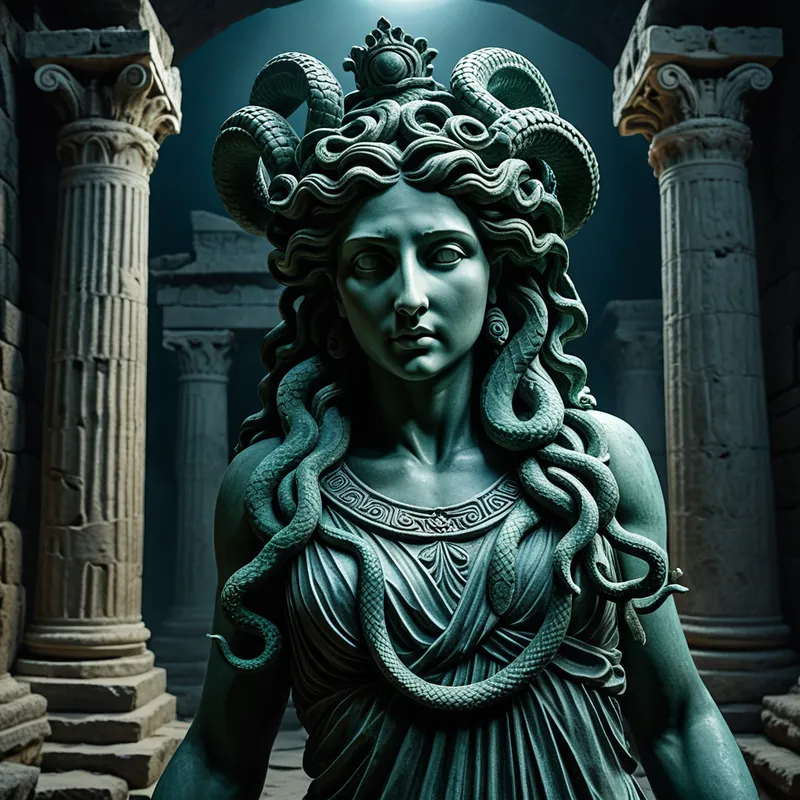
The Gorgon Medusa Myth Meaning & Symbolism
A priestess cursed, a hero's quest, and a gaze that turns to stone. The myth of Medusa reveals the shadow of trauma and the alchemy of facing it.
The Tale of The Gorgon Medusa
Listen, and hear a tale not of a simple monster, but of a fate woven by gods and unraveled by mortal hands. It begins in the sun-drenched temples of Athena, where a priestess named [Medusa](/myths/medusa “Myth from Greek culture.”/) served with a devotion that rivaled the goddess’s own. Her beauty was not of the gentle kind, but a radiant, formidable power that turned heads and stirred whispers that even [the sea](/myths/the-sea “Myth from Greek culture.”/) god [Poseidon](/myths/poseidon “Myth from Greek culture.”/) had noticed.
The sacred precinct became a profane stage. In [the shadow](/myths/the-shadow “Myth from Jungian culture.”/) of Athena’s altar, an act of violation occurred. The details are whispered—was it seduction or force? The ancient stones do not say. But the goddess’s wrath was not for the ocean lord. It fell upon the violated. Medusa’s punishment was a curse of terrible symmetry: her glorious hair became a hissing nest of vipers; her face, once so captivating, became a weapon. Her gaze, which once held devotion, now held a petrifying power. To look upon Medusa was to be frozen forever, your last moment of terror made eternal stone. Cast out, she fled to the ends of [the world](/myths/the-world “Myth from Tarot culture.”/), to a sunless cave on the shores of the [Oceanus](/myths/oceanus “Myth from Greek culture.”/), where she dwelt with her two immortal Gorgon sisters, Stheno and Euryale. Her cave became a garden of statues—men, beasts, heroes—all caught in the final gasp of their assault.
Enter the hero, [Perseus](/myths/perseus “Myth from Greek culture.”/), son of Zeus, his task set by a tyrant: bring back the head of [the Gorgon](/myths/the-gorgon “Myth from Various culture.”/). This was a suicide mission. But the gods, in their capricious calculus, provided tools: winged sandals from [Hermes](/myths/hermes “Myth from Global/Universal culture.”/), a cap of invisibility from the [nymphs](/myths/nymphs “Myth from Greek culture.”/), a sword of adamant, and, most crucially, a mirrored shield from Athena herself. [Perseus](/myths/perseus “Myth from Greek culture.”/) did not journey as a brute, but as a cunning reflection.
He found [the cave](/myths/the-cave “Myth from Platonic culture.”/), a place of deathly quiet broken only by the dry rustle of scales and the sigh of stone. Using the shield as his guide, he navigated the petrified forest of her victims. He found her sleeping, the serpents in her hair coiling slowly in dream. He did not meet her eyes. He watched her reflection in the polished bronze, averted his own lethal gaze, and in one swift, terrible motion, brought the divine blade down. From the severed neck sprang the winged horse [Pegasus](/myths/pegasus “Myth from Global/Universal culture.”/) and the warrior Chrysaor, children of her violation.
Perseus fled, the head sealed in a sack, its power undimmed. He used it as a weapon, freezing the titan Cetus and the would-be groom Phineus and his men into silent, stony assemblies. His quest complete, he presented the head to Athena, who set it upon her aegis, a perpetual ward against all enemies. The Gorgon’s gaze, once a curse of isolation, was transformed into a shield for [the polis](/myths/the-polis “Myth from Greek culture.”/).
Cultural Origins & Context
The myth of Medusa is a foundational strand in the vast tapestry of Greek mythology, primarily preserved in Hesiod’s Theogony and later elaborated by poets like Ovid. It was not a singular, fixed story but an oral tradition that evolved, reflecting the anxieties and values of the culture that carried it. In its earliest forms, Medusa was likely a primordial monster, one of three Gorgons born of sea deities. The later, more psychologically complex version—the beautiful priestess transformed—gained prominence, particularly in the Hellenistic and Roman periods.
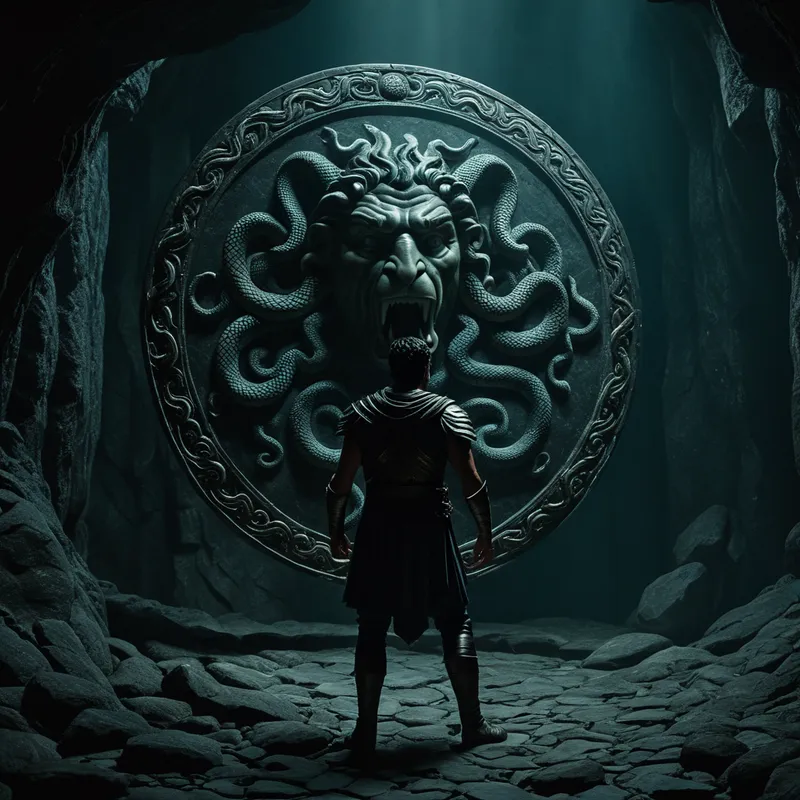
The myth functioned on multiple societal levels. It was a thrilling hero narrative, validating the cunning and divine favor of heroes like Perseus. It was an aetiological myth, explaining the origin of Pegasus and coral (said to form from her blood). Most powerfully, it was a sacred narrative tied to the cult of Athena. The Gorgoneion (the image of Medusa’s head) was ubiquitous in Greek art and architecture, carved on shields, temple pediments, and doorways as an apotropaic device. The myth thus served to transform a terrifying, chaotic power (the petrifying gaze) into a symbol of protected order, literally facing down evil from the city’s walls.
Symbolic Architecture
Beneath the heroic [adventure](/symbols/adventure “Symbol: ‘Adventure’ signifies exploration, discovery, and the pursuit of new experiences in one’s life journey.”/) lies a profound symbolic [architecture](/symbols/architecture “Symbol: Architecture in dreams often signifies structure, stability, and the framing of personal identity or life’s journey.”/). Medusa is not merely a [monster](/symbols/monster “Symbol: Monsters in dreams often symbolize fears, anxieties, or challenges that feel overwhelming.”/); she is the embodiment of the traumatic, petrifying encounter with something so overwhelming it stops us in our tracks.
The Gorgon’s gaze is the moment consciousness meets the unassimilable—the frozen shock of betrayal, the paralyzing face of our own rage or terror.
Her [serpent](/symbols/serpent “Symbol: A powerful symbol of transformation, wisdom, and primal energy, often representing hidden knowledge, healing, or temptation.”/) [hair](/symbols/hair “Symbol: Hair often symbolizes identity, power, and self-expression, reflecting how we perceive ourselves and how we wish to be perceived by others.”/) connects her to chthonic, primal wisdom and the [life](/symbols/life “Symbol: The symbol of ‘Life’ represents a journey of growth, interconnectedness, and existential meaning, encompassing both the joys and challenges that define human experience.”/)-[death](/symbols/death “Symbol: Symbolizes transformation, endings, and new beginnings; often associated with fear of the unknown.”/)-[rebirth](/symbols/rebirth “Symbol: A profound transformation where old aspects of self or life die, making way for new beginnings, growth, and renewal.”/) cycle, but here it is twisted into a defensive [crown](/symbols/crown “Symbol: A crown symbolizes authority, power, and achievement, often representing an individual’s aspirations, leadership, or societal role.”/) of thorns. Her [origin](/symbols/origin “Symbol: The starting point of a journey, often representing one’s roots, source, or initial state before transformation.”/) as a violated priestess points to the [archetype](/symbols/archetype “Symbol: A universal, primordial pattern or prototype in the collective unconscious that shapes human experience, behavior, and creative expression.”/) of sacred [innocence](/symbols/innocence “Symbol: A state of purity, naivety, and freedom from guilt or corruption, often associated with childhood and moral simplicity.”/) profaned, its power inverted into a destructive force. She becomes the ultimate [shadow](/symbols/shadow “Symbol: The ‘shadow’ embodies the unconscious, repressed aspects of the self and often represents fears or hidden emotions.”/) figure: that which we cannot bear to look at directly, for to do so is to risk psychic [paralysis](/symbols/paralysis “Symbol: A state of being unable to move or act, often representing feelings of powerlessness, fear, or being trapped in waking life.”/).
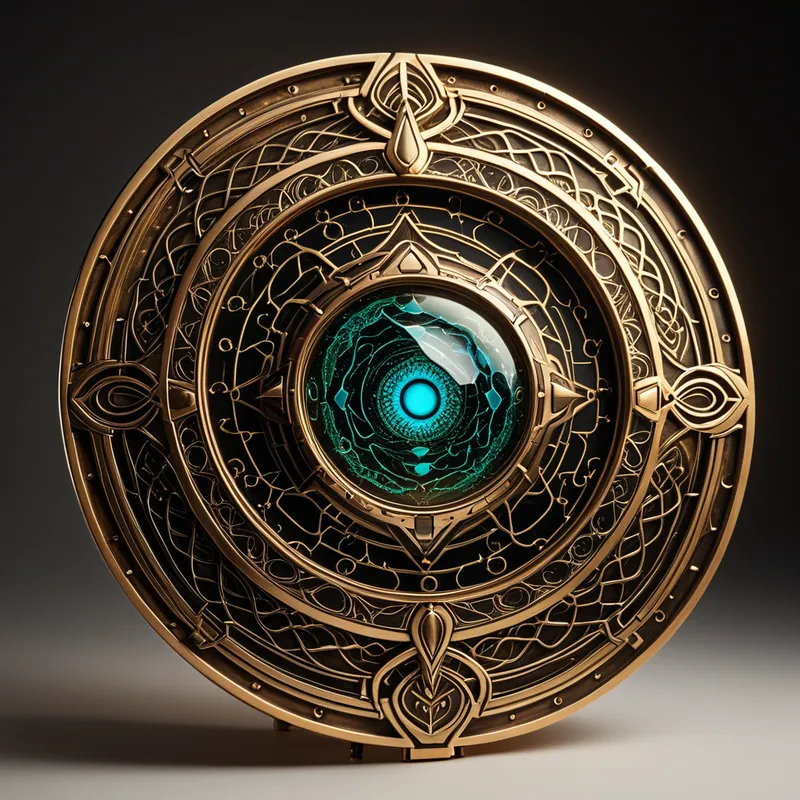
Perseus, then, represents the conscious ego tasked with integrating this shadow. His tools are symbolic of the necessary psychic apparatus: the mirrored [shield](/symbols/shield “Symbol: A symbol of protection, defense, and boundaries, representing personal security, resilience, and the need to guard against external threats or emotional harm.”/) (self-[reflection](/symbols/reflection “Symbol: Reflection signifies self-examination, awareness, and the search for truth within oneself.”/)), the winged sandals (elevated [perspective](/symbols/perspective “Symbol: Perspective in dreams reflects one’s viewpoints, attitudes, and how one interprets experiences.”/)), [the cap of invisibility](/myths/the-cap-of-invisibility “Myth from Folklore culture.”/) (the [ability](/symbols/ability “Symbol: In dreams, ‘ability’ often denotes a recognition of skills or potential that one possesses, whether acknowledged or suppressed.”/) to approach the unconscious without being completely identified with it), and the sword (discernment and decisive [action](/symbols/action “Symbol: Action in dreams represents the drive for agency, motivation, and the ability to take control of situations in waking life.”/)). He does not conquer her through brute force, but through indirection, using [reflection](/symbols/reflection “Symbol: Reflection signifies self-examination, awareness, and the search for truth within oneself.”/) to approach what cannot be faced directly.
The Dreamer’s Resonance
When the pattern of the Medusa myth arises in modern dreams, it signals a profound encounter with a petrifying element of the [psyche](/myths/psyche “Myth from Greek culture.”/). Dreaming of being turned to stone, or of facing a figure with a paralyzing gaze, often corresponds to a somatic experience of freeze response—a deep psychological or emotional trauma that has halted a part of the dreamer’s inner life.
The dream may present a terrifying figure, a looming presence, or even a mesmerizing but frightening object. The key is the feeling of immobilization. This is the psyche’s way of presenting the “unfaceable” aspect of oneself—perhaps a buried rage, a core shame, a memory of violation, or a potent creative force that feels too dangerous to unleash. The dreamer is at [the threshold](/myths/the-threshold “Myth from Folklore culture.”/) of their own “cave,” and the psychological process is one of gathering the courage and the tools (self-reflection, support, therapy) to approach this frozen territory without being destroyed by it. The petrification in the dream is both the problem and a clue: what in you has been turned to stone, and what life is waiting to be released from that frozen state?

Alchemical Translation
The myth models the complete alchemical cycle of psychic transmutation, or individuation. The starting materia is the leaden, traumatized state—the beautiful potential (Medusa as priestess) cursed into a isolated, reactive power.
The alchemical work is not to destroy the Gorgon, but to perform the sacred beheading: to separate the paralyzing power of the trauma (the gaze) from the living being who carries it, using the mirror of conscious reflection.
Perseus’s journey is the [nigredo](/myths/nigredo “Myth from Alchemical culture.”/), [the dark night of the soul](/myths/the-dark-night-of-the-soul “Myth from Christian Mysticism culture.”/) confronting the shadow. The act of beheading with averted gaze is the [separatio](/myths/separatio “Myth from Alchemical culture.”/)—the critical differentiation where [the ego](/myths/the-ego “Myth from Jungian culture.”/) learns to hold the powerful affect without being identified with it. This is not repression; it is conscious integration.
The fruits of this operation are profound. From the wound (the severed neck) springs Pegasus, the symbol of poetic inspiration, soul-flight, and the liberated spirit. Chrysaor, the golden-sworded warrior, represents a new, potent capacity for assertiveness and boundaries born from the ordeal. Finally, the Gorgon’s head placed on [the aegis](/myths/the-aegis “Myth from Global/Universal culture.”/) represents the [rubedo](/myths/rubedo “Myth from Alchemical culture.”/), the final stage. The once-paralyzing power is now a centered, protective emblem. The individual’s deepest wound, faced and integrated, becomes their source of resilience and their ability to “face down” future challenges. The curse becomes a shield, and the victim’s power is reclaimed not for isolation, but for wholeness.
Associated Symbols
Explore related symbols from the CaleaDream lexicon: