The Good Shepherd Myth Meaning & Symbolism
A divine guide who knows his flock by name, leaves the ninety-nine to seek the one lost, and lays down his life for their protection.
The Tale of The Good Shepherd
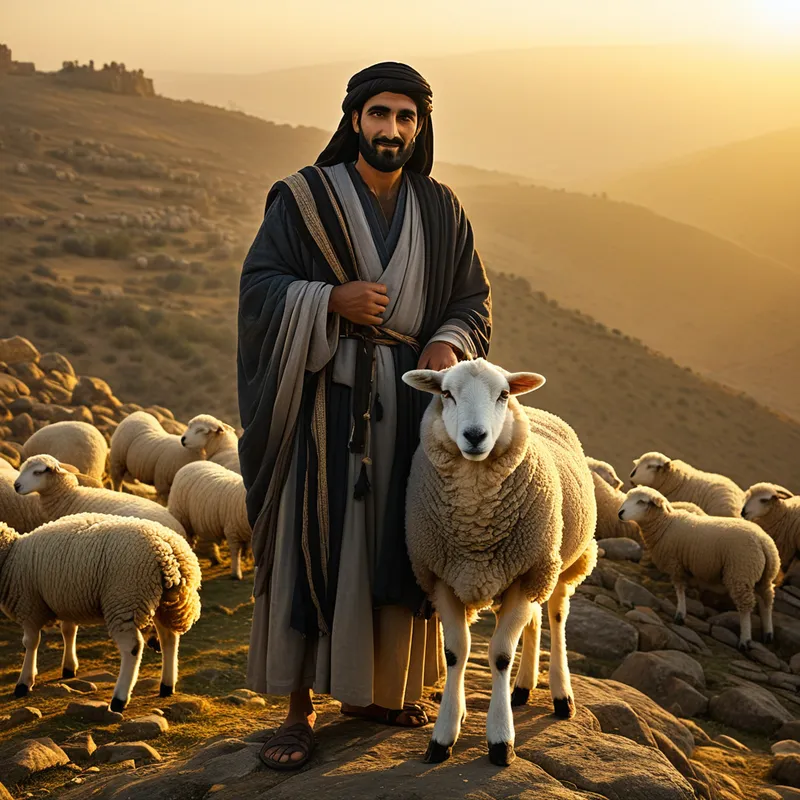
Listen. The wind does not just blow across the hills of Judea; it carries a sound older than temples—the low, trusting murmur of the flock, the soft thud of the staff upon the earth. Here, between the rock and the sky, walks the shepherd. He is not a king in a palace, but his sovereignty is absolute. He knows the sound of each cough in the dark, the peculiar limp of the ewe with the torn ear, the foolish bravery of the young ram. He knows them by name.
His world is defined by two territories: the fold and the wilderness. The fold is a circle of rough stone, a sanctuary against the creeping teeth of the night. Here, the ninety-nine are gathered, their woolly sides rising and falling in the rhythm of safety. But the shepherd’s gaze is not on the ninety-nine. His heart is tethered to the one—the one whose fear outpaced its sense, who strayed after a mirage of greener grass and now finds itself alone, its bleats swallowed by the vast, uncaring dark. The wilderness is not empty; it is full of shadows that move with predatory patience.
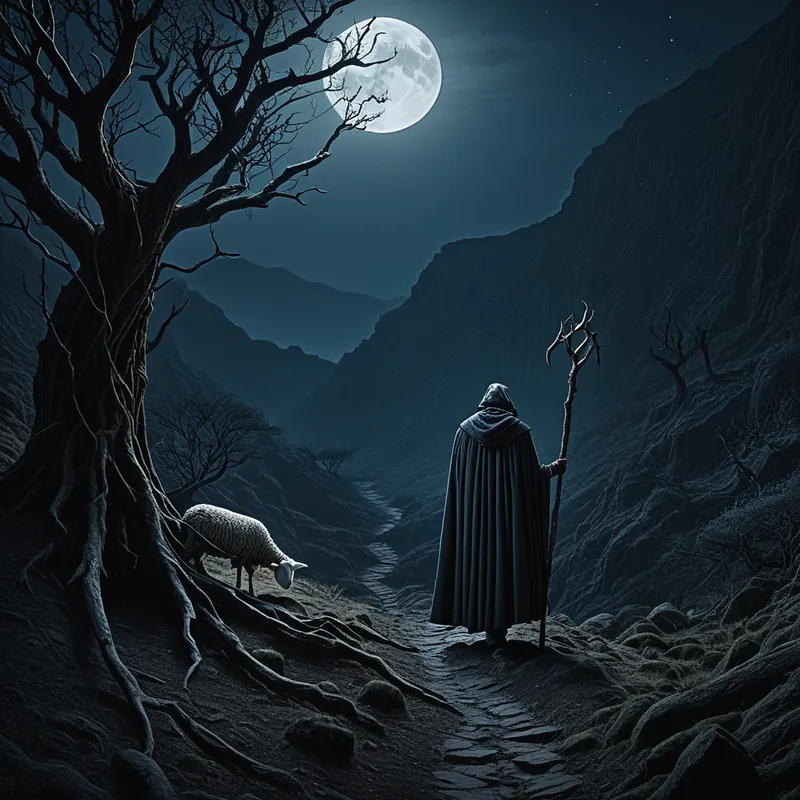
So the shepherd goes out. He leaves the safety of the circle, the warmth of the many, and steps into the throat of the gorge. Thorns claw at his cloak. The path is a mere suggestion among scree and precipice. He calls, not with a shout, but with the particular whistle, the intimate inflection meant for one pair of ears alone. The night air grows cold. The silence becomes a presence. And there, wedged between rocks, trembling with exhaustion and terror, he finds it—the lost one, too weary even to cry out.
He does not scold. He does not drive it before him with his staff. He bends, the scent of earth and wool and sweat mingling, and gathers the creature onto his shoulders. Its weight is a covenant. The journey back is longer, heavier, for he now carries the entire reason for his quest. The wilderness howls its frustration, but it cannot touch the burden borne in love.
And there is a deeper night, a more profound wilderness. There comes a hour when the threat is not a lone wolf or a treacherous cliff, but a ravenous tide of shadow itself, seeking to scatter the flock forever. In that hour, the Good Shepherd does not hire a guard. He does not barricade the gate and hope. He walks out, deliberately, purposefully, to stand between the teeth of the abyss and the heart of the fold. The staff is laid down. The shepherd becomes the gate, the living, breathing barrier. And when the shadows rush in, he meets them not with flight, but with surrender. He lays down his life. The ultimate price is paid, not for an idea, but for the specific, named, known lives in his care. In this laying down, the wilderness is disarmed. The scattering is undone. The circle of the fold becomes eternal.
Cultural Origins & Context
This is not a myth that began in grand cathedrals. It was born in the dust, carried on the breath of nomadic herders and settled agriculturalists for whom the shepherd was the central figure of economic survival and social metaphor. In the ancient Near East, the title “shepherd” was applied to kings and gods—Dumuzi, the Pharaohs, the God of Israel as depicted in Psalm 23. It spoke of provision, protection, and sovereign guidance.
Within the Christian narrative, the parable of the Good Shepherd is delivered by Jesus not to the powerful in Jerusalem, but to a mixed crowd, including those deemed religiously suspect. It was an oral story, a picture painted with familiar, earthy strokes to convey a revolutionary theological and relational idea: the divine is not a distant landlord, but a present, knowing, self-sacrificing caretaker. It functioned as both comfort and challenge—comfort to the lost and marginalized, and a stark challenge to religious leaders viewed as “hired hands” who cared not for the sheep. It was passed down in Gospels, etched in catacombs, and mosaiced in early basilicas, becoming one of the most enduring and intimate images of the divine in the West.
Symbolic Architecture
At its core, the myth dismantles hierarchies of power and redefines strength. The shepherd’s crook, symbol of authority, is used not to strike, but to guide and rescue.
True authority is not expressed in domination, but in the willingness to enter the chaos of another and bear its weight home.
The flock represents the community of souls, but also the internal community of the psyche—the myriad aspects, instincts, and vulnerable fragments of a single self. The ninety-nine are the functioning, adapted parts of us; the one is the lost, exiled, or wounded part—the neglected talent, the stifled grief, the abandoned innocence. The wilderness is the unconscious, the realm of unintegrated trauma, primal fear, and shadow.
The central, radical action—leaving the secure majority to seek the singular lost—models a profound psychological principle: wholeness (individuation) is not achieved by perfecting what already works, but by recovering what has been left behind. The ego (the conscious self) often identifies with the “ninety-nine,” the presentable persona. The shepherd represents a higher, guiding function of the psyche—the Self—that knows this wholeness is impossible while a part of us bleats in the distant dark.

The Dreamer’s Resonance
When this myth stirs in the modern dreamer, it often signals a critical moment of intra-psychic reclamation. You may dream of searching a vast, empty office building for a single important document; of hearing a child’s cry from a boarded-up room in your childhood home; of following a faint, familiar melody through a fog-shrouded forest.
Somatically, this process can feel like a persistent tug of anxiety or melancholy that has no obvious external cause—the “lost sheep” of the psyche calling out. There is a feeling of incompleteness, of a circuit left open. The dreamer is being summoned by their own inner shepherd function to undertake a journey inward. The conflict is not with an external monster, but with the inertia of the “fold”—the comfortable, known patterns of life that resist the risky, arduous quest to retrieve a forgotten self. The resolution in the dream, when it comes, is often not dramatic victory, but the profound relief of recovery: finding the lost thing, holding it, and beginning the return journey, heavier but more whole.
Alchemical Translation
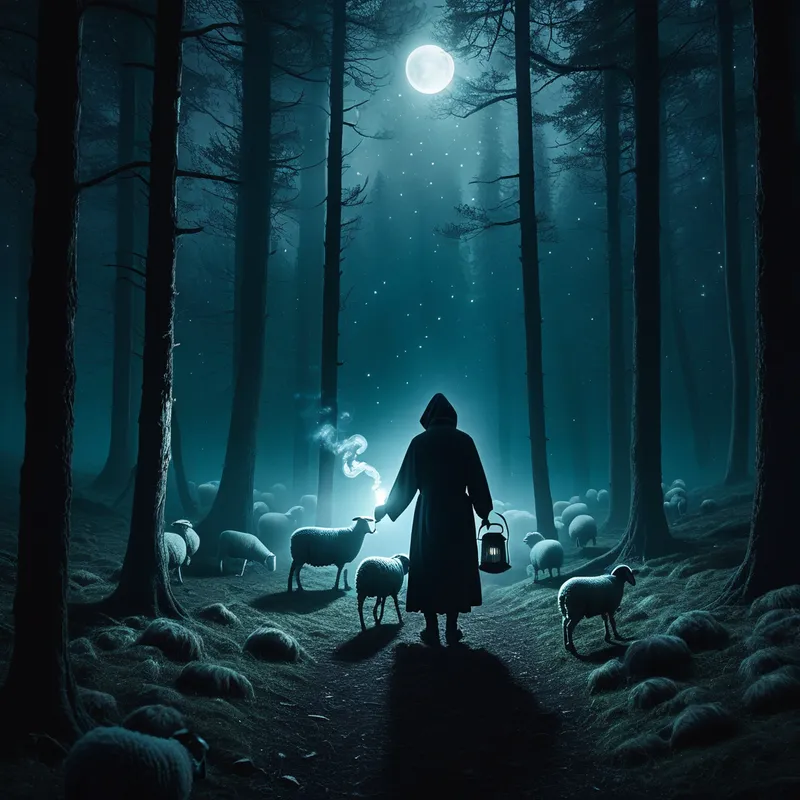
The alchemy here is the transmutation of loss into belonging, and scattering into integration. The base material is the psyche fragmented by trauma, neglect, or the simple attrition of life’s demands. The “wilderness” is the nigredo, the dark night of the soul where the lost piece suffers.
The crucible of transformation is not the safety of the fold, but the perilous love of the search.
The shepherd’s journey into the dark is the albedo, the purifying whitening, where the guiding consciousness confronts the shadowy terrain without becoming it. The act of lifting the lost onto the shoulders is the citrinitas, the yellowing or illumination—the moment of recognition and acceptance, where the exiled part is not judged, but embraced and valued. The return to the fold, now inclusive of the one that was missing, represents the rubedo, the reddening or completion—the achievement of a new, more authentic, and resilient wholeness.
For the modern individual, the myth does not call for literal martyrdom, but for the daily, psychological sacrifice of our ego’s comfort. It asks us to lay down our defensive pride, our need to appear perfectly “together” (the ninety-nine), and to courageously tend to the specific, named wounds within us. It models that the ultimate strength lies in vulnerable, devoted connection—first to the lost territories of our own soul, and by extension, to the other lost ones in the human flock. In this ongoing process of seeking and carrying home, we ourselves are gradually transformed from scattered sheep into embodied shepherds, participants in the great work of making ourselves, and our world, whole.
Associated Symbols
Explore related symbols from the CaleaDream lexicon: